
Key Fob Programming Failed? Here’s How to Diagnose the Problem and Fix It

When a key fob programming failed attempt leaves you stuck, the frustrating part is that the car won’t tell you whether the problem is the fob, the vehicle, or the programming method. I’ve seen owners replace batteries, buy new remotes, and repeat the same steps over and over—only to find out the real issue was a wrong part number, a weak vehicle battery, or a car that simply doesn’t support self-programming.
The fastest way to solve it is to separate the problem into two buckets: remote functions and start authorization. If the doors unlock but the engine won’t start, that points to a different issue than a fob that does nothing at all. That distinction saves time and keeps you from replacing parts you don’t need.
Quick Diagnosis: What Failed and What That Usually Means
If the fob won’t unlock or lock the doors, the issue is usually in the remote side of the system: battery, compatibility, damaged buttons, or a failed programming step.
If the fob works for locks but won’t start the car, the remote portion may be fine while the transponder chip or immobilizer pairing is the real problem.
If nothing works and the car won’t recognize any key, the problem may be vehicle-side rather than in the fob itself. That can include a weak car battery, a security lockout, or an immobilizer fault.
A helpful way to think about it:
- Remote-only fob problem: buttons don’t respond
- Transponder or immobilizer problem: car sees the fob for entry but not for starting
- Vehicle-side problem: multiple keys fail, or the car won’t enter programming mode at all
That distinction matters because a dead remote battery can stop door functions, but it usually does not explain a total start authorization failure by itself.
Most Likely Causes of Key Fob Programming Failure
When programming doesn’t take, the most common causes are usually these, in roughly the order I’d check them.
1. The replacement fob is not the correct part
This is one of the biggest causes of failure. A fob can look identical and still be wrong for the vehicle because of frequency, chip type, trim level, or model-year differences. Aftermarket fobs can work well, but only when they truly match the vehicle requirements.
A classic example: the remote buttons may physically fit the shell, but the electronics inside are for a different version of the same model. In that case, programming may fail every time.
Signs the replacement fob may be the wrong part number or incompatible include:
- The part number on the listing does not match the original fob
- The FCC ID, frequency, or chip type is different
- The buttons match physically, but the car never enters acceptance mode
- The fob may unlock the doors intermittently, but won’t complete start authorization
- Another known-good fob works, while the replacement fails every time
2. The programming sequence was incomplete or timed wrong
Many self-programming procedures depend on exact door, ignition, and button timing. Miss one step or wait too long, and the car exits programming mode before the new fob is accepted.
That does not always mean the fob is bad. Sometimes the car just never entered the correct mode.
3. The fob battery is weak or installed incorrectly
A new battery helps only if the battery is the right type, installed with the correct polarity, and making solid contact. A battery can also be “new” and still be weak if it sat on a shelf too long.
4. The vehicle battery is weak
A low car battery can interfere with module communication and prevent programming from completing. If the vehicle is struggling to crank, the dash is dim, or accessories behave oddly, fix the vehicle battery issue first.
5. The vehicle requires a second working key, dealer programming, or locksmith equipment
Some vehicles support self-programming. Others do not. As manufacturer-style programming guidance notes, some vehicles can be programmed at home while others require specialized equipment from an automotive locksmith or dealership.
6. The security system or immobilizer has locked out the attempt
Repeated failed attempts can trigger a temporary security lockout. That can make a good fob look bad when the car is really the thing refusing to cooperate.
If you’ve already failed a few times, do this next:
- Stop repeating the same sequence immediately
- Wait for any lockout or timeout period to clear
- Recheck the exact procedure for your vehicle
- Confirm the fob part number and key type again
- Move to locksmith or dealer programming if DIY is not supported
Check the Basics First: Fob Battery, Vehicle Battery, and Physical Damage
Before you buy another fob or book a service call, do the simple checks that cost little and often reveal the answer.
Check the fob battery
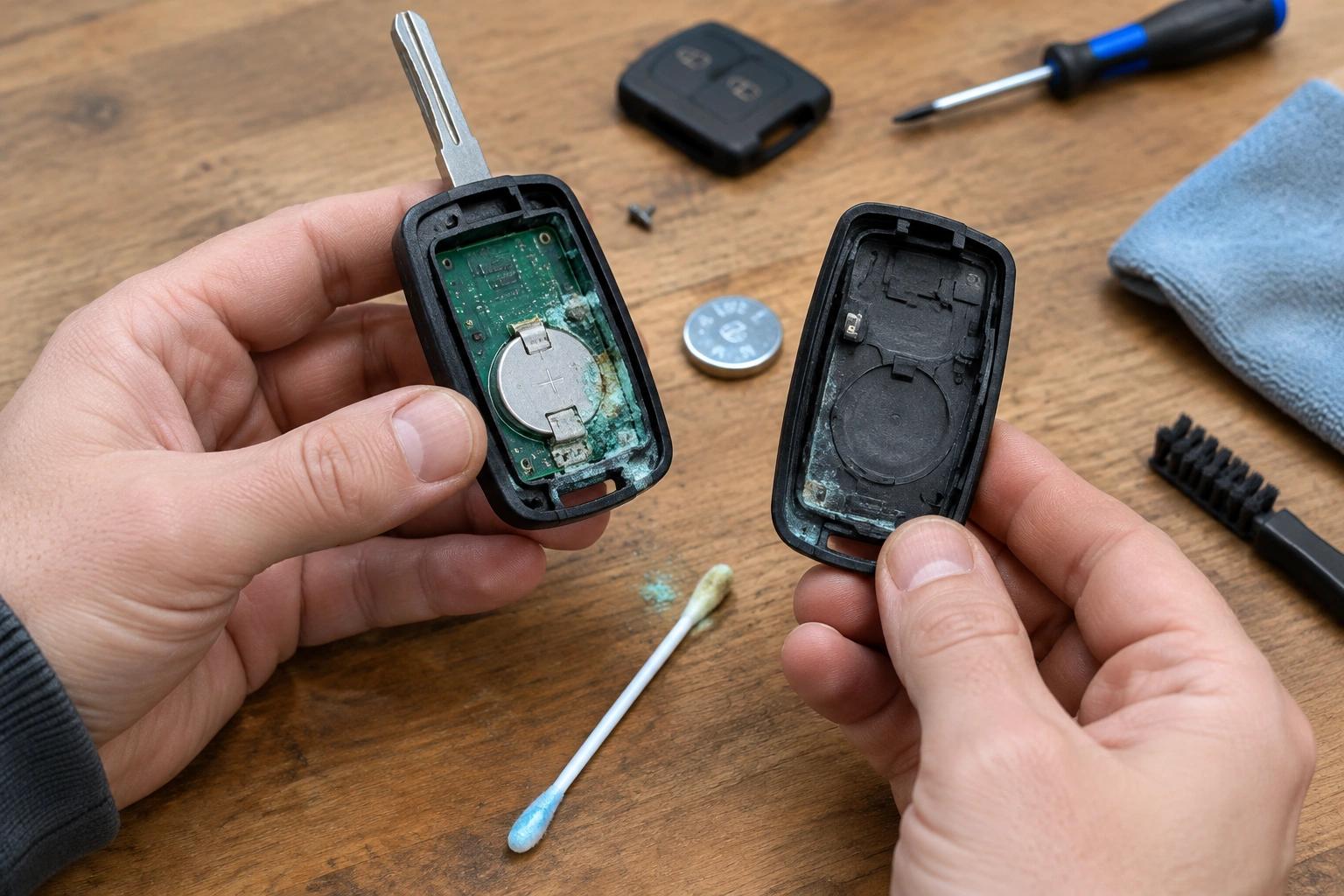
Open the fob and confirm:
- The battery type matches the one specified for that remote
- The battery is installed in the correct direction
- The contacts are clean and not bent
- The battery compartment is dry and free of corrosion
If the buttons feel mushy, the case is cracked, or the battery tab is loose, the fob may be physically damaged even if it looks fine from the outside.
Check the vehicle battery
Try the fob with the car fully awake and with a healthy system voltage. If the battery is weak, charge it or test it before another programming attempt. A car that barely starts may not be able to complete the handshake needed for programming.
Look for obvious damage
Water intrusion, corrosion, and a broken circuit board can all stop a fob from communicating properly. If the remote was dropped in water, the issue may not be the programming at all. In that case, drying or cleaning may help in some cases, but corrosion often means replacement is the safer path. If that’s the situation, our water damage guide explains what to do next.
Confirm the Fob Is the Correct Part for Your Vehicle
This is where a lot of DIY attempts go off the rails. “Fits my car” is not the same thing as “works with my car.”
Verify all of these before you try again:
- Exact make, model, and year
- Trim level, if applicable
- Remote frequency
- Chip type or transponder type
- OEM or aftermarket compatibility
- Part number match, when available
If you bought an aftermarket replacement, compare it against the old fob or the original part number. If the listing only says “compatible with” a broad range of vehicles, be cautious. Broad compatibility claims can hide small differences that matter during programming.
OEM fobs usually cost more, but they tend to be the safer choice when you want the least guesswork. Aftermarket fobs can be fine, but they are more likely to fail if the part details are off by even a little.
Make Sure Your Vehicle Actually Supports Self-Programming
Not every car allows owner programming. Some vehicles are designed so that a locksmith or dealer must pair the fob with diagnostic equipment.
The most practical way to verify support is to check your exact year, make, model, and key type in the owner’s manual or a vehicle-specific procedure from a reliable source. If the instructions mention a security code, immobilizer enrollment, or a required second key, that is a sign DIY may be limited or unavailable.
Here’s the practical rule:
- If the owner’s manual or verified instructions say self-programming is supported, DIY may be worth trying
- If the vehicle requires a second working key, a security code, or an immobilizer pairing routine, DIY may not be enough
- If the system uses a smart key or proximity key, professional programming is more common
A second working key is often mandatory when the vehicle uses an add-a-key procedure. If you only have one key left, some vehicles will not let you enroll another one yourself. In that case, DIY stops there and you’ll need a locksmith or dealer.
For a broader look at how different key types and programming methods compare, the table below can help.
| Key Type / Programming Path | What It Usually Controls | DIY Programming? | Typical Limitation |
|---|---|---|---|
| Remote-only fob | Lock, unlock, trunk, panic | Sometimes | May still need exact timing or vehicle support |
| Transponder key | Engine start authorization | Sometimes, but often limited | Often tied to immobilizer rules |
| Smart/proximity key | Passive entry and push-button start | Often no | Frequently requires specialized equipment |
| Locksmith programming | Remote + transponder + smart key, depending on vehicle | N/A | Capability varies by make and model |
| Dealer programming | Remote + transponder + smart key, depending on vehicle | N/A | May be required for certain security systems |
If your car has a proximity key or push-button start, assume the system may be more restrictive until you confirm otherwise.
Retry the Programming Procedure the Right Way
If the part is correct and the car supports self-programming, one failed attempt does not always mean the fob is bad. The issue may simply be how the procedure was carried out.
Focus on the conditions around the attempt:
- Use the exact ignition mode required by the vehicle
- Make sure all doors are in the required position
- Keep the sequence moving at the correct pace
- Avoid pausing too long between steps
- Don’t keep hammering the same failed sequence if the car appears to have locked out programming
A practical example: if the car expects a quick series of ignition cycles and door actions, slowing down to “double-check” each step can actually cause failure. On the other hand, rushing can skip the timing window entirely.
If the vehicle enters a programming mode but never confirms acceptance, that often points to compatibility, timing, or a security restriction—not necessarily a dead battery.
If the Fob Unlocks Doors but Won’t Start the Engine
This symptom is a big clue.
When the remote buttons work but the engine won’t start, the fob battery is usually not the main issue. The remote circuit and the transponder chip are different parts of the system. The car may recognize the lock/unlock signal but still reject the start authorization.
That often means one of three things:
- The transponder chip is not paired correctly
- The immobilizer is not accepting the key
- The vehicle needs professional programming or diagnosis
This is also where people get misled by a fob that “sort of works.” Sporadic or inconsistent operation can indicate the car and fob have lost proper communication, and reprogramming may restore the connection. That idea is consistent with common locksmith guidance on symptoms of lost synchronization, such as intermittent response or partial function. See this locksmith reference on reprogramming signs.
When to Consult a Locksmith
If you’ve confirmed the part is correct, the battery is good, and the vehicle still refuses to accept the fob, it’s time to stop guessing.
A locksmith is often the right next move when:
- The car requires diagnostic equipment
- You need the fob added to the immobilizer
- A second working key is required and you don’t have one
- Repeated attempts may have triggered a lockout
- The dealer quote is inconvenient and you want another option
The advantage of a locksmith is capability and convenience. Many can come to you and handle programming on-site. The drawback is that capability varies by vehicle, so it’s worth confirming they support your exact make and model before booking.
That capability also depends on the immobilizer system. Some locksmiths can handle basic remote programming but not every transponder or smart-key setup. If your vehicle uses a more advanced proximity or push-button system, dealer-level access may be required.
Dealer programming is often the safer bet for complicated security systems, but it may be less convenient and can cost more. If you want to compare your options, it helps to call both and ask whether they can program your specific key type before you commit.
When the Vehicle Needs Diagnosis Instead of Another Fob
If multiple keys fail, the issue is probably not the replacement remote. That’s the point where the car itself deserves attention.
Watch for these signs:
- The vehicle battery is weak or unstable
- The dash shows security or immobilizer warnings
- No key is recognized, including known working keys
- The car will not enter programming mode at all
- The system behaves inconsistently after several attempts
At that stage, replacing another fob is usually a waste. The vehicle may need diagnosis of the immobilizer, security module, or system voltage before any programming attempt will succeed.
For owners who want a broader troubleshooting path, our guide on key fob lost programming covers how to tell whether the problem is the remote, the car, or the programming process itself. If you’re also wondering whether interference is part of the picture, radio interference issues can help you rule that out.
How to Choose Between Dealer, Automotive Locksmith, and Replacement Fob
Here’s the simplest decision rule I use:
- Choose DIY programming if the vehicle supports it and the fob is confirmed correct
- Choose a locksmith if the vehicle needs specialized equipment but you want a mobile, often more convenient option
- Choose the dealer if the system is highly restrictive, the vehicle is under warranty, or the locksmith cannot support your exact setup
- Replace the fob only after you’ve confirmed the part is wrong, damaged, or defective
That order matters. Replacing parts before confirming compatibility is how people end up with a second useless remote.
If you’re still unsure, compare the symptom pattern:
– Buttons dead, engine starts fine with another key: likely remote-side issue
– Buttons work, engine won’t start: likely transponder or immobilizer issue
– Every key fails: likely vehicle-side diagnosis
FAQ
Why did my key fob programming fail even with a new battery?
A new battery fixes only power-related problems. Programming can still fail if the fob is the wrong part, the procedure timing was off, or the car requires specialized programming.
Can I program a key fob myself?
Sometimes. Some vehicles support self-programming, but many require a locksmith or dealer. The owner’s manual or verified vehicle-specific instructions are the best place to confirm.
Why does my fob unlock the doors but not start the car?
That usually points to the transponder chip or immobilizer, not the remote battery. The remote function and start authorization are separate systems.
Will a locksmith be able to program it if the dealer cannot?
Often, yes—but not always. It depends on the vehicle and the equipment the locksmith has. Some locksmiths can handle jobs that a basic dealer visit may not address, and sometimes the reverse is true.
Should I buy another aftermarket fob?
Only if you’ve confirmed the exact part number, frequency, and vehicle compatibility. A cheap replacement is not a bargain if it won’t program.
If you want, I can also help you turn this into a vehicle-specific troubleshooting version for your site, such as “why a Honda key fob programming failed” or “what to do when a smart key won’t program.”
