
Key Fob Unlocks but Won’t Lock: How to Find the Real Cause Fast

If your key fob unlocks but won’t lock, you’re dealing with a very specific kind of failure — and that’s good news. When one button still works, the fob is often only partially failing, which narrows the problem to the battery, the lock button itself, the internal circuit board, or the car’s locking system.
In plain terms, a key fob is a device used to operate a lock, so it should be able to both lock and unlock the vehicle. When it only does one job, the issue is usually not random. Something in the chain from button press to lock command is breaking down.
Here’s the fastest way to think about it:
- If the unlock button works normally but lock does not, the problem is often inside the fob.
- If the spare fob has the same symptom, look at the vehicle instead.
- If the lock button feels mushy, sticky, or different from the unlock button, the button pad or contact is a strong suspect.
- If the fob works only when you press hard or stand right next to the car, weak battery or worn contacts move higher on the list.
Quick Diagnosis: What the Symptom Usually Means
When a fob unlocks the doors but won’t lock them, the most likely causes are:
- Weak coin-cell battery
- Worn or damaged lock button
- Dirty or failing button contacts
- Cracked solder joint or circuit board damage
- Vehicle-side lock actuator, receiver, or wiring issue
- Less commonly, a synchronization or programming problem
The fastest first check is usually the battery, because it’s cheap, easy, and often the first thing to rule out. After that, test the spare fob and compare the interior lock switch with the door’s manual lock behavior. That combination usually tells you whether the issue is in the fob or in the vehicle.
A useful clue is whether the failure is consistent or intermittent. A totally dead lock button points more toward a physical button or circuit issue. A lock command that works only sometimes often points to a weak battery, worn contact, or cracked internal connection.
One thing to keep in mind: on some vehicles, the lock and unlock commands may not behave exactly the same, so one button can fail even when the battery is still usable. The signal path and sensitivity can vary by vehicle and fob design.
Most Likely Causes, Ranked by Probability
1) Weak or poorly seated battery
A low battery does not always kill every function at once. You may still get unlock from close range while lock becomes unreliable or stops working first.
A practical example: if you have to stand right beside the door for the lock button to work, but unlock works from farther away, the battery is a prime suspect. If the battery was replaced recently, check that it’s the correct type, installed with the right polarity, and seated firmly.
2) Worn lock button or button pad
The lock button gets pressed the same way every day, and over time that wear adds up. If the button feels softer, flatter, or less clicky than the unlock button, the rubber pad or the contact beneath it may be failing.
This is one of the most common “looks fine, acts weird” problems. The unlock button can still work because its contact is intact while the lock side is worn out.
3) Dirty contacts, corrosion, or minor internal damage
Inside many fobs, the button presses a small contact on the circuit board. Dust, moisture, or residue can interfere with that connection. If the fob has been dropped, exposed to humidity, or sat in a cup holder with spills, corrosion becomes more likely.
A little corrosion may cause one button to fail before the others. Severe corrosion usually means replacement is smarter than repair.
4) Cracked solder joints or damaged circuit board
If the fob has been dropped a few times, the board may have a cracked solder joint. That can create an intermittent problem where the lock button works only when the fob is twisted, pressed oddly, or tapped.
This is the kind of issue that often gets worse over time. A fob that works “if I wiggle it” is usually telling you the board is failing.
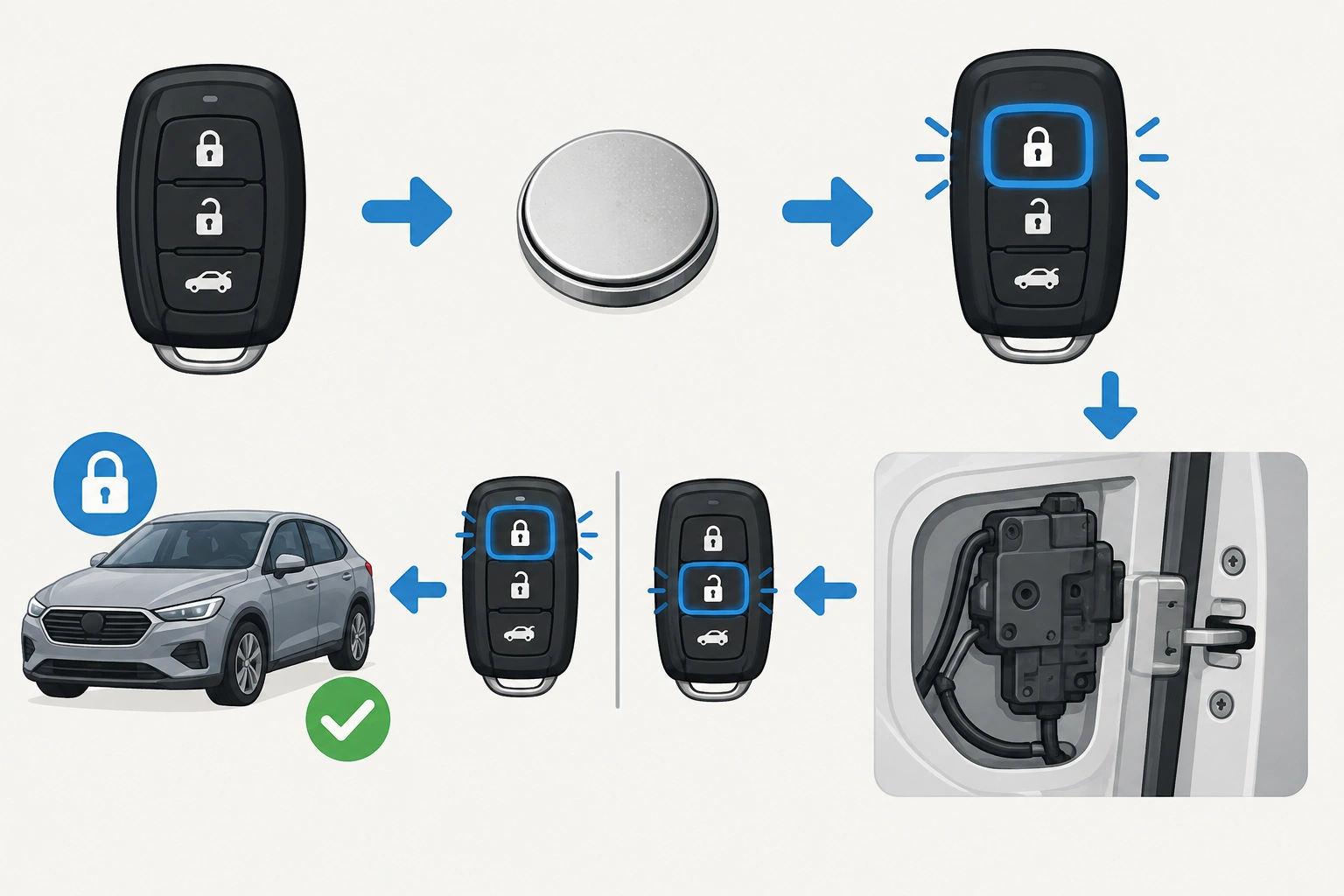
5) Vehicle-side locking fault
If the fob sends the lock command but the car does not respond, the issue may be in the vehicle’s central locking system, door lock actuator, receiver, or wiring.
That’s especially likely if:
– the spare fob has the same problem
– the manual door lock on the same door feels abnormal
– the interior lock switch does not lock the doors normally
– only one door, or one side of the vehicle, refuses to lock
– the car locks inconsistently from the inside switch too
A bad actuator can make the car seem like the fob is at fault when the real problem is the door hardware.
Fastest Troubleshooting Steps
Test the spare key fob first
This is the quickest way to separate a fob problem from a car problem.
- If the spare locks normally, your original fob is the likely culprit.
- If both fobs unlock but won’t lock, suspect the vehicle.
- If the spare works only a little better, you may have a battery issue in the original and a separate range or receiver issue in the car.
This one test saves a lot of guessing.
Check the manual lock on the same door
Use the physical lock switch or the door lock by hand if your vehicle allows it.
- If the door locks manually without trouble, the actuator is less likely to be the problem.
- If the manual lock is stiff, slow, or inconsistent, the issue may be in the door hardware rather than the fob.
That comparison matters because it tells you whether the car is capable of locking normally at all.
Test the interior lock switch
Don’t stop at the manual door lock. Also press the interior lock switch and compare its behavior with the manual lock and the fob.
- If the interior switch locks the doors normally, that leans away from a vehicle-side locking fault.
- If the interior switch also fails or acts inconsistently, the problem is more likely in the vehicle’s lock system, actuator, or wiring.
- If the interior switch works but the manual lock feels wrong on one door, focus on that door’s hardware.
This comparison is one of the clearest ways to isolate a vehicle-side issue.
Replace the battery before doing anything more expensive
If the battery is older, unknown, or the fob range has dropped, replace it first. It’s the cheapest, fastest test, and it often solves partial-function problems.
After replacement:
– confirm the battery type matches the old one
– make sure the battery sits flat in the holder
– check for bent battery clips
– close the shell fully so the contacts line up
If the lock button still fails after a fresh battery, move on to the button and circuit.
Pay attention to button feel
Compare the lock and unlock buttons side by side.
Ask yourself:
– Does the lock button feel softer?
– Does it stick?
– Does it need extra pressure?
– Does it click differently?
A button that feels physically different usually has a mechanical problem, not a programming problem.
How to Tell Whether the Problem Is the Fob or the Car
Use this simple decision guide.
| Test result | Most likely cause | What to do next |
|---|---|---|
| Spare fob locks normally | Original fob issue | Replace battery, inspect button, clean contacts, consider shell replacement |
| Both fobs fail to lock | Vehicle-side issue | Check interior lock switch, manual door lock, actuator, receiver, or wiring |
| Lock works only when pressed hard | Worn button or contact | Clean or replace button pad/shell |
| Lock works at very short range only | Weak battery or poor contact | Replace battery and inspect battery holder |
| Interior switch also acts up | Door lock actuator or related vehicle fault | Have the vehicle diagnosed |
| Fob got wet or corroded | Internal fob damage | Replacement is often more practical than repair |
This is the point where many people save money: if the spare fob works, don’t start by blaming the car. If both fobs fail, don’t keep replacing batteries.
DIY Fixes You Can Try Safely
Clean the battery contacts and button area
If the fob opens easily, inspect the battery compartment and contact points. Look for:
– white or green residue
– dull, dirty metal contacts
– a battery that sits loose
– moisture marks
Use a dry, soft cloth first. If you see light corrosion, clean carefully and let everything dry completely before reassembly. Avoid soaking the board.
Replace the battery and reseat the shell
Sometimes the battery itself is fine, but the contact isn’t making solid pressure. Reseating the battery and snapping the shell together correctly can restore function.
If the shell is cracked or the button pad is worn, a replacement shell can be a reasonable middle ground. That’s often cheaper than a full replacement fob and can fix a tired lock button when the electronics are still healthy.
Replace the button pad if the lock side is worn
If the lock button is visibly flatter or less responsive than the unlock button, a new button pad or shell may solve the problem. This is especially useful when the circuit board still works and the failure is mostly physical.
If the lock button works only intermittently even after cleaning and reseating the battery, worn button contacts are a strong possibility.
Be cautious with water-damaged fobs
If the fob has been dropped in water, washed, or exposed to heavy moisture, the damage may keep spreading even if it works today. In that case, drying it out and cleaning corrosion may buy time, but repeated failures usually mean replacement is the safer path.
When Reprogramming Might Help
Reprogramming is only worth considering when the fob seems out of sync with the vehicle, not when a button is physically broken.
It may help if:
– the fob stopped working after a battery change
– the vehicle recognizes the fob inconsistently
– you’ve ruled out a bad button and weak battery
It is rarely the fix for a one-button failure unless the fob lost sync after battery replacement or service.
It usually will not help if:
– the lock button is physically worn
– the battery contacts are corroded
– the board is cracked or water-damaged
– the vehicle’s lock actuator is failing
In other words, reprogramming can fix recognition problems, but it won’t repair a dead button or damaged circuit board.
If your issue overlaps with other remote-entry problems, our guide on key fob not detected but still starts may help you compare symptoms.
How to Test Whether the Lock Button Is Actually Transmitting a Signal
If the button feels normal but the car still won’t lock, the next question is whether the fob is transmitting a lock signal at all.
The simplest practical options are:
– an RF tester, if you have access to one
– a locksmith or dealer scan tool/test setup, which can often confirm whether the fob is transmitting
If the button feels fine but no signal is detected, a locksmith, dealer, or RF tester may be needed to confirm whether the problem is in the fob transmitter or elsewhere in the system.
When to Replace the Key Fob Instead of Repairing It
Replacement usually makes more sense when:
- the fob has visible water damage or heavy corrosion
- the lock button has failed repeatedly after cleaning
- the shell is cracked and the internals don’t stay seated
- the circuit board is damaged or the solder joints keep failing
- repair parts cost close to a replacement unit
If the fob is old and the case is worn out, a replacement shell may be enough. If the board is damaged, a full replacement is usually the cleaner fix.
A practical rule: if you’ve already replaced the battery, checked the contacts, and confirmed the spare works, the original fob may be beyond a simple DIY repair.
When to Consult a Locksmith
A locksmith is the right next step when the diagnosis points beyond the fob itself.
Call one if:
– both fobs have the same lock failure
– the vehicle’s locks are inconsistent from the inside switch too
– a door actuator is suspected
– you need a replacement or reprogrammed fob and want a faster option than the dealer
– you need help confirming whether the fob is actually transmitting a signal
A dealer may be the better choice for some vehicles with restricted programming procedures, but a locksmith can often be faster and more cost-conscious for basic lock/unlock issues.
If your vehicle also has starting problems, you may find our guide on key fob not detected and the car won’t start useful for separating remote-entry problems from start authorization issues.
Cost and Next-Step Decision Guide
Here’s the most practical way to choose your next move:
- Battery old or unknown? Replace it first.
- Lock button feels different? Inspect the button pad or shell.
- Spare fob works? Focus on the original fob.
- Both fobs fail? Diagnose the car’s locking system.
- Water damage or corrosion? Replacement is often the smarter path.
- Intermittent after battery swap? Recheck contacts and consider reprogramming only if the fob seems out of sync.
That sequence keeps you from buying parts you don’t need. It also helps you avoid the common mistake of replacing a perfectly good fob when the real issue is a door lock actuator.
FAQ
Why does my key fob unlock the car but not lock it?
The most common reasons are a weak battery, a worn lock button, dirty contacts, internal circuit damage, or a vehicle-side locking fault.
Can a weak battery cause only one button to stop working?
Yes. A weak battery can still allow partial function, and on some vehicles one command may fail before the others because the signal path or sensitivity differs.
If the spare fob works, is my original fob bad?
Most likely, yes. That usually points to a battery, button, contact, or circuit issue in the original fob.
Will reprogramming fix a lock button that doesn’t work?
Usually not. Reprogramming helps with recognition or synchronization problems, not a physically worn or damaged button.
What if both fobs unlock but neither will lock?
That points more toward the vehicle’s central locking system, actuator, receiver, or wiring than the fobs themselves.
Is it worth repairing a water-damaged fob?
Sometimes, but not always. Light moisture damage may be cleaned up, while heavy corrosion often makes replacement the better choice.
Can I keep using the fob if only the lock button fails?
You can often still unlock and drive the car, but the underlying fault may worsen. If the failure is intermittent, it’s worth fixing before the fob stops working more broadly.
How do I know if the lock actuator is the problem?
If the spare fob has the same symptom and the interior lock switch or manual lock also acts up, the actuator or related door hardware becomes much more likely.
Is a replacement shell enough?
If the circuit board is fine and the issue is just a worn button pad or cracked case, yes. If the board is damaged, a shell alone won’t solve it.
Should I go to a dealer or locksmith?
If the problem looks like a simple fob issue, a locksmith is often the more practical first stop. If the vehicle needs model-specific programming or the locking system itself is failing, a dealer or qualified automotive technician may be necessary.
