
What Does P0102 Mean? Mass Airflow Circuit Low Input Explained

P0102 means your vehicle’s computer detects the mass airflow (MAF) sensor signal voltage is lower than expected. The MAF sensor measures how much air enters the engine. When its voltage drops too low, the engine computer cannot calculate the correct fuel mixture. This typically causes rough running, stalling, or poor acceleration.
Most common causes: Dirty MAF sensor, vacuum leaks, clogged air filter, or faulty sensor wiring. Seriousness: Moderate — usually drivable short distances, but needs prompt repair to prevent catalytic converter damage from incorrect fuel mixture.
You plugged in your OBD2 scanner, saw “P0102,” and now you’re staring at your engine wondering how bad this is. The check engine light caught you off guard. You need a straight answer — not a 40-page technical manual.
P0102 is a diagnostic trouble code that points to the mass airflow sensor circuit reporting abnormally low voltage. The sensor sits between your air filter and intake manifold. Its entire job is telling the engine computer exactly how much air is flowing in so the computer can deliver the right amount of fuel. When that signal drops too low, fuel calculation falls apart.
This guide covers every angle: what triggers P0102, which symptoms you’ll notice, how to diagnose it without wasting money on wrong parts, and exactly what repairs cost. You’ll know whether to clean a sensor, fix a vacuum leak, or replace the MAF entirely — all in about 8 minutes.
What the P0102 Code Means in Plain English
The “P” stands for powertrain. “01” points to the fuel and air metering system. “02” specifies the mass airflow sensor circuit is reading low input voltage. Your engine computer — called the PCM or ECM — constantly watches the MAF sensor’s voltage signal. When that voltage drops below a calibrated threshold for a set period, it triggers P0102.
Think of it this way: your MAF sensor is like a weather vane measuring wind speed. If the wind vane suddenly reports almost no wind while you’re driving at highway speed, something is wrong with the vane, its wiring, or the air path itself. The computer flags that inconsistency as P0102.
What most people don’t think to ask is whether the code means the sensor itself failed. It doesn’t necessarily. The code says the circuit has low input — not that the sensor is dead. Wiring problems, connector corrosion, vacuum leaks, and even a severely clogged air filter can all produce the same P0102 code. Jumping straight to MAF sensor replacement without diagnosis wastes $100 to $400 unnecessarily.
8 Common Symptoms of a P0102 Code
Symptoms vary by how severely the MAF signal has degraded. Some drivers notice immediate driveability problems. Others only see the check engine light with subtle performance changes.
Here are the most frequently reported symptoms when P0102 is active:
- Check engine light illuminated — the universal first sign
- Rough or unstable idle — engine RPMs hunt up and down at stoplights
- Engine stalling — especially when coming to a stop or at idle
- Hesitation or stumble on acceleration — the engine bogs when you press the gas
- Black smoke from the exhaust — the computer defaults to rich fuel mixture as a safety measure
- Reduced fuel economy — incorrect air-fuel ratio wastes gas
- Hard starting or no-start condition — in severe cases the engine cannot calculate starting fuel
- Other fuel-related codes appearing — P0171 or P0174 lean codes often accompany P0102
Driving with a P0102 code for weeks or months can damage your catalytic converter. The incorrect fuel mixture sends unburned fuel into the exhaust, overheating the catalytic converter substrate. A catalytic converter replacement costs $1,000 to $2,500 — far more than fixing the P0102 cause now.
What Causes a P0102 Code? Ranked Most to Least Common
Not all P0102 causes happen with equal frequency. Knowing which ones dominate saves diagnostic time and prevents replacing the wrong part. The table below reflects real-world repair data from professional technicians.
| Cause | Frequency | Typical Fix |
|---|---|---|
| Dirty or contaminated MAF sensor | ~40% | Clean with MAF-specific cleaner |
| Vacuum leak after the MAF sensor | ~25% | Find and repair the leak |
| Faulty MAF sensor (electrical failure) | ~20% | Replace the MAF sensor |
| Wiring or connector damage | ~10% | Repair wiring, replace connector |
| Clogged air filter restricting airflow | ~5% | Replace air filter |
The table reveals an important pattern: the most common cause is contamination, not sensor failure. Dirt, oil residue from aftermarket air filters, and debris coat the MAF sensor’s hot wire element over time. This insulating layer prevents accurate airflow measurement, causing the sensor to under-report airflow — which drops the voltage signal into P0102 territory.
Step-by-Step P0102 Diagnosis: Fix the Real Problem, Not the Symptom
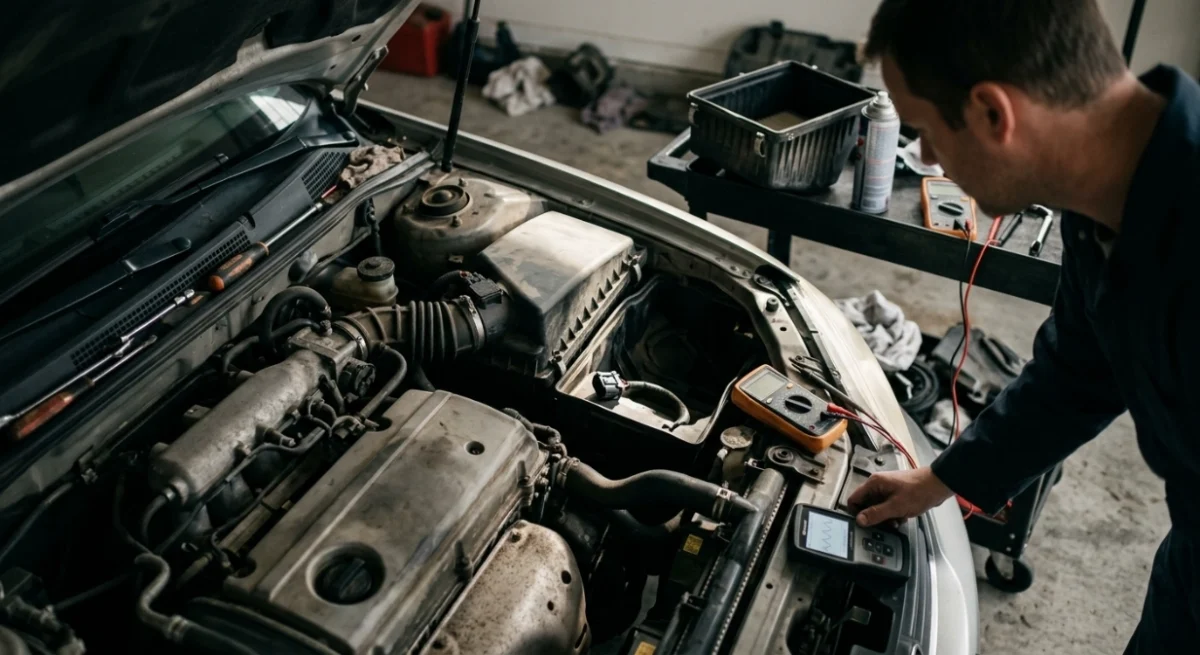
Diagnosing P0102 systematically prevents replacing a perfectly good MAF sensor. Follow these steps in order. Each step eliminates possible causes before you spend any money.
Step 1: Visual Inspection of the Air Intake System
Pop the hood and trace the entire air intake path. Start at the air filter box and follow every hose and clamp to the throttle body. Look for obvious disconnections, cracked hoses, loose clamps, or torn intake boots. Focus especially on the section between the MAF sensor and the throttle body — any unmetered air entering here bypasses the MAF and triggers P0102.
A cracked intake boot often hides in the accordion folds where the rubber flexes most. Flex the boot by hand while the engine idles. If the idle changes or you hear a sucking sound, you’ve found your vacuum leak.
Step 2: Check and Replace the Air Filter
A severely clogged air filter physically restricts airflow into the engine. Less air passing the MAF sensor means a lower voltage reading — potentially low enough to set P0102. Pull the filter and hold it up to a light source. If you cannot see light through the filter media, it’s time to replace it. Air filters cost $10 to $30 and take under 5 minutes to swap.
Step 3: Inspect the MAF Sensor and Connector
Unplug the MAF sensor electrical connector. Look inside for bent pins, corrosion, or moisture. Spray the connector with electrical contact cleaner if any contamination is visible. Check that the connector clicks firmly back into place — a partially seated connector creates intermittent low-voltage conditions that trigger P0102.
Step 4: Clean the MAF Sensor Elements
Remove the MAF sensor from the intake tube. You’ll see small wire elements or a thin film element inside the sensor bore. Spray these elements thoroughly with a dedicated MAF sensor cleaner — never use carb cleaner or brake cleaner, which leave residues that damage the sensor permanently.
Let the sensor air-dry completely before reinstalling. This 10-minute job resolves roughly 40% of P0102 cases. MAF cleaner spray costs $8 to $12 at any auto parts store.
If you use an oiled aftermarket air filter like K&N, excess filter oil commonly contaminates the MAF sensor. The oil bakes onto the hot wire element and throws off readings. Switch to a dry paper filter or clean the MAF every oil change if you keep the oiled filter.
Step 5: Live Data Verification with a Scan Tool
A basic code reader only shows the fault code. You need a scan tool capable of live data streaming to properly diagnose P0102. With the engine warmed up and idling, look at the MAF sensor reading in grams per second. A rough baseline: at warm idle, a typical 4-cylinder engine reads 2–5 g/s, a V6 reads 3–7 g/s, and a V8 reads 4–9 g/s. If your reading is drastically below the expected range or stays at zero, the sensor or its circuit has a genuine fault.
Next, watch the MAF reading while snapping the throttle open briefly. The number should spike sharply upward. A lazy or non-responsive reading confirms the MAF sensor needs replacement — not just cleaning.
Step 6: Check MAF Sensor Voltage and Ground
If cleaning and visual inspection haven’t fixed P0102, back-probe the MAF connector with a multimeter. You need three measurements: 12-volt power supply from the PCM relay, a good ground connection with less than 0.1 volt drop, and the signal wire voltage that should vary smoothly with engine RPM. A typical MAF signal at warm idle sits around 0.5–0.8 volts and rises to 3.5–4.5 volts at wide-open throttle.
If power and ground check out but the signal voltage stays stuck near zero regardless of engine speed, the MAF sensor itself has failed electrically. Replace it.
P0102 Repair Costs: What to Expect by Fix Type
Repair costs span a wide range depending on what’s actually wrong. Here is what professional shops typically charge, broken down by the actual fix needed.
| Repair | Parts Cost | Labor Cost | Total Range |
|---|---|---|---|
| MAF sensor cleaning | $8–$12 (cleaner spray) | DIY — no labor | $8–$12 |
| Air filter replacement | $10–$30 | DIY — 5 minutes | $10–$30 |
| Vacuum leak repair | $15–$80 (hose/intake boot) | 0.5–1.5 hours | $75–$300 |
| MAF sensor replacement (aftermarket) | $50–$200 | 0.3–0.5 hours | $100–$300 |
| MAF sensor replacement (OEM dealer) | $200–$500 | 0.5–1.0 hours | $300–$650 |
A word on MAF sensor quality: cheap aftermarket sensors from unknown brands fail within months or produce inaccurate readings that trigger different codes. Stick with OEM parts from your vehicle manufacturer or reputable brands like Denso, Bosch, or Delphi. The extra $50 to $100 up front avoids doing the job twice.
What Most People Get Wrong About the P0102 Code
Three misconceptions show up repeatedly in forums and repair shops. Getting these wrong turns a simple fix into an expensive parts-swapping exercise.
Misconception 1: “P0102 always means a bad MAF sensor.” This is the single most expensive mistake. The code says the circuit has low input — not that the sensor failed. Vacuum leaks cause the same code because air enters the engine without passing through the MAF, so the sensor reads lower airflow than the engine actually receives. Wiring damage and connector corrosion do the same. Always rule out leaks and electrical issues before condemning the sensor.
Misconception 2: “I can clean the MAF with any spray cleaner I have.” Brake cleaner, carburetor cleaner, and general-purpose solvents leave behind chemical residues that permanently damage the MAF’s sensitive hot wire element. Only use cleaners specifically labeled for mass airflow sensors. The wrong spray destroys a $200 sensor to save $8.
Misconception 3: “If the code clears, the problem is fixed.” P0102 sets when conditions cross a specific threshold. Clearing the code with a scanner erases the stored fault but does not fix the underlying problem. The code returns once you complete the drive cycle and the computer reruns the MAF circuit test. A code that returns within 50 to 100 miles of driving confirms the root cause still exists.
Vehicle-Specific P0102 Patterns Worth Knowing
Certain vehicles have well-documented P0102 tendencies that speed up diagnosis significantly.
Nissan and Infiniti V6 engines, particularly the VQ35DE found in the 350Z, G35, Maxima, and Pathfinder, frequently set P0102 from a dirty MAF sensor. These engines pull significant crankcase vapor through the intake, which deposits oil mist on the MAF element over time. Cleaning the sensor every 30,000 miles prevents the code entirely on these platforms.
Ford F-150 trucks with the 5.4L Triton V8 often trigger P0102 alongside lean codes P0171 and P0174. The root cause is typically a cracked PCV hose elbow at the back of the intake manifold — not the MAF sensor. The vacuum leak causes both the low MAF reading and the lean condition. Replacing the $30 PCV hose assembly fixes all three codes simultaneously.
GM vehicles with the 3.6L V6, used across the Acadia, Traverse, Enclave, and CTS, experience P0102 from intake manifold gasket leaks. The gaskets shrink with age and create small vacuum leaks that drop the MAF reading. A smoke test reveals these leaks immediately.
If your vehicle has P0102 plus P0171 or P0174 lean codes together, start by looking for a vacuum leak. The combination of low MAF input and lean condition almost always points to unmetered air entering the intake — not a sensor problem.
Can You Drive With a P0102 Code?
Yes — for a limited time and distance. The engine computer has a backup strategy called speed-density mode. When the MAF signal becomes unreliable, the computer estimates airflow using throttle position, RPM, and intake manifold pressure instead. This lets you drive the vehicle to a repair shop.
However, this backup mode runs the engine rich as a safety measure. Rich fuel mixture means unburned fuel reaches the catalytic converter, where it burns at extremely high temperatures. Sustained operation in this mode — weeks or months — causes catalytic converter substrate meltdown. The repair bill jumps from a $100 sensor to a $1,500 catalytic converter. Address P0102 within a week of the first occurrence.
Tools You Need for P0102 Diagnosis
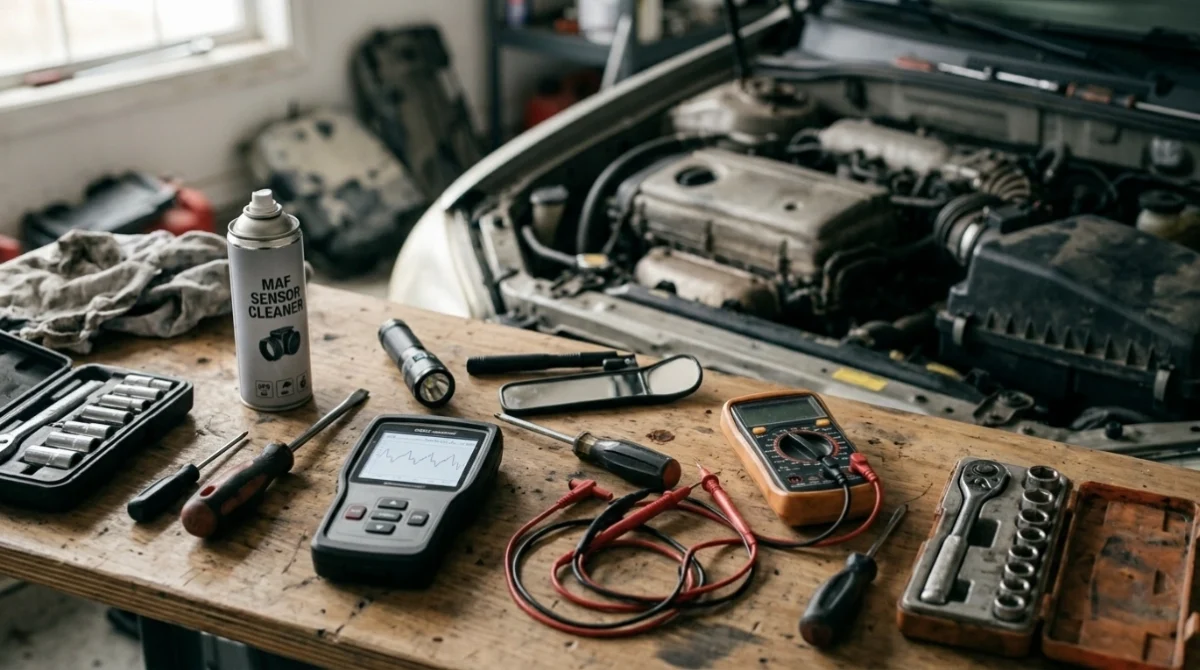
You don’t need a professional shop’s worth of equipment. A few affordable tools handle nearly every P0102 diagnostic scenario.
- OBD2 scan tool with live data — $50 to $150 gets you Bluetooth adapters paired with smartphone apps like Torque Pro. This is non-negotiable for watching real-time MAF readings.
- Digital multimeter — $15 to $30 for basic voltage and continuity testing at the MAF connector.
- MAF sensor cleaner spray — $8 to $12, CRC and Gunk make dedicated formulas available at any parts store.
- Basic hand tools — screwdrivers and sockets to remove the MAF sensor and intake components.
- Flashlight and inspection mirror — for spotting cracked intake boots and vacuum hoses hidden behind the engine.
If you have no scan tool beyond a basic code reader: Start with the air filter, visual inspection, and MAF cleaning. These three steps resolve the majority of P0102 cases with zero electrical diagnosis required.
If cleaning doesn’t help: Borrow or buy a scan tool with live data before buying a new MAF sensor. You need to confirm the sensor signal is genuinely dead before spending $100 to $500 on replacement.
If live data confirms zero or near-zero MAF reading at all RPMs: Check power and ground at the connector. If those are good, replace the MAF sensor. If not, trace the wiring fault first.
Related Codes Often Found With P0102
P0102 rarely appears alone. The PCM monitors multiple interconnected systems, and a MAF circuit fault often cascades into other fuel-related codes. Here are the ones most frequently stored alongside P0102 and what the combination means.
| Code Pair | What It Indicates |
|---|---|
| P0102 + P0171 | Low MAF input plus lean fuel trim on bank 1 — strong vacuum leak indicator |
| P0102 + P0174 | Low MAF input plus lean fuel trim on bank 2 — vacuum leak affecting both banks |
| P0102 + P0101 | Both MAF circuit range and low input — sensor is producing erratic readings, likely failing |
| P0102 + P0300 | Low MAF input causing random misfires from incorrect fuel mixture |
Frequently Asked Questions
Will a P0102 code clear itself?
Sometimes — but not because the problem fixed itself. The PCM clears the code if the MAF signal returns to normal for a set number of drive cycles. However, intermittent faults typically come back. A code that self-clears and returns within a week indicates a loose connector, early-stage wiring damage, or a sensor that’s beginning to fail.
Can a bad battery cause a P0102 code?
A weak battery can cause low voltage to the MAF sensor’s 12-volt reference circuit, which can trigger P0102. If your battery is more than 4 years old and you’re seeing multiple low-voltage codes across different systems, test the battery and charging system before chasing the MAF circuit.
What’s the difference between P0101 and P0102?
P0101 means the MAF sensor reading is outside the expected range for the current engine operating conditions — it’s a rationality check. P0102 specifically means the voltage signal is below the minimum threshold. P0101 often points to contamination or an actual sensor error. P0102 more commonly involves circuit problems, vacuum leaks, or complete signal loss.
Do I need to reprogram or relearn after replacing a MAF sensor?
Most vehicles do not require a formal relearn procedure for a MAF sensor replacement. Disconnecting the battery for 15 minutes clears the fuel trim adaptations, forcing the PCM to relearn fuel strategy with the new sensor. Some late-model European vehicles — BMW, Mercedes-Benz, Audi — do require a scan tool adaptation reset. Check your specific vehicle’s service information.
How long does it take to fix a P0102 code?
MAF sensor cleaning takes 10 to 15 minutes. Sensor replacement takes 20 to 30 minutes. Vacuum leak diagnosis and repair ranges from 30 minutes for a simple cracked hose to 2 hours for an intake manifold gasket replacement. The diagnostic process itself — following the steps above — takes roughly 30 to 60 minutes with basic tools.
P0102 does not automatically mean you need a new MAF sensor. Roughly 65% of cases resolve with cleaning, an air filter, or fixing a vacuum leak — all under $50 in parts. Start with the free visual inspection, then clean the sensor, and only replace the MAF if live data confirms zero signal with good power and ground at the connector.
What separates drivers who fix this in one afternoon from those who spend weeks chasing it is simple: diagnose the circuit before replacing the sensor. The multimeter doesn’t lie, and neither does live scan data.
Your next step: open the hood, check the air filter, and trace every intake hose for cracks. That 5-minute inspection answers more questions than any forum post ever will.
