
P0300 Causes: Why Your Engine Has Random Misfires

Quick Answer
The most common P0300 causes are worn spark plugs, weak ignition coils, vacuum leaks, fuel delivery problems, low compression, and incorrect engine timing. The code means the computer detected misfires across several cylinders or could not identify one consistent cylinder. Read this guide to understand what code P0300 means before replacing parts.
Common P0300 causes
- Worn spark plugs: Old or fouled plugs may fail to ignite the mixture consistently.
- Weak ignition coils: One or more coils may lose output when hot or under load.
- Vacuum leaks: Unmetered air can create a lean mixture across several cylinders.
- Fuel problems: Low pressure, dirty injectors, or contaminated fuel may interrupt combustion.
- Mechanical faults: Low compression, valve problems, or incorrect timing can cause repeated misfires.
- Software or sensor faults: Incorrect sensor data or outdated control software can sometimes trigger P0300.
What to do first
- Read every stored code and save the freeze-frame data before clearing anything.
P0300 can be frustrating because it points to a symptom, not one failed part. Your OBD2 scanner has detected random or multiple-cylinder misfires, but you still need to find the cause.
I approach this code by checking evidence in a fixed order. That prevents an expensive guessing game involving spark plugs, coils, injectors, and sensors.
In This Guide
What Does Code P0300 Mean?
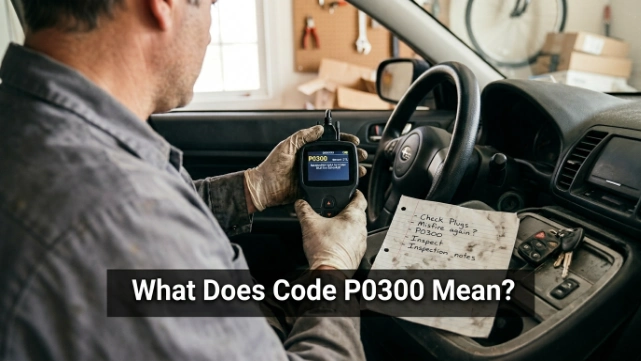
P0300 means the engine control module detected random or multiple-cylinder misfires. A misfire happens when combustion fails or produces less power than expected.
The computer monitors small changes in crankshaft speed. An uneven speed change can show that a cylinder did not produce its expected power.
- P0300: Random or multiple-cylinder misfire detected.
- P0301: Misfire detected in cylinder one.
- P0302: Misfire detected in cylinder two.
- P0303 and higher: The final digit identifies the affected cylinder.
P0300 does not automatically mean every cylinder is misfiring. The pattern may move between cylinders or remain too inconsistent for a cylinder-specific code.
Is P0300 a generic OBD2 code?
Yes. P0300 is a generic powertrain code used across many OBD2-equipped vehicles.
However, the underlying cause may be vehicle-specific. Some engines have known injector, wiring, intake, or control-software problems.
A manufacturer technical service bulletin may describe a known condition. The bulletin still needs to match the vehicle’s year, engine, and symptoms.
Does P0300 identify a bad part?
No. The code reports abnormal combustion rather than naming the failed component.
This distinction matters. A Volkswagen diagnostic bulletin published through the NHTSA technical bulletin database warns against replacing every plug, coil, or injector because P0300 is present.
The affected cylinder and failed component should be confirmed first. That principle applies well beyond one manufacturer.
Section Takeaway: P0300 confirms a misfire pattern, but it does not identify the failed part. Use the code as the start of your diagnosis.
What Are the Most Common P0300 Causes?
P0300 usually comes from an ignition, air, fuel, mechanical, timing, or control-system problem. Start with causes that match the stored data and driving conditions.
| Cause category | Typical clues | Useful confirmation |
|---|---|---|
| Spark plugs | Misfire under load, poor starting, overdue maintenance | Inspect gap, wear, deposits, and plug condition |
| Ignition coils | Misfire when hot, damp, or accelerating | Compare misfire counts and perform a controlled coil swap |
| Vacuum leak | Rough idle, high positive fuel trims, hissing | Smoke-test the intake and inspect hoses |
| Fuel delivery | Hard start, hesitation, lean codes, loss of power | Check specified fuel pressure and injector operation |
| Mechanical condition | Constant roughness, noise, low or uneven compression | Compression and cylinder leak-down tests |
| Timing or software | Multiple related codes or a model-specific pattern | Check service information, timing data, and bulletins |
Worn, damaged, or fouled spark plugs
Spark plugs are among the first items I inspect. Excessive gap, oil deposits, fuel fouling, or cracked insulation can weaken the spark.
A worn plug may work at idle but fail under acceleration. Cylinder pressure rises under load, making the spark’s job harder.
- Dry black deposits: The mixture may be rich, or the spark may be weak.
- Wet fuel deposits: The cylinder may not be firing.
- Oily deposits: Oil may be entering the combustion chamber.
- White or damaged electrodes: Excess heat or a lean condition may be present.
Compare all plugs instead of examining one alone. A plug that looks different can point toward the affected cylinder.
Weak ignition coils or damaged wiring
A weak coil may create an intermittent misfire. Heat, moisture, damaged insulation, and loose electrical terminals can make the fault worse.
Do not replace every coil because P0300 appeared. First inspect connectors, grounds, wiring, and cylinder misfire data.
A controlled swap can help when one cylinder shows more misfires. Move one suspected coil and see whether the cylinder-specific code follows it.
Vacuum leaks and unmetered air
A vacuum leak lets air enter after the mass airflow sensor. The computer may not add enough fuel for that extra air.
The mixture then becomes lean. Several cylinders may misfire, especially at idle.
- Split vacuum hoses
- Damaged intake manifold gaskets
- Loose intake ducts
- A leaking brake booster hose
- A stuck-open purge valve
- A faulty positive crankcase ventilation system
Fuel trims often become strongly positive during a vacuum leak. If trims improve at higher engine speed, an intake leak becomes more likely.
Low fuel pressure or injector problems
A weak fuel pump or restricted filter can reduce fuel delivery. The engine may misfire during starting, acceleration, or heavy load.
Dirty or restricted injectors can also create an uneven mixture. Contaminated or incorrect fuel may affect several cylinders at once.
Bad fuel should remain on the list when the problem started after refueling. AAA also lists rough running and a check-engine warning among possible symptoms of contaminated fuel.
Low compression or internal engine damage
Combustion needs compression as well as fuel and spark. Burned valves, worn rings, head-gasket leaks, or valve-train faults can reduce cylinder pressure.
Mechanical problems move higher on my list when the misfire stays on the same cylinders. They also become more likely when ignition swaps change nothing.
A compression test compares cylinder pressure. A leak-down test then helps locate escaping air through the intake, exhaust, crankcase, or cooling system.
Incorrect valve or ignition timing
A stretched timing chain or incorrectly installed timing belt can affect multiple cylinders. Variable valve timing faults may produce a similar pattern.
Look for camshaft, crankshaft, or timing-correlation codes. Engine noise, difficult starting, or poor power can provide more clues.
Sensor, control-module, or software faults
Incorrect readings from a mass airflow, crankshaft, or camshaft sensor can disturb combustion control. Wiring faults may create the same symptoms.
Software also deserves consideration on affected vehicles. Some manufacturer bulletins link P0300 to specific calibrations or operating conditions.
As of 2026, owners can search NHTSA recalls and safety campaigns using a VIN. A recall search differs from a service-bulletin search, so check both sources when needed.
Locksmith’s note: never install software or control modules based only on a generic code. Confirm the correct procedure through manufacturer service information.
Section Takeaway: Spark plugs and coils are common suspects, but air, fuel, compression, timing, wiring, and software can all cause P0300.
Can P0300 Symptoms Help Identify the Cause?
Yes. When and how the engine misfires can guide your testing, though symptoms cannot prove a failed part alone.
First review all common symptoms associated with P0300. Then match the pattern to the conditions recorded by your scanner.
| Misfire pattern | Causes to investigate | Next useful check |
|---|---|---|
| Mostly at idle | Vacuum leak, purge fault, injector issue | Fuel trims and intake smoke test |
| During acceleration | Weak spark, low fuel pressure, restricted exhaust | Misfire counts, plugs, coils, and fuel pressure |
| Only when cold | Intake leak, injector leak, carbon, compression issue | Cold-start data before the engine warms |
| Only when hot | Coil, sensor, wiring, or fuel-pressure fault | Retest after full operating temperature |
| After refueling | Contaminated fuel or purge-system fault | Fuel sample, purge command, and related codes |
| After recent repair | Loose connector, crossed wire, intake leak, timing error | Recheck every disturbed component |
What does a rough idle suggest?
A rough idle often points toward a vacuum leak or uneven fuel delivery. Low engine speed makes small airflow errors easier to feel.
Watch short-term and long-term fuel trims at idle. Compare them with readings near 2,500 rpm under safe, stationary conditions.
What does a misfire under load suggest?
A load-related misfire commonly raises suspicion around plugs, coils, or fuel pressure. Weak ignition may appear normal during an unloaded idle.
Save the freeze-frame engine load, rpm, temperature, and fuel-trim values. Try to reproduce the same condition safely during diagnosis.
Why does P0300 appear with other codes?
Companion codes often provide better direction than P0300. Lean, rich, sensor, timing, injector-circuit, or cylinder-specific codes deserve attention.
- P0171 or P0174: Investigate lean conditions and unmetered air.
- P0172 or P0175: Investigate rich operation, leaking injectors, and sensor data.
- P0201 through P0208: Inspect the named injector circuit.
- P0335 or related codes: Check crankshaft sensor signals and wiring.
- P0016 or related codes: Investigate camshaft and crankshaft timing correlation.
Section Takeaway: The operating condition matters. Idle, load, temperature, fuel trims, and companion codes can quickly shorten the suspect list.
How Do You Diagnose P0300 Correctly?
Diagnose P0300 by preserving scan data, checking simple faults, and testing each system. Replace a part only after the evidence points toward it.
- Read every code: Record pending, stored, and permanent codes before clearing them.
- Save freeze-frame data: Note rpm, load, speed, temperature, and fuel trims.
- Check misfire counters: Identify cylinders accumulating the most misfires.
- Inspect basic items: Look for loose connectors, split hoses, damaged wires, and overdue plugs.
- Check fuel trims: Determine whether the engine control module is correcting a lean or rich mixture.
- Test ignition parts: Inspect plugs and perform controlled coil swaps when appropriate.
- Test air and fuel systems: Smoke-test the intake and measure fuel pressure against specifications.
- Check engine condition: Use compression and leak-down testing when simpler checks do not explain the fault.
- Review service information: Look for bulletins, software updates, and model-specific test procedures.
- Verify the repair: Recreate the original conditions and confirm misfire counts stay low.
Start with freeze-frame data
Freeze-frame data records operating conditions when the computer set the code. Clearing P0300 too early can erase this valuable snapshot.
I write down the engine temperature, speed, load, and fuel trims first. These numbers help separate cold-start, idle, and load-related faults.
Use live data and Mode $06 carefully
A basic reader may show only the code. A scanner with live data can display fuel trims, airflow, sensor readings, and misfire information.
This live-data scanner versus code-reader comparison explains the practical difference. The added data can reduce unnecessary part replacement.
Mode $06 provides onboard monitor test results on many vehicles. Its labels and limits can be difficult to interpret without reliable service information.
Review this guide to Mode $06 versus live-data diagnostics before treating raw test values as proof. Scanner support also varies by vehicle and software.
Check ignition parts without loading the parts cannon
“Loading the parts cannon” means replacing parts without confirming they failed. P0300 makes that mistake tempting.
- Inspect plug condition and compare cylinders.
- Confirm the correct plug type and gap for the vehicle.
- Inspect coil boots for carbon tracking or oil contamination.
- Check coil power, grounds, connectors, and control wiring.
- Move one suspected coil only when a swap test is safe.
- Rescan to see whether the misfire follows the component.
Do not create a new problem during testing. Mark every connector and return each component to the correct location.
Know when professional testing makes sense
Advanced diagnosis may require a smoke machine, pressure gauge, oscilloscope, or cylinder leak-down equipment. These tools can be cheaper than several incorrect parts.
A suitable OBD2 scanner for misfire diagnosis can help with the first steps. It cannot replace mechanical testing or manufacturer service information.
Pro tip: ask the shop for the test result that proves the recommended part failed. A diagnostic code alone is not that proof.
Section Takeaway: Preserve the evidence and test in order. Freeze-frame data, fuel trims, misfire counters, and physical tests should agree before repairs begin.
Can You Drive With a P0300 Code?
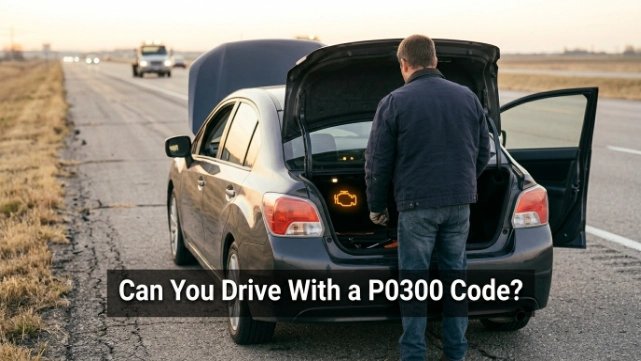
Driving may be unsafe when the check-engine light flashes or the vehicle shakes, loses power, or smells unusual. Pull over safely and arrange a tow.
A flashing light often indicates an active misfire. Unburned fuel can overheat and damage the catalytic converter.
AAA’s guidance on a flashing check-engine light recommends watching for power loss, shaking, odors, and abnormal operation. Stop when continuing could be unsafe.
Stop driving when you notice these signs
- Flashing warning light: An active misfire may be severe.
- Strong shaking: The engine may have lost one or more cylinders.
- Major power loss: The vehicle may not accelerate safely.
- Raw-fuel smell: Unburned fuel may be entering the exhaust.
- Popping or banging: Combustion may be occurring at the wrong time.
- Overheating: Stop the engine and avoid further damage.
- Oil-pressure warning: Shut the engine off as soon as it is safe.
What if the light stays solid?
A solid light usually gives you more time than a flashing light. It does not make the misfire harmless.
Drive only if the vehicle feels normal and the manual does not tell you to stop. Keep the trip short and avoid heavy acceleration.
Arrange diagnosis promptly. An intermittent misfire may become severe without warning.
Safety note: towing is the safer choice when the vehicle shakes, lacks power, overheats, or displays a flashing check-engine light.
How Much Does a P0300 Repair Cost?
P0300 repair cost depends entirely on the confirmed cause. The code itself does not support an accurate quote.
As a broad 2026 U.S. planning guide, a simple ignition repair may cost hundreds. Internal engine or timing repairs can reach several thousand dollars.
| Possible repair | Broad planning range | Important variable |
|---|---|---|
| Diagnostic testing | About $100–$250 | Testing time and regional labor rate |
| Spark plug replacement | About $150–$500 | Plug count and engine access |
| One ignition coil | About $150–$450 | Coil design and labor access |
| Vacuum leak repair | About $150–$800 | Hose versus intake-gasket repair |
| Fuel injector repair | About $300–$1,500 | Injector count, type, and access |
| Timing or internal engine work | Often $1,500–$5,000+ | Engine design and extent of damage |
These figures are planning ranges, not quotes. Make, model, year, engine, location, parts quality, and labor access can change the total sharply.
How can you avoid paying for the wrong repair?
- Request the complete scan report.
- Ask which cylinders recorded misfires.
- Ask how the shop tested the recommended part.
- Request compression results when mechanical damage is suspected.
- Confirm whether diagnostic charges apply toward the repair.
- Get a written estimate before authorizing work.
Be cautious when an estimate recommends every coil or injector without supporting tests. There may be valid reasons, but the shop should explain them.
Cost note: compare written estimates based on the same diagnosis. The cheapest quote may omit testing, programming, gaskets, fluids, or related labor.
Section Takeaway: P0300 has no single repair price. Pay for a confirmed diagnosis before approving expensive ignition, fuel, timing, or engine work.
Frequently Asked Questions
Can bad spark plugs cause P0300?
Yes. Worn, fouled, damaged, or incorrectly gapped spark plugs can cause random misfires. Inspect every plug and compare their condition. Deposits may also reveal a fuel, oil, or coolant problem that must be corrected.
Can a bad ignition coil cause P0300?
Yes. One or several weak coils can trigger P0300, especially during acceleration or after the engine warms. Use cylinder misfire data and controlled swap testing before replacing multiple coils.
Can a vacuum leak cause code P0300?
Yes. A vacuum leak can create a lean mixture across several cylinders. Rough idle and high positive fuel trims are useful clues. A proper intake smoke test can locate leaks that visual inspection misses.
Can bad fuel cause P0300?
Contaminated, incorrect, or poor-quality fuel can cause random misfires. Consider this possibility when symptoms begin soon after refueling. Fuel-pressure, fuel-quality, and injector tests can separate bad fuel from a delivery fault.
Can a bad catalytic converter cause P0300?
A severely restricted converter can reduce airflow and contribute to poor performance or misfires. More often, an ongoing misfire damages the converter. Diagnose the original combustion problem before replacing the converter alone.
Will clearing P0300 fix the problem?
No. Clearing the code only erases stored information and turns off the warning temporarily. If the underlying fault remains, P0300 will return. Save freeze-frame and scan data before clearing anything.
Why does P0300 return after replacing plugs and coils?
The cause may involve a vacuum leak, injector fault, low fuel pressure, compression loss, timing problem, wiring, or software. Recheck the original scan data and test the systems that were not confirmed before parts were replaced.
Final takeaway: Treat P0300 as evidence of failed combustion, not a parts order. Save the scan data, identify the operating pattern, test the likely system, and verify the repair under the same conditions.
