
P1101 Symptoms: What This OBD2 Code Feels Like and What to Check

Quick Answer
Common P1101 symptoms include a check engine light, rough or unstable idle, hesitation, weak acceleration, stalling, reduced power, and increased fuel consumption. P1101 is manufacturer-specific, so confirm its exact definition for your vehicle before replacing a mass air flow sensor or another part; an OBD diagnostic code lookup can help you understand what the stored code represents.
Symptoms You May Notice
- Check engine light: The engine computer has detected airflow data outside its expected range.
- Rough idle: The engine may shake, surge, or struggle to maintain a steady idle.
- Hesitation: Acceleration may feel delayed when you press the gas pedal.
- Reduced power: Some vehicles may feel noticeably weaker, especially under load.
- Higher fuel use: Incorrect airflow information can interfere with fuel-mixture calculations.
- Stalling or hard starting: Severe airflow errors can affect idle and startup behavior.
Best First Check
- Save all stored and pending codes plus freeze-frame data before clearing anything, then inspect the intake system and compare the vehicle-specific P1101 definition.
When I see P1101 on an OBD2 scanner, I don’t immediately condemn the mass air flow sensor. I’ve seen the same basic symptom pattern caused by a dirty sensor, loose intake hose, vacuum leak, wiring issue, or another airflow problem.
The important detail is that P1101 is a manufacturer-specific diagnostic trouble code. Its exact definition and diagnostic procedure can change with the make, model, year, and engine.
In This Guide
What Does the P1101 Code Mean?
P1101 generally points to an airflow performance problem, but the official definition is not identical across every manufacturer. That difference matters when you start diagnosing the vehicle.
On Ford applications, P1101 is documented as the mass air flow sensor being outside its self-test range. General Motors applications may describe the problem more broadly as intake airflow system or MAF-related performance.
- MAF sensor: The mass air flow sensor measures air entering the engine.
- MAP sensor: The manifold absolute pressure sensor helps the computer calculate engine load and airflow.
- ECM or PCM: This is the engine computer that processes sensor data and controls fuel delivery.
- DTC: A diagnostic trouble code is the stored code produced when the computer detects a problem.
A mass air flow sensor normally sits in the intake tract near the air-filter housing. Its information helps the computer decide how much fuel the engine needs.
If measured airflow no longer agrees with what the computer expects, the engine computer may store an airflow-related fault. That doesn’t prove the MAF sensor itself has failed.
Locksmith’s diagnostic note: save the complete scan report before clearing the code. Freeze-frame data can show whether the problem appeared during startup, idle, cruising, or acceleration.
Why P1101 Can Mean Different Things on Different Cars
The first digit after the letter matters in an OBD code. A P1xxx code can contain manufacturer-specific definitions instead of one universal description used across every brand.
Ford’s published diagnostic information, for example, identifies P1101 as a MAF sensor self-test range fault. Always match the code to your exact vehicle before following a repair procedure written for another brand.
- Confirm the make and model.
- Confirm the model year.
- Confirm the engine option.
- Record any code suffix shown by the scanner.
- Check manufacturer service information when available.
This simple step prevents one of the mistakes I see most often: buying the sensor named in an online code description before testing the system around it.
What Are the Most Common P1101 Symptoms?
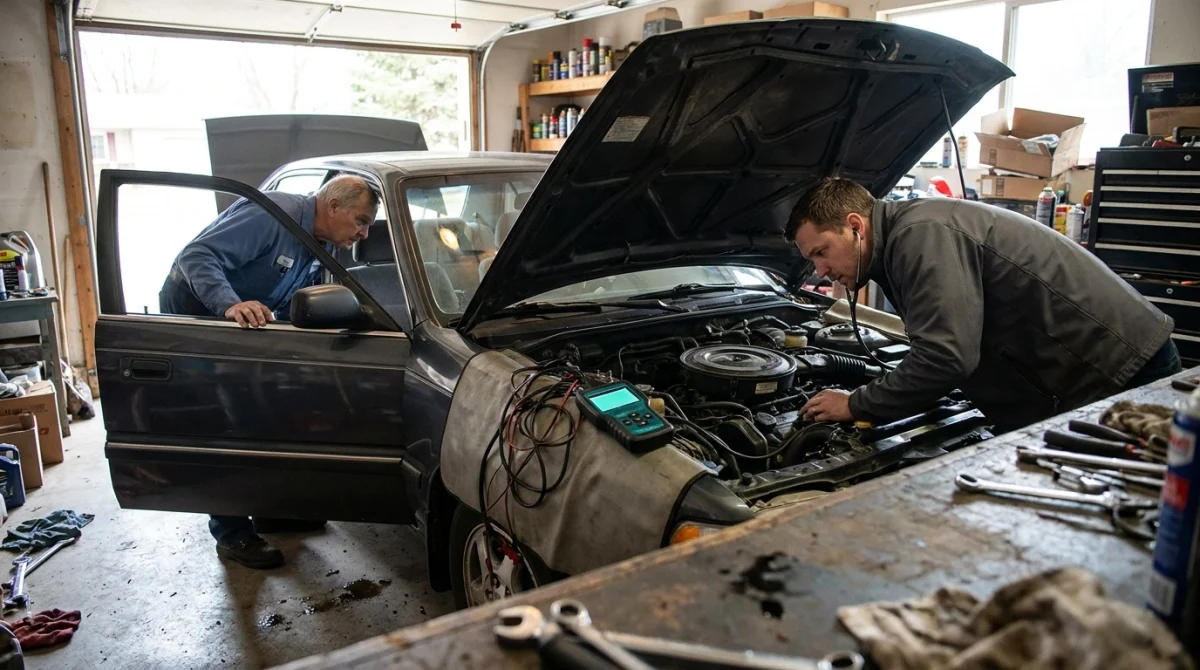
The most common P1101 symptoms involve engine performance and drivability. Some vehicles show several symptoms, while others only illuminate the check engine light.
1. Check Engine Light
A steady check engine light may be the only obvious warning at first. Chevrolet advises owners to arrange service when the malfunction indicator light appears, even when the vehicle still seems to drive normally.
You can review general manufacturer guidance on dashboard warnings through Chevrolet’s warning-light support information.
2. Rough or Unstable Idle
The engine may shake, surge, or repeatedly change speed while sitting at a stop. This can happen when measured intake airflow doesn’t match actual engine airflow.
Unmetered air from a cracked hose or vacuum leak can create similar behavior. That’s why a rough idle doesn’t automatically mean the MAF sensor needs replacement.
3. Hesitation During Acceleration
You may press the accelerator and notice a pause before the engine responds. The vehicle can also feel flat or inconsistent as engine load rises.
- Delayed throttle response
- Jerking during acceleration
- Weak pull from a stop
- Uneven power delivery
4. Reduced Engine Power
A severe airflow error can make the vehicle feel weaker than normal. Turbocharged engines may show the problem more clearly because intake and charge-air leaks can affect airflow calculations under boost.
The computer may also limit performance when it cannot trust important sensor information. The exact strategy depends on the vehicle.
5. Poor Fuel Economy
The engine computer uses airflow information when calculating fueling. Incorrect information can therefore contribute to inefficient fuel delivery.
You might notice more frequent fuel stops or a decline in displayed fuel economy. Don’t diagnose P1101 from fuel economy alone, though.
6. Stalling or Difficult Starting
Some vehicles may stall at idle or struggle during startup when airflow information is badly incorrect. These symptoms deserve faster attention because they can leave you stranded.
If the engine repeatedly stalls in traffic, avoid continuing to drive until the cause is identified.
| P1101 Symptom | What You May Notice | Other Possible Causes |
|---|---|---|
| Check engine light | Steady warning with few other symptoms | Airflow, sensor, wiring, intake, or PCV fault |
| Rough idle | Shaking, surging, unstable RPM | Vacuum leak, PCV leak, contaminated MAF |
| Hesitation | Slow response when accelerating | Air leak, sensor signal issue, throttle problem |
| Reduced power | Engine feels weak under load | Intake or charge-air leak, airflow calculation fault |
| Higher fuel use | Fuel economy drops | Incorrect airflow data or another mixture fault |
What Causes a P1101 Code?
P1101 can appear when the computer sees airflow information that doesn’t make sense for current engine conditions. The fault can come from the sensor, the intake system, wiring, or another system affecting airflow.
In my experience, replacing the MAF before inspecting the air path is one of the easiest ways to waste money.
- Dirty MAF sensor: Dust, oil, or residue can interfere with accurate airflow measurement.
- Intake air leak: Cracks, loose clamps, or disconnected tubing can let unwanted air enter.
- Vacuum leak: Air entering after the MAF may not be measured correctly.
- PCV system fault: A damaged positive crankcase ventilation component can change airflow and crankcase pressure.
- Restricted air filter: A badly restricted filter can affect airflow through the intake tract.
- Connector problem: Loose terminals, corrosion, or wiring damage can distort the MAF signal.
- Faulty MAF sensor: The sensor itself can fail, but testing should support that conclusion.
- Throttle-body issue: Deposits or airflow-control problems can affect calculated airflow.
- Charge-air leak: Turbocharged vehicles can develop leaks between the turbocharger, intercooler, and throttle body.
Ford service information also treats intake leaks and MAF contamination as possible causes when diagnosing MAF self-test range faults. Ford’s published OBD documentation lists P1101 as a mass air flow sensor out-of-self-test-range code.
You can reference the manufacturer’s documented definition in Ford’s published OBD-II code information.
Pro tip: never order an airflow sensor from the trouble code alone. Verify the sensor and connector against the VIN, engine configuration, and manufacturer parts information.
How Do You Diagnose P1101 Correctly?
Start with the scan data, then inspect the airflow system before replacing anything. A trouble code identifies a system or failed test, not automatically the failed component.
AAA likewise explains that OBD codes provide diagnostic clues for finding the underlying problem. A code reader alone doesn’t prove which part caused the fault.
- Record all codes. Save confirmed, pending, and related codes before clearing them.
- Save freeze-frame data. Note engine speed, load, temperature, and vehicle speed when P1101 set.
- Confirm the vehicle-specific definition. Don’t assume a Ford diagnostic path applies to a Chevrolet, Buick, GMC, or another make.
- Inspect the air filter and housing. Check for incorrect installation, restrictions, and loose components.
- Inspect intake tubing. Look for cracks, loose clamps, disconnected hoses, and damaged seals.
- Check the MAF connector. Inspect for loose terminals, corrosion, damaged wiring, or a partially connected plug.
- Look for unmetered air. Vacuum, PCV, and charge-air leaks can all create misleading airflow readings.
- Review live data. Compare airflow, manifold pressure, fuel trims, throttle position, and related values when supported.
- Test before replacing parts. Follow manufacturer service specifications for electrical and sensor testing.
I often pay special attention to repairs performed shortly before the code appeared. An air-filter change, intake removal, battery work, or engine repair can leave a hose, clamp, or connector disturbed.
That history can shorten the diagnostic process dramatically. Start where someone last worked.
Locksmith’s note: professional scan tools may expose manufacturer-specific data that a basic generic reader cannot display. Don’t assume a low-cost scanner gives you every parameter needed for diagnosis.
Should You Clean the MAF Sensor?
Cleaning can make sense when inspection suggests contamination, but only use a cleaner specifically intended for mass air flow sensors. Avoid touching the sensing element with fingers, brushes, or tools.
Cleaning won’t fix broken wiring, an intake leak, a failed PCV component, or an internally damaged sensor. If P1101 returns, keep diagnosing instead of repeatedly spraying the sensor.
Should You Replace the MAF Sensor?
Replace the sensor only when testing or manufacturer diagnostic information supports that repair. A new sensor won’t correct unmetered air entering through a cracked hose.
This distinction matters because a new part can temporarily distract you from the real fault. I’ve seen vehicles arrive with fresh sensors and the original loose intake connection still untouched.
Can You Drive With a P1101 Code?

You may be able to drive a vehicle with a steady check engine light and mild P1101 symptoms, but the problem shouldn’t be ignored. Rough running, stalling, or major power loss can make continued driving unsafe or cause additional problems.
AAA recommends having a check engine light evaluated and treating a flashing light as an urgent warning. A flashing malfunction indicator can indicate a condition requiring immediate service.
- Usually less urgent: Steady check engine light, normal temperature, and no major drivability change.
- Get prompt diagnosis: Rough idle, repeated hesitation, poor acceleration, or rapidly worsening fuel economy.
- Stop when safe: Repeated stalling, severe power loss, overheating, smoke, strong fuel smell, or a flashing check engine light.
The National Highway Traffic Safety Administration is also useful for checking safety recalls and manufacturer communications when you suspect a known vehicle-specific issue.
Safety note: if the vehicle cannot accelerate predictably or repeatedly stalls, don’t rely on it for normal traffic until the fault is diagnosed.
P1101 Symptoms FAQ
Can P1101 cause a rough idle?
Yes. A P1101 airflow problem can appear with rough or unstable idle because inaccurate airflow information can interfere with engine control. Intake leaks, PCV faults, and related problems may create the same symptom, so don’t assume the MAF sensor itself is bad.
Can P1101 cause stalling?
It can. Severe airflow errors or unmetered air can make idle control difficult enough for the engine to stall, although stalling has many possible causes. Save all stored codes and investigate the complete symptom pattern.
Does P1101 always mean the MAF sensor is bad?
No. P1101 can involve MAF contamination or failure, but intake leaks, wiring problems, PCV faults, charge-air leaks, throttle issues, and other airflow problems can also trigger the code. Testing should identify the root cause before parts are replaced.
Can a vacuum leak cause P1101?
Yes. Air entering downstream of the MAF sensor may not be measured correctly, creating a difference between measured and expected airflow. Check intake hoses, vacuum connections, PCV plumbing, seals, and other possible leak points.
Can a dirty air filter cause P1101?
A heavily restricted or incorrectly installed air filter can affect intake airflow and should be inspected during diagnosis. However, replacing the filter alone shouldn’t be assumed to fix P1101 unless the restriction clearly caused the airflow problem.
Can I clear P1101 with an OBD2 scanner?
Most compatible OBD2 scanners can clear an engine trouble code after the repair, but clearing it doesn’t fix the fault. Erasing codes can also remove useful diagnostic information and reset emissions readiness monitors, so record the data first.
Why does P1101 keep coming back after replacing the MAF sensor?
The original MAF sensor may not have been the cause. Recheck intake leaks, PCV operation, wiring, connectors, charge-air plumbing, throttle-related issues, and manufacturer-specific diagnostic information before replacing more parts.
The main takeaway is simple: treat P1101 as an airflow-system diagnostic clue rather than a command to replace the MAF sensor.
Start by confirming the exact vehicle-specific definition, save your scan data, inspect the entire air path, and test suspected components. If the vehicle stalls, loses substantial power, or the check engine light flashes, arrange professional diagnosis promptly.
