
What Does P0128 Mean?

P0128 means your engine coolant temperature stayed below the thermostat’s expected regulating temperature. In plain English, your engine is running too cool or warming up too slowly. The most common cause is a stuck-open thermostat, but low coolant, a bad coolant temperature sensor, wiring issues, or a cooling fan problem can also trigger it.
You searched this because your check engine light came on, and the scan tool showed P0128. That code sounds technical, but the core problem is simple: the engine computer does not see normal warm-up behavior.
This takes about 7 minutes to read. By the end, you’ll know what P0128 means, what causes it, how serious it is, and what to check first.
Fast takeaway: P0128 is usually a cooling-system temperature control issue, not an overheating code. The repair path starts with coolant level, thermostat behavior, and live coolant temperature data.
P0128 Code Meaning in Simple Terms
P0128 means the engine control module detected coolant temperature below the thermostat’s normal regulating range. The code is tied to engine warm-up, fuel control, and emissions monitoring.
A gasoline engine needs to reach operating temperature within an expected time window. When the coolant stays too cold for too long, the computer stores P0128 and turns on the check engine light.
The U.S. EPA explains that onboard diagnostics monitor emission-related systems and alert the driver when a malfunction is detected. P0128 fits that system because engine temperature affects fuel mixture and emissions control. EPA onboard diagnostics overview :contentReference[oaicite:1]{index=1}
Key point: P0128 does not mean your engine is too hot. It means the engine is staying too cool or warming too slowly.
What Causes P0128 Most Often?
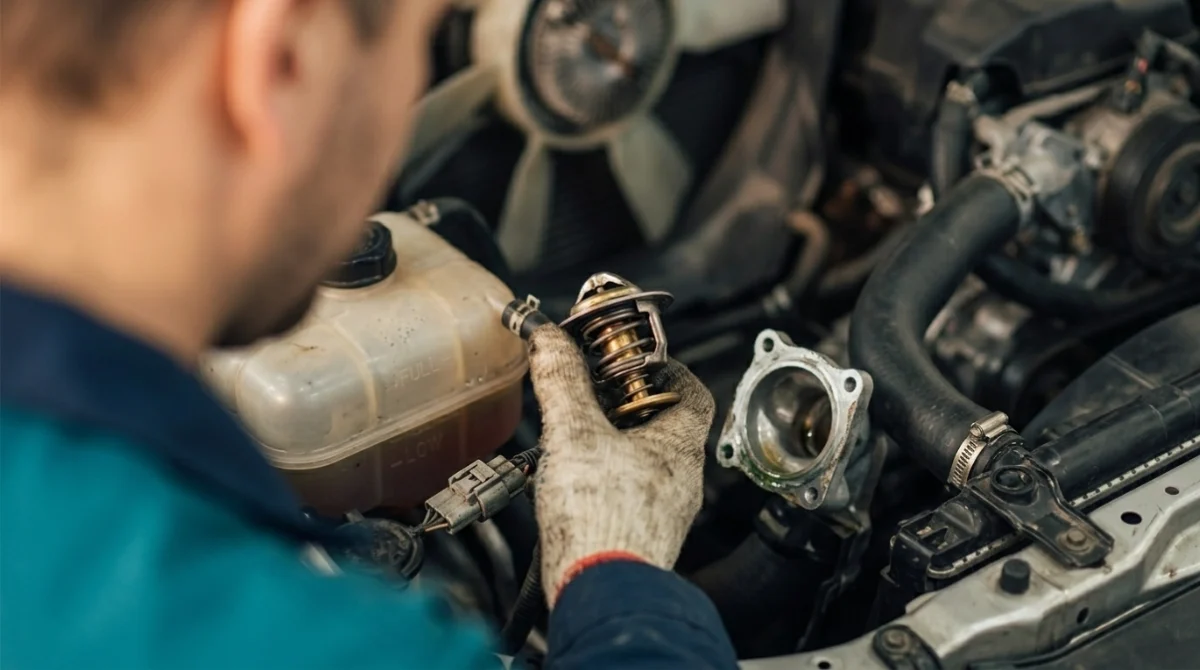
A stuck-open thermostat causes P0128 more often than any other part failure. The thermostat should stay closed during cold start so the engine warms up fast.
When the thermostat sticks open, coolant flows through the radiator too soon. That keeps the engine cooler than the computer expects.
| Possible Cause | Why It Triggers P0128 | First Check |
|---|---|---|
| Stuck-open thermostat | Coolant circulates too early | Watch warm-up temperature |
| Low coolant level | Sensor readings become unstable | Check reservoir when cold |
| Bad coolant temperature sensor | Computer receives wrong temperature data | Compare cold ECT and air temperature |
| Cooling fan stuck on | Radiator removes heat too early | Listen for fan at cold start |
| Wiring or connector fault | Sensor signal drops or reads wrong | Inspect sensor plug and harness |
The table shows why replacing the thermostat without testing can waste money. The thermostat is common, but the coolant temperature sensor and coolant level still matter.
P0128 Symptoms You May Notice
P0128 often shows only one symptom: the check engine light. Many drivers do not feel a major drivability change at first.
Other symptoms appear when the engine keeps running below its designed temperature. The heater can feel weak, the temperature gauge can stay low, and fuel economy can drop.
- Check engine light
- Low temperature gauge reading
- Weak cabin heat
- Lower fuel mileage
- Long warm-up time
- Rich fuel smell in cold weather
Modern vehicles use coolant temperature data to adjust fuel delivery. A cold-reading engine can stay in a richer warm-up strategy longer than needed.
What most people miss: P0128 can affect emissions readiness. That matters when your vehicle needs inspection.
Is P0128 Serious?
P0128 is not an emergency like an overheating warning, but you should not ignore it. The engine is operating outside the temperature range expected by the manufacturer.
You can usually drive short trips with P0128 if the temperature gauge stays normal, coolant level is safe, and there is no steam, leak, or overheating message. Stop driving if the gauge moves hot.
Warning: Never open a hot radiator cap. Pressurized coolant can cause burns. Check coolant only when the engine is fully cold.
The Federal Trade Commission advises car owners to understand the repair issue, ask clear questions, and get repair details before approving work. That matters with P0128 because several parts can create the same code. FTC auto repair basics :contentReference[oaicite:2]{index=2}
How to Diagnose P0128 Correctly
The correct P0128 diagnosis starts with data, not parts. A scan tool with live data gives the fastest clue.
Start with a cold engine. The engine coolant temperature reading should sit close to outside air temperature before the engine starts.
- Check coolant level when cold.
- Scan for other codes.
- Compare cold ECT and intake air temperature.
- Start the engine and watch coolant temperature rise.
- Check if the radiator fan runs too early.
- Inspect thermostat housing and sensor wiring.
If coolant temperature rises slowly and never reaches the expected range, the thermostat deserves close attention. If the scan tool shows an unrealistic reading at cold start, the sensor or wiring becomes the stronger suspect.
For vehicle-specific concerns, check open recalls by VIN through the National Highway Traffic Safety Administration. Recalls do not explain every P0128 code, but the VIN check can reveal known safety-related issues. NHTSA vehicle recall lookup :contentReference[oaicite:3]{index=3}
What Most People Get Wrong About P0128
The biggest mistake is assuming P0128 always means “replace the thermostat.” The thermostat is the leading suspect, but the code describes a temperature result, not a confirmed failed part.
P0128 Is Not an Overheating Code
P0128 points to coolant temperature below the expected thermostat range. Overheating codes and warning lights belong to a different failure pattern.
You should still watch the gauge. A cooling system can have more than one fault, especially when coolant level is low.
P0128 Does Not Always Mean the Sensor Failed
A bad coolant temperature sensor can trigger P0128, but sensor replacement should follow a data check. If the sensor reads close to ambient temperature before start-up, the sensor signal has passed one useful test.
The thermostat then becomes a stronger suspect because the engine is not warming the way the computer expects.
Clearing the Code Does Not Fix the Problem
Clearing P0128 only turns off the light until the monitor runs again. The check engine light will return when the same temperature pattern repeats.
The repair needs to correct the cause of the slow warm-up. That means confirming coolant level, thermostat control, sensor accuracy, and fan operation.
What Should You Do First?
Your first step is a cold coolant-level check. Low coolant can create misleading temperature readings and can damage the engine if ignored.
After that, use this simple decision block:
If the coolant is low → find the leak before replacing parts.
If the heater is weak and warm-up is slow → test the thermostat.
If live temperature data looks wrong at cold start → test the coolant temperature sensor and wiring.
If the radiator fan runs from cold start → inspect the fan relay, control module, and sensor input.
This sequence prevents the most common repair mistake. It also gives a shop clearer information if you decide to pay for diagnosis.
IMAGE SUGGESTION: A mechanic checking live coolant temperature data on a scan tool beside an engine bay.
ALT TEXT: what does P0128 mean scan tool coolant temperature diagnosis
Can P0128 Come Back After Repair?
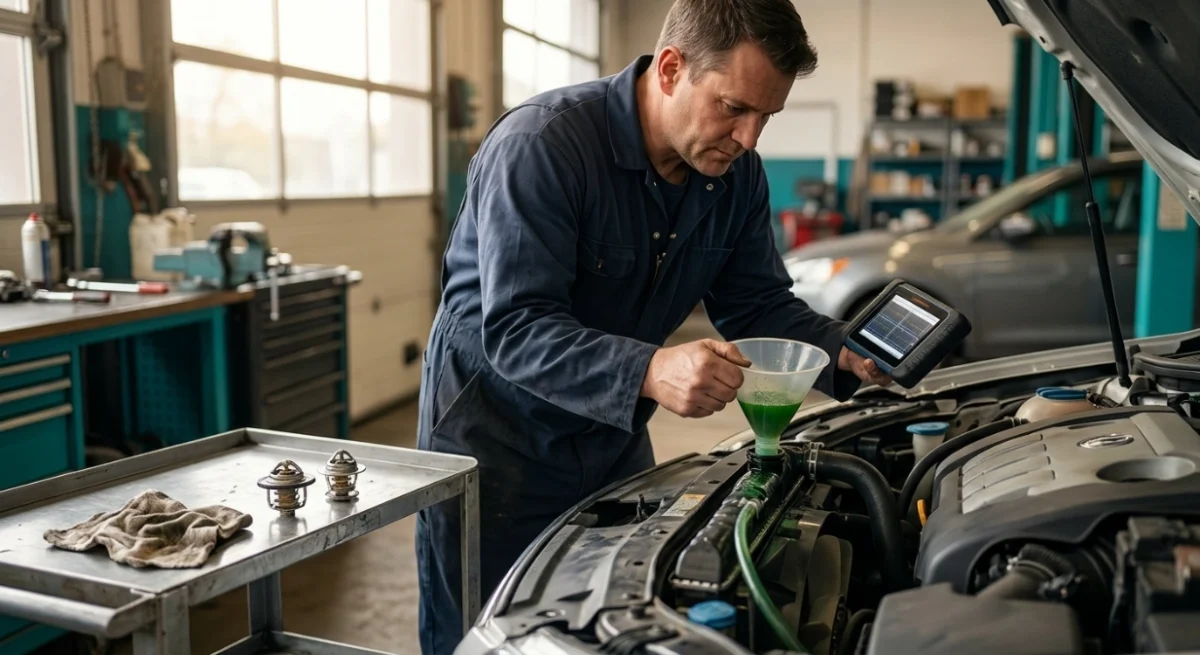
P0128 can return after repair when the root cause was not fixed. It can also return when air stays trapped in the cooling system after service.
Common comeback causes include a low-quality thermostat, incorrect thermostat temperature rating, air pockets, a weak coolant temperature sensor, or a cooling fan that runs too often.
What most people do not think to ask is whether the replacement thermostat matches the vehicle’s required temperature rating. The wrong part can keep the engine outside the computer’s expected warm-up range.
Best next move: after any repair, drive through a full warm-up cycle and confirm the temperature reaches the correct range on live data.
P0128 means the engine is running too cool or warming too slowly, and the thermostat is the first major suspect.
The smartest repair path uses live temperature data because the sensor, coolant level, wiring, and fan system can copy the same code pattern.
Before spending money, check your coolant level with the engine cold and write down any heater or temperature-gauge symptoms.
Frequently Asked Questions
Can I drive with a P0128 code?
You can drive short trips with P0128 if the coolant level is safe and the temperature gauge does not show overheating. Schedule diagnosis soon because a cool-running engine can waste fuel, affect emissions readiness, and hide a thermostat or sensor problem.
Will P0128 clear itself?
P0128 can turn off after several successful warm-up cycles if the problem no longer appears. The code will return when the engine computer sees the same coolant temperature pattern again, so clearing the light is not a repair.
Does P0128 mean I need a thermostat?
P0128 often points to a stuck-open thermostat, but it does not prove the thermostat failed. A correct diagnosis checks coolant level, live coolant temperature data, sensor readings, wiring, and cooling fan behavior before parts replacement.
Can low coolant cause P0128?
Low coolant can cause P0128 because the coolant temperature sensor needs stable coolant contact and correct system flow. A low level can also signal a leak, so topping off coolant without finding the cause leaves the real problem unresolved.
Is P0128 bad for fuel economy?
P0128 can reduce fuel economy because a cold-running engine can stay in warm-up fuel strategy longer than needed. The effect varies by vehicle, driving pattern, outside temperature, and how far below normal the coolant temperature stays.
