
What Does P0203 Mean? Cylinder 3 Injector Circuit Explained for Car Owners

Your check engine light comes on. The car starts running rough. Maybe it shakes at idle, hesitates when you accelerate, or feels like one cylinder is not helping the engine. Then an OBD2 scanner shows P0203. So, what does P0203 mean?
P0203 means your vehicle’s computer has detected a problem in the fuel injector circuit for cylinder 3. In plain English, the engine computer tried to control the fuel injector for cylinder 3, but the electrical signal did not look right. This can be caused by a bad injector, damaged wiring, a loose connector, or less commonly, a problem with the engine control module.
This guide explains what P0203 means, common symptoms, likely causes, repair options, cost factors, and when a locksmith or dealership may be involved if the problem is confused with a key fob, immobilizer, or no-start issue.
Quick Answer
What does P0203 mean? P0203 means the engine computer found an electrical problem with the fuel injector circuit on cylinder 3. The injector may be bad, unplugged, shorted, or affected by damaged wiring. It is an engine performance code, not usually a key fob or programming problem.
What Does P0203 Mean in Simple Terms?
P0203 is a generic OBD2 trouble code. It usually stands for Injector Circuit/Open – Cylinder 3.
Your engine needs the right mix of air, fuel, and spark. The fuel injector sprays fuel into the engine at the correct time. Cylinder 3 has its own injector. When the vehicle’s computer sees the wrong voltage, resistance, or control signal from that injector circuit, it can store code P0203.
The EPA’s onboard diagnostics information explains that OBD systems are designed to monitor emission-related systems and detect malfunctions. A fuel injector circuit problem can affect fuel control, engine performance, and emissions. (US EPA)
For a car owner, the important point is this:
P0203 does not automatically mean the fuel injector itself is bad. It means the circuit for cylinder 3 needs diagnosis.
The issue may be:
- A failed cylinder 3 fuel injector
- A loose injector connector
- Broken, corroded, or shorted wiring
- Poor electrical contact
- A blown fuse or power supply issue
- A driver circuit problem inside the engine computer
- Rodent damage near the wiring harness
- Previous repair work that disturbed the connector
Why P0203 Matters
P0203 matters because it can cause one cylinder to receive too much fuel, too little fuel, or no fuel at all. That can make the engine run rough and may damage other parts if ignored.
A misfiring cylinder can send unburned fuel into the exhaust. Over time, this may harm the catalytic converter. That repair can be much more expensive than fixing an injector circuit problem early.
You should take P0203 seriously if the car is shaking, has poor acceleration, smells like fuel, or the check engine light is flashing.
Important warning: If the check engine light is flashing, avoid driving the vehicle unless absolutely necessary. A flashing light often means active misfire damage may be happening.
Common Symptoms of Code P0203
Symptoms can vary by vehicle. Some cars still drive, while others run very poorly.
Common signs include:
- Check engine light
- Rough idle
- Engine shaking
- Poor acceleration
- Misfire feeling
- Reduced fuel economy
- Hard starting
- Fuel smell from the exhaust
- Engine hesitation
- Stalling at stops
- Failed emissions test
- Limp mode on some vehicles
Some drivers notice the problem most when the engine is cold. Others feel it only under load, such as merging onto a highway or climbing a hill.
Can P0203 Cause a No-Start?
Yes, but it is not the most common result. One failed injector circuit usually affects one cylinder, so many engines will still start. However, if the wiring issue affects several injectors, a shared fuse, or the engine computer, the vehicle may crank but not start.
This is where some car owners confuse P0203 with a key fob, immobilizer, or programming issue.
If your key fob unlocks the doors but the engine cranks and runs rough, that points more toward an engine problem. If the car does not recognize the key at all, shows a security light, or will not crank, the key fob or immobilizer system may need separate attention.
P0203 vs. Key Fob or Immobilizer Problems
Because ReplaceKeyFob.com focuses on key fobs and vehicle access, this distinction is important.
P0203 is mainly an engine fuel injector circuit code. It is not normally caused by a dead key fob battery or remote programming failure.
However, car owners often scan the car after a no-start or warning-light problem and see several codes at once. That can make the situation confusing.
| Problem Type | Common Signs | Likely Area to Check |
|---|---|---|
| P0203 injector circuit issue | Rough idle, misfire, fuel smell, check engine light | Cylinder 3 injector, wiring, connector, engine computer |
| Dead key fob battery | Remote does not lock/unlock, push-button start may not detect key | Key fob battery, emergency start procedure |
| Key programming issue | New fob does not start car or unlock doors | Fob programming, immobilizer pairing |
| Immobilizer/security issue | Security light flashes, car may not crank or start | Key transponder, immobilizer system, dealership or locksmith scan |
| Weak car battery | Clicking, dim lights, random warning lights | 12-volt battery and charging system |
Do not replace your key fob just because the car will not run properly. If code P0203 is present and the engine runs rough, the fuel injector circuit should be checked first.
What Causes P0203?
P0203 can come from several faults. The code points to cylinder 3, but the exact cause must be confirmed with testing.
1. Bad Cylinder 3 Fuel Injector
A fuel injector is an electrical valve. It opens and closes quickly to spray fuel. Over time, it can fail internally.
A bad injector may have:
- Open internal winding
- Shorted internal winding
- Clogged fuel passage
- Weak spray pattern
- Sticking valve
If the injector’s electrical resistance is outside specification, the engine computer may set P0203.
2. Loose or Damaged Injector Connector
The connector at the injector can become loose, cracked, oil-soaked, or corroded. Heat and vibration under the hood can make this worse.
A simple connector issue can look like a major injector failure. That is why a visual inspection should happen before buying parts.
3. Broken or Shorted Wiring
Wiring problems are common with injector circuit codes. The wire may rub against an engine bracket, melt near hot parts, or get damaged during another repair.
Rodents can also chew wiring. This is especially common when a vehicle sits unused for days or weeks.
4. Power Supply or Fuse Problem
Some vehicles feed power to multiple injectors through a shared circuit. If that power feed is weak or interrupted, more than one injector code may appear.
A technician may check injector power, ground control, and related fuses before condemning the injector.
5. Engine Computer Driver Issue
The engine control module controls injector pulse. Inside the module, an injector driver circuit turns the injector on and off.
Computer failure is less common than injector or wiring failure, but it can happen. This should be diagnosed carefully because engine computer replacement can be expensive and may require programming.
6. Previous Repair or Incorrect Part Installation
P0203 may appear after:
- Spark plug replacement
- Valve cover gasket work
- Intake manifold removal
- Fuel rail service
- Engine wiring repair
- Injector replacement with the wrong part
If the code appeared right after recent work, inspect the area that was touched.
Is It Safe to Drive With P0203?
It depends on how the car behaves.
If the engine runs almost normally and the check engine light is steady, you may be able to drive a short distance to a repair shop. But you should avoid long trips, hard acceleration, and highway driving until it is checked.
Do not keep driving if:
- The check engine light flashes
- The engine shakes badly
- You smell raw fuel
- The car stalls
- Acceleration is unsafe
- The exhaust smells unusually strong
- The vehicle goes into limp mode
A flashing check engine light means you should stop driving as soon as it is safe.
How a Mechanic Diagnoses P0203
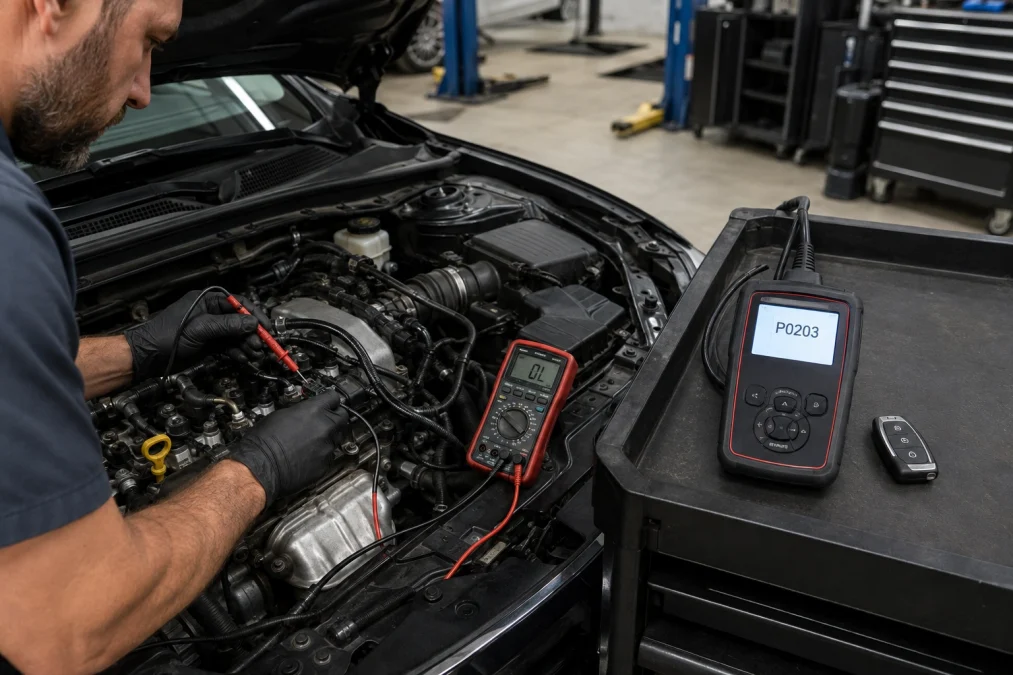
A good diagnosis does not start with guessing. It starts with confirming the code and checking the circuit.
Here is a typical process:
- Scan all codes The technician checks P0203 and any related misfire, fuel, or voltage codes.
- Check freeze-frame data This shows what was happening when the code set, such as engine speed, load, temperature, and speed.
- Inspect cylinder 3 injector and connector The injector plug, wiring, and harness are checked for damage, corrosion, looseness, or oil contamination.
- Test injector resistance The injector is tested with a multimeter and compared with manufacturer specifications.
- Check power and control signal The technician verifies that the injector receives power and that the computer is controlling it.
- Swap injectors if appropriate On some engines, the cylinder 3 injector may be swapped with another cylinder. If the code follows the injector, the injector is likely bad.
- Check wiring continuity Wiring between the injector and engine computer may be tested for opens, shorts, or high resistance.
- Confirm the repair After repair, the codes are cleared and the vehicle is test-driven.
This process prevents unnecessary parts replacement.
Can You Fix P0203 Yourself?
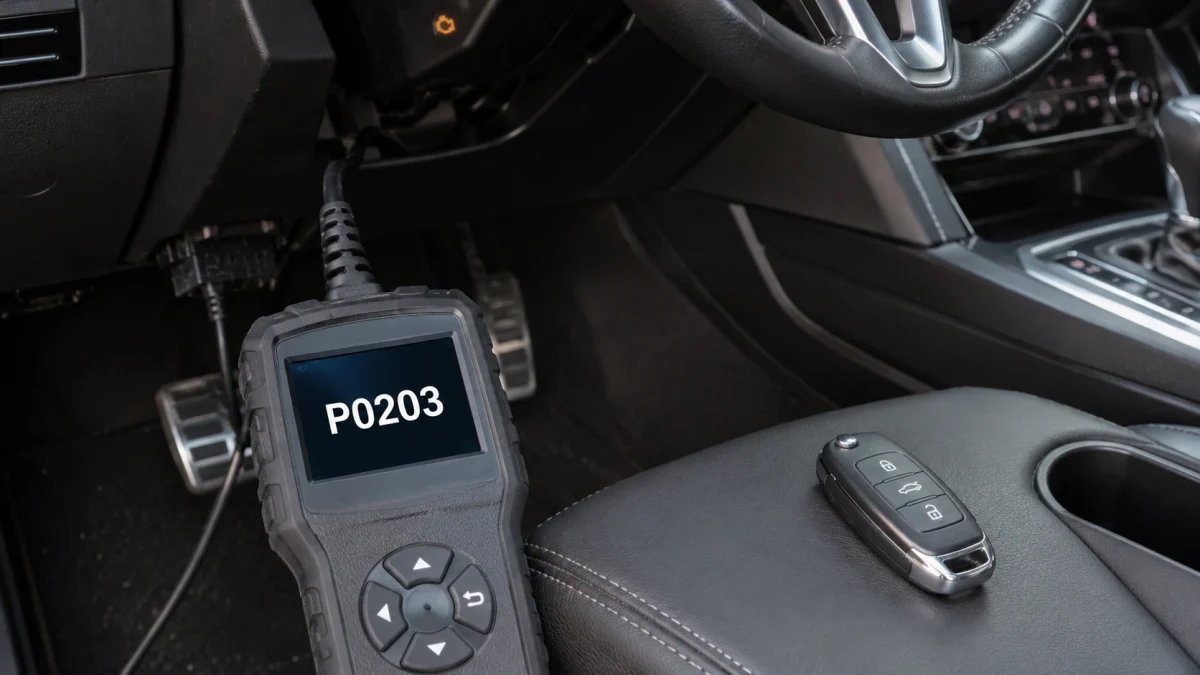
Some basic checks are reasonable for a careful DIY car owner. But injector circuit testing can become technical quickly.
You may be able to:
- Check if the injector connector is fully seated
- Look for obvious broken wires
- Check for rodent damage
- Read codes with an OBD2 scanner
- Clear the code after a repair
- Replace a damaged connector if you have proper tools and experience
You should be careful with:
- Back-probing electrical connectors
- Testing injector pulse
- Removing fuel rails
- Replacing injectors
- Working near fuel pressure
- Replacing or programming an engine computer
Fuel systems can be dangerous. Fuel pressure, electrical sparks, and incorrect repairs can create fire risk or engine damage.
If you are not comfortable testing wiring or fuel injectors, it is better to use a qualified mechanic.
P0203 Repair Cost: What Car Owners Should Expect
The cost to fix P0203 depends on the real cause. A loose connector may be cheap. A failed injector or damaged wiring harness may cost more.
Here is a general cost guide for U.S. car owners:
| Possible Repair | Typical Cost Range | Notes |
|---|---|---|
| Diagnostic inspection | $75–$180 | Often needed to confirm the cause |
| Injector connector repair | $80–$250 | Depends on access and wiring condition |
| Wiring repair | $100–$500+ | Higher if the harness is hard to reach |
| Fuel injector replacement | $150–$600 per injector | Varies by vehicle and injector type |
| Fuel rail removal labor | $100–$400+ | Some engines require extra labor |
| Engine computer repair/replacement | $500–$1,500+ | Usually requires programming |
| Key fob/immobilizer diagnosis | $75–$200+ | Only if security/no-start symptoms are present |
These are broad estimates. Luxury vehicles, direct-injection engines, and hard-to-access engine layouts can cost more.
Before approving repairs, ask for:
- The confirmed cause
- The test results
- Whether the problem is injector, wiring, or computer-related
- Parts brand and warranty
- Labor warranty
- Whether programming is required
The FTC’s auto repair basics guide recommends being prepared, understanding the repair, and choosing a shop carefully before paying for auto service. That advice is especially useful when a diagnostic code could have several possible causes. (Consumer Advice)
Should You Replace the Fuel Injector Right Away?
Not always.
A common mistake is replacing the cylinder 3 fuel injector as soon as P0203 appears. That may work if the injector has failed. But it wastes money if the problem is a broken wire, loose connector, or poor power supply.
A smart order is:
- Confirm P0203 with a scanner.
- Check for other codes.
- Inspect the cylinder 3 injector connector.
- Test injector resistance.
- Test power and control signal.
- Repair wiring or connector issues first.
- Replace the injector only if testing supports it.
The code tells you where to look. It does not prove which part is bad.
How P0203 Can Affect Fuel Economy and Engine Life
A failing injector circuit can hurt fuel economy because the engine is no longer running evenly. The computer may try to compensate by changing fuel trim. That can waste fuel and reduce performance.
If cylinder 3 gets no fuel, the engine may misfire. If the injector leaks or sprays incorrectly, the cylinder may receive too much fuel. Both conditions can create problems.
Possible long-term risks include:
- Catalytic converter damage
- Spark plug fouling
- Fuel smell
- Poor emissions
- Hard starting
- Engine vibration
- Damage to related wiring if a short is ignored
Fixing P0203 early usually costs less than ignoring it.
Could a Recall Be Related to P0203?
Sometimes, but not always.
Most P0203 repairs are normal maintenance or repair issues. However, some vehicles may have recalls or service campaigns related to engine wiring, fuel injectors, software, or engine control systems.
It is smart to check your VIN using the NHTSA recall lookup tool before paying for expensive repairs. NHTSA explains that recalls are issued when a manufacturer or NHTSA determines that a vehicle or equipment creates an unreasonable safety risk or fails to meet safety standards. (NHTSA)
A recall does not guarantee your P0203 repair is free. But if your vehicle has an open recall related to fuel injection, wiring, engine control, or fire risk, you should contact the dealer before approving paid work.
When P0203 Appears With Other Codes
P0203 may appear alone or with other codes.
Common related codes include:
- P0303: Cylinder 3 misfire
- P0201, P0202, P0204: Other injector circuit codes
- P0171 or P0174: Lean condition
- P0172 or P0175: Rich condition
- P0300: Random/multiple misfire
- Battery voltage codes
- Immobilizer or key recognition codes on some vehicles
If P0203 appears with P0303, the cylinder 3 injector circuit may be causing a cylinder 3 misfire.
If several injector circuit codes appear at once, the issue may be a shared power feed, fuse, wiring harness, or computer control problem.
If key or immobilizer codes appear with no-start symptoms, the vehicle may need both engine diagnosis and security-system diagnosis.
When to Call a Professional Locksmith or Dealership
Call a professional locksmith or dealership if the problem involves vehicle access, key recognition, immobilizer programming, or security-related no-start symptoms.
P0203 itself is usually handled by a mechanic, not a locksmith. But locksmith help may be needed if:
- The car does not recognize the key
- The security light flashes during starting
- A new key fob unlocks the doors but does not start the car
- The push-button start says “key not detected”
- The vehicle was recently reprogrammed
- All keys were lost
- The ignition lock, transponder key, or smart key system is involved
A dealership may be required if:
- The engine computer needs replacement and programming
- Security module programming is locked to dealer tools
- A factory recall or software update applies
- The car requires OEM-level immobilizer pairing
A qualified automotive locksmith may be the better choice if:
- You need key fob programming
- You need a replacement smart key
- You are locked out
- You lost all keys
- You need mobile help at your location
- The issue is clearly key or immobilizer related
When hiring a locksmith, the ALOA consumer guide for hiring a professional locksmith is a helpful resource because it explains how consumers can look for qualified locksmith professionals and avoid poor service choices. (aloa.org)
Security warning: Do not hand your vehicle, VIN, key code, or proof-of-ownership documents to an unknown person from an unverified ad. Automotive key programming involves vehicle security access.
Expert Tip
Expert Tip: If your car has both a check engine light and a key warning light, diagnose them separately. A P0203 code points to the cylinder 3 injector circuit, while a key warning light points to the fob, transponder, or immobilizer system.
Dealership vs. Locksmith vs. Mechanic: Who Should You Call?
Choosing the right professional can save time and money.
| Situation | Best First Call | Why |
|---|---|---|
| P0203 with rough running | Mechanic or repair shop | Injector circuit testing is engine/electrical work |
| P0203 after engine repair | Mechanic who performed the work | A connector or harness may have been disturbed |
| P0203 plus open recall | Dealership | Recall-related repairs may need dealer handling |
| Car says “key not detected” | Automotive locksmith or dealership | Key fob or immobilizer diagnosis is needed |
| Lost all keys | Automotive locksmith or dealership | New key/fob must be cut and programmed |
| Engine computer replacement needed | Dealership or advanced repair shop | Module programming may be required |
| Lockout only | Automotive locksmith | Vehicle entry service is needed |
A locksmith is not the main repair choice for P0203 unless the symptoms also involve the key, fob, or immobilizer.
A mechanic is usually the right first call for rough running, misfire, and injector circuit testing.
Quality and Durability: OEM vs. Aftermarket Parts
If the fuel injector needs replacement, you may have a choice between OEM and aftermarket parts.
OEM Injectors
OEM means original equipment manufacturer. These parts are made to match factory specifications.
Benefits:
- Better fit confidence
- Usually reliable quality
- Often preferred for newer vehicles
- May reduce compatibility issues
Limitations:
- Higher price
- May only be available through dealer or specialty supplier
Aftermarket Injectors
Aftermarket injectors can be less expensive, but quality varies.
Benefits:
- Lower cost
- Easier availability
- Good brands may perform well
Limitations:
- Cheap injectors may fail early
- Poor spray pattern can cause performance issues
- Incorrect injector specs can create new problems
Do not choose the cheapest injector only by price. A poor-quality injector can cause rough running, fuel trim problems, or repeat check engine lights.
The same idea applies to key fobs. A cheap fob may look correct but fail to program, have weak buttons, or use poor internal electronics.
Battery, Key Fob, and Programming Warning Signs That Are Not P0203
P0203 is an engine code, but car owners often deal with several problems at the same time. Here are signs that point more toward key fob or programming issues:
- Remote buttons work only near the car
- The car says “key not detected”
- Push-button start works only when the fob is held near the start button
- The remote unlocks but does not start the car
- A replacement fob will not program
- The security light stays on or flashes
- The physical key blade works, but the transponder does not start the engine
- The vehicle starts with one key but not another
If those signs appear without rough running or injector codes, start with key fob battery, programming, or immobilizer diagnosis.
If those signs appear along with P0203, you may have two separate problems.
Common Mistakes Car Owners Should Avoid
Avoid these costly mistakes:
- Replacing the key fob because the engine runs rough. P0203 points to the injector circuit, not the remote.
- Replacing the injector without testing the wiring. A broken wire can trigger the same code.
- Ignoring a flashing check engine light. This can lead to catalytic converter damage.
- Clearing the code repeatedly without fixing it. The problem usually returns.
- Buying the cheapest injector online. Poor-quality parts can cause repeat failures.
- Assuming every no-start is a fob issue. A car can have fuel, spark, battery, or engine computer problems.
- Letting an unverified person program keys. Vehicle security work should be handled carefully.
- Skipping recall checks. A related recall may change where you should take the vehicle first.
- Driving long distances with a severe misfire. This can turn a smaller repair into a bigger bill.
Practical Example: How a P0203 Diagnosis Might Go
Imagine your sedan starts shaking at a stoplight. The check engine light comes on. You scan the car and see P0203.
A quick parts-store scan says “fuel injector circuit cylinder 3.” You buy an injector and install it, but the code comes back.
A repair shop later finds that the injector connector lock was cracked. The connector was loose and losing contact when the engine vibrated.
In this case, the injector was not the real problem. The connector was.
This is why diagnosis matters.
Another Example: P0203 and a Key Warning Light
Now imagine a push-button-start vehicle that sometimes says “key not detected.” The owner also sees a check engine light and P0203.
These may be separate issues:
- The “key not detected” warning may come from a weak fob battery or smart key problem.
- The P0203 code may come from the cylinder 3 injector circuit.
Replacing the fob will not fix the injector circuit. Replacing the injector will not fix key detection. Both systems need the right test.
How to Talk to a Repair Shop About P0203
You do not need to sound like a mechanic. Just ask clear questions.
Useful questions include:
- “Did you confirm whether the problem is the injector or the wiring?”
- “Did you test the cylinder 3 injector resistance?”
- “Is the injector getting power?”
- “Is the engine computer sending the injector signal?”
- “Are there any related misfire or voltage codes?”
- “Could this be related to a recall or service bulletin?”
- “Will the repair include a test drive and code recheck?”
- “What warranty comes with the part and labor?”
A trustworthy shop should be able to explain the diagnosis in plain language.
How to Prevent Future Injector Circuit Problems
You cannot prevent every electrical problem, but you can reduce risk.
Helpful habits include:
- Fix oil leaks that drip onto wiring
- Keep rodents away from stored vehicles
- Avoid pressure-washing sensitive engine electronics
- Repair damaged engine covers and harness clips
- Use quality replacement parts
- Address misfires early
- Keep the 12-volt battery in good condition
- Do not pull on wiring when changing spark plugs or coils
- Have warning lights checked before long trips
For key fobs, keep a spare working fob. Replace weak fob batteries early. Store smart keys safely. Avoid water damage and hard drops.
FAQs
What does P0203 mean on my car?
P0203 means the vehicle’s computer detected a problem in the fuel injector circuit for cylinder 3. The injector, connector, wiring, or engine computer control circuit may need testing.
Is P0203 a serious code?
Yes, it can be serious. P0203 can cause misfires, rough running, poor fuel economy, and possible catalytic converter damage if ignored. A flashing check engine light is especially urgent.
Can a bad key fob cause P0203?
Usually, no. A bad key fob can cause lock, unlock, key detection, or immobilizer problems. P0203 is an engine injector circuit code. If both issues appear, diagnose them separately.
Can I drive with code P0203?
You may be able to drive a short distance if the car runs smoothly and the check engine light is steady. Do not drive if the engine shakes badly, stalls, smells like fuel, or the check engine light flashes.
Does P0203 always mean I need a new injector?
No. P0203 can be caused by a bad injector, but it can also come from a loose connector, damaged wiring, poor power supply, or computer control problem. Testing should come first.
How much does it cost to fix P0203?
Many repairs fall between about $100 and $600, depending on the cause. Wiring repairs, injector replacement, and computer-related repairs can cost more. Diagnosis is important before approving parts.
Should I go to a dealership for P0203?
A repair shop can often handle P0203. A dealership may be better if there is an open recall, factory software issue, warranty coverage, or engine computer programming requirement.
Conclusion
So, what does P0203 mean? It means your vehicle has detected a problem with the cylinder 3 fuel injector circuit. The issue may be a bad injector, loose connector, damaged wire, power problem, or less commonly, an engine computer fault.
For most car owners, the smartest next step is not to guess. Scan the vehicle, check for related codes, inspect the injector connector and wiring, and get proper testing before replacing parts.
If the car also has key fob, immobilizer, or “key not detected” symptoms, treat that as a separate vehicle access issue. A mechanic should handle the injector circuit diagnosis, while a qualified automotive locksmith or dealership can help with key fob programming, transponder keys, smart keys, and security-system problems.
Use the code as a starting point, not a final answer. Get the right diagnosis, protect your engine, and choose the right professional before spending money on parts or key services.
