
What Does P0715 Mean? Causes, Symptoms, Fixes, and Repair Costs

P0715 means the transmission control module is not getting a good signal from the input or turbine speed sensor. Common causes are a failed sensor, damaged wiring or connector, or low or dirty transmission fluid. Symptoms include harsh or late shifts, slipping and limp mode. You can drive a short distance, but get it checked soon to avoid transmission damage.
If your check engine light suddenly turns on and a scan tool shows P0715, you may be wondering what it means and whether it is safe to keep driving.
The P0715 trouble code is related to your vehicle’s transmission system. Specifically, it indicates a problem with the Input/Turbine Speed Sensor Circuit. This sensor helps the transmission control module (TCM) monitor how fast the transmission input shaft is spinning. Without accurate data from this sensor, the transmission may shift poorly, enter limp mode, or experience performance issues.
In this guide, you’ll learn:
- What P0715 means
- Common symptoms
- Possible causes
- How mechanics diagnose it
- Repair options and costs
- Whether you can continue driving
Let’s dive in.
What Is Code P0715?
P0715 Definition
P0715 – Input/Turbine Speed Sensor Circuit Malfunction
This generic OBD-II trouble code applies to most vehicles manufactured after 1996, including:
- Toyota
- Honda
- Ford
- Chevrolet
- Nissan
- Hyundai
- Kia
- Dodge
- Jeep
- Volkswagen
Although the code definition remains the same, the exact repair procedure can vary depending on the make and model.
What Does the Input/Turbine Speed Sensor Do?
Modern automatic transmissions rely on multiple sensors to operate correctly.
The Input Speed Sensor, sometimes called the Turbine Speed Sensor, measures the rotational speed of the transmission’s input shaft.
The Transmission Control Module uses this information to:
- Determine gear ratios
- Control shift timing
- Monitor torque converter operation
- Adjust transmission performance
- Detect transmission slippage
When the sensor signal becomes inaccurate or disappears completely, the TCM can no longer calculate transmission speed correctly.
As a result, the P0715 code may be stored.
How Serious Is Code P0715?
The seriousness depends on the underlying cause.
In some cases, the issue may be a simple wiring problem.
In others, it may indicate:
- Internal transmission damage
- Failing speed sensor
- Transmission control module issues
Ignoring the problem for too long may lead to:
- Transmission overheating
- Harsh shifting
- Reduced fuel economy
- Expensive transmission repairs
For that reason, P0715 should be diagnosed as soon as possible.
Symptoms of a P0715 Code
Different vehicles may show different symptoms.
The most common signs include:
Check Engine Light
The first symptom is usually the illuminated check engine light.
Many drivers discover the code during a routine scan.
Hard or Delayed Shifting
The transmission may:
- Shift harshly
- Shift late
- Shift unpredictably
Drivers often notice rough gear changes.
Transmission Slipping
The transmission may feel like it:
- Hesitates
- Loses power briefly
- Struggles to engage gears
This is known as transmission slipping.
Limp Mode
Many vehicles enter a protective mode called limp mode.
When this happens:
- Transmission performance is restricted
- Vehicle speed may be limited
- Only one or two gears may be available
Manufacturers use limp mode to prevent transmission damage.
Poor Acceleration
Because the transmission cannot determine proper shift points, acceleration may become sluggish.
Reduced Fuel Economy
Improper shifting causes the engine to operate inefficiently.
This often results in:
- Higher fuel consumption
- Reduced MPG
Transmission Warning Light
Some vehicles display a separate transmission warning indicator.
Common Causes of P0715
Several issues can trigger this code.
Let’s look at the most common causes.
Faulty Input Speed Sensor
This is the most frequent cause.
Over time, the sensor may fail due to:
- Heat
- Vibration
- Internal electrical damage
- Age-related wear
Replacing the sensor often solves the problem.
Damaged Wiring
Transmission wiring operates in a harsh environment.
Problems may include:
- Broken wires
- Chafed insulation
- Short circuits
- Open circuits
Even a small wiring issue can interrupt sensor communication.
Corroded Connectors
Moisture and dirt can damage electrical connectors.
Corrosion increases resistance and causes inaccurate readings.
Low Transmission Fluid
Low fluid levels can create abnormal transmission behavior.
While low fluid may not directly cause P0715, it can contribute to sensor-related issues.
Dirty Transmission Fluid
Contaminated fluid can:
- Affect sensor operation
- Cause shifting problems
- Trigger related transmission codes
Faulty Transmission Control Module (TCM)
The TCM receives and interprets sensor signals.
A defective TCM may incorrectly set the P0715 code.
Although less common, it is possible.
Internal Transmission Damage
Mechanical problems inside the transmission can affect speed sensor readings.
Examples include:
- Damaged input shaft
- Broken tone wheel
- Worn internal components
These repairs are typically more expensive.
How Mechanics Diagnose P0715
Proper diagnosis prevents unnecessary parts replacement.
A professional technician usually follows these steps.
Step 1: Scan the Vehicle
A scan tool retrieves:
- Active codes
- Pending codes
- Freeze frame data
Related transmission codes often provide additional clues.
Step 2: Check Transmission Fluid
The technician examines:
- Fluid level
- Fluid color
- Fluid smell
Burnt or contaminated fluid may indicate internal problems.
Step 3: Inspect Wiring
The entire sensor circuit is visually inspected.
Technicians look for:
- Loose connectors
- Corrosion
- Damaged wiring
- Pinched harnesses
Step 4: Test the Sensor
Using a multimeter or oscilloscope, the technician verifies:
- Resistance values
- Voltage signals
- Sensor output
If readings fall outside specifications, replacement is usually required.
Step 5: Check Live Data
Modern scan tools display real-time sensor information.
Technicians compare:
- Input speed readings
- Output speed readings
- Engine RPM
Abnormal values help pinpoint the fault.
Step 6: Evaluate the TCM
If the sensor and wiring appear normal, the transmission control module may require testing.
Common Diagnostic Mistakes
Many people make mistakes that lead to unnecessary repairs.
Here are the most common ones.
Replacing the Sensor Too Quickly
The sensor is often blamed first.
However, damaged wiring may be the actual issue.
Ignoring Transmission Fluid
Poor fluid condition can create symptoms similar to a bad sensor.
Overlooking Related Codes
Codes such as:
- P0716
- P0717
- P0720
- P0722
can provide important diagnostic information.
Failing to Inspect Connectors
Corroded connectors frequently cause intermittent faults.
How to Fix Code P0715
The correct repair depends on the diagnosis.
Possible solutions include:
Replace the Input Speed Sensor
If testing confirms sensor failure, replacement is usually straightforward.
Many vehicles allow sensor replacement without removing the transmission.
Repair Wiring
Damaged wiring should be:
- Repaired
- Replaced
- Properly insulated
A quality repair prevents future issues.
Clean Electrical Connections
Corrosion can often be removed using:
- Electrical contact cleaner
- Connector repair kits
Service the Transmission
A transmission service may include:
- Fluid replacement
- Filter replacement
- Pan inspection
This helps restore proper operation.
Replace the TCM
If the transmission control module has failed, replacement and programming may be necessary.
Repair Internal Transmission Damage
In severe cases, repairs may involve:
- Valve body replacement
- Internal transmission rebuild
- Complete transmission replacement
How Much Does It Cost to Fix P0715?
Repair costs vary widely.
Here are typical estimates.
| Repair | Estimated Cost |
|---|---|
| Diagnostic Scan | $75–$150 |
| Sensor Replacement | $100–$350 |
| Wiring Repair | $100–$500 |
| Transmission Service | $100–$300 |
| TCM Replacement | $500–$1,500 |
| Transmission Rebuild | $1,500–$4,500+ |
Luxury vehicles may cost significantly more.
Can You Drive With a P0715 Code?
Technically, yes.
However, it is not recommended.
Short-Term Driving
If the vehicle:
- Shifts normally
- Shows no severe symptoms
You may be able to drive it a short distance.
Long-Term Risks
Continued driving can lead to:
- Transmission overheating
- Increased wear
- Costly repairs
When to Stop Driving
Seek immediate repair if you notice:
- Severe slipping
- Limp mode
- Burning smell
- Transmission overheating
These symptoms indicate a higher risk of transmission damage.
Vehicles Commonly Affected by P0715
Although any OBD-II vehicle can experience P0715, the code is frequently reported in:
Toyota
- Camry
- Corolla
- Highlander
- RAV4
Honda
- Accord
- Civic
- CR-V
- Odyssey
Ford
- Escape
- Explorer
- Fusion
- F-150
Chevrolet
- Malibu
- Silverado
- Equinox
Nissan
- Altima
- Rogue
- Sentra
Hyundai and Kia
- Sonata
- Elantra
- Santa Fe
- Sportage
P0715 vs Related Transmission Codes
Understanding related codes helps improve diagnosis.
| Code | Description |
|---|---|
| P0715 | Input/Turbine Speed Sensor Circuit Malfunction |
| P0716 | Input Speed Sensor Range/Performance |
| P0717 | Input Speed Sensor No Signal |
| P0720 | Output Speed Sensor Circuit |
| P0722 | Output Speed Sensor No Signal |
These codes often appear together.
Frequently Asked Questions
What Does P0715 Mean on a Toyota?
The meaning remains the same:
Input/Turbine Speed Sensor Circuit Malfunction.
Toyota vehicles commonly experience this code due to sensor wear or wiring issues.
Can Low Transmission Fluid Cause P0715?
Indirectly, yes.
Low fluid can create abnormal transmission behavior that may contribute to sensor-related trouble codes.
Will Clearing the Code Fix the Problem?
No.
Clearing the code only removes it temporarily.
If the underlying fault remains, the code will return.
How Long Does It Take to Replace an Input Speed Sensor?
Most replacements take:
- 1 to 3 hours
depending on vehicle design.
Is P0715 a Transmission Failure Code?
Not necessarily.
Many cases involve:
- Bad sensors
- Wiring problems
- Connector issues
However, severe cases may indicate internal transmission damage.
Can a Bad Battery Cause P0715?
A weak battery can sometimes create electrical faults and communication errors, but it is not a common cause of P0715.
Final Thoughts
The P0715 code indicates a problem within the Input/Turbine Speed Sensor Circuit of your vehicle’s transmission system. While the issue may be as simple as a faulty sensor or damaged wiring, it can also point to more serious transmission problems if left unresolved.
The most common causes include:
- Failed input speed sensor
- Damaged wiring
- Corroded connectors
- Transmission fluid issues
- Faulty TCM
If your vehicle displays a P0715 code, diagnose it promptly. Early repairs are often inexpensive, while delaying service can lead to costly transmission damage.
A proper inspection and repair can restore smooth shifting, improve fuel economy, and help extend the life of your transmission.
What Should You Do Next?
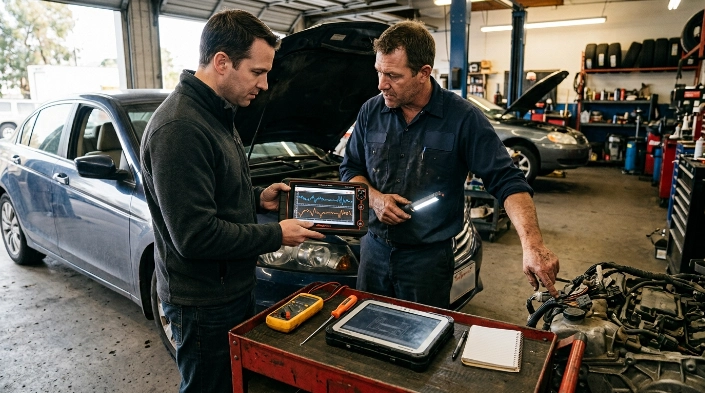
If your scanner shows P0715, start by saving the code and freeze-frame data. Then inspect the transmission connector and use live data to see whether the input-speed signal is missing, unstable, or implausible.
- Do not order a sensor from the code alone.
- Check wiring and connectors first.
- Compare transmission input and output speed data.
- Use specifications for your exact vehicle.
- Check manufacturer bulletins before expensive repairs.
- Avoid normal driving if the transmission is shifting harshly or stuck in limp mode.
As of 2026, modern transmission diagnostics depend heavily on scan data and vehicle-specific information. A basic code reader can identify P0715, but a scanner with transmission live data gives you far more useful evidence.
For me, that is the main lesson with this code: diagnose the signal before replacing the part. It is the best way to avoid turning a wiring repair into an unnecessary transmission bill.
What Causes P0715 and Which Repairs Change the Cost?
The most common P0715 causes involve the sensor circuit, but the signal depends on both electrical and mechanical components. That is why diagnosis should come before the parts order.
1. Failed input/turbine speed sensor
The sensor may stop producing a usable signal or become erratic. When testing confirms this failure, replacement is usually more predictable than chasing an intermittent harness problem.
2. Damaged wiring or connector
Heat, vibration, moisture, road debris, previous repairs, and fluid contamination can damage a transmission sensor circuit. A tiny terminal problem may produce an intermittent P0715 that appears only during certain driving conditions.
- Broken insulation
- Corroded terminals
- Loose connector locks
- Pulled or stretched wires
- Shorts to power or ground
- Damaged previous splices
Electrical repairs can be inexpensive once the fault is visible. Finding a hidden break inside a harness can take far more labor.
3. Metal debris at a magnetic sensor
Some transmission speed sensors can collect metallic debris. Heavy contamination may interfere with the signal or point toward wear elsewhere in the transmission.
Cleaning should never become a substitute for finding the source of abnormal debris. Repeated contamination deserves closer inspection.
4. Reluctor, shaft, or mechanical damage
The sensor needs a usable mechanical target to generate reliable information. Damage to the reluctor or related rotating components can make a good sensor look faulty.
This is where repair cost can rise quickly. Access may require substantially more transmission disassembly than an external sensor replacement.
5. Internal transmission or torque-converter fault
P0715 can appear alongside abnormal shifting or other transmission codes when the problem reaches beyond the electrical sensor circuit. A qualified transmission diagnosis becomes important before approving major work.
Transmission specialist’s note: Don’t authorize internal transmission work solely because P0715 is stored. Ask what mechanical or live-data test supports the diagnosis.
6. PCM or TCM problem
A control-module fault is possible, but it should not be the first assumption. Power, ground, wiring, connectors, sensor operation, and manufacturer guidance should be checked first.
Section Takeaway: P0715 can come from a cheap connection problem or a much larger transmission fault. The code alone cannot tell you where your repair falls on that range.
Why Does P0715 Come Back After Repair?
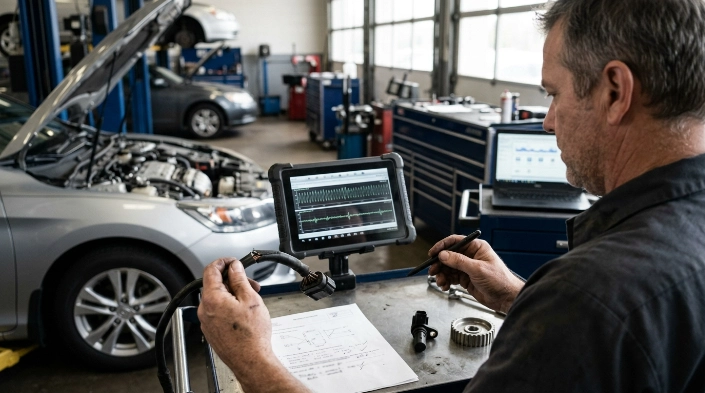
If P0715 returns after replacing the sensor, don’t assume the replacement is defective. A recurring code often means the original diagnosis focused on the component instead of the complete circuit.
Recheck these possibilities:
- The harness has an intermittent break that appears with vibration or heat.
- A connector terminal has weak tension even though it looks clean.
- The wrong sensor or transmission-specific part was installed.
- The sensor mounting surface or air gap is incorrect.
- The reluctor or internal component producing the speed signal is damaged.
- The control module requires updated software.
- Another transmission fault is causing implausible speed relationships.
Also compare the new scan data with the freeze-frame information saved before the first repair. If the code now sets under the same temperature, gear, load, or speed conditions, that pattern can narrow the remaining fault.
A technical service bulletin can be especially important at this stage. Manufacturer-specific software and transmission designs are why a generic trouble code should never be treated as a universal repair instruction.
Can You Fix P0715 Yourself or Do You Need a Mechanic?

A basic visual inspection is realistic for many DIY owners. Accurate diagnosis gets harder when the problem requires electrical waveform testing, transmission access, or manufacturer-level service information.
DIY checks that make sense
- Confirm the code: Use an OBD2 scanner and record every stored or pending code.
- Save information first: Record freeze-frame data before clearing anything.
- Inspect accessible wiring: Look for broken insulation, loose plugs, corrosion, and obvious damage.
- Check fluid concerns: Note visible leaks or abnormal fluid condition without assuming they caused P0715.
- Research the exact vehicle: Use service information for your year, engine, and transmission.
When professional diagnosis is worth paying for
Professional help makes sense when the sensor is difficult to reach, the code returns after a basic repair, or live data needs deeper interpretation. It is also smart when transmission symptoms are severe.
- P0715 returns immediately after clearing.
- Several transmission codes are present.
- Wiring damage is not visible.
- The speed-sensor signal is intermittent.
- The transmission slips or shifts harshly.
- Testing requires an oscilloscope or advanced scan tool.
- Internal transmission damage is suspected.
You are not limited to a dealership for many diagnostic repairs. The Alliance for Automotive Innovation’s right-to-repair information describes access to diagnostic and repair information for independent repair facilities.
If you want another shop option, the AAA Approved Auto Repair locator can help you find participating facilities. Whatever shop you choose, ask for diagnostic findings before approving expensive transmission components.
Questions to ask before approving a P0715 repair
- What test showed the sensor or circuit failed?
- Did you inspect the wiring and connector first?
- Was input-speed live data checked?
- Are there other transmission codes?
- Does the estimate include diagnostic labor?
- Is the proposed part OEM or aftermarket?
- How will the repair be verified afterward?
Repair tip: The best quote isn’t automatically the lowest initial number. Compare what each shop tested and what the estimate actually includes.
Section Takeaway: DIY inspection can uncover obvious problems, but signal testing and transmission diagnosis often justify professional equipment and vehicle-specific service information.