
How to Reset the Immobilizer System: Steps That Work

Most immobilizers cannot be “reset” by the owner. If the car will not start, try your spare key, replace the fob battery, check the 12V battery, and on push-button cars hold the fob against the start button. Older GM Passlock cars allow a 10-minute ignition relearn. A key the car no longer recognizes must be reprogrammed with a tool.
When the security light flashes and the engine will not start, the immobilizer has decided it does not recognize your key. The good news is that the cause is often simple: a weak fob battery, a low car battery or a key that has been damaged. The bad news is that the “reset tricks” you find online only work on certain vehicles, and some do nothing at all.
This guide gives you the steps in the order most likely to work, from free checks to the procedures that need a key programmer. For background on the light itself, see our article on a flashing immobilizer light, and for adding keys, our guide to programming a key fob yourself.
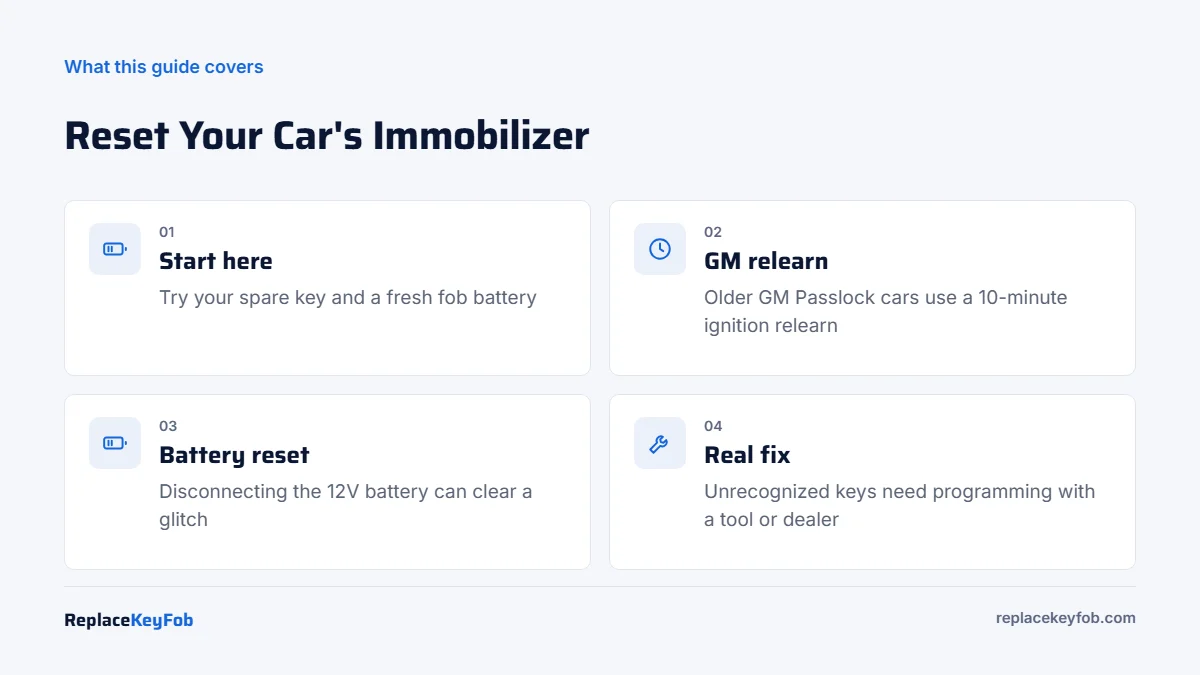
Immobilizer reset at a glance
| Item | Details |
|---|---|
| Time | 5 minutes for basic checks; 10 to 30 minutes for a GM relearn; longer with a tool |
| Tools | Spare key, fob battery, 12V battery charger or jump pack; key programmer for reprogramming |
| DIY? | Basic checks yes; relearn on some older GM vehicles; reprogramming with a tool on many cars |
| Signs it worked | Security light goes out after the bulb check and the engine starts and keeps running |
| Call a pro if | No key works, the light keeps flashing after every step, or modules have been replaced |
What you need
- Every key or fob you have for the car, especially a spare.
- A new coin cell for the fob. Our key fob battery size chart lists the right size by brand.
- A battery charger, jump pack or multimeter to check the 12V battery.
- Your owner’s manual, which shows where the smart key backup position is.
- For reprogramming: an OBD2 key programmer that supports your vehicle, or a locksmith.
OBD2 Key Programmer With Immobilizer Functions
If the car has stopped recognizing a key, it needs key learning. Pick a tool that lists your exact make, model and year for immobilizer and key functions.
As an Amazon Associate, ReplaceKeyFob earns from qualifying purchases.
How to reset the immobilizer system: step by step
- Try your spare key. If the spare starts the car, the problem is the first key (dead battery, damaged chip or worn transponder), not the car. Keep using the spare and replace or reprogram the faulty key.
- Replace the fob battery. On smart key cars, a weak coin cell stops the car from detecting the key inside the cabin. Fit a fresh cell with the correct polarity.
- Use the smart key backup position. Most push-button cars can read a fob with a dead battery if you hold it against the start button, place it in a marked slot or pocket, or hold it near a marked spot on the steering column or console. Then press the start button with your foot on the brake.
- Check the 12V battery. Low voltage confuses the modules that run the immobilizer. If the dash dims or the starter clicks, charge or jump the battery. A healthy battery reads about 12.4 to 12.7 volts at rest.
- Disarm the factory alarm. Lock and then unlock the car with the fob, or unlock the driver door with the metal key blade. On many cars this clears an armed alarm that is blocking the start.
- Remove other keys and interference. Take other transponder keys, metal key rings and RFID cards away from the ignition. Two chips near the antenna can confuse it.
- Try a battery disconnect. Turn everything off, disconnect the negative battery cable for about 10 to 15 minutes, reconnect it and try again. This can clear a module glitch, but it is not a fix for an unrecognized key and can reset radio and window settings.
- Run a relearn if your vehicle supports one (see the GM section below), or move to reprogramming.
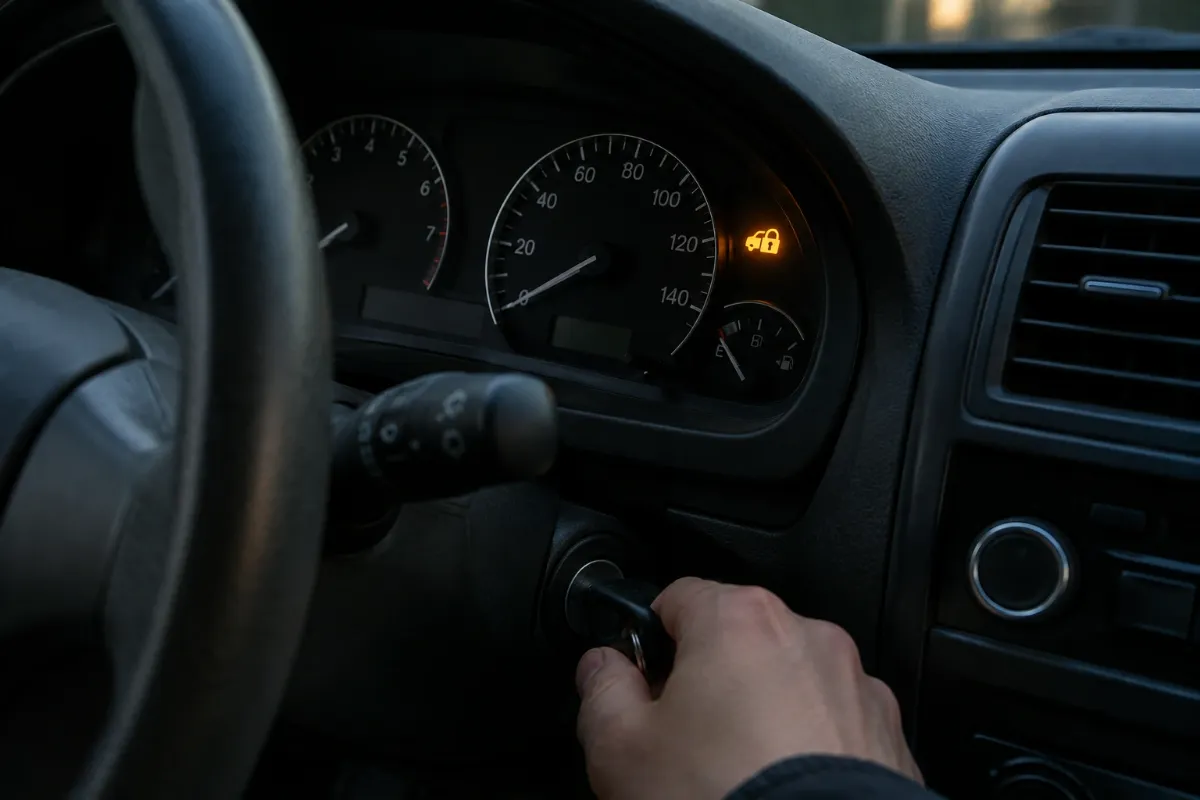
How to reset the GM Passlock immobilizer (10-minute relearn)
Many GM cars and trucks from roughly the mid-1990s to the mid-2000s use Passlock, and some use the related Passkey III system. These systems often accept a timed relearn when a sensor glitch or ignition cylinder fault triggers the security light:
- Turn the key to ON (not START). The security light should come on or flash.
- Leave the key in ON for about 10 minutes, until the security light turns off or stops flashing.
- Turn the key OFF for about 5 seconds.
- Start the engine. If it does not start, repeat the 10-minute cycle up to two more times (about 30 minutes in total), which some models require.
The relearn often gets the car running, but if the problem keeps coming back, the Passlock sensor in the ignition cylinder or its wiring is usually failing and needs repair.
Other brands: what “reset” really means
- Ford and Lincoln (PATS): there is no owner reset. A theft light that flashes fast or stays on means the key was not recognized. On many models you can add a key yourself only with two working programmed keys, or with a tool. See programming a Ford key with FORScan.
- Chrysler, Dodge, Jeep and Ram (SKIM/Sentry Key): no owner reset. Keys are added with a tool, often after a timed security wait or a PIN.
- Toyota and Lexus: no reset. Some older models allow adding a key with existing master keys; newer smart keys need a tool or dealer.
- Honda, Nissan, Hyundai and Kia: no owner reset. Keys are registered with a tool, and the dealer or locksmith may need a PIN.
- Volkswagen, Audi, BMW and Mercedes-Benz: immobilizer data is tied to multiple modules. Replacing or resetting it is specialist or dealer work.
If it still will not start
If none of your keys work after these steps, the car has lost key data, a part of the immobilizer has failed, or a module was replaced and not matched. At that point a key programmer or a locksmith is needed to read the system and relearn the keys. Our guides to programming a key fob with an OBD2 scanner and a car that will not start but the fob unlocks the doors go deeper.
When to call a dealer or locksmith, and the cost
Call a professional if no key starts the car, if the security light stays on after every check, or after a module replacement. A mobile locksmith can often diagnose and relearn keys where the car sits, which avoids a tow. Typical 2026 costs are about $100 to $250 for key relearning and $150 to $500 or more when a module or ignition part needs replacing; dealer prices are usually higher. See what a mobile locksmith can do.
Frequently Asked Questions
Start with your spare key, a new fob battery and a charged 12V battery. Older GM Passlock vehicles allow a 10-minute ignition relearn. On most other cars, an unrecognized key has to be reprogrammed with a tool or by a locksmith or dealer.
It can clear a temporary module glitch, but it does not erase or reset key data. If the car does not recognize the key, disconnecting the battery will not fix it.
Basic checks take a few minutes. A GM Passlock relearn takes 10 to 30 minutes. Reprogramming keys with a tool usually takes 15 to 45 minutes.
Bypassing a factory immobilizer reduces theft protection and can affect insurance. The proper fix is to repair the fault or program a working key. Remote start installers use approved bypass modules that still require a programmed key.
On many cars a slow flash with the ignition off is normal and shows the system is armed. A flashing or steady light with the ignition on usually means the key was not recognized.