
Battery Maintainer vs Trickle Charger: What’s the Difference?

We may earn a commission when you buy through links on this page, at no extra cost to you. How we pick products.
A traditional trickle charger pushes a small, constant current into the battery whether it needs it or not, so leaving it connected for weeks can overcharge and damage the battery. A battery maintainer monitors the battery, stops charging when it is full and only tops up when voltage drops, so it can stay connected for months. For storing a car, motorcycle or boat, choose a maintainer. Many products now sold as “smart trickle chargers” are really maintainers; look for automatic float or maintenance mode on the label.
The two terms are used as if they mean the same thing, and the packaging does not help: some maintainers are marketed as “trickle chargers”, and some basic trickle chargers are sold next to smart maintainers on the same shelf. The difference matters if you plan to leave the charger connected for weeks or months, because one type is designed for that and the other is not. This guide explains how each works, the risks, and how to tell which one you are looking at.
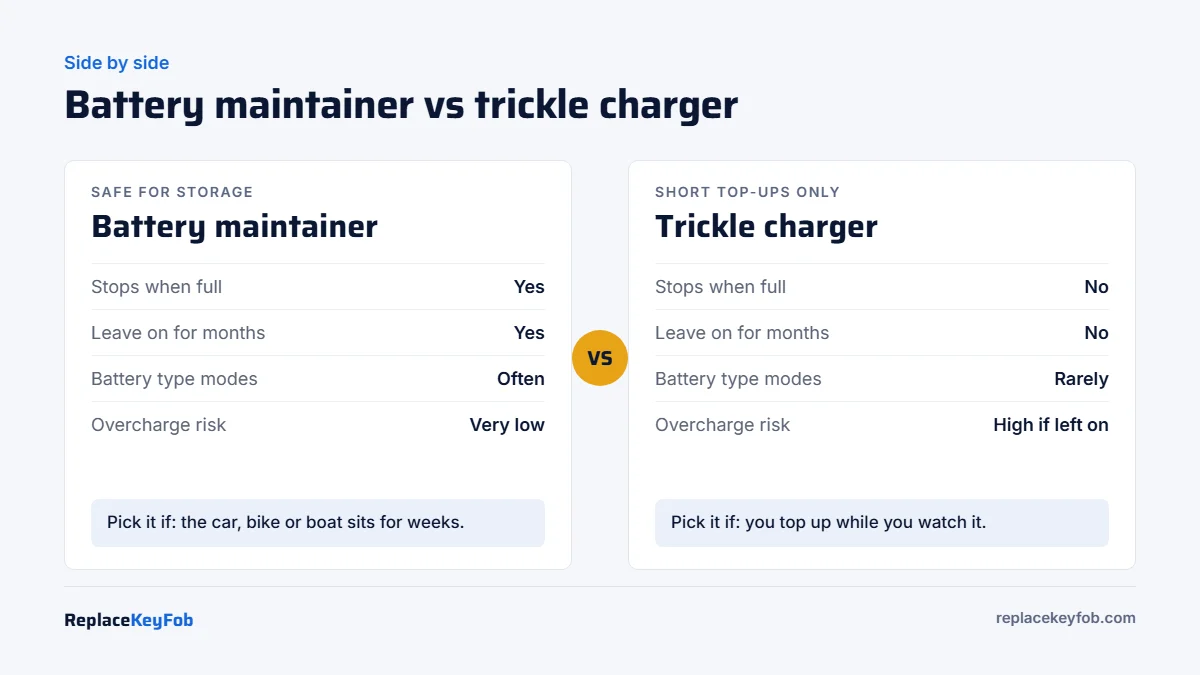
Battery Maintainer vs Trickle Charger at a Glance
| Traditional trickle charger | Battery maintainer (smart/float charger) | |
|---|---|---|
| How it charges | Constant low current | Charges, then switches to float or maintenance |
| Stops when full | No | Yes |
| Safe to leave on for months | No | Yes |
| Risk | Overcharging, water loss, plate damage | Very low when matched to battery type |
| Battery type settings | Usually none | Often AGM, gel and lithium modes |
| Typical output | About 1A to 2A | About 0.75A to 1.5A for maintainers; more for smart chargers |
| Best use | Short, supervised top-ups | Long-term storage |
What Is a Trickle Charger?
A traditional trickle charger is a simple low-current charger. It delivers a steady small current, often around 1 to 2 amps, for as long as it is plugged in. That is fine for slowly bringing up a battery while you watch it, but it has no way to know when the battery is full. Once the battery is charged, the current keeps flowing. Over days and weeks, that overcharging boils off electrolyte in flooded batteries, dries out AGM and gel batteries, and can damage the plates.
The old advice to “unplug the trickle charger after a day or two” comes from this. It is also why many people have killed a battery by leaving one connected all winter.
What Is a Battery Maintainer?
A battery maintainer is a smart charger designed to stay connected. It charges the battery to full using a multi-stage program, then drops to a float or maintenance stage. In float, it holds the battery at a safe voltage and only supplies the tiny current needed to offset self-discharge and the car’s parasitic draw. If the voltage drops, it charges again, then returns to float.
The Battery Tender Plus, for example, uses a 4-step program (initialization, bulk, absorption, float) and resumes full output if the voltage drops under load. NOCO’s Genius models monitor the battery continuously and adjust for temperature, and NOCO says they can stay connected indefinitely.
Why the Names Get Mixed Up
Because “trickle charger” is the term people search for, many smart maintainers include it in their product names, often as “smart trickle charger”. NOCO calls the Genius line a “battery charger, maintainer, trickle charger and desulfator” in one. Schumacher describes a “smart trickle charge” mode. In those cases, “trickle” refers to the low maintenance current, not to the old constant-current design.
To tell the difference, ignore the name and check for these on the box or manual:
- Automatic float, maintenance or “storage” mode
- Microprocessor control or multi-stage charging
- Wording that it can be “left connected indefinitely” or “for long-term storage”
- Battery type selection (AGM, gel, lithium)
If none of these appear and the charger has just an on/off switch and a fixed amp rating, treat it as a traditional trickle charger and do not leave it connected unattended.
When to Use Each
| Situation | Use |
|---|---|
| Car stored for the winter | Maintainer |
| Motorcycle, boat or lawn tractor off-season | Maintainer |
| Second car driven once every few weeks | Maintainer |
| Quick top-up while you are in the garage | Either, if you unplug a trickle charger afterwards |
| Battery already flat and you need to drive soon | A 5A to 10A smart charger or a jump starter |
| Lithium battery | A maintainer with a lithium mode only |
Good Maintainers to Consider
Battery Tender Plus: simple and long warranty
Battery Tender Plus 12V 1.25A Charger and Maintainer
1.25A, 4-step charging, 10-year warranty
Check Price on AmazonNo modes to choose, a quick-disconnect ring harness and a 10-year warranty. A safe choice for 12V lead-acid, AGM and gel batteries in storage.
NOCO Genius1: compact with lithium support
NOCO Genius1 1A Smart Charger and Maintainer
1A, 6V/12V, lead-acid and LiFePO4
Check Price on AmazonA 1A maintainer with 6V and 12V modes, a lithium mode, a temperature sensor and a long 110-inch DC cable. Good for motorcycles and cars in storage.
Schumacher SC1355: smart trickle with 6V/12V detection
Schumacher SC1355 1.5A Charger and Maintainer
1.5A, auto 6V/12V detection, desulfation mode
Check Price on AmazonDespite the “trickle” name, it is microprocessor controlled with multi-stage charging and a smart maintenance mode, plus automatic 6V/12V detection.
See more options in our best battery maintainers for cars guide.
Can a Trickle Charger Damage a Battery?
Yes, if it is left connected long after the battery is full. Constant charging past full causes gassing, water loss and heat. Flooded batteries lose electrolyte, and sealed AGM and gel batteries can dry out because the water cannot be replaced. Signs of overcharging include a battery that is hot to the touch, swelling, a rotten-egg smell, or electrolyte around the vent caps. If you see any of these, unplug the charger and have the battery tested.
A maintainer avoids this by stopping at full charge. It is still important to choose the right battery type setting, since AGM and lithium batteries need different voltages from flooded batteries.
Common Myths
- “Any charger can be left on if it is low amp.” Low current slows the damage, but a constant-current charger still overcharges a full battery over time. What matters is whether it stops at full.
- “A maintainer will fix a bad battery.” It keeps a good battery good. It cannot repair a battery with a shorted or dead cell.
- “Driving for 10 minutes recharges the battery.” Short trips often use more energy starting the car than the alternator puts back. A car used only for short trips can benefit from a maintainer too.
- “You must disconnect the battery to use one.” Modern smart maintainers are designed to charge with the battery in the car.
Do You Need Either One?
If you drive your car several times a week, a healthy battery stays charged on its own. A maintainer earns its place when a car sits for two weeks or more, when you own a seasonal vehicle, or when your car has a heavy parasitic draw from alarms, telematics and keyless systems. A slowly discharging car battery can also cause odd electrical symptoms, including key fob and push-button start problems; see can a bad car battery cause key fob problems.
Related Guides
- Best battery maintainers for cars
- NOCO Genius vs Battery Tender
- Best car battery chargers
- How to test a car battery at home
FAQ
Is a battery maintainer the same as a trickle charger?
No. A traditional trickle charger supplies constant current even when the battery is full. A maintainer stops at full charge and only tops up as needed, so it can stay connected safely.
Can I leave a trickle charger on all winter?
Not a traditional one, because it can overcharge the battery. A smart maintainer with float mode is designed for that.
How do I know if my charger is a maintainer?
Look for automatic float or maintenance mode, multi-stage charging, or a statement that it can be left connected indefinitely. If it only has an on/off switch, treat it as a basic trickle charger.
Will a maintainer charge a dead battery?
Slowly, and some will not start on a very low battery. For a flat car battery, use a 5A to 10A smart charger first, then let it maintain.
Can I use a maintainer on a lithium battery?
Only if it has a lithium mode, such as the NOCO Genius models. Lead-acid profiles are not suitable for lithium batteries.
What amp maintainer is best for a car?
For maintaining a healthy car battery, 1A to 1.5A is enough. If you also want to recharge drained batteries, choose a 5A smart charger that can stay connected.