
6 Best Car Batteries for Cold Weather (2026): Winter Picks

We may earn a commission when you buy through links on this page, at no extra cost to you. How we pick products.
For cold climates, choose an AGM battery in your car’s correct group size with cold cranking amps (CCA) at or above the original. The Odyssey Extreme Series is the strongest cold starter in our list. The Optima RedTop is a proven all-rounder for group 34 and 34/78 vehicles. For the many cars that use a group 48 (H6) battery, the Weize Platinum AGM 48 and Interstate MTX AGM 48 are solid choices with 760 CCA.
Cold is the hardest test a car battery faces. At low temperatures the chemical reaction inside slows down, so the battery can deliver less current exactly when a cold, thick-oiled engine needs more to turn over. A battery that starts the car easily in September can fail on the first frosty morning of winter. This guide explains which specs matter in the cold, compares six batteries that suit winter climates, and shows how to pick the right one for your car’s group size.
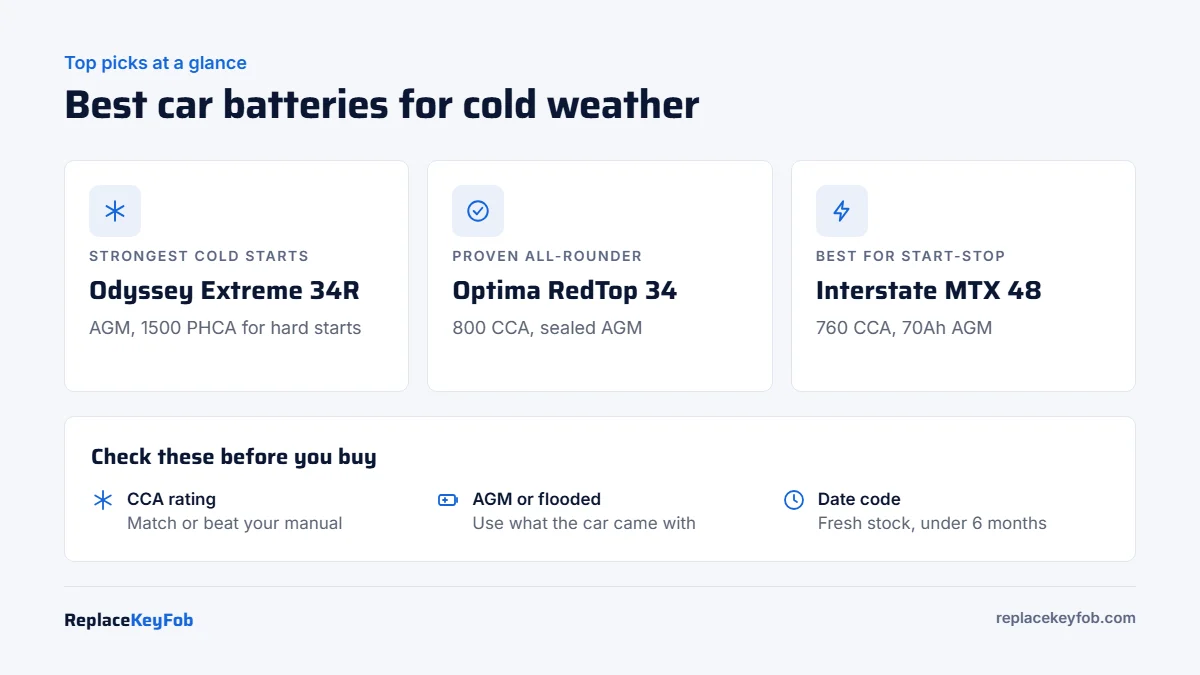
Our Top Picks at a Glance
| Battery | Best for | Group size | Cold rating |
|---|---|---|---|
| Odyssey Extreme ODX-AGM34R | Strongest cold starts | 34R | 1500 PHCA (pulse hot cranking amps) |
| Optima RedTop 34 | Proven all-rounder | 34 | 800 CCA |
| Optima YellowTop D34/78 | Heavy accessory loads | 34/78 | 750 CCA, 120-min reserve |
| Weize Platinum AGM 48 | Group 48 / H6 cars | 48 (H6) | 760 CCA |
| Interstate MTX AGM 48 | Start-stop cars | 48 (H6) | 760 CCA |
| ACDelco Gold 48AGM | GM and European group 48 cars | 48 (H6) | AGM, high-density plates |
What Matters in a Cold-Weather Battery
- Cold cranking amps (CCA). The current a battery can deliver at 0°F for 30 seconds while staying above a set voltage. This is the single most useful number for winter. Match or exceed your car’s original CCA.
- Battery type. AGM (absorbed glass mat) batteries have lower internal resistance than flooded batteries, recharge faster and handle cold better. If your car came with AGM, you must replace it with AGM.
- Reserve capacity (RC). Minutes the battery can power the car’s electrical load if the alternator fails. A higher RC also helps cars with heated seats, defrosters and lots of electronics.
- Correct group size. The group size sets the case dimensions and terminal positions. The wrong size may not fit the hold-down or reach the cables.
- Age at purchase. A battery that has sat on a shelf for months is already partly discharged. Check the date code.
The Best Car Batteries for Cold Weather
1. Odyssey Extreme Series ODX-AGM34R: Strongest Cold Starts
Odyssey Extreme Series ODX-AGM34R AGM Battery
Group 34R, 1500 PHCA
Check Price on AmazonOdyssey’s Extreme Series uses thin plates of pure lead packed tightly into an AGM case, a design known for very strong cranking power and long life. Odyssey rates this group 34R model at 1500 pulse hot cranking amps, a short-burst measure, and the Extreme line is consistently among the strongest cold starters you can fit in a passenger vehicle. It is also built to handle deep discharges better than most starting batteries.
The trade-off is weight (about 52 lb) and its premium position. It makes the most sense for cold climates, trucks with big engines, plowing and vehicles with winches or heavy electronics.
Pros: exceptional cranking power, deep-cycle tolerance, long service life.
Cons: heavy; check that the 34R terminal layout matches your car.
Best for: very cold climates, trucks and high-demand vehicles.
Skip it if: your car uses a different group size or a standard battery is enough.
2. Optima RedTop 34: Proven All-Rounder
Optima RedTop 34 Sealed AGM Starting Battery
Group 34, 800 CCA, 50Ah, 100-min reserve
Check Price on AmazonThe RedTop is the battery many enthusiasts know by sight, thanks to its six-cylinder SpiralCell design. Optima rates the group 34 model at 800 CCA with 50Ah capacity and a 100-minute reserve. The spiral-wound cells resist vibration (Optima says 15 times better than standard flooded batteries) and deliver strong starting power in bad weather.
RedTop is a starting battery, so it suits vehicles with normal electrical loads. If you run a big stereo, a winch or lots of accessories, the YellowTop below is the better Optima choice.
Pros: 800 CCA, very vibration resistant, maintenance-free, mounts in any position.
Cons: lower Ah capacity than flat-plate AGM batteries of similar size.
Best for: cars, trucks and SUVs that use group 34 batteries.
Skip it if: your vehicle has high accessory loads.
3. Optima YellowTop D34/78: Best for Heavy Accessory Loads
Optima YellowTop D34/78 Dual Purpose AGM Battery
Group 34/78, 750 CCA, 55Ah, 120-min reserve
Check Price on AmazonThe YellowTop is Optima’s dual-purpose battery: it starts the engine and also handles deep cycling from accessories. The D34/78 has dual terminals (SAE top posts and GM side terminals), so it fits a wide range of vehicles. Optima rates it at 750 CCA, 55Ah and a 120-minute reserve. In winter, that reserve helps when heated seats, defrosters and lights run at idle.
Pros: dual terminals, strong reserve capacity, handles deep cycling.
Cons: slightly lower CCA than the RedTop.
Best for: trucks and SUVs with winches, plows, lights or audio systems.
Skip it if: you only need a starting battery.
4. Weize Platinum AGM 48: Best for Group 48 (H6) Cars
Weize Platinum AGM Battery Group 48 (H6)
760 CCA, 70Ah, 120-min reserve
Check Price on AmazonGroup 48 (also called H6) is one of the most common sizes in newer cars and crossovers, including many GM, Ford, VW, Audi and Jeep models. Weize’s Platinum AGM 48 is rated at 760 CCA, 70Ah and a 120-minute reserve, and it supports start-stop systems. Weize lists an operating range of -22°F to 158°F and less than 8% self-discharge after 90 days, which helps cars that sit in the cold. It comes with a 36-month warranty.
Pros: strong CCA and reserve for the size, start-stop support, 3-year warranty.
Cons: newer brand with a shorter track record than Optima or Interstate.
Best for: cars and crossovers that use a group 48 battery.
Skip it if: you prefer an established brand with local store support.
5. Interstate MTX AGM 48: Best for Start-Stop Cars
Interstate MTX AGM Battery Group 48 (H6)
760 CCA, 70Ah
Check Price on AmazonInterstate’s MTX AGM line is designed for start-stop vehicles, which cycle the battery many times on every drive. The group 48 model is rated at 760 CCA and 70Ah, and Interstate says its pure lead design gives about twice the life of a conventional lead alloy AGM battery and three times a flooded battery. Interstate’s large dealer network also makes warranty claims simple in North America.
Pros: built for start-stop cycling, strong brand support, 760 CCA.
Cons: use the compatibility guide to confirm fit.
Best for: start-stop cars and drivers who want easy local warranty service.
Skip it if: your car uses another group size.
6. ACDelco Gold 48AGM: Best for GM and European Group 48 Cars
ACDelco Gold 48AGM Automotive Battery
Group 48 (H6) AGM
Check Price on AmazonACDelco is GM’s parts brand, and the Gold 48AGM is a common replacement for GM vehicles and many European cars that use group 48. ACDelco highlights high-density negative paste, an enhanced alloy grid for longer cycle life, and a robust separator that improves acid circulation and helps the battery run cooler. It is a sensible OE-style choice if you want a replacement that behaves like the original.
Pros: OE-style design, good fit for GM vehicles, AGM construction.
Cons: check the CCA on your exact part number against your car’s requirement.
Best for: GM owners and European cars that specify a group 48 AGM.
Skip it if: you want the highest possible CCA.
How Many CCA Do You Need?
| Vehicle | Typical CCA range | Cold-climate advice |
|---|---|---|
| Small 4-cylinder car | About 400 to 550 | Pick the higher end of your group size |
| Mid-size car or crossover | About 550 to 700 | AGM if the car has start-stop |
| V8 truck or large SUV | About 650 to 850 | Consider a premium AGM like Odyssey |
| Diesel pickup (often two batteries) | About 750 to 1000 each | Replace both batteries together |
These ranges are general. Your owner’s manual or the label on the original battery gives the exact minimum for your car.
Winter Battery Care Tips
- Test before winter. A quick test with a battery tester tells you if the battery is weak before the first cold snap.
- Keep it charged. A fully charged battery resists freezing far better than a discharged one. If the car sits, use a battery maintainer.
- Clean the terminals. Corrosion adds resistance, which matters most when current is already low.
- Turn off accessories before starting. Headlights, heater fan and seat heaters all draw current the starter needs.
- Carry a jump starter. Even a good battery can be caught out. See the best portable jump starters.
Cold Batteries and Key Fob Problems
A weak car battery in cold weather can cause symptoms that look like a key fob fault: doors that do not unlock, “key not detected” messages or a push-button start that will not respond. Cold also weakens the coin cell inside the fob. Check both before paying for a new fob; see does cold weather affect a key fob and can a bad car battery cause key fob problems.
Signs Your Battery Will Not Survive the Winter
Batteries rarely fail without warning. Watch for these signs in late autumn, before the first hard frost:
- Slow cranking. The engine turns over more slowly than usual on cool mornings, even if it starts in the end.
- Dim lights at start-up. Headlights or dash lights dim noticeably while the engine cranks.
- Warning messages. Start-stop stops working, or the car shows a battery or charging message.
- Age. In most climates, a battery that is four or five years old is living on borrowed time. In hot regions, three years is common.
- Corrosion or swelling. White or green deposits on the terminals or a bulging case both point to a battery that needs attention.
- Key fob or keyless start glitches. Low system voltage can make keyless entry and push-button start act strangely, even when the fob battery is fine.
A five-minute test with a digital battery tester tells you far more than guessing. Many parts stores will also test your battery free of charge.
Should You Replace the Battery Before Winter?
If a test shows the battery’s measured cold cranking amps are well below its rating, or the tester reports “replace” or “recharge and retest” more than once, replace it before winter arrives. Replacing it on a mild afternoon in your driveway is far easier than waiting for a tow in a frozen parking lot. If the battery tests healthy but your car sits for long periods, a battery maintainer is a cheaper way to keep it ready.
Related Guides
- Best battery maintainers for cars
- Best car battery chargers
- How to register a new car battery with a scan tool
- How to test a car battery at home
FAQ
Does a car battery lose power in the cold?
Yes. A battery delivers much less power when cold, while a cold engine needs more power to crank. That is why weak batteries usually fail on the first freezing morning.
Is a higher CCA rating always better?
Higher CCA gives more margin in the cold, but the battery must still fit your car’s group size and electrical needs. Do not go below the manufacturer’s recommended CCA.
What type of car battery is best for cold weather?
An AGM battery with CCA at or above your car’s original rating is usually the best choice for cold climates. It has lower internal resistance and recharges faster than a flooded battery.
Can I replace an AGM battery with a regular battery?
No. Cars that came with AGM, especially those with start-stop, need AGM. A flooded battery will wear out quickly and may cause charging system errors.
Do I need to register a new battery?
Many newer BMW, Audi, VW, Ford and other models do. Registration tells the charging system it has a new battery. See how to register a car battery.
At what temperature does a car battery freeze?
A fully charged battery is very resistant to freezing. A discharged battery can freeze at temperatures not far below 32°F, which can crack the case. Keep batteries charged in winter.
How long do car batteries last in cold climates?
Often three to five years, depending on driving habits and care. Heat actually does more long-term damage; cold reveals the weakness.