
How to Fix a Car Door That Won’t Close or Latch

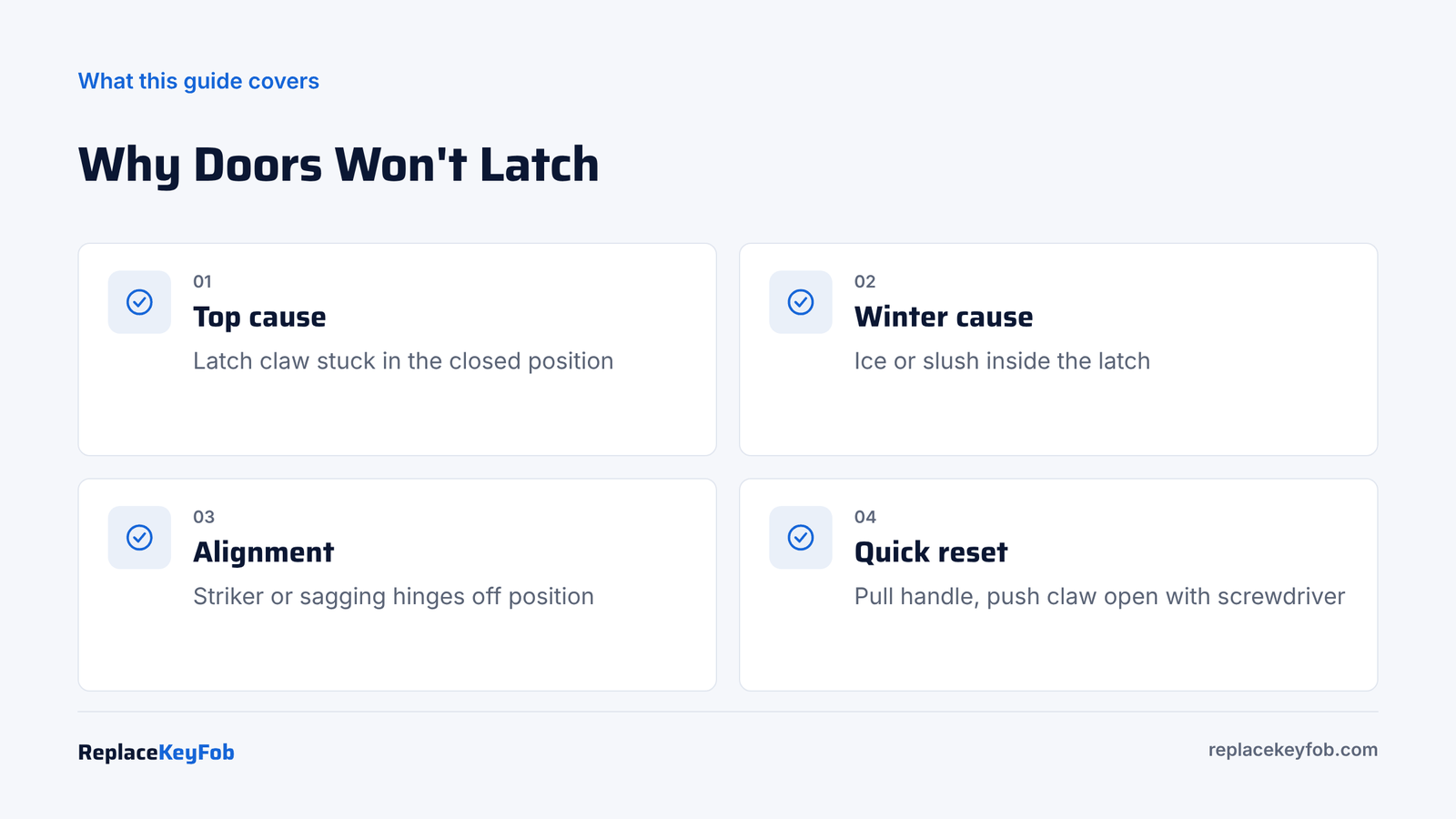
To fix a car door that won’t close, look at the latch on the door edge. If the claw is closed, pull and hold the door handle and push the claw open with a screwdriver until it clicks. Then grease it. If the latch is fine, check for ice, the striker position and sagging hinges.
A door that bounces open when you shut it is almost always a latch problem. The latch claw has rotated into its closed position while the door was open, so when the door meets the striker there is nothing to catch it. This happens when someone pulls the handle while the door is open and the claw snaps shut, when the latch is frozen, or when a dirty latch fails to spring back.
The fix for that case takes about a minute and costs nothing. If it does not work, the problem is alignment, ice or a worn latch, and each has a clear test. Do not drive with a door that will not latch: tying it shut with a strap is unsafe at any speed.
What Stops a Car Door From Closing
| Symptom | Likely cause | Fix |
|---|---|---|
| Door bounces back open, no click | Latch claw stuck closed | Reset the claw |
| Only happens in freezing weather | Ice or slush in the latch | Thaw, dry, lubricate |
| Door needs slamming to latch | Striker too far in, stiff latch or swollen seal | Clean latch, adjust striker |
| Door closes only to first click | Latch dirty or worn, striker slightly out | Clean and grease, then adjust |
| Door drops when opened, hits the striker | Worn hinge pins or bushings | Replace pins and bushings |
| Something visible blocks it | Seatbelt, floor mat, debris | Remove obstruction |
| Door closes but the car says door ajar | Latch switch fault or partial latch | Check latch and switch |
| Soft-close door will not pull itself shut | Cinch motor or latch fault | Dealer diagnosis |
Quick Checks First
- Seatbelt: a belt buckle or webbing caught in the door is the most common obstruction. Check along the bottom and the B-pillar.
- Floor mats and cargo: a raised mat edge or a bag strap can stop the door from closing fully.
- Trim and weatherstrip: a seal that has come loose and hangs into the opening stops the door short.
- Debris in the latch: leaves, gravel or ice packed into the latch jaw.
How to Reset a Latch Stuck in the Closed Position
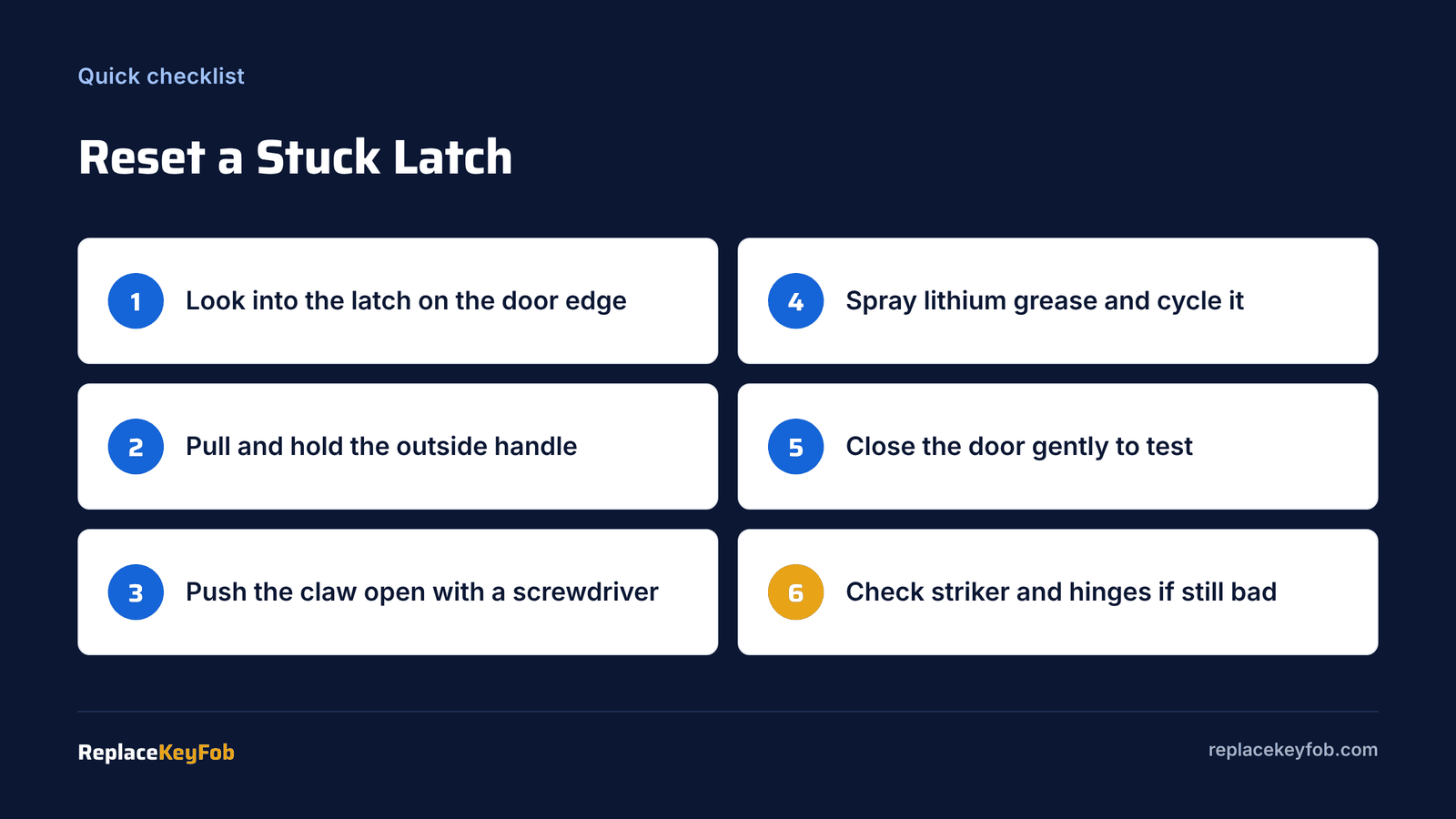
- Look at the latch on the rear edge of the open door. A normal open latch shows a U-shaped jaw with the claw open. A stuck latch shows the claw rotated across the opening.
- Pull and hold the outside door handle. This releases the latch’s internal pawl.
- While holding the handle, use a flat screwdriver or the tip of your key to push the claw back to the open position. You will hear or feel it click.
- Release the handle. The claw should stay open.
- Close the door gently. It should latch on the first try.
If the claw will not move, try pulling the inside handle instead of the outside handle while you push. Some latches release more easily from one side. Also try unlocking the door with the lock switch first: on some models the lock position affects how the claw resets.
Why it worked
The claw is spring-loaded and held by a pawl. When the door is open, the claw should stay open. Pulling the handle lifts the pawl so the claw can rotate back. If you push the claw without pulling the handle, the pawl blocks it and you may think the latch is broken.
White lithium grease spray
Use a white lithium spray with a straw to grease the latch claw and pawl after resetting it. A clean, greased latch is less likely to stick again.
As an Amazon Associate, ReplaceKeyFob earns from qualifying purchases.
Clean and Grease the Latch
A latch that stuck once will likely stick again unless it is cleaned.
- Spray lock or contact cleaner into the latch jaw and wipe away the dirty run-off.
- Spray white lithium grease into the claw and pivot.
- Push the claw closed with a screwdriver, then pull the handle to release it. Repeat ten times.
- Lock and unlock several times with the door open.
For the full process, see how to lubricate car door locks and latches.
Winter: Frozen Latches
When a latch is frozen open or closed, the claw cannot move. You will see ice in the jaw or the claw will not respond to the reset steps.
- Spray de-icer into the latch, wait two minutes.
- Run the cabin heater with the engine on; the latch is inside the door shell and warms slowly.
- Reset the claw as above once it moves freely.
- Dry the latch and grease it before the next freeze.
Our guide on how to unfreeze a car door covers frozen seals and doors in more depth.
Check Alignment: Striker and Hinges
If the latch is clean and resets correctly but the door still will not latch or needs a slam, the door is not meeting the striker squarely.
Striker position
The striker is the U-shaped bolt on the body pillar. Look at it closely:
- Shiny wear marks on one side or the top show where the latch is rubbing.
- Compare the door gaps around the panel. Uneven gaps at the rear edge suggest misalignment.
- If someone replaced the latch or the door was in a minor collision, the striker may have moved.
Moving the striker in small steps fixes most of these doors. We explain it step by step in our dedicated guide to adjusting a door striker plate.
Hinge sag
Open the door halfway and lift its rear edge gently. If it moves up and down more than a millimeter or two, the hinge pins or bushings are worn. A sagging door drops onto the striker instead of meeting it squarely. Do not move the striker down to compensate; fix the hinges with new pins and bushings. This is common on heavy front doors of older trucks and SUVs.
Variations by Vehicle Type
- Soft-close doors: some luxury models pull the door shut with a cinch motor. If the motor fails, the door stops at the first click. Close it firmly by hand as a workaround and have it diagnosed.
- Sliding van doors: check the lower track for debris, the rear latch and the power door fuse. Turn off the power door switch and close by hand to test the latch.
- Tailgates and liftgates: the same latch reset method works on many hatches. Look for the claw near the bottom center.
- Older cars: worn latches and hinge pins are common after 150,000 miles.
Door Ajar Light Stays On
If the door closes properly but the dash still shows door ajar, the problem is the switch inside the latch or the wiring, not the latch claw. A door ajar signal can stop the car from locking with the fob and can keep interior lights on and drain the battery. See why a key fob unlocks but won’t lock for that link between door switches and locking.
Mistakes to Avoid
- Slamming harder. A stuck claw cannot catch no matter how hard you slam, and you risk bending the door.
- Driving with the door tied shut. A door that is not latched can open in a turn or a crash.
- Moving the striker before cleaning the latch. You may misalign a door that only needed a reset.
- Compensating for hinge sag with the striker. It hides the problem and wears the latch.
Repair Costs and When to Call a Pro
Most latch resets and cleanings are free. Typical 2026 US costs for repairs:
| Repair | Typical shop total |
|---|---|
| Striker adjustment | About $50 to $120 |
| Latch replacement with actuator | About $200 to $600 |
| Hinge pin and bushing kit | About $150 to $350 per door |
| Door ajar switch or wiring | About $100 to $300 |
| Soft-close cinch motor | About $400 to $1,000+ |
Call a pro if the latch is broken inside, the door is bent from a collision, or you have a soft-close or electronic latch. If you also cannot open the door, see how to open a car door with a broken latch.
Frequently Asked Questions
The latch claw has snapped into the closed position while the door was open. Pull and hold the handle and push the claw open with a screwdriver until it clicks, then close the door.
Ice in the latch stops the claw from moving. Spray de-icer into the latch, run the heater for 15 minutes, reset the claw, then dry and grease the latch.
No. A door that is not latched can open while driving, and tying it shut is not safe. Fix the latch or have the car towed or repaired first.
The latch may be dirty or stiff, the striker may be set too far inward, or the door seal may be pushing back. Clean and grease the latch first, then check the striker position.
Often nothing if the latch only needs resetting. A striker adjustment is about $50 to $120, and a latch replacement is about $200 to $600 at a shop in 2026.