
How to Jump Start a Truck (Gas and Diesel)

To jump start a truck, use heavy 4-gauge (or thicker) cables or a jump pack rated about 2000 peak amps or more for V8 and diesel engines. Connect red to the dead truck’s positive, red to the donor positive, black to donor negative, and black to bare frame metal. On diesels, cycle the key to warm glow plugs before cranking.
A pickup or work truck is jumped the same basic way as a car, but the details matter more. The engine is bigger, the battery cables are longer, diesels can carry two batteries, and some heavy trucks run a 24-volt system. Get any of those wrong and you either get a slow, useless crank or a fried module.
This guide covers half-ton gas pickups, heavy-duty diesels with dual batteries, and 24V commercial trucks. If you are jumping a sedan or small SUV, our main guide on how to jump start a car is the shorter read.
What You Need to Jump a Truck
Trucks pull far more current while cranking than a compact car. A 6.7L diesel on a cold morning can draw several hundred amps for several seconds, and thin cables simply cannot carry that.
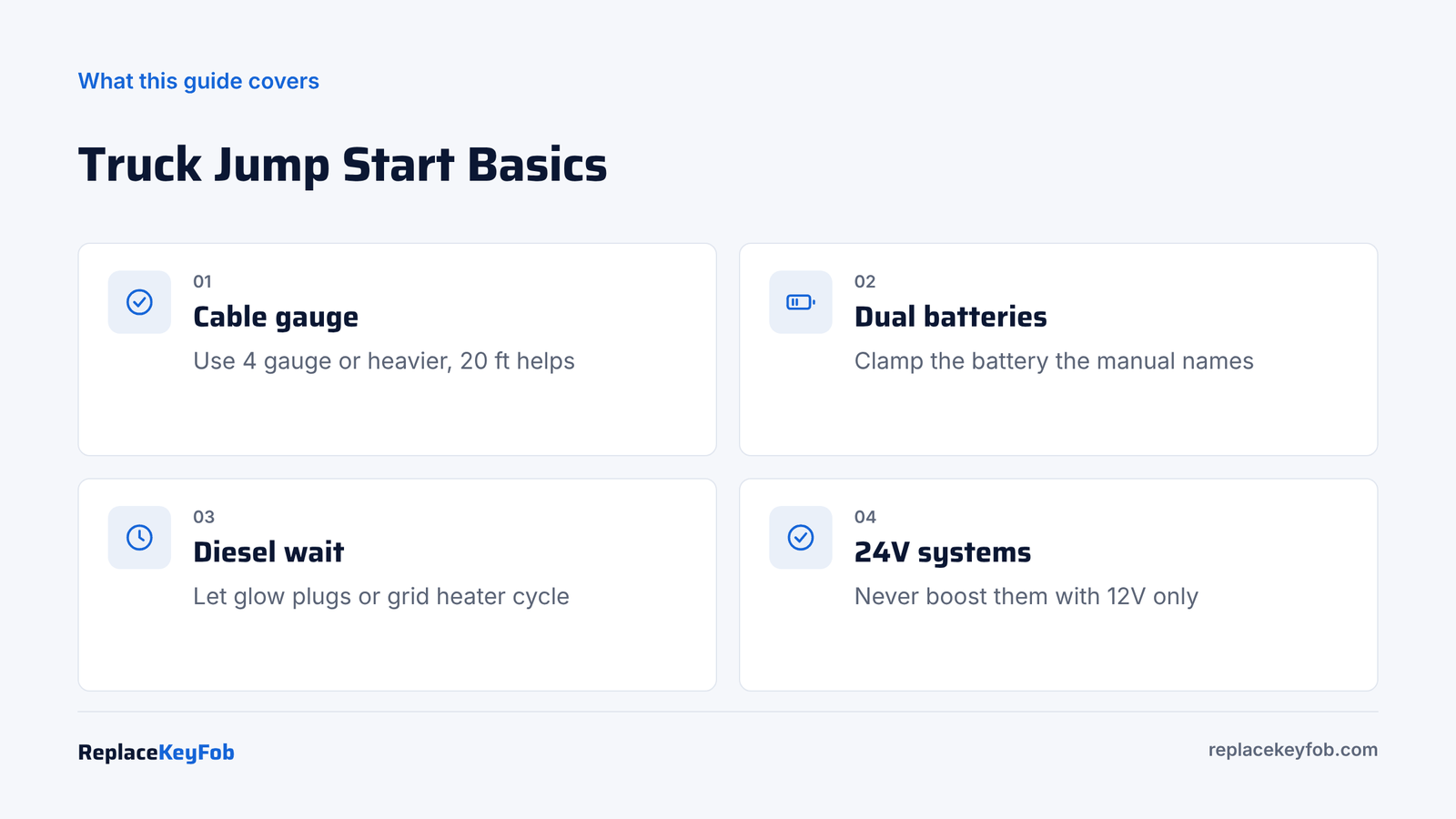
- Jumper cables: 4 gauge is the minimum for a truck, 2 gauge or 1 gauge is better for diesels. Length of 20 to 25 feet lets you reach a truck parked nose-out in a driveway or a trailer lot.
- Or a jump pack: about 1000 to 1500 peak amps for most gas V6 and V8 pickups, about 2000 to 4000 peak amps for big diesels, especially in cold weather.
- Donor vehicle: another truck or a full-size vehicle with a healthy battery. A small compact car can work for a gas pickup but often struggles with a diesel.
- Safety gear: safety glasses and gloves. Battery acid and sparks near a battery are the main injury risks.
- Wire brush: for corroded terminals, since corrosion is the most common reason a good jump still fails.
Heavy-duty 2 gauge jumper cables
Look for true copper (not copper-clad aluminum), 2 gauge or heavier, at least 20 feet long and strong clamps that bite onto side or top posts.
As an Amazon Associate, ReplaceKeyFob earns from qualifying purchases.
If you would rather not rely on a second vehicle, see our list of jump starters for diesel trucks and jump starters for V8 trucks and SUVs.
Before You Connect Anything
Spend one minute checking these points. They prevent the two worst outcomes: a battery explosion and a damaged computer.
- Confirm the system voltage. Almost every pickup sold in the US (F-150 through F-450, Silverado and Sierra HD, Ram 1500 through 3500, Tundra, Titan) is 12 volts, even when it has two batteries. Many heavy commercial trucks, buses, military vehicles and some imported diesels run 24 volts. Look for “24V” on the battery label or the jump-start terminals.
- Look at the dead battery. If the case is cracked, bulging, leaking or the battery is frozen solid, do not jump it. A frozen battery can burst when current flows through it.
- Turn everything off in both trucks. Headlights, HVAC blower, radio, and any inverter or plow controller. Pull the key or switch push-button ignition off.
- Park close without touching. Vehicles touching each other can create an unexpected ground path.
- Find the right posts. Some trucks have remote jump terminals under the hood. Ram HD, many Ford Super Duty and GM HD diesels have two batteries; the owner’s manual says which one to use.
How to Jump Start a Gas Truck
- Put both trucks in Park (or Neutral with the parking brake on for a manual).
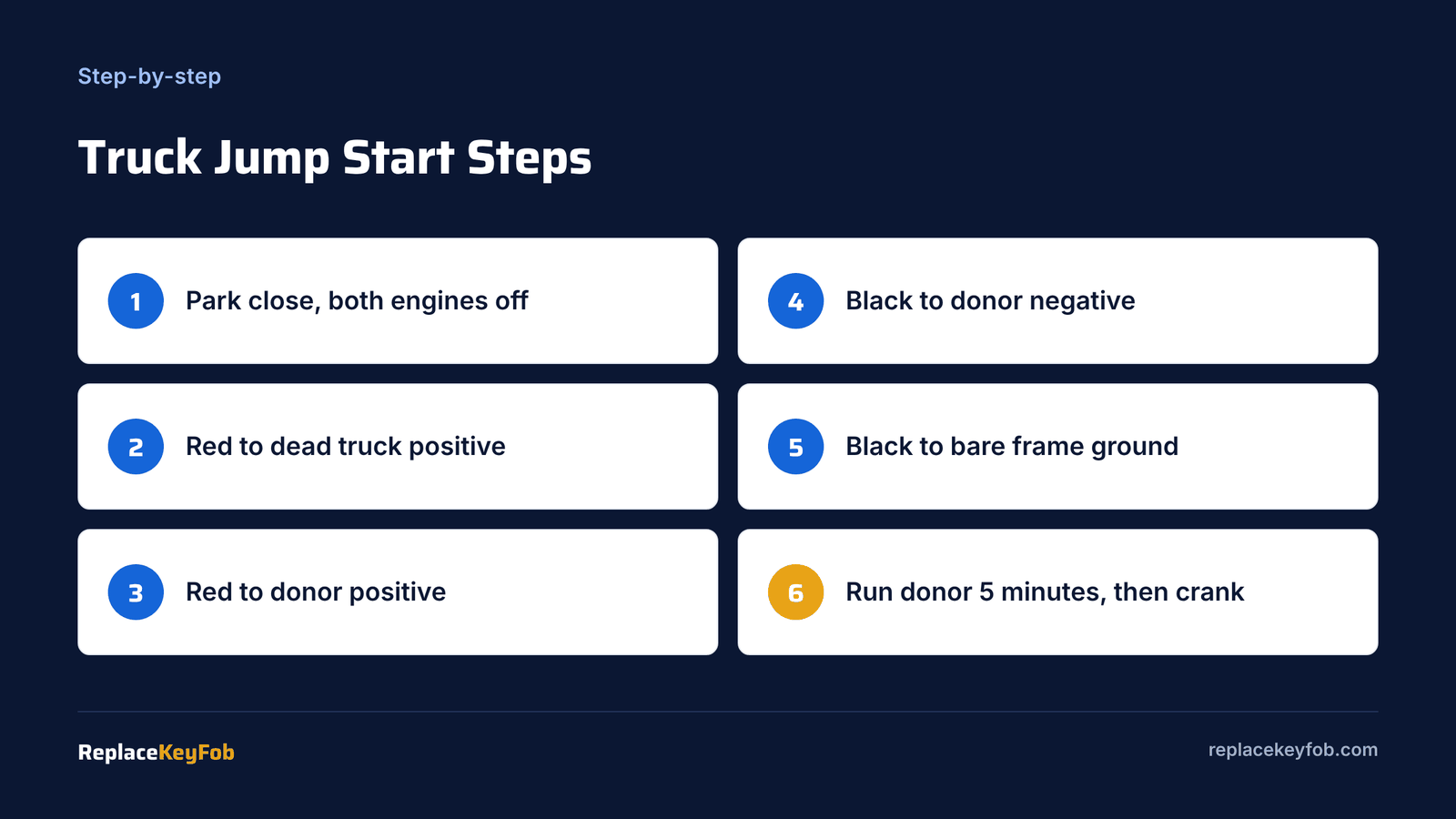
- Clamp one red clamp to the positive (+) terminal of the dead truck’s battery.
- Clamp the other red clamp to the positive (+) terminal of the donor battery.
- Clamp one black clamp to the negative (-) terminal of the donor battery.
- Clamp the last black clamp to a bare, unpainted metal point on the dead truck: an engine bracket, a frame bolt or the marked ground stud. Keep it at least 12 to 18 inches from the battery. This last connection is where a small spark happens, so keeping it away from battery gas matters.
- Start the donor and let it run at a fast idle for 3 to 5 minutes. This puts some charge into the dead battery so it does not rely only on the cables.
- Crank the dead truck for no more than 10 seconds. If it does not start, wait 1 to 2 minutes so the starter cools, then try again.
- Once it starts, remove the cables in reverse order: black from the ground point, black from the donor, red from the donor, red from the jumped truck.
Keep the jumped truck running for at least 20 to 30 minutes, or drive it, before shutting it off. Idling a big truck with a deeply drained battery barely recharges it.
How to Jump Start a Diesel Truck
Diesels are where most truck jump starts go wrong. They have higher compression, need more cranking speed, and use glow plugs or an intake grid heater that pulls heavy current before you even turn the starter.
Step 1: Charge both batteries a little
On a dual-battery diesel the two batteries are wired in parallel at 12 volts. When one is weak, it drags the other down. Clamp to the battery the manual recommends (or the remote jump post), run the donor for 5 to 10 minutes, and let the pack or donor raise the whole system.
Step 2: Cycle the glow plugs
Turn the key to On (not Start) and wait for the “Wait to Start” or coil light to go out. On a cold morning, cycle it two or three times. The glow plugs or grid heater can draw 100 amps or more, so you want that done before cranking.
Step 3: Crank in short bursts
Crank for up to 10 to 15 seconds. Diesels can take longer to fire, but long cranks overheat the starter. Rest 1 to 2 minutes between tries.
Step 4: Watch for the right signs
- Fast, even cranking but no start: fuel issue (gelled fuel in winter, empty tank, air in lines), not a battery issue.
- Slow cranking even with cables on: bad cable connection, corroded terminals, or cables too thin.
- Clicking only: the jump is not reaching the starter. See car clicks but won’t start.
Ford, Ram and GM dual-battery tips
| Truck | Typical layout | What to do |
|---|---|---|
| Ford Super Duty diesel | Two 12V batteries, one each side | Use the battery or jump point the manual shows; clamp ground to engine or frame |
| Ram 2500/3500 Cummins | Two 12V batteries, front corners | Clamp the battery nearest the starter cable path or the one the manual lists |
| Silverado/Sierra HD Duramax | Two 12V batteries | Follow the manual’s jump point; some years list the driver-side battery |
| Older diesels (pre-2010) | Two 12V batteries | Charge both a little before cranking; check cable ends for corrosion |
If you are not sure which side, clamping positive to either battery and ground to the engine block will usually work because they are joined. It just takes a little longer to bring both up.
How to Jump Start a 24V Truck
A 24-volt truck usually has two 12V batteries in series: positive of one wired to negative of the other. The free positive and free negative give 24 volts.
- Use a 24V source: a 24V jump pack (many heavy-duty packs have a 12V/24V switch) or another 24V truck.
- Clamp the 24V points: positive to the free positive post (the one going to the starter), negative to frame ground or the free negative.
- Never jump a 12V car from a 24V truck. Twice the voltage can destroy the car’s electronics instantly.
- A 12V donor on one battery of a 24V pair will not crank the engine properly and can unbalance the pair. It is only useful to slowly charge that one weak battery.
How to Jump Start a Truck With 2 Batteries From a Car
A car can jump a pickup, but it needs patience. Connect as normal, then let the car run at about 1,500 to 2,000 rpm for 10 minutes before cranking the truck. The car’s alternator is effectively charging the truck’s battery bank. Crank once. If the truck cranks slowly, wait another 10 minutes rather than grinding the starter.
If the Truck Still Won’t Start
| Symptom | Likely cause | Fix |
|---|---|---|
| Nothing at all, no dash lights | Clamps not biting, dead terminal | Move clamps, scrape terminal, check main fuse |
| Single loud click | Starter, solenoid or high resistance | Recheck ground clamp; test the starter |
| Rapid clicking | Battery still too low | Charge longer before cranking |
| Cranks fast, no start (diesel) | Fuel gelling, empty tank, glow plug fault | Warm fuel, add anti-gel, check codes |
| Starts, then dies | Alternator not charging or immobilizer | Test charging voltage; check key light |
| Key not recognized after jump | Low voltage reset | See key fob not detected after a jump start |
Mistakes to Avoid
- Thin cables. Cheap 8 or 10 gauge cables heat up and drop voltage on a truck.
- Ground on the battery negative of the dead truck. It works, but it puts the spark right at the battery vent.
- Clamping a painted bracket. Paint is an insulator. Scrape or choose a bolt head.
- Revving hard while cranking. Fast idle on the donor is enough.
- Shutting the truck off right away. A diesel restart needs a lot of energy; drive it first.
- Jumping a frozen battery. Let it thaw indoors and test it first.
After the Jump: Test the Battery
A jump fixes the moment, not the cause. Within a day, test the batteries. A resting reading of 12.6V is full, 12.4V is about 75 percent, and anything under 12.2V after driving points to a weak battery or charging problem. Our guides on how to test a car battery with a multimeter and how to load test a car battery walk through it. On a dual-battery truck, replace both batteries together if one has failed, because a new battery paired with an old one ages quickly.
When to Call for Help and What It Costs
Call roadside assistance or a mobile mechanic if the battery is damaged, the truck is 24V and you have no 24V source, or several jump attempts fail. In 2026, a roadside jump typically costs about $50 to $125 without a membership. A mobile mechanic call-out with testing is often $100 to $200. Two new truck batteries for a diesel typically run about $350 to $700 installed.
Frequently Asked Questions
On most 12V dual-battery pickups, the batteries are wired in parallel, so clamp positive to the battery the manual names (or either one) and ground to the engine or frame. Let the donor run 5 to 10 minutes before cranking so both batteries gain some charge.
Often yes, but slowly. Connect normally and let the car run at a fast idle for about 10 minutes before cranking. A jump pack rated about 2000 peak amps or more is usually more reliable for a cold diesel.
Use a 24V jump pack or another 24V vehicle and connect to the 24V positive and ground points. Never connect a 24V truck to a 12V car, because it can destroy the car’s electronics.
Drive it at least 20 to 30 minutes. Idling a large engine with a deeply drained battery puts in very little charge, especially with headlights and heater running.
If it cranks fast, the battery is fine. Look at fuel: gelled diesel in cold weather, an empty tank, air in the fuel lines, or a glow plug or grid heater fault. Check for stored codes.