
How to Diagnose Multiple OBD2 Codes (Which to Fix First)

This post contains affiliate links. As an Amazon Associate, ReplaceKeyFob earns from qualifying purchases, at no extra cost to you.
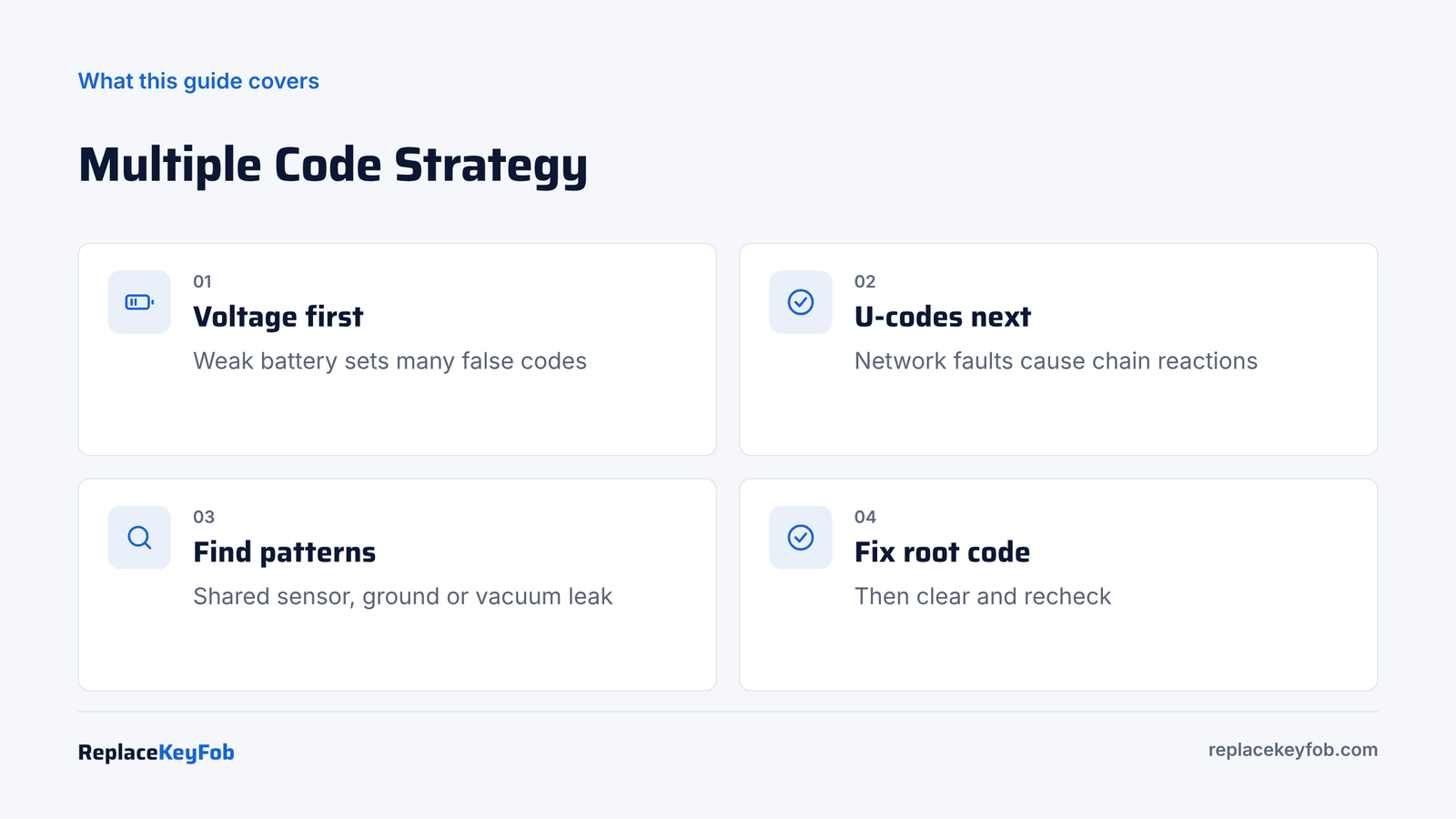
To diagnose multiple OBD II codes, save every code and its freeze frame first, then check battery and charging voltage, because low voltage sets many false codes. Fix communication U-codes next, then look for a shared cause, such as a vacuum leak behind both lean codes or a shared sensor reference wire. Fix that root cause, clear once and recheck.
Plug in a scanner and see six codes, and it is easy to start shopping for six parts. That is almost always the wrong move. Most of the time, multiple codes share one cause, and the other codes are side effects. A failing alternator, a corroded ground or one vacuum leak can light up a list that looks like the whole engine is failing.
This guide shows how to read multiple codes as a pattern, which ones to fix first, and how to confirm you found the real cause.
What Multiple OBD II Codes Mean
| Pattern | What it usually means |
|---|---|
| Many codes across different systems at once | Low voltage, bad ground, or a network fault |
| Several U-codes (lost communication) | Network wiring, a failed module, or low voltage |
| Several sensor codes ending in “circuit low” | Shared 5-volt reference shorted |
| Both bank lean codes (P0171 and P0174) | Vacuum leak, MAF sensor, or low fuel pressure |
| Random misfire (P0300) plus lean codes | Vacuum leak or fuel delivery |
| Catalyst code (P0420) plus misfire codes | Misfire may be damaging or fooling the catalyst monitor |
| Codes only after a battery change or jump | Voltage dip, often clears after reset |
What You Need
- An OBD2 scanner with freeze frame and live data
- A multimeter
- A notepad or phone to record codes, freeze frame and mileage
- Basic access to the wiring diagram for your car if you need to trace circuits
OBD2 scanner with live data and freeze frame
Freeze frame and live data are what turn a list of codes into a diagnosis. Look for graphing, fuel trims and multiple module access.
As an Amazon Associate, ReplaceKeyFob earns from qualifying purchases.
Step 1: Record Everything Before Clearing
- Read all codes from the engine module and, if your scanner allows, from every module.
- Write down whether each code is stored, pending or permanent; see pending, stored and permanent codes.
- Save the freeze frame. It shows engine speed, coolant temperature, load and fuel trims at the moment the first code set. Our guide on freeze frame data explains how to use it.
Why first: clearing codes erases the freeze frame, and that snapshot often points directly at the root cause.
Step 2: Check Voltage
Battery and charging problems create more false codes than any other single cause.
- With the engine off, the battery should read about 12.4 to 12.7V.
- Running, it should read about 13.5 to 14.7V.
- Watch voltage during cranking. If it drops well below about 9.6V, modules may reset and set codes.
You can read voltage through the OBD2 port; see how to check battery voltage with an OBD2 scanner. Also check the main engine and body grounds for corrosion or looseness.
Step 3: Fix Communication Codes First
U-codes such as U0100 (lost communication with the engine computer) or U0121 (lost communication with the ABS module) mean modules cannot talk to each other. When the network fails, other modules often set their own codes because they stop receiving data. Fix the network problem first: check fuses for the module, its power and ground, and the network wiring.
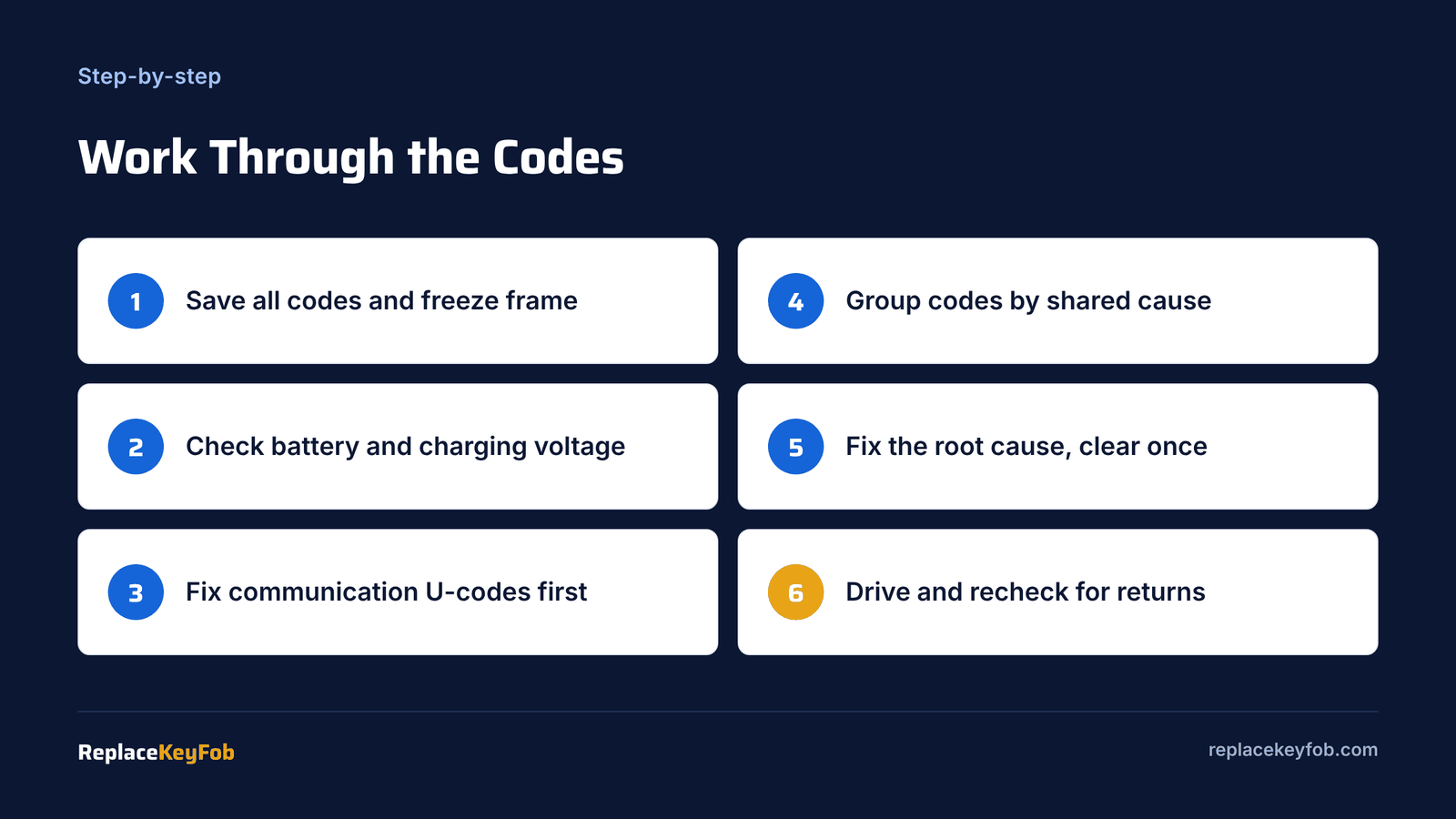
Step 4: Group Codes by Shared Cause
Look for codes that point to one common part or circuit.
Shared sensor reference
Many engine sensors share a 5-volt reference wire from the computer, such as the throttle position, MAP and some pressure sensors on many vehicles. If one sensor shorts that wire, every sensor on it sets a “circuit low” code. Unplug the sensors one at a time and watch whether the reference voltage returns.
Vacuum and air leaks
A cracked intake hose, a leaking PCV valve or an intake gasket leak causes lean codes, misfire codes and sometimes idle codes together. Fix the leak, and they all go away.
Fuel delivery
A weak fuel pump or clogged filter causes lean codes on both banks and misfires under load. Check fuel pressure.
Downstream effects
Misfires can cause catalyst codes. A bad engine coolant temperature sensor can cause rich codes and poor idle. Fix the first cause in the chain.
Step 5: Use Live Data to Confirm
| Live data value | What to look for |
|---|---|
| Short and long-term fuel trims | Above about +10% points to a lean condition |
| MAF reading at idle | Too low for engine size suggests a dirty or failed MAF |
| Coolant temperature | Should reach about 190 to 220°F warm |
| O2 sensor voltage | Upstream should switch quickly; stuck values suggest a fault |
| Misfire counters | Show which cylinder is misfiring |
See how to read fuel trims, how to read live data and diagnosing a misfire with an OBD2 scanner.
How to Fix Multiple OBD II Codes: A Priority List
- Power and ground problems (battery, alternator, ground straps)
- Communication codes (U-codes)
- Sensor circuit codes (circuit high, low or open)
- Fuel and air codes (lean, rich, MAF, vacuum)
- Misfire codes
- Emissions system codes (catalyst, EVAP, EGR)
Work down the list. After each repair, clear codes once, drive and rescan. Many lower codes disappear once the root cause is gone.
Real-World Examples
| Codes seen | Root cause found |
|---|---|
| P0171, P0174, P0300 | Cracked intake boot after the MAF sensor |
| P0122, P0107, P0452 | Shorted 5V reference from one damaged sensor |
| U0100, U0121, P0562 | Weak alternator causing low voltage |
| P0420, P0302 | Misfire on cylinder 2 overheating the catalyst |
| P0128, P0171 | Thermostat stuck open, engine running cold and rich-lean swings |
A Worked Example: Five Codes, One Leak
A common case on a V6 sedan shows how the priority list works.
- Codes found: P0171 (bank 1 lean), P0174 (bank 2 lean), P0300 (random misfire), P0507 (idle higher than expected) and a pending P0420.
- Voltage check: 12.6V engine off and 14.2V running. Power is fine.
- No U-codes, so the network is fine.
- Pattern: both banks lean plus a high idle points to unmetered air entering after the MAF sensor, affecting the whole engine rather than one cylinder.
- Live data: long-term fuel trims around +18% on both banks at idle, dropping to about +5% at 2,500 RPM. A leak that matters most at idle is a classic vacuum leak sign.
- Repair: a smoke test finds a split PCV hose. A new hose costs a few dollars.
- Result: after clearing codes and a week of driving, trims return near zero, the idle settles and the pending catalyst code never matures.
Five codes, one cheap part. Replacing the O2 sensors, the catalytic converter or the spark plugs first would have cost hundreds and fixed nothing.
Codes in Other Modules
A generic scan reads only the engine computer. If your scanner can read the ABS, transmission, airbag and body modules, check them too. A wheel speed sensor fault in the ABS module, for example, can cause transmission shift codes, because the transmission uses vehicle speed from the ABS. Our guide on how to reset the ABS light covers that side.
How to Prevent Multiple OBD II Codes
- Keep the battery and charging system healthy, and clean the terminals.
- Replace cracked vacuum hoses and intake boots during routine service.
- Use the right spark plugs and change them at the scheduled interval.
- Fix a single code soon, before it causes side effects.
- Avoid low-quality sensors that do not match OEM specs.
Mistakes to Avoid
- Clearing everything before recording it.
- Replacing parts code by code without looking for a pattern.
- Ignoring pending codes, which often show the earliest sign of the real problem.
- Overlooking codes in other modules, such as ABS or transmission, that share the network.
When to Call a Pro and What It Costs
If you find network faults, shorts on a shared reference or codes you cannot connect to a cause, a diagnostic shop is often cheaper than guessing. Typical 2026 US diagnostic fees are about $100 to $180 for the first hour, and about $150 to $250 at a dealer.
Frequently Asked Questions
Usually that one root cause is affecting several systems. Low voltage, a bad ground, a network fault, a vacuum leak or a shorted sensor reference wire can set several codes at once.
Start with battery and charging voltage, then communication U-codes, then sensor circuit codes, then fuel and air, misfire and emissions codes. Many later codes clear once the earlier causes are fixed.
Yes. Low voltage during cranking or from a weak alternator can make modules reset or lose communication, setting many unrelated codes at once.
Only after recording every code and the freeze frame. Clearing erases that data and resets monitors. Codes that return quickly are active faults and the best place to start.
Keep the battery and charging system healthy, replace cracked vacuum hoses, maintain spark plugs on schedule and fix single codes quickly before they cause side effects.