
How to Program a Car Key When You Only Have One Key

This post contains affiliate links. As an Amazon Associate, ReplaceKeyFob earns from qualifying purchases, at no extra cost to you.
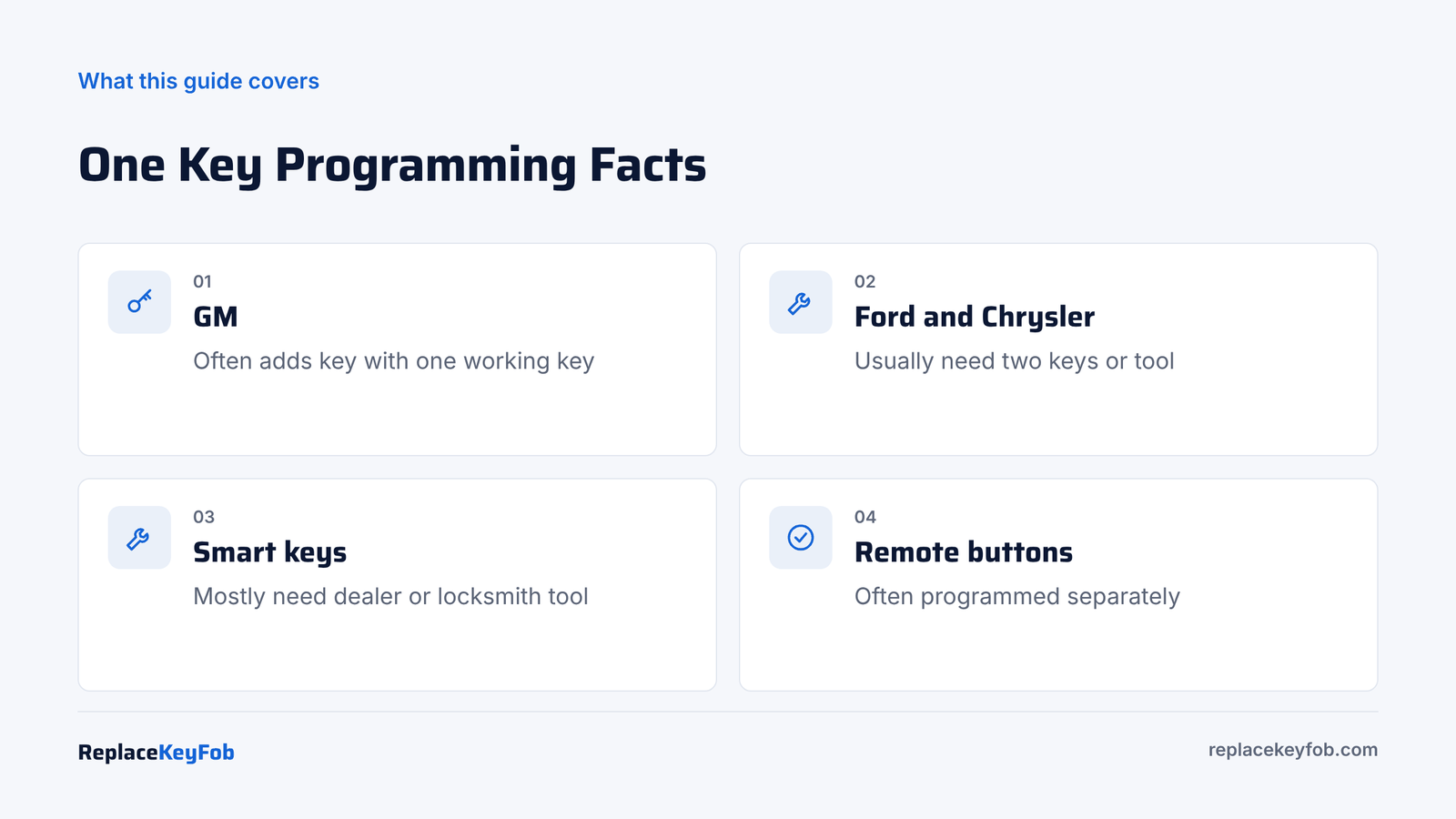
To program a car key with only one key, first check your brand’s rules. Many GM vehicles let you add a new transponder key with one working key using a short ignition sequence, and some older Toyotas allow it with a master key. Most Ford and Chrysler on-board methods need two working keys, so with one key you need a scan tool, locksmith or dealer.
Programming a car key means teaching the immobilizer to accept a new transponder chip, and often also teaching the body module to accept the remote buttons. Carmakers protect that process because a key that starts the car is valuable to thieves. The usual protection is simple: the car only lets you add a key if you prove you already have one or two valid keys.
Having only one key is the most common reason people search this, often after losing a spare. The good news is that one key is far better than none. With one key, many cars can still be programmed at home or by a mobile locksmith much more cheaply than an all-keys-lost job. If you have no working key at all, see how to program a key fob without a key.
What You Need
- Your one working key. It must start the car, not just open the doors.
- A new key that is correctly cut to your locks and has the right transponder chip for your car. Buying by FCC ID and part number helps match it.
- The procedure for your exact year and model. The owner’s manual sometimes includes it; many do not.
- Patience. Most procedures depend on timing, such as switching the ignition within a few seconds.
If you buy a key online, check our replacement key fobs from Amazon guide first; many cheap keys have the wrong chip or a blade that a locksmith cannot cut cleanly.
OBD2 key programmer
If your car does not support on-board adding, a key programming tool that lists your make and model can add keys through the OBD2 port; confirm exact year coverage before buying.
As an Amazon Associate, ReplaceKeyFob earns from qualifying purchases.
Brand Rules at a Glance
| Brand | Add a key with one working key? | Notes |
|---|---|---|
| GM (Chevy, GMC, Buick, Cadillac) many older keyed models | Often yes, on-board | Sequence with working key, then new key |
| GM “30 minute relearn” | Works on many keyed models without a working key | Three 10-minute ignition cycles |
| Toyota and Lexus older keyed (non-smart) | Often yes with a master key | Long on-board sequence on many models |
| Ford and Lincoln (PATS) | Usually needs two keys on-board | One key: tool, FORScan, locksmith or dealer |
| Chrysler, Dodge, Jeep, Ram | Usually needs two keys on-board | One key: tool, locksmith or dealer |
| Honda and Acura | Usually needs tool | Dealer or locksmith |
| Nissan and Infiniti | Usually needs tool | Locksmith or dealer |
| Most push-button smart keys | Usually needs tool | Dealer, locksmith or advanced programmer |
These rules apply to many, but not all, models. Always confirm for your exact year, because procedures changed across generations.
Step-by-Step: GM One-Key Method (Many Keyed Models)
Many GM vehicles with a turn key (common through the 2000s and into the 2010s) allow this:
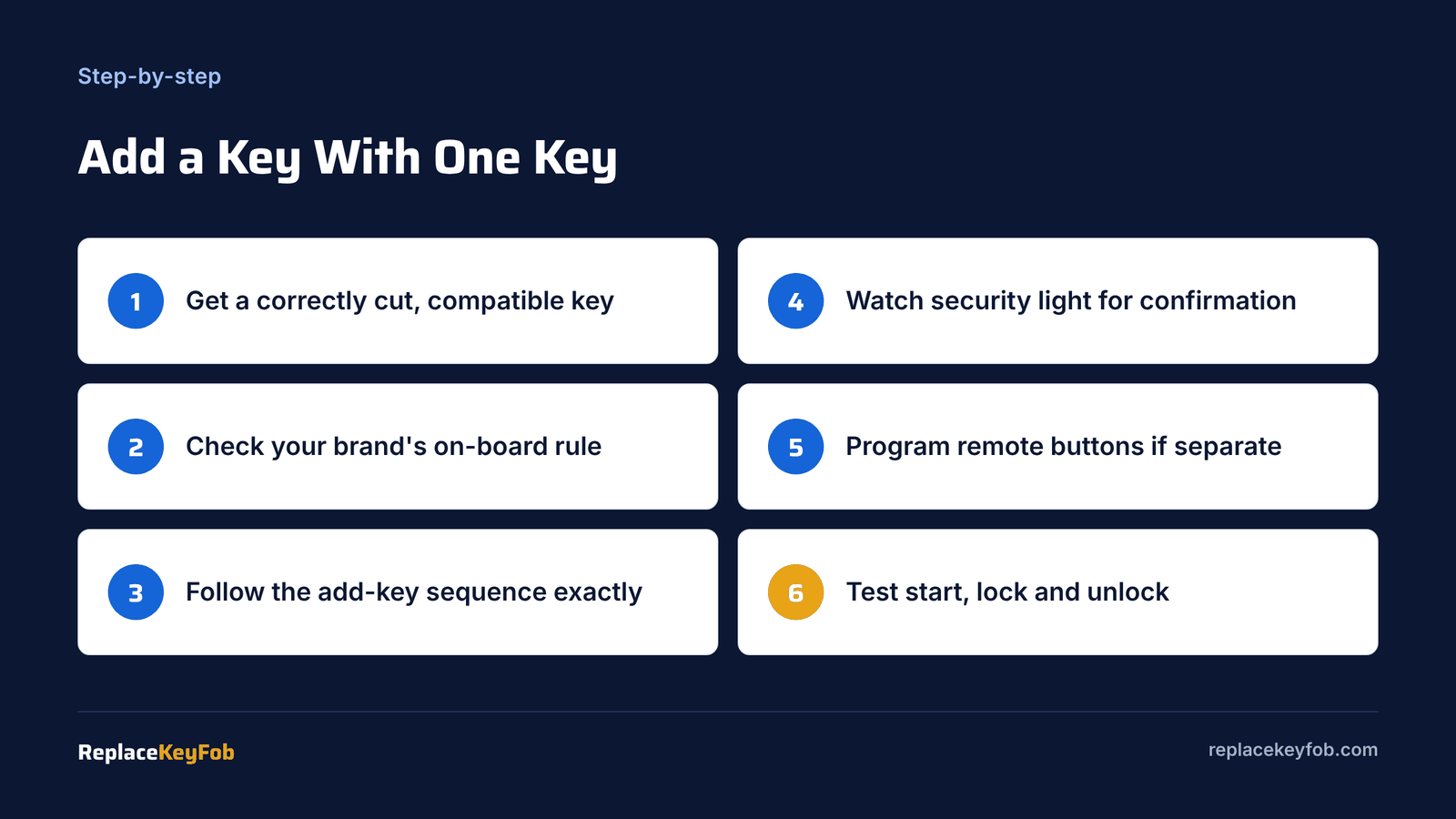
- Insert the working key and turn it to ON (do not start). The security light comes on briefly and goes off.
- Turn the key to OFF and remove it.
- Within about 10 seconds, insert the new key and turn it to ON.
- The security light should turn off after a few seconds. That means the new key is learned.
- Start the engine with the new key to confirm.
Why timing matters: the body module opens a short learning window after it sees a valid key. If you wait too long, the window closes and the new key is treated as unknown.
GM 30-minute relearn
On many GM models, if adding with a working key fails, the “30 minute relearn” can teach a new key: turn the new key to ON and wait about 10 minutes until the security light stops flashing, turn off for a few seconds, and repeat for a total of three cycles. On many models this erases other keys, so you may need to relearn the one you already have afterward.
Toyota and Lexus With a Master Key
Many older Toyota and Lexus models with a turn key and transponder chip have an on-board “add key” routine that works with one master key (often the black-headed key on older models; grey-headed valet keys usually cannot add keys). It involves a long sequence of door openings, key insertions and pedal presses within strict time limits, and it differs by year. If you can find the exact procedure for your model, it can work at home. Many owners find it quicker to let a locksmith do it with a tool.
Toyota smart keys (push-button start) usually require a dealer tool or locksmith programmer.
Ford and Chrysler: Why Two Keys Matter
Ford’s PATS system and Chrysler’s SKIM/SKREEM systems commonly use a two-key rule for on-board programming. You cycle the ignition with key one, then key two, then the new key. With only one key, the car will not enter programming mode on its own.
Your options with one key:
- A diagnostic tool that supports key programming. For Ford, many owners use FORScan with a compatible adapter; see how to program a Ford key fob with FORScan.
- A locksmith with a programmer, often cheaper than the dealer.
- The dealer, which can always program keys with proof of ownership.
Our broader guide on programming a key fob with an OBD2 scanner explains how these tools work.
Remote Buttons Are Often a Separate Step
A key that starts the car may still not lock or unlock it. On many older GM, Ford and Chrysler cars, the remote (keyless entry) is programmed separately, sometimes with an on-board sequence that does not need two keys. On integrated smart keys, the tool usually programs both at once. Check whether your remote and chip are separate before you finish.
If It Does Not Work
| Problem | Likely cause | Fix |
|---|---|---|
| Security light flashes, no start | Chip not learned or wrong chip | Retry timing; confirm chip type |
| Key turns but will not start any time | Blade fine, transponder incompatible | Buy correct key by part number |
| Doors open, engine will not | Remote works, chip not programmed | Program the transponder |
| On-board sequence does nothing | Model needs two keys or a tool | Use locksmith or programming tool |
| Old key stopped working after | Procedure erased other keys | Relearn every key in the same session |
If your security light keeps flashing after programming, our guide to how to reset the immobilizer system can help.
Mistakes to Avoid
- Buying the cheapest key online. Wrong chips and rough blades are common.
- Cutting the key after programming. It is fine either way on many cars, but get the blade cut first so you can test the ignition.
- Erasing your only key. Some procedures clear all keys. Know before you start, and have the working key ready to relearn.
- Running the battery down. Long procedures with the ignition on can drain a weak battery. Connect a charger or maintainer.
- Ignoring a flashing security light. If the light keeps flashing after the procedure, the key is not learned. Do not keep cranking the engine; stop and recheck the chip type.
When to Call a Locksmith and Costs
With one working key, a mobile locksmith can usually cut and program a new key in 20 to 60 minutes. Typical 2026 US costs:
- Basic transponder key cut and programmed: about $80 to $200.
- Remote head key: about $120 to $300.
- Smart key (push-button): about $200 to $500, more for luxury brands.
- Dealer prices are often higher, especially for smart keys.
Doing this before you lose your last key saves a lot. An all-keys-lost job costs more and takes longer. See spare key fob cost for detailed pricing.
Frequently Asked Questions
On many GM models and some older Toyotas, yes, using an on-board sequence. Most Ford and Chrysler vehicles need two keys for on-board programming, so with one key you need a tool or locksmith.
Ford’s PATS security uses two valid keys as proof of ownership before it enters on-board programming mode. With one key, a dealer, locksmith or tool like FORScan is required.
Some procedures erase all keys and relearn only the ones present. Have every key you want to keep with you during programming.
Yes. Most automotive locksmiths can cut and program a new key with your one working key, often cheaper than a dealer.
On many older cars, yes. The transponder chip and the remote buttons are programmed by different procedures. Smart keys usually do both at once.