
P0172 Causes: What Your OBD2 Scanner Is Telling You

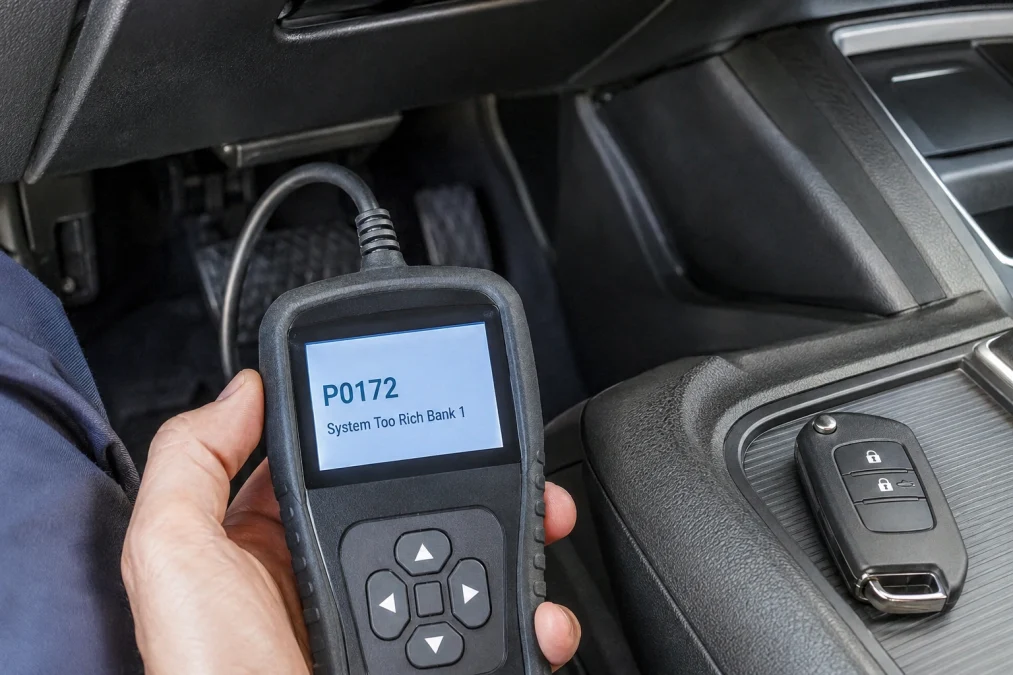
A check engine light can be stressful, especially when your OBD2 scanner shows a code you have never seen before. If the scanner displays P0172, your engine computer has detected a fuel mixture that is too rich on Bank 1.
Understanding the most common P0172 causes can help you avoid replacing good parts or paying for repairs you do not need. The problem may be as simple as a dirty airflow sensor or clogged air filter. It may also involve a leaking fuel injector, excessive fuel pressure, or a faulty sensor.
This guide explains what P0172 means, which symptoms to watch for, how to use an OBD2 scanner correctly, and when professional diagnosis is the smarter choice.
Quick Answer
P0172 means the engine is receiving too much fuel or not enough air on Bank 1. Common P0172 causes include a dirty mass airflow sensor, leaking fuel injector, high fuel pressure, restricted air filter, faulty oxygen sensor, stuck purge valve, or incorrect coolant temperature reading. Proper testing is important before replacing parts.
What Does the P0172 Code Mean?
The full definition of P0172 is:
System Too Rich — Bank 1
Your engine needs a controlled mixture of air and fuel to run correctly. The engine control module, commonly called the ECM or PCM, adjusts this mixture by studying information from several sensors.
When the computer detects too much fuel or too little air for an extended period, it attempts to correct the mixture by reducing fuel delivery. If the correction reaches its programmed limit, the computer stores code P0172 and may turn on the check engine light.
The Environmental Protection Agency explains that an on-board diagnostic system monitors emission-related components and engine systems, then illuminates the malfunction indicator light when it detects a problem. (NEPIS)
What Does “Bank 1” Mean?
Bank 1 is the side of the engine containing cylinder number one.
An inline four-cylinder engine usually has only one cylinder bank. A V6 or V8 engine has two banks. If both banks are running rich, your scanner may show P0172 together with P0175.
The location of Bank 1 varies by vehicle. Check the repair manual for your exact year, make, model, and engine before working on bank-specific sensors or injectors.
Common P0172 Causes
A P0172 code does not automatically identify one failed part. It describes the condition the computer has detected.
Here are the most common causes.
Dirty or Faulty Mass Airflow Sensor
The mass airflow sensor, or MAF sensor, measures how much air enters the engine.
If it reports more airflow than is actually present, the computer may add too much fuel. Dirt, oil residue, damaged wiring, and internal sensor failure can all affect the reading.
A dirty MAF sensor is especially possible when:
- The air filter was installed incorrectly.
- An over-oiled reusable air filter was used.
- Dirt entered through a damaged intake tube.
- The sensor was cleaned with the wrong chemical.
- The MAF connector has loose or corroded terminals.
Do not touch the sensing wires. If cleaning is appropriate for your vehicle, use only a product labeled as mass airflow sensor cleaner.
Leaking or Stuck Fuel Injector
A fuel injector should open and close in precise pulses. A leaking injector can continue delivering fuel after it should have closed.
Possible signs include:
- Rough starting after the car sits.
- A strong gasoline smell.
- One unusually dark or wet spark plug.
- Rough idle immediately after startup.
- Fuel pressure that falls quickly after shutdown.
Injector problems require careful testing. Replacing all injectors because of one rich code can be expensive and unnecessary.
Excessive Fuel Pressure
The engine may run rich when fuel pressure is higher than the manufacturer’s specification.
Possible causes include:
- A faulty fuel pressure regulator.
- A restricted fuel return line on vehicles that use one.
- An incorrect replacement fuel pump.
- A faulty fuel pressure sensor.
- An electrical or control problem in a returnless fuel system.
Fuel pressure must be checked with the correct equipment and compared with vehicle-specific specifications.
Fuel systems are pressurized and gasoline is highly flammable. Do not open a fuel line unless you have the proper tools, safety equipment, and repair information.
Restricted Air Filter or Intake Passage
A severely clogged air filter may reduce the amount of air entering the engine.
Also inspect the intake system for:
- A collapsed intake hose.
- Packaging or debris inside the air box.
- A blocked air inlet.
- An incorrectly fitted air filter.
- Damage between the air filter and throttle body.
This is one of the easiest inspections a car owner can perform before paying for advanced diagnosis.
Faulty Upstream Oxygen or Air-Fuel Ratio Sensor
The upstream oxygen sensor or air-fuel ratio sensor helps the computer evaluate the combustion mixture.
A biased sensor may falsely report a lean condition. The computer then adds fuel, which can create an actual rich condition.
However, P0172 does not prove the oxygen sensor is defective. The sensor may be accurately reporting excess fuel caused by another problem.
Replacing an oxygen sensor without checking fuel trims, airflow data, and fuel delivery is a common diagnostic mistake.
Stuck-Open EVAP Purge Valve
The evaporative emissions system stores fuel vapor and later sends it into the engine to be burned.
A purge valve that remains open can allow too much fuel vapor into the intake, especially at idle or after refueling. This can create:
- Hard starting after filling the tank.
- Rough idle.
- Rich fuel trims.
- Fuel odor.
- EVAP-related trouble codes.
A technician can test purge flow with a scan tool, vacuum equipment, or bidirectional controls when supported by the vehicle.
Incorrect Coolant Temperature Reading
A cold engine needs more fuel than a fully warmed engine. The coolant temperature sensor tells the computer how warm the engine is.
If the sensor falsely reports that the engine is cold, the computer may continue adding extra fuel after the engine reaches operating temperature.
Before starting a completely cold engine, compare the scanner’s coolant temperature reading with the outside air temperature. The readings should normally be reasonably close.
Other Possible P0172 Causes
Less common causes include:
- Faulty manifold absolute pressure sensor.
- Contaminated engine oil from fuel dilution.
- Restricted exhaust or damaged catalytic converter.
- Incorrect engine computer programming.
- Wiring damage or poor sensor grounds.
- Faulty thermostat keeping the engine too cold.
- Aftermarket performance modifications.
- Incorrectly installed replacement parts.
- Internal engine mechanical problems.
Symptoms That May Appear With P0172
Some vehicles continue running almost normally when P0172 first appears. Others show noticeable performance problems.
Common warning signs include:
| Warning sign | What it may indicate |
|---|---|
| Check engine light | The rich condition has exceeded the computer’s correction limit |
| Poor fuel economy | The engine may be burning more fuel than needed |
| Rough idle | Excess fuel may be affecting combustion |
| Black exhaust smoke | The mixture may be extremely rich |
| Fuel smell | Unburned fuel or a fuel-system leak may be present |
| Hard starting | An injector or purge valve may be leaking |
| Loss of power | Spark plugs or the catalytic converter may be affected |
| Dark spark plugs | Excess fuel may be fouling the plugs |
| P0172 with P0175 | A problem may be affecting both engine banks |
A flashing check engine light is more urgent than a steady light. It often indicates an active misfire that may quickly damage the catalytic converter. Reduce driving and arrange professional service.
Stop the vehicle and seek assistance if you notice a strong raw-fuel smell, visible fuel leakage, heavy smoke, or severe engine shaking.
How to Diagnose P0172 With an OBD2 Scanner
A basic code reader can retrieve P0172. A scanner that displays live data and freeze-frame information is much more useful.
1. Scan Every Vehicle Module Available
Do not focus only on P0172. Record all stored, pending, and permanent codes.
Related codes may point toward the real cause, including:
- MAF or MAP sensor codes.
- Oxygen sensor codes.
- Misfire codes.
- Fuel pressure codes.
- Coolant temperature codes.
- EVAP purge codes.
- P0175 for Bank 2.
Diagnose related electrical or sensor codes in a logical order rather than treating every code as a separate failure.
2. Save the Freeze-Frame Data
Freeze-frame data records operating conditions from when the code was stored.
Write down:
- Engine speed.
- Vehicle speed.
- Coolant temperature.
- Engine load.
- Short-term fuel trim.
- Long-term fuel trim.
- MAF reading.
- Intake pressure.
- Oxygen or air-fuel sensor data.
This information can show whether the fault occurred during a cold start, idle, acceleration, or highway driving.
3. Check Short-Term and Long-Term Fuel Trims
Fuel trims show how much the computer is adjusting fuel delivery.
- Positive fuel trim: The computer is adding fuel.
- Negative fuel trim: The computer is removing fuel.
With P0172, Bank 1 fuel trims are often strongly negative because the computer is attempting to correct a rich mixture.
Do not judge the vehicle from one number. Compare readings at:
- Warm idle.
- Approximately 2,000 to 2,500 rpm.
- Light driving load, when safe.
The pattern matters. A problem that is severe only at idle may suggest a leaking injector or excessive purge flow. A problem present at all engine speeds may point toward airflow measurement, fuel pressure, or sensor bias.
Fuel-trim limits and normal ranges vary by manufacturer. Use service information for your vehicle before deciding that a reading is unacceptable.
4. Perform a Visual Inspection
Before buying parts, inspect the simple items.
Check:
- Air filter condition.
- Air-filter housing.
- Intake ducts and clamps.
- MAF sensor connector.
- Injector connectors.
- Visible wiring damage.
- Damaged vacuum and EVAP hoses.
- Fuel leakage.
- Recent repair areas.
- Aftermarket intake components.
A disconnected connector or incorrectly installed filter can create symptoms that look like an expensive component failure.
5. Compare Live Sensor Data
Compare the scanner readings with expected operating conditions.
Useful checks include:
- Coolant temperature before a cold start.
- MAF airflow at idle and increased rpm.
- MAP reading with the engine off and running.
- Upstream oxygen or air-fuel sensor response.
- Fuel pressure data, when supported.
- Purge valve command.
- Bank 1 and Bank 2 fuel trims on V-type engines.
One unusual reading does not always mean that sensor is bad. Wiring faults, air restrictions, fuel problems, and mechanical faults can influence sensor data.
6. Test Before Replacing Parts
A professional may perform:
- Mechanical fuel-pressure testing.
- Injector balance testing.
- Injector leak-down testing.
- EVAP purge valve testing.
- Sensor circuit voltage checks.
- Exhaust gas analysis.
- Smoke testing.
- Technical service bulletin research.
- Powertrain software checks.
The goal is to prove the cause before authorizing a replacement.
Expert Tip: Save the original codes, freeze-frame data, and fuel-trim readings before clearing anything. That information may disappear after codes are erased and can save significant diagnostic time.
Can You Continue Driving With P0172?
Limited driving may be possible when the check engine light is steady and the car runs normally. However, the code should not be ignored.
A rich-running engine can cause:
- Poor fuel economy.
- Carbon buildup.
- Spark plug fouling.
- Fuel-contaminated engine oil.
- Increased exhaust emissions.
- Catalytic converter overheating or failure.
Avoid unnecessary driving when the vehicle is running poorly. Do not continue driving if the check engine light flashes, the engine shakes badly, black smoke appears, or you smell leaking fuel.
P0172 Diagnosis and Repair Cost Factors
The final cost depends on the cause, vehicle design, parts quality, labor rate, and how much testing is needed.
| Possible repair | General cost level | Important consideration |
|---|---|---|
| Replace dirty air filter | Low | Confirm the filter is actually restricted |
| Clean MAF sensor | Low | Use only approved MAF cleaner |
| Replace MAF sensor | Moderate | Cheap aftermarket sensors may provide inaccurate readings |
| Replace purge valve | Low to moderate | Test for unwanted purge flow first |
| Replace coolant sensor | Low to moderate | Wiring and connector faults can imitate sensor failure |
| Replace oxygen or air-fuel sensor | Moderate | Prove the sensor is biased before replacement |
| Repair leaking injector | Moderate to high | Injector access and testing time vary |
| Repair fuel-pressure problem | Moderate to high | Pump, regulator, sensor, or wiring may be involved |
| Replace catalytic converter | High | Correct the rich condition before installing a new converter |
| Diagnose wiring or computer problem | Variable | Electrical testing may require additional labor |
A scan is not the same as a complete diagnosis. Some shops retrieve a code quickly, while a proper diagnosis requires live-data analysis and physical testing.
Before approving repairs, ask for:
- The diagnostic fee.
- The test results.
- The exact failed part or system.
- Parts and labor costs.
- Warranty terms.
- Whether additional repairs need approval.
The FTC’s auto repair guidance recommends comparing repair policies, asking about diagnostic charges, and obtaining a written estimate before authorizing work. (Consumer Advice)
DIY Diagnosis vs. Professional Diagnosis
| Task | Suitable for many owners | Better for a professional |
|---|---|---|
| Read and record trouble codes | Yes | Not always necessary |
| Save freeze-frame information | Yes | Helpful |
| Inspect the air filter | Yes | Not usually necessary |
| Inspect accessible connectors | Yes | Helpful if damage is found |
| View basic fuel trims | Yes, with care | Best for interpretation |
| Clean an approved MAF sensor | Sometimes | Yes if access is difficult |
| Test fuel pressure | Usually no | Yes |
| Test injectors | No | Yes |
| Diagnose sensor wiring | Limited | Yes |
| Update powertrain software | No | Dealership or qualified specialist |
| Repair a fuel leak | No | Yes |
DIY scanning can help you communicate with a repair shop and avoid blind parts replacement. It cannot replace vehicle-specific testing equipment, technical information, or experience.
When to Call a Professional Locksmith or Dealership

P0172 is an engine-management code, so an automotive repair technician is normally the correct professional. A general locksmith does not usually diagnose fuel trims, injectors, airflow sensors, or emission-control systems.
Contact a qualified repair shop when:
- Fuel trims are strongly negative.
- The engine has multiple related codes.
- You smell raw fuel.
- The engine misfires or stalls.
- Testing requires opening the fuel system.
- You suspect a leaking injector.
- Sensor readings do not make sense.
- The code returns after a basic inspection.
- You do not have vehicle-specific repair information.
A dealership may be the better choice when:
- The vehicle is still under factory warranty.
- A manufacturer software update may be required.
- Factory-level scan functions are needed.
- The vehicle has a model-specific technical service bulletin.
- An open recall or service campaign may apply.
You can use the official NHTSA recall lookup tool to check your VIN for unrepaired safety recalls and available manufacturer recall information. (NHTSA)
When an Automotive Locksmith May Be Relevant
An automotive locksmith may be appropriate when the vehicle cannot be started because of a separate key, transponder, smart-key, or immobilizer problem.
For example, contact a qualified automotive locksmith or dealership if:
- The key fob is not recognized.
- The security light stays on.
- The engine will not crank because of an immobilizer fault.
- All keys have been lost.
- A replacement key requires programming.
These issues may prevent you from starting the engine to complete P0172 testing, but they do not normally cause the rich fuel condition itself.
Common Mistakes Car Owners Should Avoid
- Replacing the oxygen sensor immediately. The sensor may be reporting a genuine rich condition caused by fuel delivery or airflow problems.
- Clearing the code before saving data. Freeze-frame information may reveal when and how the fault occurred.
- Buying the cheapest MAF sensor available. Poorly calibrated sensors may create new fuel-trim problems.
- Cleaning the MAF with brake cleaner or carburetor cleaner. Harsh chemicals may damage the sensitive sensor element.
- Assuming a new part cannot be faulty. Incorrect, defective, or low-quality replacement parts can cause P0172.
- Ignoring other stored codes. Misfire, temperature, pressure, or EVAP codes may identify the underlying problem.
- Opening a pressurized fuel system without training. Fuel leakage can create a serious fire risk.
- Continuing to drive with black smoke or a flashing warning light. Excess fuel can damage the catalytic converter and contaminate the engine oil.
- Replacing several parts at once. You may spend more money without learning which part actually caused the problem.
- Using one generic diagnosis for every vehicle. Testing procedures and normal values differ among engines.
FAQs
What is the most common cause of P0172?
Common causes include a dirty or inaccurate MAF sensor, a leaking injector, excessive fuel pressure, a faulty purge valve, or an incorrect oxygen-sensor reading. The most likely cause depends on the vehicle and live scan data.
Can a dirty air filter cause P0172?
A severely restricted air filter can reduce airflow and contribute to a rich mixture. Inspecting the filter is a sensible first step, but moderate dirt alone may not be enough to trigger the code.
Can a bad oxygen sensor cause P0172?
Yes. A biased upstream oxygen or air-fuel ratio sensor can cause incorrect fuel adjustment. However, the sensor may also be accurately reporting a rich condition created by another component.
Will cleaning the MAF sensor fix P0172?
It may help when contamination is causing an inaccurate airflow reading. Cleaning will not repair damaged wiring or an internally failed sensor. Use only approved MAF cleaner and follow vehicle-specific instructions.
Can a bad spark plug cause P0172?
A fouled or misfiring spark plug can leave unburned fuel in the exhaust and affect sensor readings. Spark plugs may also become fouled because the engine has already been running rich.
Why did P0172 return after I cleared it?
Clearing the code removes stored information but does not correct the cause. The code will return when the computer again detects a rich mixture beyond its correction limit.
Is P0172 related to the key fob or immobilizer?
Normally, no. P0172 is related to engine air, fuel, and emissions control. A key fob or immobilizer fault may prevent the engine from starting, but it does not usually create a rich-running condition.
Conclusion
The main P0172 causes involve excessive fuel delivery, restricted or incorrectly measured airflow, inaccurate sensor information, or unwanted fuel vapor entering the engine.
Start by recording every code and saving the freeze-frame data. Inspect the air filter, intake system, connectors, and recent repair areas. Then use live fuel trims and sensor readings to narrow the problem before replacing anything.
A basic OBD2 scanner can tell you that the engine is running rich, but it cannot automatically identify the failed part. When fuel-system testing, injector diagnosis, wiring checks, or software updates are required, choose a qualified automotive technician or dealership and request a written diagnosis.
