
What Does P0204 Mean? Causes, Symptoms, and Fixes

Quick Answer
P0204 means the engine control module detected an electrical problem in the fuel injector circuit for cylinder 4. Common causes include a damaged connector, broken wire, poor terminal contact, failed injector, or—less often—a control-module fault. Check your vehicle through the NHTSA recall lookup before paying for repairs.
What P0204 usually tells you
- Affected cylinder: The electrical fault involves the injector circuit assigned to cylinder 4.
- Main symptom: The engine may misfire, shake, lose power, or become difficult to start.
- Most likely area: Inspect the injector connector and nearby wiring before replacing the injector.
- Important distinction: P0204 identifies a circuit problem, not automatic proof of a clogged injector.
- Driving advice: Avoid extended driving when the engine is misfiring or the check-engine light flashes.
Best next step
- Record all stored and pending codes, inspect the cylinder 4 connector, and test the circuit before buying parts.
If your OBD2 scanner displays P0204, the code points toward cylinder 4’s fuel injector circuit. It isn’t a key fob, immobilizer, or transponder-chip fault.
I often use this distinction during no-start call-outs. A scan can quickly show whether the problem involves vehicle security or the engine’s fuel-control system.
In This Guide
What Does the P0204 Code Mean?
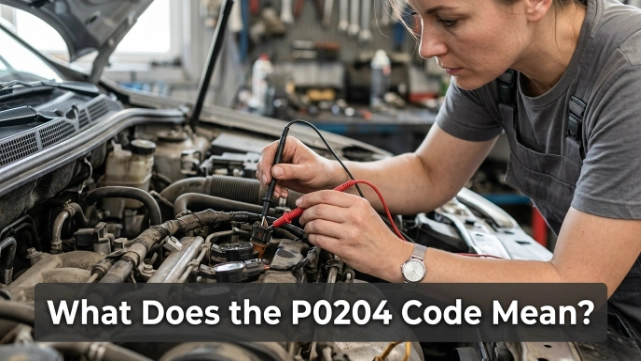
P0204 is a generic powertrain diagnostic trouble code. It means the engine control module, or ECM, detected an unexpected electrical condition in cylinder 4’s injector circuit.
The exact cylinder location depends on the engine design. Cylinder 4 may sit on either bank, so confirm the firing order and cylinder layout in reliable service information.
- P: The problem involves the powertrain.
- 0: It is a generic OBD2 code rather than a manufacturer-only code.
- 2: The fault relates to fuel or air-metering systems.
- 04: The affected circuit belongs to the cylinder 4 fuel injector.
What does a fuel injector circuit do?
A fuel injector is an electronically operated valve. It delivers a measured amount of fuel to its assigned cylinder.
The ECM usually controls injection by switching the circuit at carefully timed intervals. Depending on the vehicle, the injector may receive shared power and an individually controlled ground.
A circuit fault can appear when the ECM sees unexpected voltage, current, or resistance. The problem may occur with the injector open or closed.
- Open circuit: A broken wire, loose terminal, or failed injector coil interrupts current flow.
- Short to ground: Damaged insulation allows the circuit to contact ground.
- Short to voltage: The control wire contacts a powered circuit.
- Abnormal resistance: Corrosion or a failing coil changes the electrical load.
Is P0204 the same as a cylinder 4 misfire?
No. P0204 identifies an injector circuit fault, while P0304 identifies combustion failure in cylinder 4.
The codes can appear together because an injector circuit failure can stop fuel delivery. However, P0304 can also result from ignition, compression, air, or mechanical problems.
Codes in this family identify different injector circuits. For comparison, P0203 refers to the cylinder 3 injector circuit, while P0204 concerns cylinder 4.
Section Takeaway: P0204 points to an electrical fault in cylinder 4’s injector circuit. It does not prove the injector itself has failed.
What Are the Symptoms of P0204?
P0204 commonly causes rough running, weak acceleration, and a check-engine light. Symptoms depend on whether the circuit fails constantly or intermittently.
- Illuminated warning light: The check-engine light may stay on after the ECM confirms the fault.
- Flashing warning light: A severe active misfire can make the light flash.
- Rough idle: The engine may shake because cylinder 4 receives too little or too much fuel.
- Power loss: The vehicle may hesitate or feel weak during acceleration.
- Difficult starting: An incorrect fuel mixture can extend cranking time.
- Stalling: Some engines may stall at idle or during low-speed driving.
- Poor fuel economy: Incorrect injection can increase fuel use.
- Fuel odor: A stuck-open or improperly controlled injector may introduce excessive fuel.
Can P0204 appear without obvious symptoms?
Yes. An intermittent terminal connection may store P0204 even when the engine seems normal during inspection.
Freeze-frame data can reveal the engine speed, temperature, load, and vehicle speed present when the code set. Record that information before clearing anything.
Similar injector faults produce similar drivability problems. Reviewing the typical symptoms associated with an adjacent injector circuit code can help you understand the pattern.
Is it safe to drive with P0204?
Driving a short distance may be possible if the engine runs smoothly and the warning light stays steady. However, continued driving can increase emissions and leave you stranded if the fault worsens.
Stop driving when the check-engine light flashes, the engine shakes heavily, or you smell raw fuel. Arrange professional help if the vehicle stalls or loses substantial power.
- Stop immediately: Flashing warning light, strong fuel smell, smoke, or severe shaking.
- Drive cautiously to service: Steady light with mild symptoms and no fuel odor.
- Schedule diagnosis soon: Stored code without current symptoms.
The AAA automotive glossary defines a misfire as failure of a cylinder’s fuel charge to ignite at the proper time. That distinction matters because a persistent misfire can have causes beyond the injector.
Safety note: never continue driving a vehicle that smells strongly of fuel. A leaking fuel system needs immediate inspection.
Section Takeaway: Mild symptoms still deserve prompt diagnosis. Severe shaking, a flashing light, or a fuel smell means you should stop driving.
What Causes the P0204 Code?
Damaged wiring and poor connector contact are common P0204 causes. A failed injector is possible, but it should be tested before replacement.
| Possible cause | Typical clue | How it is confirmed |
|---|---|---|
| Loose or corroded connector | Fault changes with vibration | Terminal inspection and connection testing |
| Broken or chafed wire | Visible harness wear or intermittent code | Continuity and short-circuit tests |
| Failed injector coil | Electrical reading differs from comparable injectors | Resistance, current-ramp, or substitution testing |
| Power-supply fault | Several injectors or related circuits affected | Fuse, relay, voltage-drop, and wiring tests |
| ECM driver fault | Circuit and injector pass all tests | Pin-level testing with factory procedures |
Connector or wiring damage
Heat, oil contamination, vibration, and contact with brackets can damage an injector harness. A terminal can also spread or back out inside an apparently secure connector.
I have seen connectors that looked locked but lost contact when the engine moved. A careful terminal-drag test found the problem before an expensive injector was ordered.
Manufacturer bulletins show why model-specific research matters. One Subaru campaign document hosted by NHTSA describes connector damage that could affect the number four injector.
Failed cylinder 4 injector
The injector’s internal winding can open, short, or develop abnormal resistance. Some failures appear only when the injector becomes hot.
A mechanically clogged injector may cause a misfire without setting P0204. Since P0204 concerns the circuit, electrical evidence should guide the repair.
Power, fuse, relay, or ECM problem
Some systems share a power feed across several injectors. That makes related codes and fuse condition important diagnostic clues.
An ECM injector driver can fail, but this is less common than wiring or connector damage. Test every external part of the circuit before condemning the module.
Neighboring codes can help reveal a broader harness issue. For example, learning what P0202 means can clarify why multiple cylinder-specific codes may appear together.
Technician’s note: never probe a connector with an oversized test lead. It can spread the terminal and create a new intermittent fault.
Section Takeaway: Inspect the connector and harness first. Replace the injector or ECM only after test results identify the failed component.
How Is P0204 Diagnosed Correctly?
Correct diagnosis begins with a complete scan and visual inspection. The technician then tests cylinder 4’s injector, power supply, control signal, and wiring.
- Scan every module: Record stored, pending, and related codes before clearing them.
- Save freeze-frame data: Note engine temperature, speed, load, and battery voltage.
- Confirm cylinder location: Use service information for the exact engine.
- Inspect the connector: Look for oil, water, corrosion, broken locks, and displaced terminals.
- Inspect the harness: Check areas near brackets, covers, and hot engine parts.
- Test the electrical circuit: Follow the manufacturer’s voltage, resistance, and continuity procedures.
- Verify injector command: Use suitable test equipment to determine whether the ECM is pulsing the circuit.
- Confirm the repair: Clear codes only after repairs, then complete an appropriate road test.
What can an OBD2 scanner reveal?
A basic reader can retrieve P0204 and erase it. A better scan tool can also display freeze-frame data, misfire counters, fuel corrections, and manufacturer-specific information.
A code reader cannot inspect a wire or prove an injector is defective. It identifies where testing should begin.
If you need more diagnostic detail, compare tools designed to show live data for check-engine-light diagnosis. Confirm compatibility with your make, model, year, and required data functions.
What tests might a technician use?
- Visual inspection: Finds loose connectors, rubbed wiring, contamination, and damaged insulation.
- Resistance test: Compares the injector coil with manufacturer specifications.
- Voltage-drop test: Detects unwanted resistance while the circuit operates.
- Noid-light test: Provides a basic indication of injector pulse on compatible systems.
- Oscilloscope test: Displays the injector’s control waveform and electrical behavior.
- Current-ramp test: Helps evaluate injector coil operation without relying on resistance alone.
Do not use an ordinary test light on an ECM-controlled wire unless service information permits it. The tool may draw too much current for a sensitive control circuit.
Pro tip: disconnecting injectors or measuring resistance on a powered circuit can damage components. Follow the vehicle manufacturer’s procedure.
Section Takeaway: A scan code starts the diagnosis; it does not finish it. Confirm the fault with circuit tests before purchasing an injector.
How Do You Fix P0204, and What Can It Cost?

The correct fix depends on the failed test. Repairs range from cleaning and securing a connector to replacing an injector or repairing the ECM circuit.
- Reconnect or repair terminals: Correct loose, corroded, or displaced terminal contact.
- Repair damaged wiring: Restore open, shorted, or high-resistance sections using approved methods.
- Replace the connector pigtail: Install a quality replacement when heat or corrosion has damaged the housing.
- Replace the injector: Use the correct injector and new required seals when electrical or functional testing confirms failure.
- Repair the power supply: Address a failed fuse, relay, splice, or shared feed after finding the underlying cause.
- Repair or replace the ECM: Consider this only after circuit tests rule out external faults.
How much does P0204 repair cost?
Costs vary widely by engine, injector type, access, labor rate, and region. Direct-injection systems often require more expensive parts and procedures than conventional port injection.
| Repair category | Broad 2026 planning range | Main cost factor |
|---|---|---|
| Professional diagnosis | About $100–$250 | Testing time and local labor rate |
| Minor wiring or terminal repair | About $100–$400 | Harness access and damage extent |
| Connector pigtail replacement | About $150–$500 | Connector availability and labor |
| Single injector replacement | About $250–$1,500 or more | Port versus direct injection and accessibility |
| ECM-related repair | Often $800–$2,500 or more | Programming, calibration, and module price |
These ranges are budgeting estimates, not quotes. Taxes, diagnostic fees, seals, fuel lines, calibration, and related repairs can change the total.
The AAA repair estimator can provide a location-aware starting point. A written local estimate remains the best source for your vehicle.
Can you fix P0204 yourself?
A careful owner can inspect the accessible connector and harness with the engine off. Advanced circuit testing and injector removal require suitable tools and service information.
Fuel systems can retain pressure after shutdown. Direct-injection systems operate at especially high pressure, so injector removal is not a casual DIY repair.
A related cylinder code uses the same general diagnostic logic. This guide to fixing a P0202 injector circuit fault provides useful comparison, but vehicle-specific procedures still take priority.
Cost note: authorize testing before parts replacement. A diagnostic fee can prevent an unnecessary injector or control-module purchase.
Section Takeaway: Repair the fault proven by testing. Budget ranges vary sharply, especially between simple wiring work and direct-injection repairs.
Frequently Asked Questions About P0204
Can a bad spark plug cause P0204?
A worn spark plug can cause a cylinder 4 misfire, but it normally does not cause P0204. P0204 concerns the injector’s electrical circuit. If P0204 and P0304 appear together, diagnose the injector circuit first while checking ignition and mechanical condition as needed.
Can a clogged fuel injector trigger P0204?
A purely clogged injector usually causes a lean condition or misfire rather than an electrical circuit code. However, an injector can have both mechanical and electrical problems. Testing the circuit and injector operation separates a blockage from a failed coil or connection.
Will P0204 clear itself?
The warning light may turn off after enough successful trips if the fault stops recurring. The code can remain stored in memory, and some emissions-related information may persist. Clearing the code without fixing the fault usually results in its return.
Can low battery voltage cause P0204?
Low system voltage can disrupt electronic operation and create multiple codes, but an isolated P0204 more often indicates a local injector circuit issue. Check battery and charging voltage when several unrelated electrical codes appear or cranking speed is unusually slow.
Which side of the engine is cylinder 4?
There is no universal answer. Cylinder numbering varies by engine family, bank layout, and manufacturer. Check the correct service manual or a reliable manufacturer diagram before disconnecting anything, because working on the wrong injector wastes time and can create another fault.
Does replacing the injector always fix P0204?
No. Replacing the injector will not repair a broken wire, loose terminal, failed power feed, or damaged ECM driver. Test the injector and its complete circuit first. Parts swapping can make diagnosis more expensive without correcting the original problem.
Can P0204 prevent the engine from starting?
Many engines will still start with one affected injector, although they may run badly. A no-start becomes more likely when several injectors lose power, a shared fuse fails, or another system fault exists. Scan for additional codes before blaming P0204 alone.
What Should You Do Next?
Start by recording every code and its freeze-frame data. Then confirm the cylinder layout and inspect the cylinder 4 injector connector and nearby harness.
- If the engine runs smoothly: Schedule diagnosis soon and avoid clearing useful data.
- If the engine misfires badly: Limit driving and arrange professional inspection.
- If the warning light flashes: Stop driving to reduce the risk of further damage.
- If you smell fuel: Shut the engine off and move away from ignition sources.
- If several injector codes appear: Check shared power, fuses, relays, and harness sections.
Ask the technician to explain the test result that identifies the failed part. A good diagnosis should distinguish the injector from its connector, wiring, power supply, and ECM driver.
P0204 is often repairable without replacing major modules. The key is testing the full cylinder 4 injector circuit before ordering parts.
