
P0300 Symptoms: Signs of a Random or Multiple Cylinder Misfire

Quick Answer
Common P0300 symptoms include a rough idle, shaking, hesitation, weak acceleration, hard starting, stalling, and reduced fuel economy. A flashing check-engine light can indicate a severe active misfire, so stop driving safely and arrange professional diagnosis. Unlike a key fob, smart key, or immobilizer fault, P0300 points toward inconsistent engine combustion. Use an OBD2 scanner with live data for misfire diagnosis to check related codes, freeze-frame data, and misfire counts.
Symptoms You May Notice
- Rough idle: The engine may shake, surge, or sound uneven while stopped.
- Weak acceleration: The vehicle may hesitate or stumble when you press the accelerator.
- Check-engine light: The light may remain steady or flash during an active misfire.
- Hard starting: The engine may crank longer or need several attempts to start.
- Poor fuel economy: Incomplete combustion can increase fuel consumption.
- Exhaust changes: You may notice popping, an unusual odor, or uneven exhaust pulses.
How to Verify It
- Scan before replacing parts: Record every stored, pending, and cylinder-specific code before clearing anything.
I’ve seen drivers mistake severe engine shaking for a key or immobilizer problem because the car also starts poorly. P0300 changes the direction of the diagnosis because it identifies a combustion problem rather than a remote or transponder-chip failure.
This guide explains which P0300 symptoms matter most, when driving becomes risky, and what your scanner data can reveal.
In This Guide
What Does the P0300 Code Mean?
P0300 means the powertrain control module detected random or multiple-cylinder misfires. It cannot consistently assign the problem to only one cylinder.
Definition: A misfire happens when a cylinder fails to burn its air-fuel mixture correctly. That cylinder may produce weak power, no power, or combustion at the wrong moment.
The first character, “P,” identifies a powertrain fault. The “03” family generally relates to ignition or misfire detection.
Cylinder-specific codes may appear with P0300:
- P0301: Misfire detected in cylinder 1.
- P0302: Misfire detected in cylinder 2.
- P0303: Misfire detected in cylinder 3.
- P0304 and higher: The final digit identifies another affected cylinder.
A P0300 code doesn’t name the failed part. Spark plugs, coils, injectors, air leaks, fuel delivery, compression, or timing problems can produce similar results.
The code may also be pending before the check-engine light stays on. That often happens when the misfire is intermittent or has not met the carmaker’s threshold.
As of 2026, even an inexpensive code reader can display P0300. A capable scanner provides more useful evidence through freeze-frame information and live sensor data.
Section takeaway: P0300 identifies a misfire pattern, not a specific defective component.
What Are the Most Common P0300 Symptoms?

P0300 symptoms range from an illuminated warning light with no obvious change to severe shaking and stalling. Their intensity depends on how often the misfire occurs and how many cylinders are affected.
Rough Idle and Engine Shaking
A rough idle is one of the most recognizable signs. The steering wheel, seat, or entire body may vibrate while the vehicle is stopped.
The engine speed may also rise and fall. In severe cases, the engine sounds as though it is skipping a beat.
Hesitation or Weak Acceleration
The vehicle may stumble when pulling away or passing another car. Power can feel inconsistent because the affected cylinders are not contributing normally.
A misfire that appears mainly under load often directs attention toward ignition strength, fuel delivery, or cylinder pressure. It still requires testing before parts are replaced.
Steady or Flashing Check-Engine Light
A steady light means the computer stored a fault requiring diagnosis. The car might still seem normal if the misfire was brief.
A flashing light is more urgent. It commonly indicates an active misfire that could send unburned fuel into the exhaust.
Hard Starting or Stalling
The engine may crank longer, start unevenly, or stall shortly after starting. These symptoms become more likely when several cylinders are affected.
Stalling can also create a traffic hazard. Move away from traffic only if the vehicle can be controlled safely.
Poor Fuel Economy and Exhaust Odor
Incomplete combustion can reduce efficiency. You may notice more frequent fuel stops before seeing another obvious symptom.
The exhaust may smell stronger than normal. Popping or uneven pulses from the tailpipe can also accompany a misfire.
| Symptom Pattern | What It May Suggest | Urgency |
|---|---|---|
| Steady light with normal driving | Intermittent or stored misfire | Scan promptly |
| Rough idle and shaking | Active combustion failure | Limit driving |
| Hesitation under acceleration | Load-related ignition, fuel, or air problem | Diagnose soon |
| Flashing light with power loss | Severe active misfire | Stop safely and tow |
| Stalling or repeated hard starts | Wider fuel, mechanical, or timing fault | Professional diagnosis |
Section takeaway: The warning light’s behavior and the vehicle’s drivability reveal more urgency than the code alone.
Is It Safe to Drive With a P0300 Code?
Driving may be possible with a steady light and no noticeable performance change. However, you should scan and diagnose the vehicle promptly.
Do not continue driving normally if the engine shakes, loses power, stalls, overheats, or produces unusual smells. A misfire can worsen without warning.
AAA’s check-engine-light guidance identifies a flashing light as a likely ignition malfunction or engine misfire. Continuing to drive may expose the catalytic converter to damaging heat.
Stop Driving When You Notice These Signs
- Flashing check-engine light: Treat it as an active and potentially damaging misfire.
- Strong shaking: Several cylinders may not be producing steady power.
- Major power loss: Entering traffic or climbing hills may become unsafe.
- Stalling: The engine could stop at an intersection or during a turn.
- Fuel or burning odor: Shut the engine off and avoid ignition sources.
- Overheating: Stop safely and do not open a hot cooling system.
If the light starts flashing, ease off the accelerator and find a safe stopping place. Arrange a tow when strong symptoms continue.
A short drive to a repair facility may be reasonable only when the light is steady and the engine runs normally. Your owner’s manual should guide the final decision.
Safety note: A code reader cannot determine whether the car is safe to drive. Use the warning light, engine behavior, temperature, and manufacturer guidance together.
Section takeaway: A flashing check-engine light or severe drivability problem makes P0300 a stop-driving issue.
What Causes P0300 Along With These Symptoms?
P0300 can result from ignition, fuel, air, mechanical, sensor, or control problems. The symptom pattern helps narrow the test plan but cannot confirm the failed part.
Ignition-System Problems
- Worn, fouled, damaged, or incorrectly gapped spark plugs
- Weak ignition coils or failing coil boots
- Damaged plug wires on vehicles that use them
- Moisture or oil inside spark-plug wells
- Loose, corroded, or heat-damaged electrical connectors
Ignition problems often become more noticeable under acceleration. Higher cylinder pressure demands a stronger spark.
Fuel and Air Problems
- Dirty, restricted, leaking, or electrically faulty fuel injectors
- Low fuel pressure or inconsistent fuel delivery
- Contaminated or incorrect fuel
- Vacuum leaks after the airflow sensor
- A dirty or inaccurate mass airflow sensor
- An exhaust gas recirculation fault affecting several cylinders
Fuel-trim data can help separate a lean condition from another misfire cause. Compare both banks when the engine design provides two banks.
Mechanical and Timing Problems
- Low compression from a valve, piston-ring, or head-gasket problem
- Incorrect camshaft or crankshaft timing
- A stretched timing chain or failed timing component
- A sticking valve, damaged valve spring, or valvetrain fault
- Excessive carbon buildup on certain direct-injection engines
Manufacturer information shows why model-specific research matters. A Honda bulletin hosted by NHTSA connects P0300 with particular driveability conditions in certain CR-V vehicles.
A separate GM service bulletin hosted by NHTSA discusses several mechanical causes for misfire complaints. These examples do not apply automatically to every vehicle.
This is why replacing all coils or injectors from the code alone can waste money. Check the vehicle identification number, service information, and test results first.
Technician’s note: Never order a sensor, coil, or injector solely because it appears in a generic P0300 causes list.
Section takeaway: Similar P0300 symptoms can come from several systems, so testing must lead the repair.
How Can You Confirm a P0300 Misfire?
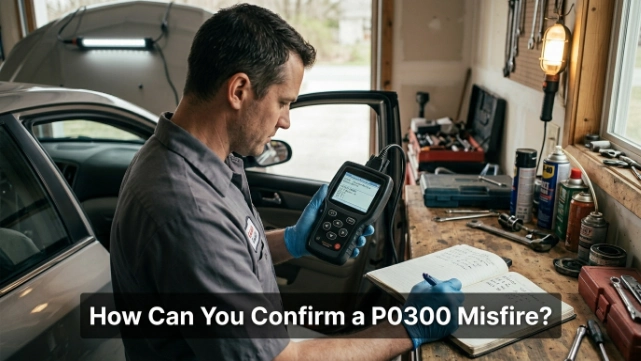
Start by recording the code and operating conditions. Do not clear the computer until you save the available evidence.
1. Read Every Diagnostic Code
Look for stored, pending, and permanent codes. Cylinder-specific, lean-condition, injector, camshaft, or crankshaft codes can change the diagnostic direction.
This guide to permanent and stored OBD2 codes explains why the same fault can appear in different code states.
2. Save the Freeze-Frame Data
Freeze-frame data records conditions present when the computer set the code. Useful fields include engine speed, coolant temperature, vehicle speed, engine load, and fuel trim.
A cold-start misfire requires a different test path than one appearing only during hard acceleration. Evidence matters.
3. Review Live Data and Misfire Counters
Watch short-term fuel trim, long-term fuel trim, oxygen-sensor behavior, airflow, and available misfire counters. Some vehicles reveal detailed counts through enhanced data or Mode $06.
Learn how Mode $06 compares with live-data diagnostics before interpreting unfamiliar test values. Manufacturer limits can differ.
4. Perform a Careful Visual Inspection
- Check for loose intake hoses and cracked vacuum lines.
- Inspect ignition connectors and visible wiring damage.
- Look for oil or water around the spark-plug wells.
- Check whether recent repairs left a connector unplugged.
- Review maintenance history and fuel quality.
Do not touch hot, moving, or high-voltage components while the engine runs. Modern ignition systems can produce dangerous voltage.
5. Test Before Replacing Parts
A qualified technician may use spark testing, injector balance testing, smoke testing, fuel-pressure testing, compression testing, or cylinder leakage testing. The correct tests depend on the scanner evidence.
If you need a simpler tool, compare car code readers for misfire diagnosis. A basic reader can retrieve codes but may not provide enhanced misfire counters.
More capable options appear in this guide to OBD2 scanners for misfire diagnosis.
Before paying for a repair, enter the VIN at the NHTSA recall lookup. A recall or manufacturer campaign may affect the repair path.
Pro tip: Record screenshots of codes and freeze-frame data before disconnecting the battery or clearing the warning light.
Section takeaway: Confirm P0300 with codes, freeze-frame data, live readings, inspection, and targeted mechanical tests.
Frequently Asked Questions
Can P0300 appear without noticeable symptoms?
Yes. An intermittent misfire may set a pending or stored P0300 code before you feel a drivability change. The check-engine light may be the only clue, especially when the fault occurs briefly under specific temperature or load conditions.
Can bad spark plugs cause P0300?
Yes. Worn, fouled, damaged, or incorrectly gapped plugs can cause random or multiple-cylinder misfires. However, P0300 does not prove the plugs are faulty, so inspect and test the ignition system before replacing parts.
Can low-quality fuel trigger P0300?
Contaminated or incorrect fuel can disrupt combustion across several cylinders. If symptoms began immediately after refueling, save the receipt and tell the technician where and when you bought the fuel.
Why does P0300 happen only during acceleration?
Acceleration increases engine load and cylinder pressure. Weak ignition, restricted fuel delivery, an air-measurement error, or low compression may become noticeable only under those demanding conditions.
Will P0300 clear itself?
The light may turn off after enough successful drive cycles if the misfire stops. The code may remain stored or permanent until the monitoring system confirms the problem has been corrected.
Can a weak car battery cause P0300?
Low system voltage can disrupt engine electronics, especially during starting. However, a weak battery is not the most common P0300 cause, so test voltage and charging performance instead of assuming the battery caused the misfire.
Is P0300 related to a key fob or immobilizer?
Usually not. A smart-key, remote, transponder chip, or immobilizer fault normally creates security-related symptoms or codes. P0300 means the engine controller detected irregular combustion after or during an attempted start.
What Should You Do Next?
Start with the warning light. Stop driving and arrange a tow if it flashes or the engine shakes, stalls, overheats, or loses substantial power.
If the light remains steady and the vehicle runs normally, scan it soon. Save every code, freeze frame, and relevant live-data reading.
Check simple visual items without working around hot or moving parts. Then give the recorded evidence to a qualified repair technician.
A P0300 code is a starting point, not a parts order. Careful diagnosis protects the engine, catalytic converter, and your repair budget.
