
P0442 Symptoms: What Your Small EVAP Leak Code Is Telling You

Quick Answer
The most common P0442 symptom is a steady check-engine light with little or no noticeable change in how the vehicle drives. You may also notice a faint fuel-vapor smell or an emissions-test problem, but P0442 does not tell you which EVAP component is leaking. Confirm the stored code and related data with an OBD diagnostic code reference before replacing parts.
Common P0442 Symptoms
- Check-engine light: This is often the only symptom a driver notices.
- Normal drivability: The engine may still start, idle, and accelerate normally.
- Fuel-vapor smell: A small EVAP leak can sometimes let gasoline vapors escape.
- Inspection problem: An active emissions-related trouble code can interfere with emissions testing requirements.
- No obvious symptom: Small leaks can be too subtle to detect without testing.
Best First Check
- Save the code and freeze-frame data, inspect the fuel cap and accessible EVAP hoses, and avoid replacing parts until the leak is confirmed.
P0442 can be confusing because your car may feel completely normal. Your OBD2 scanner finds a fault, yet there may be no rough running, stalling, or obvious mechanical problem.
I often see drivers assume a trouble code names the failed part. It doesn’t, and P0442 is a good example of why diagnosis should come before parts replacement.
In This Guide
What Does the P0442 Code Mean?
P0442 is a generic OBD2 diagnostic trouble code for a small leak detected in the evaporative emission control system, usually shortened to the EVAP system. The code identifies a system condition, not one specific failed component.
Definition: The EVAP system captures gasoline vapors from the fuel system, stores them in a charcoal canister, and controls when those vapors enter the engine to be burned instead of escaping into the atmosphere.
Your vehicle’s computer performs EVAP self-tests under certain operating conditions. If the system cannot maintain the expected pressure or vacuum during a small-leak test, it may store P0442.
That doesn’t automatically mean the fuel cap is bad. The leak could exist at a hose, seal, valve, canister, filler-neck connection, or another part of the sealed vapor system.
This distinction matters. An OBD2 scanner tells you where to begin testing, but the code itself is not a parts order.
I’ve seen this same misunderstanding when drivers bring me scan results while troubleshooting an unrelated key, immobilizer, or electrical issue. P0442 may be stored at the same time, yet it belongs to the emissions system rather than the key fob or transponder system.
Diagnostic note: Save the original code, pending codes, and freeze-frame information before clearing anything. That information can help identify when the EVAP monitor detected the fault.
What Are the Most Common P0442 Symptoms?
The classic P0442 symptom is simple: the check-engine light comes on while the car continues driving normally. Many drivers notice nothing else.
Because P0442 points to a relatively small EVAP leak, it often doesn’t produce the dramatic symptoms associated with ignition, fuel-delivery, or transmission faults.
1. Steady check-engine light
A steady malfunction indicator lamp is usually the first thing that gets the driver’s attention. An OBD2 scan then reveals P0442 stored in the vehicle’s computer.
Don’t assume the light appeared because of P0442 alone. Scan for every stored, pending, and permanent code before deciding what the vehicle needs.
2. Little or no change in engine performance
A vehicle with P0442 may start, idle, accelerate, and cruise normally. That makes the code easy to ignore.
If you also have severe hesitation, misfiring, stalling, or major power loss, look for additional codes or another problem. Those symptoms shouldn’t automatically be blamed on a small EVAP leak.
3. Possible gasoline-vapor odor
Some drivers notice a faint gasoline smell near the vehicle. Since the EVAP system handles fuel vapor, a leak can allow vapor to escape.
A strong gasoline odor deserves more caution. Never assume an intense fuel smell is harmless simply because your scanner displays P0442.
Safety note: If you see liquid fuel, find active dripping, or smell a strong persistent gasoline odor, avoid treating the situation as a routine code-clearing job. Have the fuel system inspected promptly.
4. Emissions inspection trouble
P0442 is an emissions-related fault. Depending on your location and inspection program, an active check-engine light or incomplete readiness monitor can create an inspection problem.
Clearing the code immediately before a test isn’t a reliable shortcut. Clearing codes also resets readiness information on many vehicles, so the monitors may need to run again.
| What You Notice | Does It Fit P0442? | Best Next Step |
|---|---|---|
| Steady check-engine light | Yes | Scan all stored and pending codes |
| Car drives normally | Yes | Inspect EVAP system rather than ignoring the light |
| Faint fuel-vapor smell | Possible | Inspect for vapor leaks and damaged components |
| Rough idle or hard starting | Possible with another EVAP fault | Check related codes and purge-valve operation |
| Visible liquid fuel leak | Not something to dismiss as P0442 | Treat as a fuel-system safety problem |
Section Takeaway: P0442 often produces a warning light without obvious drivability problems. Fuel odor or additional engine symptoms deserve closer investigation.
What Causes a P0442 Code?
P0442 appears when the vehicle detects a small loss of integrity in the EVAP system. Several different faults can create that condition.
The right approach is to inspect and test the system instead of replacing the most popular part first.
- Loose fuel cap: A cap that wasn’t fully installed after refueling can prevent the system from sealing.
- Damaged fuel-cap seal: Cracks, hardening, contamination, or physical damage may interfere with sealing.
- Incorrect fuel cap: A replacement cap that doesn’t fit or seal correctly can cause EVAP faults.
- Cracked EVAP hose: Small splits in vapor hoses and plastic lines can be difficult to find visually.
- Leaking purge valve: A purge valve that doesn’t seal when commanded closed can interfere with EVAP testing.
- Leaking vent valve: A vent valve or its sealing surface can prevent the system from holding the expected pressure or vacuum.
- Damaged charcoal canister: Cracks, damaged connections, or other defects can create a vapor leak.
- Filler-neck or seal problem: Corrosion, damaged sealing surfaces, or related connections can create small leaks.
- Other seals and fittings: O-rings, quick-connect fittings, tank connections, and related EVAP joints can leak.
A common mistake is buying a new gas cap solely because P0442 appeared. Checking the cap first makes sense, but replacing it without finding a defect is still guessing.
Another mistake is assuming the smallest visible crack must be the only problem. More than one EVAP fault can exist, especially on an older vehicle.
Technician tip: Match replacement components to the vehicle’s year, make, model, engine, and manufacturer requirements. Don’t assume a universal cap, hose, valve, or connector is correct.
How Do You Diagnose P0442 Correctly?
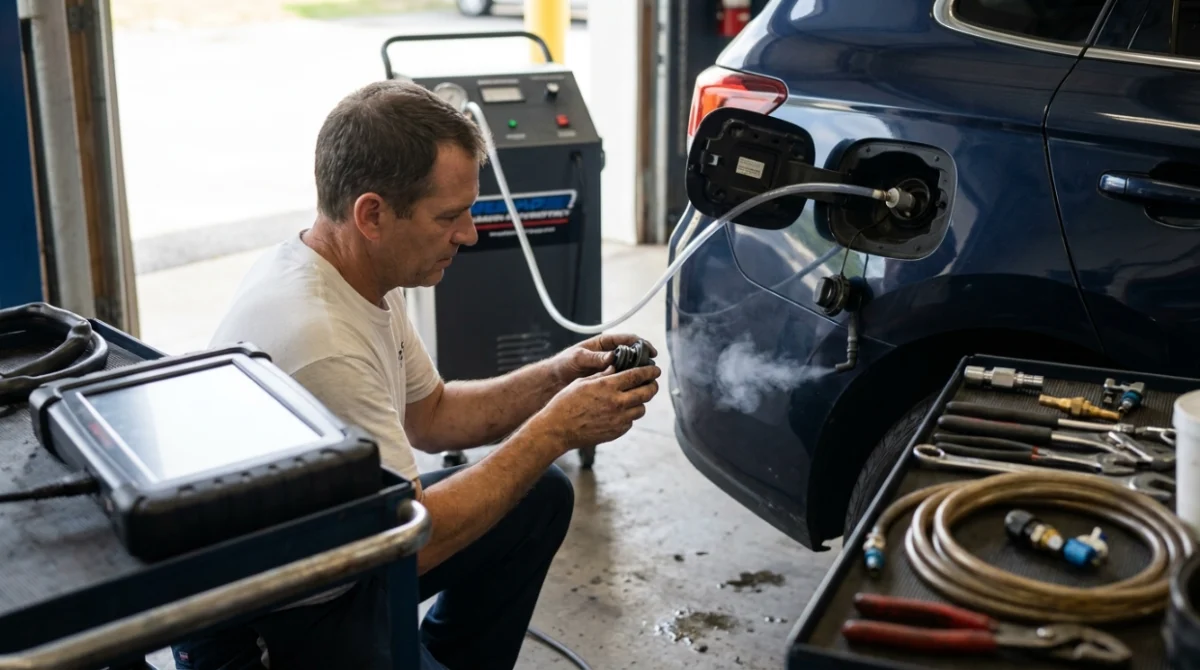
Start with the easiest checks, then move toward testing that can locate a leak too small to see. Small EVAP leaks often reward patience more than parts swapping.
- Scan the vehicle completely. Record P0442 plus stored, pending, and permanent codes where your scanner supports them.
- Save freeze-frame data. Note operating conditions stored when the computer detected the fault.
- Inspect the fuel cap. Check installation, seal condition, physical damage, contamination, and the filler sealing surface.
- Inspect accessible EVAP lines. Look for cracks, disconnected fittings, rubbed areas, damaged connectors, or deteriorated hoses.
- Check related valves. Purge and vent valves may need functional testing according to manufacturer procedures.
- Use an EVAP smoke test when needed. Controlled smoke testing can reveal small leaks that aren’t obvious during a visual inspection.
- Repair the confirmed fault. Avoid replacing unrelated EVAP parts as a package.
- Retest the system. Confirm the code stays away and the applicable emissions monitor completes normally.
A basic code reader can tell you that P0442 exists. More capable scan tools may also display freeze-frame information, readiness status, live data, and manufacturer-enhanced information.
Professional diagnosis becomes more useful when visual inspection finds nothing. A small vapor leak can hide at a seal or fitting that appears normal from the outside.
Diagnostic note: Smoke-testing and commanding EVAP valves should follow vehicle-specific service information. Don’t pressurize a fuel-vapor system with improvised equipment or excessive pressure.
Can You Drive With a P0442 Code?
In many cases, a vehicle with P0442 and a steady check-engine light continues to drive normally. The code usually points to an emissions-system leak rather than an immediate steering, braking, or engine-failure condition.
That doesn’t mean you should ignore it indefinitely. Diagnose the leak so you know whether you’re dealing with a simple sealing problem or something that needs repair.
When should you be more cautious?
- Strong gasoline smell: A persistent or intense odor needs investigation.
- Visible fuel: Liquid fuel around the tank, filler area, engine compartment, or under the vehicle is not a routine small-vapor-leak symptom.
- Flashing check-engine light: A flashing light can indicate a different, more urgent engine fault.
- New drivability problems: Stalling, heavy misfiring, or major power loss should trigger a broader diagnosis.
- Additional trouble codes: Another stored code may change the urgency and diagnostic direction.
AAA advises drivers to use OBD codes as diagnostic clues and seek evaluation when a check-engine light appears. A flashing warning deserves more immediate attention than a typical steady P0442 light.
For unrelated vehicle-safety concerns, you can also review NHTSA vehicle safety resources and IIHS vehicle safety research. Those resources address broader safety issues rather than diagnosing an EVAP leak.
Safety note: A scan code cannot prove that a gasoline smell is only vapor. If you suspect an actual liquid-fuel leak, have the vehicle inspected rather than relying on the P0442 description.
How Do You Fix P0442?
The correct P0442 fix is whatever repairs the leak or component fault you verified during diagnosis. There is no universal part that should automatically be replaced for this code.
Possible repairs include:
- Correctly reinstalling a loose fuel cap
- Replacing a confirmed damaged or incorrect fuel cap
- Repairing cracked or leaking EVAP vapor lines
- Replacing a tested faulty purge valve
- Replacing a tested faulty vent valve
- Repairing leaking seals, fittings, or connections
- Repairing a confirmed filler-neck sealing problem
- Replacing a confirmed damaged charcoal canister
- Repairing wiring or connector problems found during testing
How much does P0442 cost to fix?
P0442 repair cost varies widely because the code doesn’t identify the failed component. A simple sealing issue and a leak requiring professional smoke testing involve very different parts and labor.
Your vehicle’s make, model, year, component access, diagnostic time, local labor rates, and parts source all affect the bill. Get the leak diagnosed before using an online price estimate as a repair budget.
Repair note: Ask what test confirmed the failed component before approving a larger EVAP repair. Paying for diagnosis can be cheaper than replacing several good parts one after another.
Should you clear P0442 after tightening the gas cap?
If you discover that the cap was obviously loose, reinstall it correctly and inspect the seal. You can then follow the manufacturer’s recommended process for clearing or rechecking the fault.
Remember that clearing diagnostic codes can also reset emissions readiness information. The EVAP monitor may need suitable operating conditions before it runs again.
Section Takeaway: Fix the verified leak, not the code name. P0442 can come from several different EVAP components, so testing protects you from unnecessary parts replacement.
P0442 Frequently Asked Questions
Is P0442 usually just a gas cap?
A loose or damaged fuel cap is one possible cause and is worth checking first because it’s easy to inspect. However, P0442 can also come from EVAP hoses, seals, purge or vent valves, canister connections, filler components, and other leak points.
Does P0442 cause rough idle?
P0442 by itself often appears without a noticeable drivability problem. If the engine also idles poorly, scan for other codes and consider whether a purge-system fault or unrelated engine problem is creating the additional symptom.
Can P0442 cause a fuel smell?
Yes, a small EVAP leak can sometimes allow enough fuel vapor to escape for you to notice an odor. A strong or persistent gasoline smell deserves prompt inspection because a scan code cannot rule out a more serious fuel-system leak.
Will P0442 make my car fail an emissions test?
An active emissions-related check-engine fault can create an inspection problem where OBD-based emissions testing is required. Clearing the code immediately before testing may also leave readiness monitors incomplete.
Can an OBD2 scanner tell me exactly where the P0442 leak is?
A basic scanner normally identifies the trouble code but not the physical leak location. Freeze-frame data, enhanced scan functions, valve testing, visual inspection, and an EVAP smoke test may be needed to find the actual fault.
Should I replace the purge valve for P0442?
Not unless testing shows the purge valve is leaking or malfunctioning. Replacing it because P0442 appeared can waste money if the actual problem is a cap, hose, vent valve, seal, or another EVAP component.
What should I check first when P0442 appears?
Start by recording all diagnostic codes and freeze-frame data. Then inspect the fuel cap, filler sealing area, accessible EVAP lines, hoses, connectors, and any obvious physical damage before moving to more advanced leak testing.
The main takeaway: P0442 usually means your vehicle detected a small EVAP-system leak, and the check-engine light may be the only symptom you notice. Treat the code as a starting point, verify the leak, and repair the component that testing proves is faulty.
If the leak isn’t visible or the code keeps returning, a qualified repair facility with EVAP testing equipment can usually narrow the problem down more efficiently than repeated parts replacement.
None — the outbound links used in the article were checked as live, broad authority resources.
