
P0455 Causes: What Triggers This EVAP Large Leak Code?

Quick Answer
P0455 means the vehicle detected a large leak, or gross leak, in the evaporative emission control system. Common causes include a loose or damaged gas cap, cracked EVAP hoses, a purge valve that will not seal, a vent valve problem, or a damaged charcoal canister. A loose gas cap is worth checking first, which is also part of AAA’s check-engine-light guidance.
Common P0455 causes
- Loose gas cap: The fuel system cannot seal correctly after refueling.
- Damaged cap seal: A cracked, hardened, or incorrect seal can let vapor escape.
- Broken EVAP hose: A split or disconnected vapor line creates a large opening.
- Purge valve fault: A valve stuck open may stop the system from sealing during its self-test.
- Vent valve fault: A vent that cannot close can make the computer see a major leak.
- Canister or filler damage: Cracks around the charcoal canister, filler neck, or related seals can also trigger P0455.
Best first move
- Scan for every stored and pending code before replacing parts, then inspect the gas cap and visible EVAP connections.
If your OBD2 scanner shows P0455, don’t let the words “large leak” convince you that a major repair is guaranteed. Some of the simplest sealing problems can produce this code.
I recommend diagnosing P0455 in a strict order. Start with the parts you can inspect, then test the valves and use a smoke test only when the easy checks do not reveal the cause.
In This Guide
What Does P0455 Mean?
P0455 is a generic OBD-II powertrain code for an evaporative emission system large leak, also called a gross leak. The computer detected that the EVAP system could not seal as expected during its self-test.
Definition: The EVAP system captures gasoline vapor from the fuel tank and routes or stores it instead of allowing that vapor to escape directly into the air.
The system normally includes several connected parts:
- Fuel tank: Holds fuel and the vapor produced above it.
- Fuel cap or capless filler: Seals the tank at the refueling point.
- Charcoal canister: Temporarily stores fuel vapor.
- Purge valve: Controls when stored vapor enters the engine.
- Vent valve: Controls outside airflow into the EVAP system.
- Vapor lines: Connect the tank, canister, valves, and engine.
- Monitoring hardware: Depending on the vehicle, pressure sensors or leak-detection hardware help the computer test the system.
Your vehicle’s computer performs an EVAP monitor under certain operating conditions. If it cannot create or maintain the expected pressure or vacuum, it can store P0455.
The code tells you about the type of failure. It does not identify the failed part.
That’s an important distinction. Replacing a purge valve simply because P0455 appeared can waste money if the real problem is a loose cap or disconnected hose.
Some OBD standards use leak-size references such as 0.040 inch when describing evaporative monitoring. However, you should not treat P0455 as proof that your car has one physical hole of an exact size.
The test strategy varies by vehicle. The safest approach is always to follow the diagnostic information for your make, model, year, and engine.
Section Takeaway: P0455 tells you the EVAP system has a major sealing problem. It does not tell you which component has failed.
What Are the Most Common P0455 Causes?
The best P0455 diagnosis starts with simple sealing problems. I would not replace an EVAP valve before checking the fuel cap, filler area, hoses, and visible connections.
1. Loose, Missing, or Incorrect Gas Cap
A loose gas cap leaves the EVAP system open to the atmosphere. That can prevent the system from passing its leak test.
Check whether the cap is installed correctly and matches the vehicle. An incorrect replacement cap may fit physically but still fail to provide the seal the system expects.
2. Damaged Gas Cap Seal
The cap can look normal while its sealing surface has deteriorated. Look for cracks, cuts, flattening, hard rubber, debris, or damage around the gasket.
Also inspect the surface where the cap seals against the filler neck. Dirt or corrosion can interfere with a good seal.
3. Cracked or Disconnected EVAP Hose
EVAP systems use plastic and rubber vapor lines throughout the vehicle. Age, engine heat, road debris, previous repairs, or physical damage can split or disconnect them.
A hose that has completely slipped off a fitting is especially worth looking for with P0455. The resulting opening can be large enough to prevent the system from sealing.
4. Purge Valve Stuck Open
The purge valve controls fuel vapor flow toward the engine. During parts of the EVAP leak test, the system needs that flow path to behave as designed.
A purge valve that leaks when it should be closed can create the same test result as an external leak. This is why visual inspection alone cannot diagnose every P0455.
Tech note: Don’t replace a purge valve only because you found P0455. Confirm whether the valve seals and responds correctly using the vehicle manufacturer’s diagnostic procedure.
5. Vent Valve That Cannot Close
The vent side is another common place to investigate. The vent normally manages fresh airflow through the charcoal canister.
If it cannot close during the EVAP self-test, the system may remain open. Dirt, corrosion, mechanical failure, wiring problems, or a blocked vent assembly can interfere with its operation.
6. Damaged Charcoal Canister
A cracked canister housing can release fuel vapor. The fittings around the canister can also break or become disconnected.
Do not assume the canister itself is bad just because the leak seems to come from that area. A hose, fitting, seal, or vent assembly may be the actual source.
7. Fuel Filler Neck or Capless Filler Problem
Vehicles with a traditional filler neck can develop sealing damage or corrosion. Capless systems can also have problems with their internal sealing doors or surrounding components.
These problems are vehicle-specific. Check manufacturer service information before replacing a complete filler assembly.
8. Tank, Sending-Unit, or Related Seal Leak
Several seals sit around the fuel tank and its attached components. A damaged seal can allow vapor to escape even when the tank itself looks fine.
These areas become more suspicious if P0455 appeared after fuel-pump, sending-unit, or tank work.
9. Leak-Detection or Sensor Problem
Some vehicles use pressure sensors, pumps, switches, or other hardware to evaluate EVAP integrity. A fault in that monitoring system can complicate diagnosis.
I place these lower on the list unless companion codes or scan data point in that direction. Testing should be based on the exact vehicle design.
Section Takeaway: Start with the fuel cap and visible vapor plumbing. Move to purge, vent, canister, tank seals, and monitoring hardware only as the evidence leads you there.
How Do I Narrow Down P0455 Without Guessing?
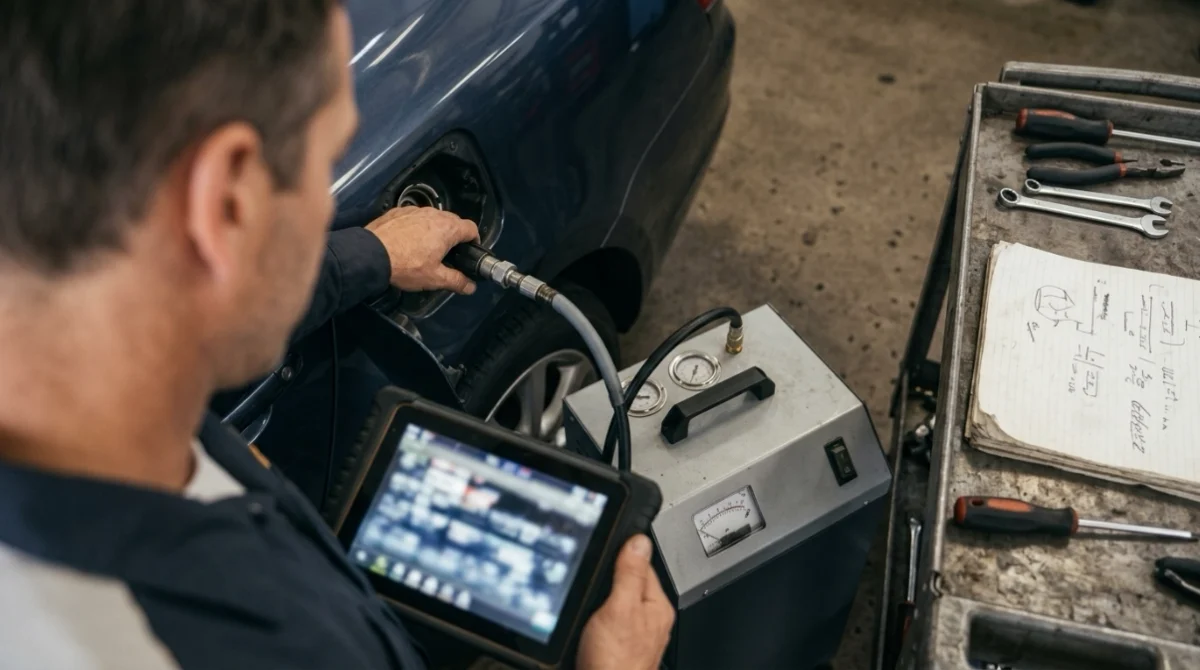
The fastest way to waste money on P0455 is to use the code as a parts list. Instead, use your OBD2 scanner and basic inspection to narrow the fault before buying anything.
- Read every code. Record stored, pending, and related EVAP codes rather than focusing on P0455 alone.
- Save freeze-frame data. It may show the conditions present when the fault was detected.
- Check the fuel cap or capless filler. Look for installation, seal, dirt, and visible damage problems.
- Inspect accessible EVAP lines. Look for disconnected fittings, split hoses, broken plastic lines, and obvious canister damage.
- Test purge and vent operation. Follow vehicle-specific procedures rather than assuming either valve has failed.
- Use a smoke test when needed. A properly performed low-pressure smoke test can reveal leaks that are difficult to see.
- Verify the repair. Recheck codes and allow the EVAP monitor to run according to the manufacturer’s requirements.
Why I Check Companion Codes First
A second code can change the entire diagnostic path. A purge-flow or vent-circuit code, for example, gives you more direction than P0455 alone.
An OBD2 scanner is useful here because it separates the stored code from the repair decision. AAA also provides an onboard diagnostic code reference for drivers who want more context before speaking with a repair shop.
Why a Smoke Test Helps
A smoke test introduces low-pressure diagnostic vapor into the EVAP system. Escaping smoke can expose a disconnected hose, leaking seal, damaged fitting, or cracked component.
This test becomes especially valuable when the cap looks good and no obvious damage is visible. It can prevent several rounds of unnecessary parts replacement.
Shop note: EVAP systems should only be tested using equipment and procedures designed for fuel-vapor systems. Avoid improvised pressure or ignition sources around gasoline vapors.
Don’t Clear the Code Too Early
Clearing P0455 before recording the other information can erase useful clues. Capture the code set and available freeze-frame data first.
After the repair, clearing codes may also reset readiness monitors. Your vehicle may need specific operating conditions before the EVAP monitor runs again.
Section Takeaway: Diagnose first and erase later. Codes, freeze-frame data, visual inspection, valve testing, and smoke testing should work together.
Can a Gas Cap Really Cause P0455?
Yes. A loose, missing, damaged, or incorrectly sealing gas cap can cause P0455 because the fuel filler opening is part of the sealed EVAP system.
That’s why the cap deserves attention before expensive diagnostic work.
Check these areas:
- Cap is fully installed.
- Seal is not cracked or torn.
- Seal has not become hard or badly flattened.
- Filler sealing surface is clean.
- Cap appears to be the correct type for the vehicle.
- Capless filler doors are clean and closing normally.
If the cap was loose after your last fuel stop, correcting it may solve the underlying problem. However, the check-engine light may not disappear immediately because the EVAP monitor must run again.
Don’t keep replacing caps if P0455 returns. At that point, move deeper into the system and inspect the vapor lines, valves, and canister.
One detail I watch is timing. A P0455 that appears shortly after refueling makes the filler area worth inspecting early, although timing alone does not prove the cap caused the code.
Which P0455 Cause Fits Your Symptoms Best?
Symptoms can help prioritize testing, but they cannot confirm the failed component by themselves. Use this table as a diagnostic starting point.
| Possible Cause | What May Point Toward It | Best First Check | Useful Confirmation |
|---|---|---|---|
| Gas cap or filler seal | Code appeared after refueling or cap was found loose | Inspect cap, gasket, and filler surface | Seal inspection or vehicle-specific cap test |
| Disconnected EVAP line | Recent repair work or obvious damaged tubing | Visual inspection of accessible connections | Smoke test |
| Purge valve | Related purge code or abnormal purge behavior | Review scan data and related codes | Vehicle-specific sealing and command test |
| Vent valve | Vent-related code, contamination, or system will not seal | Inspect vent area and wiring | Command/function test and smoke test |
| Canister or tank-area leak | Damage underneath vehicle or recent tank work | Inspect canister, hoses, and connections | Sectional smoke testing |
| Monitoring hardware | Companion sensor, circuit, or leak-detection codes | Check complete code set | Manufacturer diagnostic procedure |
A recurring P0455 after previous EVAP repairs deserves a more systematic inspection. Before authorizing expensive parts, you can also check your VIN through the NHTSA recall lookup for relevant safety recalls or manufacturer communications.
Is It Safe to Drive With P0455?
A vehicle with P0455 often still drives normally because the EVAP system mainly manages fuel vapor. However, you should not ignore the warning light or assume every P0455 situation is harmless.
Pay attention to what the vehicle is doing.
- Steady check-engine light: Arrange diagnosis soon, especially if the car otherwise runs normally.
- Strong gasoline odor: Stop treating the problem as a routine code and have the vehicle inspected promptly.
- Visible liquid fuel: Do not continue driving until the leak is professionally assessed.
- Flashing check-engine light: This can indicate another serious engine fault, so treat it as more urgent.
- Rough running or stalling: Scan for additional codes because P0455 may not explain all symptoms.
An EVAP vapor leak is not automatically the same thing as liquid gasoline leaking onto the ground. Still, fuel odor deserves caution because the source has not yet been confirmed.
For general vehicle-safety information, drivers can also review NHTSA vehicle safety guidance.
I would also avoid clearing the light repeatedly just to make the dashboard look normal. You want to know whether the fault returns after proper diagnosis and repair.
As of 2026, the basic diagnostic principle has not changed: a trouble code provides direction, not a guaranteed parts diagnosis.
Section Takeaway: P0455 often does not cause immediate drivability problems, but fuel odor, visible leakage, a flashing warning light, or abnormal engine behavior changes the urgency.
P0455 Causes FAQ
What is the number one cause of P0455?
A loose, missing, damaged, or poorly sealing fuel cap is one of the first causes to check. However, P0455 does not prove the cap is bad. Cracked hoses, purge or vent problems, canister damage, and other EVAP leaks can produce the same code.
Can a bad purge valve cause P0455?
Yes. A purge valve that leaks when it should be closed can prevent the EVAP system from sealing during a leak test. The valve should be tested before replacement because a P0455 code alone cannot identify the purge valve as the failed part.
Can a vent valve cause a P0455 code?
Yes. If the EVAP vent path cannot close when the computer runs its leak test, the system can behave as though it has a large opening. Dirt, mechanical failure, electrical faults, or damaged plumbing around the vent may be involved.
Will tightening the gas cap clear P0455 immediately?
Not always. Even after correcting a loose cap, the check-engine light may remain until the computer reruns the EVAP monitor and confirms that the system now passes. The required conditions and number of trips vary by vehicle.
Can I diagnose P0455 with an OBD2 scanner?
An OBD2 scanner is the right starting tool because it shows P0455, companion codes, and often freeze-frame information. It cannot physically locate every vapor leak. A smoke test or component test may still be needed after basic inspection.
Does P0455 always mean a physical hole or broken hose?
No. A disconnected or cracked hose can cause P0455, but a valve that fails to seal may create the same diagnostic result. Capless filler problems and vehicle-specific leak-detection hardware can also be involved.
Should I replace the gas cap first?
Inspect it first. If the cap is loose, damaged, missing, or clearly incorrect, addressing that problem makes sense. If it appears healthy, don’t keep buying caps. Continue diagnosis and test the remaining EVAP system instead of guessing.
Final takeaway: When I see P0455, I start with the simplest possible opening and work inward. Check the fuel cap, filler area, hoses, and connections before blaming an EVAP valve or canister.
If nothing obvious appears, scan every related code and have the system tested correctly. That approach is faster, safer, and far less likely to turn P0455 into an expensive guessing game.
