
Why Your Key Fob May Not Be Detected in Hot Weather — and What to Do Next

Hot weather can expose a weak key fob fast. One day it works normally, and the next day your car says it can’t detect the fob, especially after the fob has been sitting in a hot pocket, cup holder, or parked car. When that happens, the problem is usually not “heat” by itself so much as heat pushing an already marginal fob battery or internal component past the point where the car can read it reliably.
If you’re dealing with a key fob not detected in hot weather warning, the good news is that the fix is often simple. The trick is figuring out whether the issue is the fob battery, the fob itself, the vehicle’s receiver system, or something environmental. That saves time and keeps you from replacing parts you don’t need.
Emergency checklist: what to try first
- Move the fob out of heat.
- Try the spare fob.
- Hold the fob at the backup sensing point.
- Use the emergency key blade if needed.
- Replace the coin-cell battery.
What a Hot-Weather Key Fob Detection Problem Looks Like
A heat-related fob issue usually shows up as inconsistency, not a complete dead fob. You may notice one or more of these:
- The doors unlock only when you’re very close to the car.
- The push-button start works sometimes, then refuses to detect the fob later in the day.
- The warning appears after the fob has been in direct sun or inside a hot vehicle.
- The fob works again after it cools down.
That pattern matters. A truly failed fob tends to stay dead. A heat-sensitive one often acts weak, then comes back once conditions change.
If your vehicle uses passive keyless entry, the car is constantly listening for a wireless signal from the fob. When that signal gets too weak or too inconsistent, the car may display a “Key Not Detected” message even though the fob is still in your pocket or bag. For a related walkthrough on start problems, see our guide to key fob not detected and the car won’t start.
Most Likely Causes, in Order of Probability
In my experience, the most common cause is still the simplest one: a weak coin-cell battery inside the fob. Heat may make a battery that is already near the end of its life perform even less reliably, and that can be enough to make the signal inconsistent.
Here’s the usual order I’d check things:
1. Weak or dying fob battery
A marginal battery may still power the fob at room temperature, then fall short when the fob gets hot. That can lead to intermittent detection rather than a total failure.
2. Heat-stressed internal electronics
The circuit board, solder joints, or battery contacts inside the fob can sometimes become less reliable after repeated exposure to high heat. That doesn’t always mean the fob is ruined, but it can make the signal unstable.
3. Poor battery contact or corrosion
If the battery isn’t seated firmly, or if there’s corrosion on the contacts, heat can make an already weak connection worse.
4. Vehicle-side receiver or antenna issue
Sometimes the fob is fine, but the car isn’t reading it well. A receiver or antenna problem can sometimes look a lot like a bad fob, especially when the signal is already weak.
The key point: heat often doesn’t create a brand-new problem. It can expose one that was already there.
What to Do Right Now if the Car Won’t Detect the Fob
If you’re stuck in a parking lot or driveway and the car won’t see the fob, use the fastest path back to normal operation.
1. Move the fob out of the heat
Take it out of a hot pocket, off the dashboard, or away from direct sun. If you’re carrying it in a bag, move it to a cooler spot for a few minutes.
2. Try the spare fob
This is the quickest comparison test. If the spare works normally in the same conditions, the original fob is the more likely problem.
3. Use the emergency key blade if you need to unlock the door
Many fobs contain a hidden emergency key blade. That lets you get into the vehicle even when the electronic part isn’t being detected. Your owner’s manual shows where the release is and where the lock cylinder may be hidden.
4. Hold the fob at the backup sensing point
Many push-button start vehicles have a backup sensing area near the start button, steering column, center console, or cupholder area. In some vehicles, placing the fob there allows the car to recognize the transponder even when the battery is weak. The exact method varies by model, so follow the owner’s manual.
If you need a more model-specific overview of backup starting, our guide to key fob not detected on push-button start covers the usual procedures.
5. Replace the coin-cell battery
If the spare works, or if the original fob only works when held very close to the car, the battery is a strong suspect. Replacing it is often the simplest next step.
How to Tell if the Problem Is Heat, RF Interference, or the Vehicle
The spare fob is the main comparison test here. If the original fob fails in hot conditions but the spare works in the same spot, that points toward the original fob. If both fobs fail only in one location, environmental RF interference or a vehicle-side issue becomes more likely. If both fobs work when held directly against the backup sensing point, that also suggests the car can detect the fob at short range, even if normal passive keyless entry is struggling.
How to Test Whether the Key Fob Battery Is the Real Cause
You do not need to guess. A quick decision path usually tells you enough.
Check the age of the battery
If the battery is old, unknown, or has been in the fob for years, replacement is a sensible first move. Coin-cell batteries are inexpensive compared with the time wasted diagnosing a weak one.
Watch for close-range-only behavior
If the fob works only when you are very close to the car, that is a classic sign of a weak signal. A low battery can make that more noticeable.
Compare cool vs. hot performance
If the fob works in the morning but becomes unreliable after sitting in the sun or a hot car, that points toward a marginal battery or heat-sensitive internal issue.
Compare with the spare
If the spare works normally and the original does not, you’ve narrowed it down quickly. If both behave badly in the same vehicle, the car-side receiver becomes more suspicious.
A simple at-home test path is: try the spare first, then hold the original fob at the backup sensing point, then check the battery voltage if you have a meter and know the battery type. If the car only detects the fob when it is pressed directly against the start button or backup sensing area, that usually points to a weak signal rather than a fully dead fob.
How to Tell if the Problem Is the Fob or the Vehicle
A spare key fob is your best test tool.
| Symptom | Likely source | Best next step |
|---|---|---|
| Original fob fails in heat, spare works normally | Original fob battery or internal fob issue | Replace battery first, then inspect the fob |
| Both fobs fail in the same hot conditions | Vehicle receiver, antenna, or vehicle-side detection issue | Check the owner’s manual and seek diagnosis |
| Fob works only at very close range | Weak battery or weak signal | Replace the battery and inspect contacts |
| Fob works again after cooling down | Heat-sensitive battery or electronics | Avoid heat exposure and monitor for repeat failures |
This comparison saves money and time. If the spare behaves exactly the same way, don’t keep buying batteries for the wrong fob.
If both fobs are affected, the vehicle may not be reading the signal correctly. That can happen with a receiver, antenna, or related keyless-entry component. At that point, the problem is no longer just a battery swap.
A quick non-dealer check is to try the fob in different locations around the car, especially near the driver door handle and the backup sensing point. If the fob works in one spot but not another, that can help narrow whether the issue is range, interference, or a vehicle-side detection problem.
When Replacing the Key Fob Battery Will Fix It
A battery replacement is the best first repair when:
- the battery is old or unknown,
- the fob works inconsistently,
- the signal range has gotten shorter,
- the issue gets worse in heat,
- the fob works again after cooling off.
That said, a new battery is not a magic fix for every case. If the fob has corrosion, internal damage, a cracked case, or damaged contacts, the battery may improve things briefly or not at all.
One useful clue: if the fob is only marginally better after a battery swap, the problem may be deeper than the battery. That usually means internal wear or damage.
For general detection and start issues, NHTSA’s vehicle safety resources are a good place to check for recalls or manufacturer guidance if the problem seems broader than the fob itself.
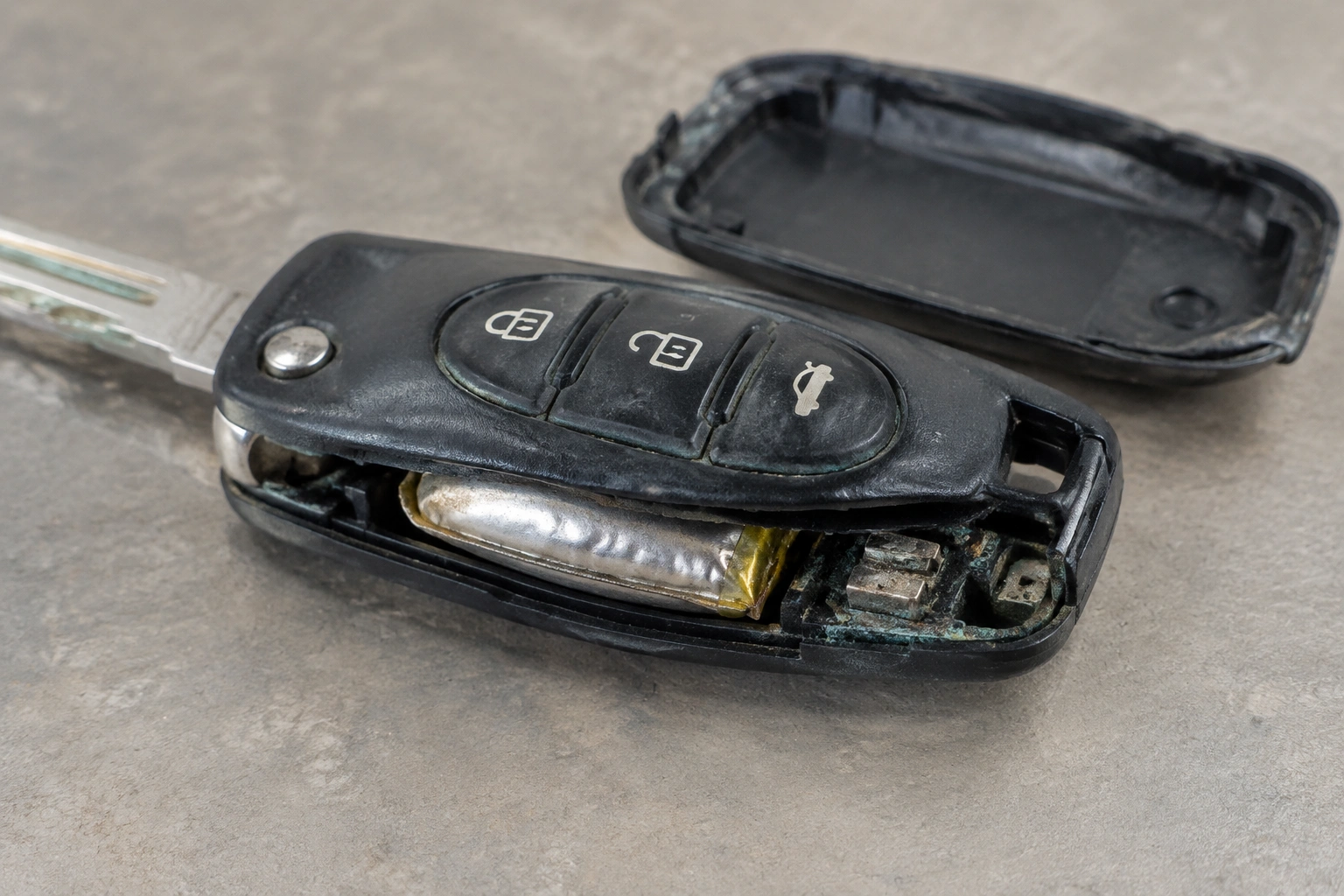
Signs of Heat Damage, Swelling, or Internal Fob Failure
A key fob that has been repeatedly overheated can show physical warning signs. Look for:
- a swollen or warped case,
- loose battery contacts,
- green or white corrosion,
- cracked plastic,
- liquid damage,
- buttons that feel sticky or uneven,
- a fob that only works after being cooled and then fails again quickly.
If the battery is swollen or leaking, handle it carefully and replace it promptly. Don’t keep using a fob that feels abnormally hot or looks distorted. That’s no longer a simple “weak battery” situation.
Using the Spare Key Fob and Preventing Repeat Failures
If the spare fob works, use it while you sort out the original. That keeps you mobile and gives you a reference point for diagnosis.
To reduce repeat problems:
- keep the fob out of direct sun,
- don’t leave it on the dashboard,
- avoid storing it in a hot cup holder,
- don’t leave it in a parked car for long periods,
- keep an eye on battery age if the fob has already become inconsistent.
I’ve seen plenty of fobs fail because they were stored in a sun-baked car interior. Heat may not kill a healthy fob, but it can push a weak one over the edge.
For broader lock and remote access context, Edmunds has helpful owner-oriented coverage on keyless entry and smart key systems, which can be useful if you’re comparing how your vehicle’s system should behave.
When to Consult a Locksmith
Call a locksmith, dealer, or mechanic if:
- both fobs fail in the same vehicle,
- a battery replacement does not improve detection,
- the fob has visible damage or corrosion,
- the backup start method does not work,
- the car still says “Key Not Detected” even with a known-good spare,
- you suspect a receiver, antenna, or immobilizer issue.
A locksmith is especially useful when you need a fast diagnosis of the fob itself, such as battery replacement, case repair, contact cleanup, or confirming whether the fob is transmitting. If the vehicle-side system is the likely problem, a dealer or qualified mechanic may be the better fit because they can check receiver, antenna, or immobilizer faults more directly.
If you want to compare your symptoms with another common detection issue, our article on key fob not detected while driving explains how intermittent signal problems can show up on the road.
FAQ
Can hot weather really make a key fob stop working?
Yes. Heat can make a weak battery or marginal internal component perform badly enough that the car no longer detects the fob reliably.
Will a new battery always fix the problem?
No. A new battery often helps, but if the fob has corrosion, internal damage, or broken contacts, the issue may continue.
Why does the fob work in the morning but not later in the day?
That usually points to a marginal battery or heat-sensitive electronics. Cooler conditions can let a weak fob work normally for a while.
Is the car battery the problem?
Not usually if the issue is only with fob detection. A car-side receiver or antenna issue is more likely than the vehicle battery in this situation.
What if the spare fob works?
That strongly suggests the original fob is the problem, not the car.
Should I keep the fob out of the sun?
Yes. Avoid leaving it on the dashboard, in a hot pocket, or anywhere else it can soak up heat for long periods.
Can the fob be permanently damaged by heat?
In some cases, yes. If you see swelling, corrosion, or repeated failures after cooling, the fob may need repair or replacement.
What is the fastest thing to try first?
Use the spare fob if you have one. If not, try the backup start method and replace the coin-cell battery as soon as practical.
How do I know if it’s heat or RF interference?
Use the spare fob as the comparison test. If both fobs fail only in one location, interference or a vehicle-side issue is more likely than heat alone.
Can I test the vehicle-side antenna myself?
You can narrow it down by trying the fob at different spots around the car and at the backup sensing point. If it works in one spot but not another, that can help distinguish a fob problem from a receiver or antenna issue.
