
Subaru Key Fob Not Working? A Practical Troubleshooting Guide for Drivers

If your Subaru key fob suddenly stopped unlocking the doors, the first instinct is usually to blame the fob itself. Sometimes that’s right. But in the shop, I learned that a lot of “dead fob” complaints turn out to be something simpler: a weak coin-cell battery, a worn button, a bad connection inside the fob, or even a vehicle-side issue.
The good news is that you can sort out most of those possibilities at home without guessing. The trick is to test the easy things in the right order so you don’t waste time or money replacing parts you didn’t need.
Quick Diagnosis: What Subaru Key Fob Symptoms Usually Mean
The symptom often tells you where to look first.
If the fob works only when you stand very close to the car, the battery is usually weak. That’s a classic sign: the remote still sends a signal, but not a strong one.
If the buttons work sometimes and fail other times, I’d look at two things before anything else: the battery contacts inside the fob and the button pads themselves. A fob that needs to be pressed hard or at an angle often has worn internal contacts.
If the fob does nothing at all, even after a battery change, the problem could be a dead battery installed the wrong way, a damaged circuit board, or a vehicle-side issue.
If your Subaru has push-button start and the doors still unlock but the car won’t recognize the fob inside, that points away from the lock/unlock buttons and toward the smart-key communication side of the system.
A useful comparison:
- Weak range or intermittent operation usually points to battery or contact problems.
- No response after a fresh battery raises the odds of damage, bad programming, or a car-side issue.
- Multiple fobs failing at once makes the vehicle battery or receiver more suspicious than the fob itself.
For a broader look at how remote-button failures show up across vehicles, see our guide on key fob lock button problems.
Most Likely Causes, From Easiest to Least Likely
When a Subaru key fob not working complaint comes in, I’d rank the causes like this:
- Weak or dead CR2032 battery
- Poor battery contact inside the fob
- Worn buttons or a cracked case
- Programming or sync issue
- Low vehicle battery or vehicle-side receiver problem
- Internal fob damage from water, impact, or corrosion
That order matters because the first three are the cheapest and fastest to check. A lot of owners jump straight to reprogramming, but if the battery is weak, reprogramming won’t fix anything.
A simple example: if your Outback remote only works when you press it right next to the door handle, that’s much more consistent with a weak battery than with a lost program. On the other hand, if both the main fob and spare stopped working after the car sat for a while, the car battery becomes a much better suspect.
Check the Key Fob Battery First
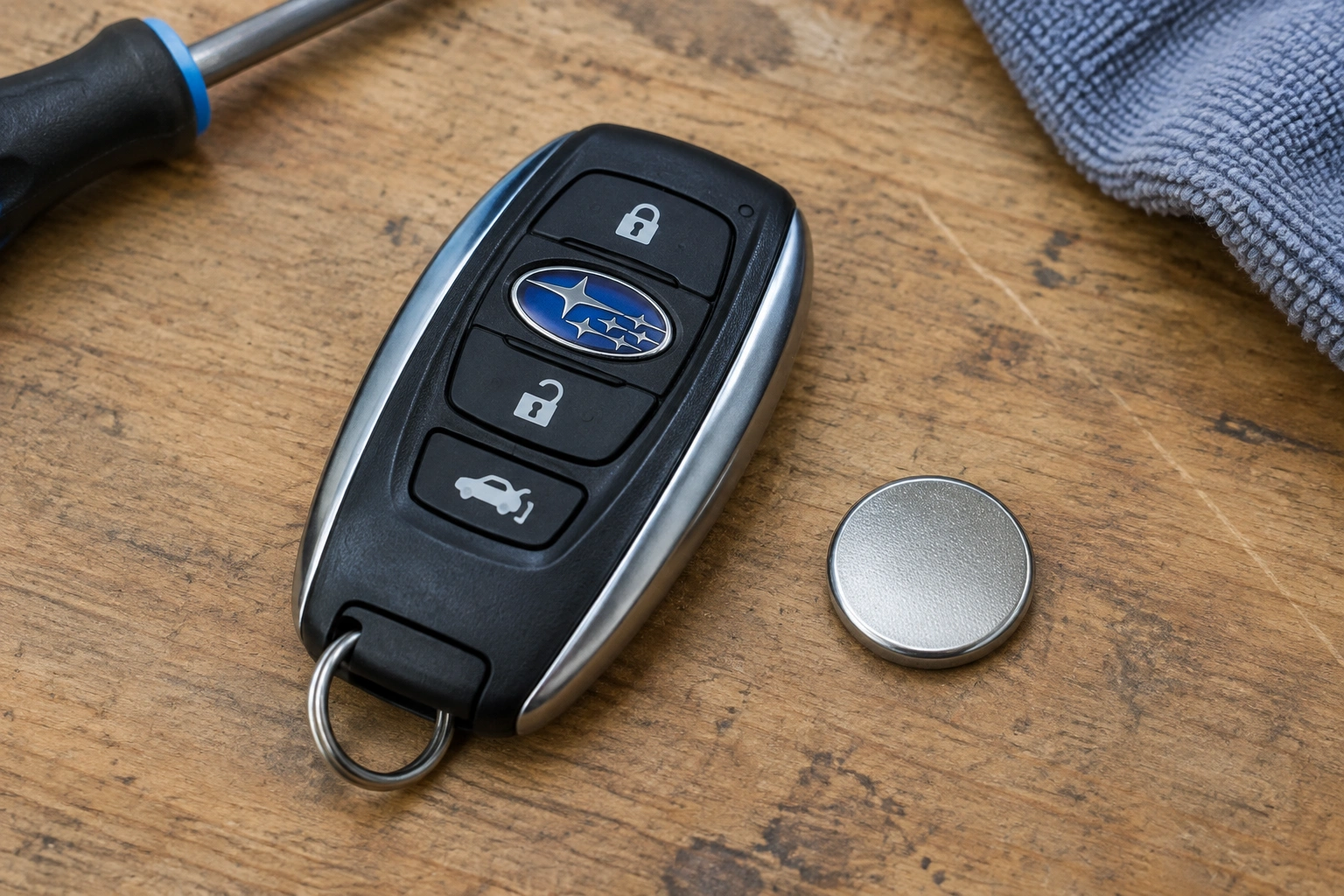
Most Subaru remotes and smart keys use a CR2032 battery, but always confirm the battery type in your owner’s manual or by opening the fob and reading the old cell. Using the wrong coin-cell size can create a false “the fob is broken” diagnosis when the real problem is a bad replacement battery or poor fit.
Signs the battery is weak include:
- Shorter range than usual
- Needing to press the button multiple times
- Intermittent locking or unlocking
- Push-button start recognition that comes and goes
- The car only responding when the fob is very close
If the battery is old, replacing it is the safest first move. It doesn’t require programming in most cases, and it’s the most common fix to rule out.
For more on why weak batteries can mimic bigger problems, Subaru owners often find it helpful to compare symptoms with general remote-entry troubleshooting from Edmunds.
How to Replace the Battery in a Subaru Key Fob
Open the fob carefully. Don’t pry hard against the seam or twist the shell with a screwdriver like you’re opening a paint can. Subaru fobs use plastic clips, and forcing the case can crack the housing or damage the circuit board.
A practical approach:
- Remove the backup key if your fob has one.
- Use the key blade or a small flat tool to separate the case at the seam.
- Note the battery orientation before removing it.
- Replace the old cell with a fresh CR2032 battery.
- Reassemble the case firmly so the halves sit flush.
Two mistakes cause a lot of unnecessary headaches:
- Installing the battery backward
- Touching or bending the metal contacts so they no longer press firmly on the battery
If the battery looks fine but the contacts are dirty or flattened, the fob may still act dead. A battery swap only helps if the circuit can actually power up.
A quick caution: if the fob was exposed to water, don’t assume a new battery will save it. Corrosion can take out the board even when the case still looks normal.
Test the Fob After Battery Replacement
After the new battery is in, test all the functions one by one:
- Lock
- Unlock
- Panic, if equipped
- Remote start, if your Subaru uses it
- Push-button start recognition, if applicable
A fob that works normally again after the battery swap is usually done. If it works only part of the time, that’s a clue that the battery wasn’t the only issue. At that point, I’d inspect the button feel, battery contact pressure, and case condition.
If the fob still does nothing, don’t keep swapping batteries blindly. That usually means one of three things:
- The battery isn’t seated correctly
- The fob has internal damage
- The car-side system isn’t recognizing the signal
If the Fob Still Does Not Work: Reprogramming, Resyncing, or Vehicle-Side Issues
This is where people lose time. Not every Subaru key fob problem is a programming problem.
If a fresh battery doesn’t restore operation, the next step depends on the model and year. Some Subaru fobs can be resynced by the owner using the procedure in the owner’s manual, but many smart-key systems require dealer or locksmith programming. In other words, if your Subaru uses a newer push-button start setup, don’t assume there’s a simple at-home reset.
Here’s the practical split:
- One fob fails, spare works: the problem is likely in the bad fob.
- Both fobs fail: look at the car battery, receiver, or vehicle-side system.
- Fob unlocks doors but won’t start the car: the smart-key recognition side may be the issue, not the remote buttons.
- Manual resync works only on some models: check the owner’s manual before trying any reset procedure.
If the car battery is weak, keyless entry and push-button start can act erratic even though the fob is fine. That’s why I check the vehicle battery after the fob battery, not before it.
How to Start and Unlock Your Subaru When the Fob Battery Is Dead
If your Subaru smart key battery dies, you still need a way in. Most Subaru fobs include a backup key hidden inside the shell.
Use it to unlock the driver’s door manually. That gets you access even when the remote buttons are dead.
For push-button start models, Subaru vehicles commonly have an emergency start method that allows the car to detect the fob when it is held in a specific position near the start area. Verify the exact backup-start procedure in your owner’s manual for your specific Subaru model and year, because the steps vary.
A few practical reminders:
- Don’t keep pressing the start button over and over if the car doesn’t recognize the fob.
- Use the backup key to get inside first.
- If the car battery is also weak, the emergency start method may not behave normally.
If you’re stuck and need a broader comparison of remote vs vehicle-side failures, our Ford key fob troubleshooting guide shows the same diagnostic logic in another brand context.
Signs the Key Fob Is Damaged Beyond a Simple DIY Fix
At some point, a battery swap is no longer the answer.
Watch for these warning signs:
- Cracked or separated case
- Buttons that sink, stick, or feel mushy
- Water damage or corrosion inside the shell
- Battery contacts that are bent, loose, or broken
- A fob that only works after you squeeze it or tap it
- Visible damage to the circuit board
A fob with those symptoms may still be repairable, but it’s no longer a simple battery job. If the board is corroded or the button pads are worn through, replacement is usually more practical than repeated DIY attempts.
When to Consult a Locksmith
A locksmith is worth calling when the problem is bigger than a battery swap but doesn’t clearly require a dealer.
That usually makes sense if:
- Your Subaru uses a smart key and the fob needs programming
- You’ve already tried a fresh battery and the backup key works, but remote functions don’t
- You have one working fob and need a second one cloned or programmed
- The car recognizes neither fob and you want a faster diagnosis than a dealership visit may offer
The key question is whether the locksmith can actually handle Subaru smart keys. Some automotive locksmiths cut basic backup keys and replace simple remotes, but not all of them can program Subaru proximity fobs or newer push-button start systems. Before you book, ask whether they can cut and program Subaru smart keys for your model year.
Dealer service can be the right move for newer Subaru systems or situations where model-specific programming support is limited. But an automotive locksmith can sometimes handle the job faster and with less hassle, especially for standard replacement and programming work. Availability varies by area and by model.
Replace the Fob or Repair It? How to Decide
Use this rule of thumb:
- Replace the battery when the fob is intermittent, weak, or completely dead but physically intact.
- Repair the fob when the case, buttons, or contacts are the main issue and the electronics still seem alive.
- Reprogram or resync when the battery is good but the car no longer recognizes the fob.
- Replace the whole fob when there’s water damage, a cracked board, or repeated failures after basic fixes.
If the fob is old and the shell is worn out, replacement can be the more sensible long-term choice. If the issue is only a dead battery, though, replacing the entire unit is unnecessary.
Subaru Key Fob Troubleshooting Checklist
Use this sequence and you’ll avoid most dead-end repairs:
- Test the spare fob.
- Replace the battery with the correct coin cell.
- Check battery orientation and contact fit.
- Inspect the case, buttons, and battery contacts.
- Compare behavior with the vehicle battery and other fobs.
- Try the backup key and verify the emergency-start method in the owner’s manual if needed.
- Consider reprogramming only after the battery check.
- Call a locksmith or dealer if the fob still won’t work.
That order saves time because it separates fob-side problems from vehicle-side problems early.
FAQ
Does a Subaru key fob need to be reprogrammed after a battery change?
Usually not, but if the fob still doesn’t work after a correct battery replacement, programming or another issue may be involved.
Can I start my Subaru if the key fob battery is dead?
Often yes, using the backup key for access and the manufacturer’s emergency start procedure for push-button start models. Check your owner’s manual for the exact steps.
Why does my Subaru key fob work sometimes but not always?
That pattern usually points to a weak battery, poor contact inside the fob, or worn button components.
What if both of my Subaru key fobs stop working?
When both fobs fail at the same time, the car battery or vehicle-side receiver becomes much more likely than two bad fobs.
Do I need a dealer to fix the fob?
Not always. A locksmith may be able to help with battery replacement, programming, or replacement, but newer Subaru systems sometimes require dealer support.
How do I know if the fob is broken instead of just dead?
If a fresh battery doesn’t help and the case, buttons, or contacts are damaged, the fob may be beyond a simple DIY fix.
