
Does Cold Weather Affect a Key Fob? What Drivers Should Check First

Yes — cold weather can absolutely affect a key fob. In winter, a fob may lose range, respond slowly, work only sometimes, or seem dead until it warms up. That does not always mean the fob is broken. More often, the cold is exposing a weak coin-cell battery, a weak car battery, or a borderline connection in the vehicle’s receiving system.
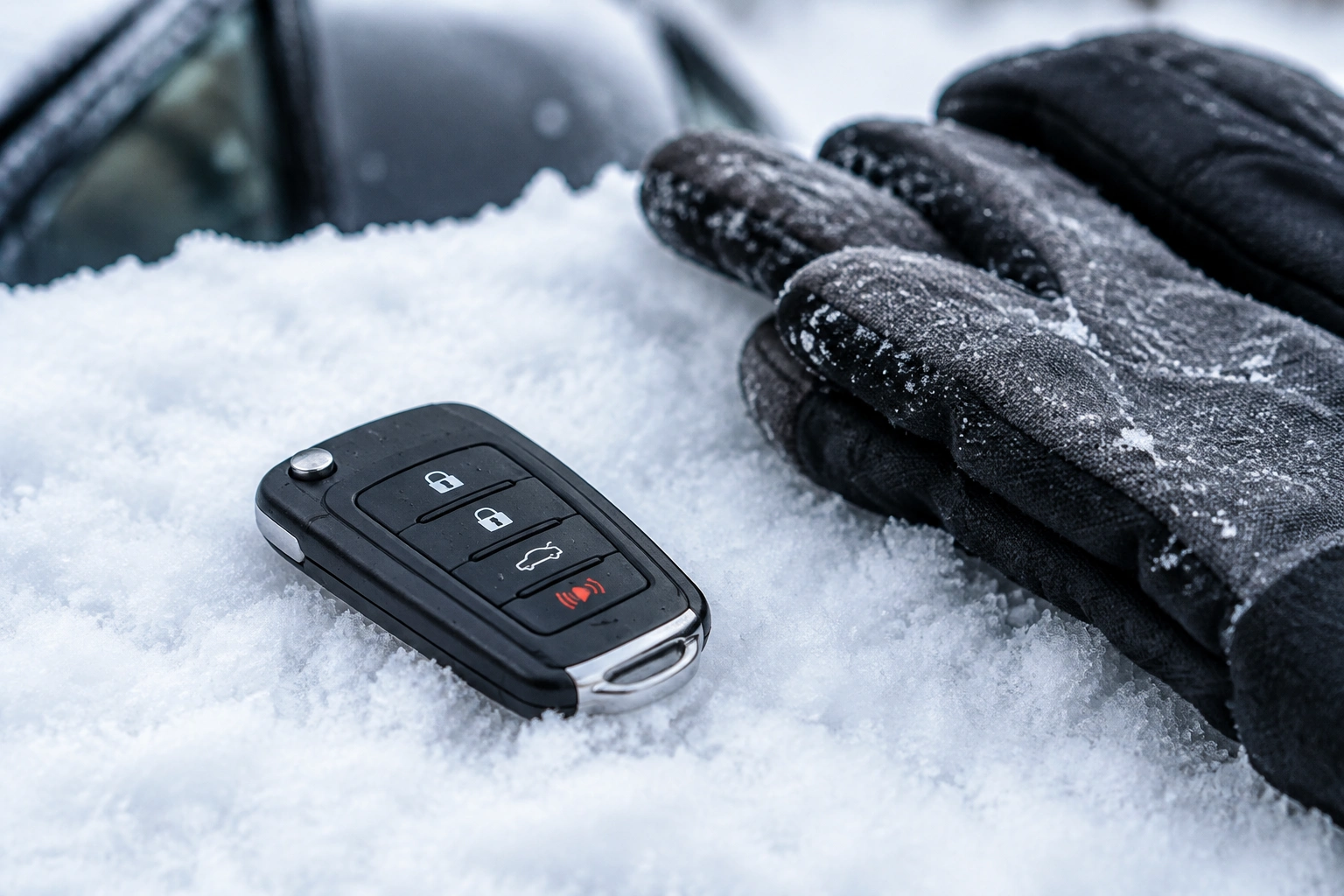
If your key fob acts up only on cold mornings, treat that pattern as a clue. The goal is to figure out whether you are dealing with a temporary cold-related slowdown or a battery that is already near the end of its life.
What Cold Weather Does to a Key Fob
A key fob is a small radio transmitter. It sends an RF signal to the vehicle, and that signal depends on battery power. In cold temperatures, the battery’s chemistry slows down, which can reduce output enough that the fob becomes weaker or stops working altogether. That is why a fob may seem fine indoors, then struggle outside in freezing air.
Cold can also affect the fob in less obvious ways. Some internal parts may contract slightly, which could contribute to button response or connection issues in some cases. Moisture is another winter problem: snow, rain, and condensation can get into a fob and cause short circuits or corrosion if the casing is damaged.
Keeping car keys in a warmer place when not in use can help reduce winter failures. A fob that works in a coat pocket may still fail after sitting overnight in a cold garage or on a frozen kitchen counter.
Symptoms That Point to a Cold-Related Fob Problem
Cold weather usually leaves a pattern. The fob may not be completely dead; it may just be inconsistent. These are the signs I pay attention to first:
- The range gets shorter in winter.
- The fob works after warming up in your hand or pocket.
- It fails on very cold mornings, then works later in the day.
- You have to press buttons more than once.
- The car unlocks, but the push-button start does not recognize the fob right away.
That last symptom matters. If the doors unlock but the car will not start, the fob may still be transmitting just enough for the locks but not enough for the vehicle’s start authorization system. That often points to a weak fob battery, especially if the car recognizes the fob only when it is held close to the start button or backup reader location.
The Most Likely Causes, in Order
When a fob stops working in the cold, I work through the likely causes in this order:
1) Weak key fob battery
This is the most common and cheapest fix. A lithium coin cell can still have some life left and still fail under cold conditions because voltage output drops when the battery is stressed. That is why winter often exposes a battery that was already borderline.
2) Weak car battery
A weak vehicle battery can mimic a key fob problem. If the car’s electrical system is struggling, the receiver, locks, and push-button start may not behave normally. Cold weather is hard on car batteries too, so winter can create a double problem: the fob battery is weaker and the car battery is weaker.
3) Cold-stiffened electronics or signal issues
Sometimes the fob itself is fine, but cold conditions affect the electronics enough to make the signal less reliable. This is more likely when the problem is intermittent and improves quickly after warming the fob.
4) Moisture, corrosion, or physical damage
If the fob has been dropped, exposed to water, or already has battery leakage, cold weather can make an existing problem more noticeable.
5) Vehicle-side receiver or backup system issue
If the fob battery is new and the car battery checks out, the problem may be on the vehicle side. That is when deeper diagnosis becomes worthwhile.
Key Fob Battery vs. Car Battery: How to Tell the Difference
Here is the fastest way to separate the two.
| Symptom | More likely key fob battery | More likely car battery |
|---|---|---|
| Fob works better when warmed in your hand or pocket | Yes | No |
| Fob unlocks the car only at very close range | Yes | Sometimes |
| Push-button start works only when the fob is held near the start area | Yes | Sometimes |
| Interior lights are dim or the engine cranks slowly | No | Yes |
| Multiple electrical systems act weak in cold weather | No | Yes |
| Fob battery is older and has never been replaced | Yes | Maybe |
| Car starts normally once jump-started, then the fob works | Maybe | Yes |
The key difference is scope. A key fob battery problem usually affects the remote itself. A car battery problem usually affects the whole vehicle: cranking, lights, electronics, and sometimes the smart-key receiver.
If you are seeing both symptoms at once, do not assume the fob is the only issue. A weak car battery can make a good fob look bad.
Quick Fixes to Try First
These are the fastest low-risk checks I recommend before replacing parts.
Move closer to the car
If the fob is weak, range matters. Stand right next to the driver’s door and try again. If the car has a push-button start, hold the fob in the exact backup reader location described in the owner’s manual.
Warm the fob safely
Put the fob in a coat pocket, hold it in your hand, or bring it indoors for a few minutes. That is usually enough to tell whether cold is the trigger. Do not use an oven, microwave, space heater, or direct high heat. You want gentle warming, not heat damage.
Use the mechanical key
If your fob has a hidden mechanical key, use it to get into the car. This gets you access even when the electronics are not cooperating. It does not fix the fob, but it prevents a lockout from becoming a bigger problem.
Try the backup start method
Many push-button start vehicles have a backup way to start the car when the fob battery is weak. Usually the fob must be held very close to the start button or a marked detection area. Check the owner’s manual for the exact procedure for your vehicle.
Test again after warming
If the fob works after warming but fails again once it is cold, that is a strong sign the battery is borderline.
When Warming Helps and When It Does Not
Warming is useful as a test, not a cure.
If the fob starts working after a few minutes in your pocket, that tells you the battery is probably weak or temperature-sensitive. In that case, warming buys time, but it is not a reliable long-term fix.
If warming does nothing, the issue may be more serious:
– the coin-cell battery may be too far gone,
– the fob may have moisture inside,
– the car battery may be weak,
– or the vehicle may not be receiving the signal properly.
That distinction matters because it helps you avoid the common mistake of testing the fob over and over when the real problem is the battery or the car itself.
When to Replace the Key Fob Battery
Replace the coin-cell battery when the fob shows any of these patterns:
– reduced range,
– intermittent operation,
– repeated winter-only failures,
– delayed response,
– or temporary recovery after warming.
That is usually the first low-cost fix worth trying. If the battery is old enough to be acting up in cold weather, replacing it is often smarter than waiting for a full failure. A fresh battery is not a guarantee if the fob is damaged or the car battery is weak, but it removes the most common variable from the equation.
When the Problem Is Probably the Car Battery or Vehicle System
If the car itself is struggling, the fob may be getting blamed unfairly.
Look for these signs:
– the engine cranks slowly,
– the dash lights are dim,
– the interior electronics act sluggish,
– the car needed a jump start,
– or the fob still fails even after you replace the coin-cell battery.
A weak car battery can create strange winter symptoms because the vehicle may not power the receiver or start system correctly, even if the fob itself is fine. In that case, a new fob battery alone will not solve the root issue.
If the vehicle starts normally but still does not recognize the fob, then the issue may be on the receiver side or in the backup detection process. That is when the owner’s manual becomes especially important, because some vehicles have a specific emergency start procedure that is easy to miss.
For more detail on that side of the diagnosis, see what to check when a key fob is not detected in cold weather and how a weak car battery can affect your key fob.
Step-by-Step Troubleshooting for Unlocking and Starting
Use this sequence when the fob is acting up in the cold:
- Try the fob right next to the vehicle. If it works at close range, the battery is likely weak.
- Warm the fob in your pocket or hand. If it recovers, temperature is part of the problem.
- Use the mechanical key for entry. This keeps you from getting locked out while you diagnose.
- Check whether the car battery seems weak. Slow cranking or dim lights point away from the fob.
- Try the backup start method. If the car starts only when the fob is placed near the reader, the fob battery is probably borderline.
- Replace the fob battery. This is the most practical next step if symptoms keep returning.
- Retest in the cold. If the problem persists after a battery swap, the issue may be the fob itself or the vehicle system.
That order saves time because it starts with the most likely, least expensive fixes first.
Winter Prevention Tips That Actually Help
The best winter habits are simple and realistic:
- Keep the fob in an inside coat pocket when you are outside.
- Replace an aging coin-cell battery before winter if the range is already shrinking.
- Keep a spare fob battery in the glove box or home drawer.
- Check the car battery before severe cold arrives, especially if it is several years old or has been slow to crank.
- Keep the fob dry. If it gets wet, dry it promptly and inspect the battery compartment for corrosion.
- Avoid tossing the fob into places where it sits in deep cold for hours, like an unheated garage shelf or a freezing cup holder.
The trade-off is simple: a spare battery costs little and can save a lot of hassle, while a spare fob is more reliable but obviously a bigger investment.
When to Call an Automotive Locksmith
Call an automotive locksmith when the fob still fails after you replace the battery and try the backup start method, or when the fob has visible damage, corrosion, or a battery leak. That is also the right move if the car works inconsistently and you cannot tell whether the problem is in the fob, the receiver, or the vehicle battery.
A locksmith can usually help you narrow down whether the issue is a battery, a damaged fob, or a vehicle-side problem without forcing you to guess. That is especially useful when winter weather is making the symptoms come and go.
FAQ
Can cold weather make a key fob stop working completely?
Yes. Cold can reduce battery output enough that the fob appears dead, especially if the battery was already weak.
Why does my key fob work sometimes in the cold and not others?
That usually points to a borderline battery or a signal that is only strong enough under certain conditions. Temporary warming often makes that pattern more obvious.
Is it the fob battery or the car battery?
If only the fob is affected, suspect the fob battery first. If the whole vehicle is sluggish, dim, or hard to start, check the car battery too.
Why will my fob unlock the doors but not start the car?
The fob may still be transmitting enough for locking but not enough for the start authorization system. That often means the fob battery is weak.
Should I replace the battery or warm the fob first?
Warm it first as a test. If it comes back to life, replace the battery soon because the cold is exposing a weak battery.
What if the fob still does not work after a battery change?
Then the issue may be the vehicle receiver, moisture damage, corrosion, or a deeper fob fault. That is when professional diagnosis is worth it.
Can moisture from snow or rain damage a fob?
Yes. Moisture can cause short circuits or corrosion, especially if the case is cracked or the battery cover is loose.
Is it worth keeping a spare battery in winter?
Yes. It is one of the simplest ways to avoid being stuck with a weak fob on a freezing morning.
