
Can a Dead Key Fob Be Repaired? A Practical Troubleshooting Guide for Car Owners

A dead key fob is frustrating, but it is not always a throwaway problem. In many cases, the issue is something simple: a weak battery, dirty contacts, a loose internal connection, or a fob that needs to be resynced. In other cases, the circuit board is damaged enough that replacement makes more sense than repair.
The short answer to can a dead key fob be repaired is: sometimes, yes — but only if you identify what failed first. If the battery is the problem, the fix may take only a few minutes. AAA notes that changing a key fob battery is often straightforward when you have the correct battery and handle the case carefully. AAA’s dead key fob guide is a good reminder not to buy a new fob before checking the basics.
If your fob is completely unresponsive, the goal is to separate three possibilities:
1. the fob battery is dead,
2. the fob electronics are damaged, or
3. the car is not detecting the signal.
That order matters because it keeps you from paying dealer prices for a problem that may be solved with a coin-cell battery.
Quick answer: when a dead key fob is repairable
A dead fob is usually worth repairing when the issue is limited to:
– a dead or weak battery
– loose battery contacts
– dirty or corroded terminals
– worn buttons
– a minor internal connection issue
– a resync or reprogramming problem after a battery change
A dead fob is often not worth repairing when:
– it has water damage on the circuit board
– the board is cracked or burned
– corrosion has spread widely
– the case is broken and parts are missing
– repair costs are close to the price of a replacement fob
That is the decision rule I use when people ask whether to fix or replace: if the failure is local and simple, repair it; if the board is damaged, replace it.
Signs your key fob is actually dead
A “dead” fob can mean different things, and the symptom pattern tells you a lot.
Weak-signal symptoms
These often point to a battery or contact issue:
– the fob works only when you stand close to the car
– unlock works, but only sometimes
– the range has gotten shorter over time
– buttons need extra pressure to respond
Total failure symptoms
These can mean a dead battery, but they also raise the odds of electronics trouble:
– nothing happens when you press any button
– the car shows no sign of receiving the signal
– the fob stopped working after being dropped or exposed to moisture
– the key fob light, if equipped, does not illuminate
Symptoms that point to the car, not the fob
Sometimes the fob is fine and the vehicle is the issue:
– both key fobs stop working at the same time
– the vehicle battery is weak
– the car only responds intermittently
– the doors or start system behave oddly even with a known-good fob
If you have a second fob, compare them. When one works and the other does not, the problem is usually in the fob itself. When both fail the same way, look harder at the vehicle battery, receiver, or immobilizer system.
Most likely causes, in order
A practical diagnosis usually starts with the cheapest and most common causes first.
1) The key fob battery
This is the first thing to check because it fails often and is usually easy to replace. Many fobs use a coin-cell battery, but the exact type depends on the vehicle. Use the battery listed in the owner’s manual or on the old battery itself.
A common mistake is installing the right battery backward or using a slightly different size that seems to fit but does not make solid contact.
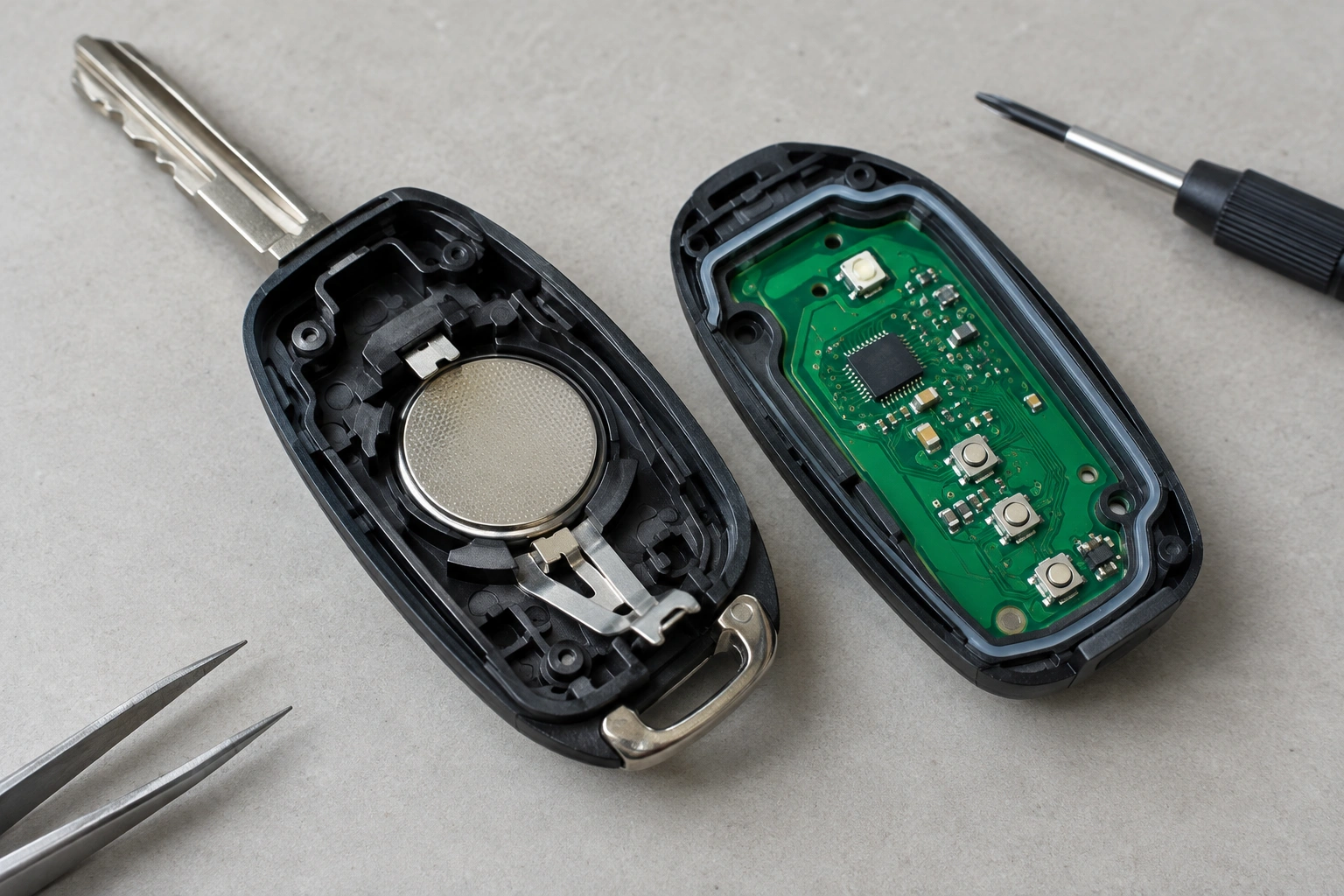
2) Dirty or loose battery contacts
A battery can be brand new and still not work if the metal contacts inside the fob are bent, dirty, or corroded. Even light oxidation can interrupt power, depending on the fob design and how much buildup is present.
3) Button wear or case damage
If the rubber buttons are worn through, the fob may not send a reliable signal. Cracked cases can also shift the battery enough to break contact.
4) Reprogramming or resync issues
Some fobs need to be resynced after a battery change. Others lose programming if the battery was disconnected too long or if the vehicle has had electrical work.
5) Vehicle-side detection problems
The issue may be in the car, not the fob. A weak vehicle battery, radio-frequency interference, or a fault in the receiver can make a healthy fob seem dead. If you want a deeper look at interference as a cause, see our guide on when radio interference can stop a key fob from working.
6) Internal electronics damage
If the fob was dropped, soaked, or exposed to corrosion, the circuit board may have a cracked solder joint or damaged component. That is where repair becomes more uncertain.
Step-by-step troubleshooting you can do at home
Here is the practical sequence to use before spending money on a replacement.
1) Try the spare fob, if you have one
This is the fastest way to tell whether the car or the fob is at fault.
- If the spare works, your original fob is the likely problem.
- If both fail, the issue may be the car battery, receiver, or programming.
2) Check whether the fob is transmitting at all
If the remote buttons seem dead, first confirm whether the fob is sending a signal.
- On some fobs, you can use a phone camera to look for an infrared LED flash when a button is pressed.
- For many RF-based fobs, a key-fob tester or RF tester can confirm whether the fob is transmitting.
This does not fix the problem, but it helps separate a dead transmitter from a vehicle-side issue. Not every fob uses the same signal type, so this test is vehicle- and fob-specific.
3) Replace the battery first
This is the most cost-effective first move. Open the fob carefully, note the battery orientation, and install the correct replacement.
If you need a step-by-step reminder, our guide on what to do when the key fob battery is dead covers the emergency-start side of the problem too.
4) Inspect the battery contacts
Look for:
– bent metal tabs
– white or green corrosion
– moisture
– a battery that sits loosely in the holder
If contacts look dirty, a dry cotton swab or a small amount of electronics-safe cleaning can help. Do not soak the circuit board or flood the fob with spray.
5) Check whether the buttons feel normal
A mushy or stuck button can keep the fob from signaling correctly. If one button works and another does not, the issue may be mechanical rather than electrical.
6) Try the resync or reprogram procedure in the owner’s manual
Some vehicles let you resync the fob yourself. Others need a scan tool or manufacturer-specific programming. If the battery change fixed nothing, this step is worth trying before replacement.
7) Test the car’s response from different distances
If the fob works only when held very close to the door handle or start button, that usually points to a weak battery, weak signal, or poor contact rather than a fully failed fob.
How to tell whether the fob or the car is the problem
This is where many owners get stuck, because the symptoms overlap. A simple test flow helps:
Start with the battery in the fob
- If the battery is old, replace it first.
- If the fob starts working after the battery change, the problem was likely the battery or contact pressure.
Then check the vehicle battery
A weak car battery can cause strange keyless-entry behavior. If dash lights are dim, the starter sounds sluggish, or the car has been sitting, do not blame the fob too quickly.
Compare the spare fob
- If the spare fob works normally, the car is probably fine and the original fob is the likely problem.
- If both fobs fail after a fresh battery in the fob, the vehicle receiver, immobilizer, or vehicle battery becomes more suspect.
Look for immobilizer behavior
Some vehicles will still recognize the transponder chip inside the fob even when the remote buttons fail. In that case, the car may start if the fob is placed in the correct backup location, even though the lock and unlock buttons do not work. If the transponder chip is also not recognized, the vehicle may not start at all.
Watch for interference
Parking near strong radio sources, security equipment, or dense electronics can affect keyless entry. If the fob works fine somewhere else, the vehicle may not be the problem at all.
When a key fob can be repaired
Repair makes sense when the problem is limited and the parts are still intact.
Common repairable issues
- battery replacement
- cleaning corroded contacts
- tightening or reshaping battery terminals
- replacing a damaged shell or button pad
- repairing a loose connection, if the board is otherwise healthy
A dropped fob with a loose battery contact is a good example. That can often be fixed without replacing the whole unit.
Minor internal faults
A cracked solder joint or a small connection issue may be repairable by someone who works on automotive electronics or a locksmith with the right tools. The key question is whether the board damage is isolated. If the board is mostly healthy, repair can be worth it.
When repair is not worth it
There is a point where repair becomes a bad investment.
Replace the fob if:
- water got inside and caused widespread corrosion
- the circuit board is visibly damaged
- the case is broken beyond a simple shell swap
- the fob was crushed or severely bent
- the repair quote is close to the cost of a replacement
Water damage is the big one. A fob that was washed, soaked, or left in a wet pocket may still be salvageable if dried quickly, but once corrosion spreads across the board, the odds get worse.
Repair vs. replacement cost
I’ll keep this practical: battery and contact fixes are usually the cheapest, while full replacement is usually the most expensive.
Approximate U.S. cost ranges often break down like this:
– Battery replacement: about $5 to $20 for the battery itself, or roughly $10 to $30 if installed during a quick service visit
– Locksmith repair or reprogramming: often about $50 to $150, depending on the vehicle and whether the issue is only programming or includes minor repair
– Dealer programming: often about $100 to $250+, especially when proprietary tools or brand-specific procedures are required
– Replacement fob: commonly about $50 to $400+ for the fob itself, with some smart keys costing more once programming is added
A useful way to decide is to compare:
– the cost of a battery and your time
– the cost of a locksmith repair or reprogramming
– the cost of a dealer replacement fob
If the fob only needs a battery or contact cleaning, repair usually wins. If the board is damaged and programming is needed anyway, a replacement may be the better value.
For many drivers, the biggest savings come from avoiding a full replacement before the battery and contacts are checked. That is especially true on newer vehicles where dealer pricing can climb quickly once programming enters the picture.
DIY fixes vs. locksmith vs. dealer
DIY
Best for:
– battery replacement
– visual inspection
– basic contact cleaning
– checking the owner’s manual for resync steps
Pros:
– lowest cost
– fastest if you already have the battery
– good for simple failures
Cons:
– easy to damage the case or contacts if you force it open
– not enough for some programming issues
Automotive locksmith
Best for:
– many reprogramming jobs
– fob replacement on supported vehicles
– diagnosing whether the fob is transmitting
Pros:
– often faster than the dealer
– may cost less
– can be a strong option for non-deep-electronics problems
Cons:
– not every locksmith supports every vehicle
Dealer
Best for:
– brand-specific programming
– unusual security systems
– vehicles that require proprietary tools
Pros:
– full manufacturer support
– more likely to handle complex cases
Cons:
– usually the most expensive route
– may take longer
Emergency ways to start the car with a dead fob
If your fob is dead and the car will not unlock or start normally, check the owner’s manual for the backup procedure. The exact method is vehicle-specific and should always be verified in the manual, because backup start steps vary by make and model. Many vehicles have one of these options:
- a hidden key blade inside the fob for the door
- a marked backup spot near the start button
- a method for holding the fob against the steering column or center console
The reason this works is that the transponder chip or immobilizer system may still recognize the fob at very close range, even when the remote battery is dead. That can get you moving long enough to replace the battery or get help.
If you are already dealing with a no-start situation, our article on why a key fob battery low warning can stay on after replacement can help you avoid chasing the wrong fix.
When to consult a locksmith
Call a locksmith when:
– the battery is new but the fob still will not work
– the fob needs programming and your vehicle supports locksmith service
– the case is damaged but the board looks intact
– you want a faster, usually cheaper alternative to the dealer
Go to the dealer when:
– the vehicle uses a security system that requires manufacturer tools
– the locksmith cannot confirm support for your model
– the fob is tied to advanced smart-key functions that need brand-specific programming
FAQ
Can a key fob be repaired if the battery is dead?
Usually, yes. If the only problem is the battery, replacing it is often the simplest fix.
How do I know if my key fob is transmitting?
If your vehicle uses an infrared-style fob, a phone camera may show a flash from the emitter. For many RF fobs, a key-fob tester or RF tester is the better option.
Will a dead key fob still start the car?
Sometimes. If the remote buttons are dead but the transponder chip still works, the vehicle may start using its backup start method. If the transponder is not recognized, the car may not start at all.
Is it cheaper to repair or replace a key fob?
If the issue is only a battery, contacts, or a simple resync, repair is usually cheaper. If the board is damaged or programming is required, replacement can be the better value.
Bottom line
So, can a dead key fob be repaired? Yes, often — but only when the failure is something simple like the battery, contacts, or a resync issue. If the board is water-damaged or physically broken, replacement is usually the smarter choice.
The best move is to diagnose before buying. Check the battery, inspect the contacts, try the spare fob, and use the owner’s manual for the backup start procedure. That sequence solves a lot of dead-fob problems without wasting money.
