
How to Diagnose Rough Idle With OBD2 Live Data

Quick Answer
To diagnose a rough idle with OBD2 live data, scan for stored and pending trouble codes, then compare fuel trims, engine RPM, misfire counts, coolant temperature, and airflow readings. High positive fuel trims at idle that improve when RPM rises can suggest a vacuum leak, while repeated misfires on one cylinder point toward an ignition, injector, wiring, or mechanical problem. Confirm the suspected cause with additional tests before replacing parts.
Live Data Patterns to Check
- Fuel trims: Persistent positive corrections suggest a lean condition, while negative corrections indicate the computer is removing fuel.
- Misfire counters: Repeated counts on one cylinder help narrow the investigation to that cylinder.
- Engine RPM: Fluctuations or a mismatch with commanded idle speed can reveal an unstable idle-control problem.
- MAF and MAP: Airflow and intake-pressure readings can help identify air leaks or incorrect load measurements.
- Coolant temperature: An implausible reading can affect cold-start fueling and idle behavior.
- Oxygen sensor data: Sensor feedback, interpreted with fuel trims, helps assess mixture control.
The Most Important Rule
- Compare warm-idle readings with readings at a steady, modestly higher engine speed when the vehicle manufacturer permits the test.
- Treat live data as diagnostic evidence, not proof that a particular sensor or component has failed.
A rough idle can make your engine shake, stumble, or feel as though it might stall at a traffic light. An OBD2 scanner can help you narrow down the cause without guessing which part to replace first.
In this guide, I’ll explain how to read the most useful live data, recognize common fault patterns, and decide what to test next. You don’t need an expensive professional scan tool for every basic check, although some vehicles require enhanced diagnostic functions.
In This Guide
- What Does OBD2 Live Data Reveal About a Rough Idle?
- How Do You Prepare Your Scanner and Capture Useful Data?
- How Do You Read Fuel Trims to Find an Air or Fuel Problem?
- How Do Misfire Counts, RPM, MAF, and MAP Help?
- Which Live Data Patterns Point to Common Rough-Idle Causes?
- How Do You Confirm the Fault Before Replacing Parts?
- Rough Idle and OBD2 Live Data FAQs
What Does OBD2 Live Data Reveal About a Rough Idle?
OBD2 live data is the stream of current sensor readings and calculated operating values reported by a vehicle’s electronic control system. These readings help you see how the engine responds while it idles, warms up, or operates under changing conditions.
A rough idle means the engine runs unevenly when the vehicle is stationary or the engine is operating at its idle speed. Common symptoms include shaking, fluctuating RPM, stumbling, unusual exhaust pulses, and occasional stalling.
Live data helps distinguish several possible causes:
- Air leaks: Extra air enters the engine without being measured correctly.
- Fueling problems: The engine receives too much or too little fuel.
- Ignition faults: A spark plug, ignition coil, or related circuit fails to ignite the mixture properly.
- Mechanical faults: Low compression or a valve problem prevents a cylinder from contributing normally.
- Control problems: Throttle, exhaust-gas recirculation, purge, or sensor faults interfere with stable idle operation.
A PID, or Parameter ID, is an individual data item displayed by your scanner. Available PIDs vary by vehicle, model year, engine, control module, and scanner capabilities.
Which live data should you monitor first?
Start with a small group of readings rather than selecting every available parameter. Too many PIDs can slow some scanners and make it harder to spot relationships.
| Live data | What it tells you | Why it matters |
|---|---|---|
| Engine RPM | Current engine speed | Reveals unstable or fluctuating idle |
| STFT and LTFT | Short- and long-term fuel corrections | Helps identify lean or rich conditions |
| Misfire counts | Detected combustion irregularities | Helps identify affected cylinders |
| MAF or MAP | Airflow or intake pressure | Helps investigate air leaks and load calculations |
| ECT | Engine coolant temperature | Helps assess warm-up and temperature-related fueling |
| Oxygen or air-fuel sensor | Exhaust mixture feedback | Helps evaluate fuel-control behavior |
Some basic scanners only show generic emissions-related data. Enhanced tools may provide cylinder-specific misfire information, commanded idle speed, manufacturer-specific sensor values, and additional control-system tests.
Section takeaway: Begin with RPM, fuel trims, misfire information, and airflow readings. Add more PIDs only when the first group suggests a direction.
How Do You Prepare Your Scanner and Capture Useful Data?
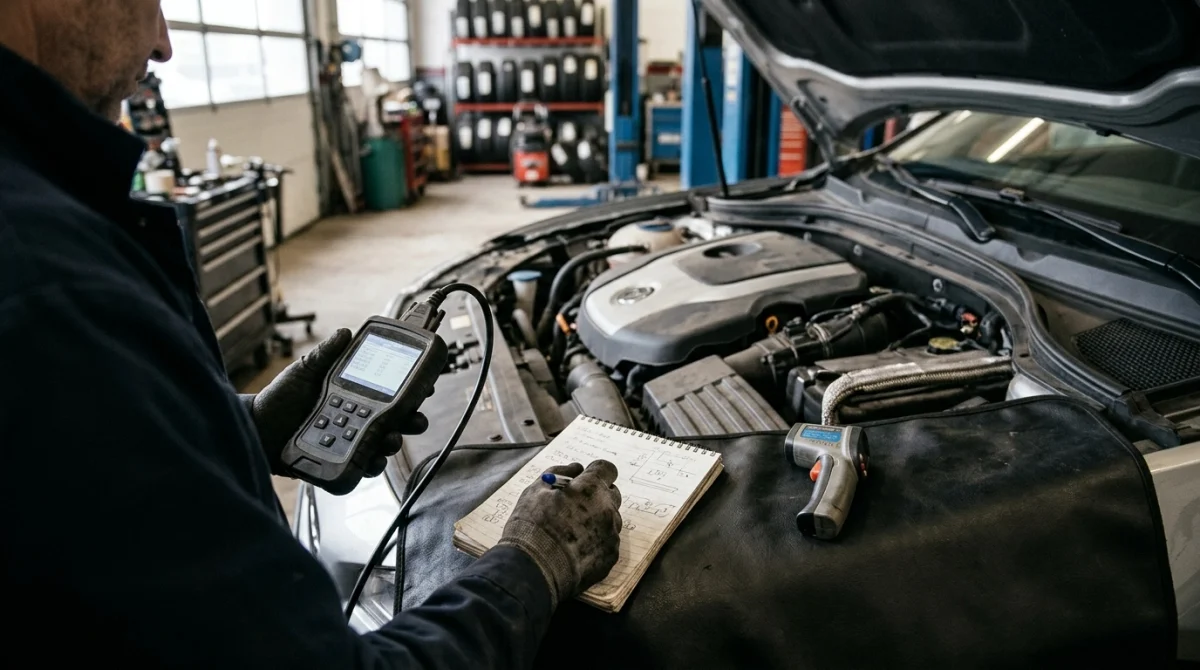
Good diagnosis starts with capturing the fault under the conditions in which it occurs. A single screenshot taken after the engine has recovered may miss the evidence you need.
1. Read trouble codes before clearing anything
Connect your OBD2 scanner and check for stored, pending, and permanent diagnostic trouble codes where supported. Save the results, including freeze-frame information, before clearing codes or disconnecting the battery.
Codes can help narrow the investigation, but they don’t automatically identify the failed part. For example, a lean-condition code may result from an intake leak, fuel-delivery problem, incorrect airflow measurement, or another fault.
Look for relevant codes such as:
- P0300: Random or multiple-cylinder misfire detected.
- P0301, P0302, and similar codes: A misfire detected on a particular cylinder.
- P0171 or P0174: System too lean on the indicated bank.
- P0172 or P0175: System too rich on the indicated bank.
- P0101: Mass airflow sensor range or performance concern.
Use the manufacturer’s service information to interpret the code for your specific vehicle. The code describes a detected condition, not necessarily a defective sensor.
2. Check the engine cold, then warm
Before starting a cold engine, compare engine coolant temperature (ECT) and intake air temperature (IAT) with the surrounding conditions. After the vehicle has sat long enough to reach ambient temperature, these readings should generally be reasonably close, allowing for heat soak and sensor placement.
Start the engine and watch how RPM and temperature change. Once the engine reaches its normal operating state, record the live data again with the vehicle safely parked.
Compare these conditions where appropriate:
- Cold start versus fully warmed idle.
- Air conditioning off versus on.
- Park or Neutral versus Drive, if applicable and safe.
- Idle versus a steady, modestly higher engine speed.
These comparisons can reveal whether the fault depends on temperature, accessory load, transmission load, or engine speed. Follow the vehicle’s service procedure, especially when testing an automatic transmission in Drive.
3. Record readings instead of relying on memory
Write down the engine temperature, RPM, fuel trims, and misfire information at each test condition. If your scanner supports graphing or recording, capture the data while the rough idle is happening.
Do not clear codes before saving freeze-frame data, and don’t assume a cleared warning light means the fault is repaired. Clearing diagnostic information may reset emissions readiness monitors.
Safety note: Work outdoors or in a properly ventilated workshop. Keep hands, clothing, and cables away from moving belts, fans, and hot exhaust parts; electric cooling fans can start unexpectedly.
Section takeaway: Save codes and freeze-frame data first, then compare cold and warm operation. Repeatable measurements are more useful than isolated readings.
How Do You Read Fuel Trims to Find an Air or Fuel Problem?
Fuel trims are among the most useful live data values for diagnosing a rough idle. They show how the engine computer adjusts fueling to correct the mixture detected by its feedback system.
Short-term fuel trim (STFT) reflects immediate fueling corrections, while long-term fuel trim (LTFT) reflects learned corrections over time. Positive values mean the computer is adding fuel, and negative values mean it’s removing fuel.
What fuel-trim numbers are normal?
On many warmed-up gasoline engines operating in closed loop, fuel trims tend to remain relatively close to zero. Readings within approximately ±5% are common in favorable conditions, while sustained corrections beyond ±10% deserve investigation rather than an automatic diagnosis.
These are general reference points, not universal pass-or-fail limits. Engine design, operating conditions, fuel-control strategy, sensor behavior, and manufacturer specifications can change what you should expect.
What do positive fuel trims at idle mean?
Strongly positive trims at idle that move closer to zero as engine speed rises can indicate an intake or vacuum leak. The leak may introduce extra air that has not been measured by the airflow system, particularly at low engine speeds.
Possible causes include:
- Cracked or disconnected vacuum hoses.
- A leaking intake manifold gasket.
- A damaged PCV hose or faulty crankcase ventilation valve.
- An intake duct leak downstream of the MAF sensor.
- An EVAP purge valve that allows unintended vapor flow.
Don’t replace a hose or valve based only on this pattern. Confirm the suspected leak using an appropriate inspection or professional smoke test.
What do positive trims at idle and higher RPM mean?
If fuel trims remain strongly positive at both idle and higher engine speeds, investigate causes that may affect the engine across a wider operating range. These include inadequate fuel delivery, inaccurate MAF readings, or other mixture-control problems.
Compare fuel trims with available fuel-pressure data, airflow readings, upstream oxygen or air-fuel sensor behavior, and the vehicle’s service specifications. An exhaust leak ahead of an oxygen sensor can also distort mixture feedback on some engines.
What do negative fuel trims mean?
Persistently negative trims indicate that the computer is removing fuel because its feedback suggests a rich mixture. This can contribute to an unstable idle, strong fuel odor, poor fuel economy, or other running problems.
Investigate possibilities such as:
- A leaking fuel injector or excessive fuel pressure.
- An EVAP purge valve allowing excessive fuel vapor into the intake.
- An inaccurate coolant-temperature or airflow reading.
- An oxygen or air-fuel sensor reporting misleading information.
Compare both fuel-trim banks where the engine supports them. One bank behaving differently can help narrow the search to a bank-specific intake leak, injector issue, exhaust leak, or sensor-related problem.
For a more detailed explanation of fuel-trim interpretation, consult a qualified technician or the vehicle’s service documentation rather than relying on a single universal threshold.
Section takeaway: Fuel trims help identify whether the engine is correcting a lean or rich mixture. Comparing idle with higher RPM often provides more diagnostic value than reading trims once.
How Do Misfire Counts, RPM, MAF, and MAP Help?
Fuel trims show mixture corrections, but they don’t explain every rough idle. Misfire data, engine speed, airflow, and intake pressure help you determine whether the problem affects one cylinder or the engine more broadly.
How do you use misfire counters?
A misfire occurs when a cylinder fails to contribute normal combustion during an engine cycle. If your scanner supports cylinder-specific misfire counters, watch which cylinders accumulate counts while the engine runs unevenly.
- One cylinder: Investigate its spark plug, ignition coil, injector, wiring, and mechanical condition.
- Several cylinders: Investigate shared causes such as an intake leak, fuel-delivery problem, incorrect engine timing, or a broader mixture-control issue.
- Misfires mainly at idle: Consider air leaks, idle-specific mixture problems, deposits, ignition weaknesses, or mechanical faults.
- Misfires under load: Consider ignition breakdown, fuel-delivery limitations, or other faults that become more apparent as engine demand increases.
Misfire counters may be unavailable on basic scanners, and their behavior varies by vehicle. Some systems also report intermittent counts that require further confirmation.
Technician’s note: A cylinder-specific misfire code doesn’t prove the ignition coil is faulty. Confirm the cause with appropriate ignition, injector, wiring, and compression tests.
What can unstable RPM tell you?
Watch engine RPM while the vehicle is stationary and the rough idle occurs. If RPM repeatedly rises and falls, the engine computer may be compensating for changing airflow, combustion instability, accessory load, or another control problem.
If available, compare actual RPM with commanded idle speed. A mismatch can guide further testing, but it doesn’t automatically identify a faulty throttle body or idle-control component.
How do MAF and MAP readings help?
The mass airflow (MAF) sensor measures incoming air, while the manifold absolute pressure (MAP) sensor measures pressure in the intake manifold. Depending on the engine design, the computer uses these readings to calculate engine load and manage fueling.
- MAF: Check whether airflow readings are plausible for the engine’s size, speed, and operating conditions.
- MAP: Compare manifold pressure with engine speed, throttle position, and the manufacturer’s specifications.
- Throttle position: Check whether reported throttle values respond plausibly to commanded operation.
- Oxygen or air-fuel sensor: Compare feedback with fuel trims and other evidence to evaluate mixture control.
For example, a rough idle combined with positive fuel trims and suspicious airflow data could justify checking the intake duct and MAF circuit. However, the same symptoms can result from other faults, so test the circuit and airflow system before replacing the sensor.
Section takeaway: Misfire counts help localize combustion problems, while RPM and airflow readings reveal how the whole engine responds. Use these signals together to choose the next test.
Which Live Data Patterns Point to Common Rough-Idle Causes?
The most useful diagnosis comes from combining several readings recorded under the same conditions. The patterns below help you choose a direction for further testing, but none proves that a specific component has failed.
| Observed pattern | Possible cause | Useful next test |
|---|---|---|
| Positive trims mainly at idle | Vacuum or unmetered-air leak | Inspect intake hoses and perform an appropriate leak test |
| Positive trims across operating speeds | Fuel-delivery or airflow-measurement problem | Check fuel pressure, MAF data, and sensor circuits |
| Repeated misfires on one cylinder | Ignition, injector, wiring, or compression fault | Perform cylinder-specific ignition and mechanical tests |
| Negative trims with rough idle | Rich mixture or excessive fuel vapor | Check purge operation, injector leakage, and fuel pressure |
| Cold-start idle is poor, warm idle improves | Temperature-related fueling or ignition issue | Compare cold ECT/IAT readings and inspect relevant systems |
| RPM fluctuates when accessories switch on | Idle compensation, electrical, or load-related issue | Compare charging voltage, commanded idle, and engine load |
Example: Rough idle with positive fuel trims
Imagine a warmed-up gasoline engine shakes at idle, and both short-term and long-term fuel trims are substantially positive. When the engine runs at a steady higher speed, the combined corrections move closer to zero.
This pattern makes an intake or vacuum leak worth investigating first. Inspect the intake plumbing and PCV connections, then confirm the suspected leak with a suitable test rather than replacing the MAF sensor immediately.
Example: Rough idle with a cylinder-specific misfire
Now imagine the engine shakes while the scanner reports repeated misfires on cylinder two. The other cylinders show little or no misfire activity, and the fuel trims don’t indicate a major overall mixture problem.
Focus on cylinder two’s ignition, injector, wiring, and compression. If an appropriate component-swap test is permitted by the service procedure, moving a compatible ignition coil to another cylinder can help determine whether the fault follows the coil.
If the misfire stays with cylinder two, investigate the remaining possibilities. A compression or leak-down test may be necessary to identify a mechanical problem.
Technician’s note: Don’t disconnect ignition components or swap parts while the engine is running. Follow the manufacturer’s safety and diagnostic procedures, particularly on vehicles with high-voltage ignition systems.
Section takeaway: Match the live-data pattern to a targeted test. A good diagnostic process narrows the possibilities without treating a symptom or code as proof of component failure.
How Do You Confirm the Fault Before Replacing Parts?
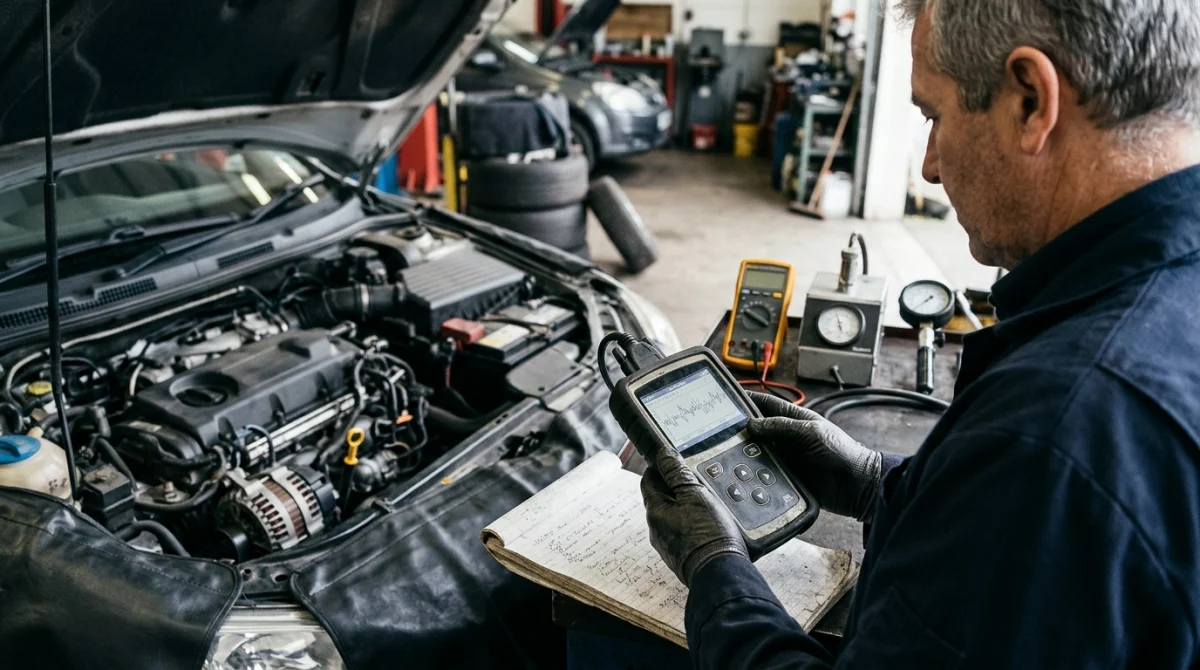
Once live data points toward a likely cause, use a test that can confirm or rule out that cause. This final step prevents unnecessary parts replacement and helps avoid overlooking more than one fault.
Follow a simple diagnostic sequence
- Save the evidence: Record codes, freeze-frame information, and the live-data readings associated with the rough idle.
- Identify the pattern: Determine whether the engine appears lean, rich, misfiring on one cylinder, or unstable across several cylinders.
- Inspect the relevant system: Check visible hoses, intake connections, electrical connectors, and other components related to the evidence.
- Run a confirming test: Use a smoke test, ignition test, fuel-pressure test, circuit test, compression test, or another appropriate procedure.
- Repair the confirmed fault: Follow the correct service procedure for the vehicle’s make, model, year, and engine.
- Verify the repair: Repeat the original operating conditions and compare the new readings with the saved data.
The required equipment depends on the suspected problem. A basic OBD2 scanner can reveal useful patterns, but a smoke machine, fuel-pressure gauge, multimeter, oscilloscope, or enhanced scan tool may be needed to confirm the diagnosis.
When is a basic OBD2 scanner enough?
A basic scanner is often sufficient to retrieve generic engine codes, view supported PIDs, and compare fuel trims. It may not show manufacturer-specific misfire counters, detailed throttle-control information, or the enhanced tests needed for a particular engine.
Choose a scanner based on the functions you need rather than the number of readings shown on its screen. Confirm compatibility with your vehicle before buying, especially if you need enhanced data or active tests.
When should you stop and seek professional help?
Stop running the engine and arrange professional assistance if the vehicle develops severe shaking, significant power loss, unusual mechanical knocking, overheating, or a strong fuel leak. A flashing check-engine light commonly signals an active misfire that can damage the catalytic converter, so avoid continued driving and follow the vehicle manufacturer’s guidance.
For further vehicle maintenance and repair guidance, consult AAA’s Auto Repair resources and the appropriate service information for your vehicle. For safety-related vehicle information, you can also visit the National Highway Traffic Safety Administration.
When manufacturer-specific procedures or safety warnings matter, use the official support resources for your vehicle brand. For Toyota vehicles, start with Toyota Owners and locate the information for your exact model.
Section takeaway: Use live data to guide testing, not to justify guesswork. Confirm the fault, repair the cause, and repeat the original test before considering the job complete.
Rough Idle and OBD2 Live Data FAQs
Can an OBD2 scanner diagnose a rough idle without a check-engine light?
Yes, sometimes. A scanner may reveal unstable RPM, unusual fuel trims, or supported misfire data even when the check-engine light is off. However, not every rough-idle problem triggers a stored code, and some basic scanners cannot access the enhanced data needed to identify the fault.
What should fuel trims read at idle?
Many warmed-up gasoline engines operate with short- and long-term fuel trims relatively close to zero, often within approximately ±10%. Sustained readings outside that range deserve investigation, but the correct interpretation depends on the engine, operating conditions, and manufacturer specifications.
Can a vacuum leak cause rough idle without a trouble code?
Yes. A small intake or vacuum leak may cause unstable idle or positive fuel trims before the engine computer detects a fault. Compare fuel trims at idle and higher engine speed, then inspect the intake system and confirm any suspected leak with an appropriate test.
Can bad spark plugs cause rough idle even when live data looks normal?
Yes. Worn spark plugs or weak ignition components can cause intermittent misfires without producing obviously abnormal fuel trims. Check available misfire counters and diagnostic codes, then inspect the ignition system and perform the appropriate tests for your vehicle.
Is a high positive fuel-trim reading proof of a vacuum leak?
No. Positive fuel trims mean the engine computer is adding fuel based on its mixture-control feedback. An intake leak is one possibility, but low fuel delivery, inaccurate airflow measurement, exhaust leaks, and other faults can produce similar readings.
Should I clear the trouble codes before diagnosing rough idle?
No. Save stored, pending, and permanent codes, along with freeze-frame data, before clearing anything. These records may show the conditions under which the fault occurred. Clearing codes can erase useful evidence and reset emissions readiness monitors, making diagnosis more difficult.
Can a cheap OBD2 scanner show cylinder-specific misfires?
Some basic scanners display generic misfire-related trouble codes, but detailed cylinder-specific misfire counters often require enhanced diagnostic support. Check your scanner’s supported functions and vehicle compatibility before purchasing it for this purpose.
Final Takeaway: Diagnose the Pattern, Not Just the Code
The most effective way to diagnose rough idle with OBD2 live data is to combine fuel trims, misfire information, engine RPM, and airflow readings under repeatable conditions. Start with stored codes, compare cold and warm operation, and use the results to select the next diagnostic test.
Don’t replace a sensor just because its reading looks unusual. Confirm the underlying problem, repair it correctly, and repeat the same live-data checks to verify the result.
If your engine is still shaking and you aren’t sure which reading matters most, begin with the trouble codes and fuel trims. Those two pieces of evidence often provide a useful starting point for a more focused diagnosis.
