
How to Find the Fuse Box in Your Car (Car Fuse Box Location Guide)

The car fuse box location is usually in two places: under the hood near the battery, and inside the cabin under the driver-side dash, behind the kick panel or behind a cover at the end of the dash. Some cars add a third box in the glove box, passenger footwell or trunk. The owner’s manual index under “fuses” shows the exact spot.
You only need the fuse box when something stops working, which is the worst time to go hunting for it. Automakers tuck these boxes behind trim panels, under carpet and inside the glove box, and two cars from the same brand can put them in different places.
This guide shows where to look, in order, and the common locations by brand. Once you find the right fuse, use our guide on how to check car fuses to test it in place.
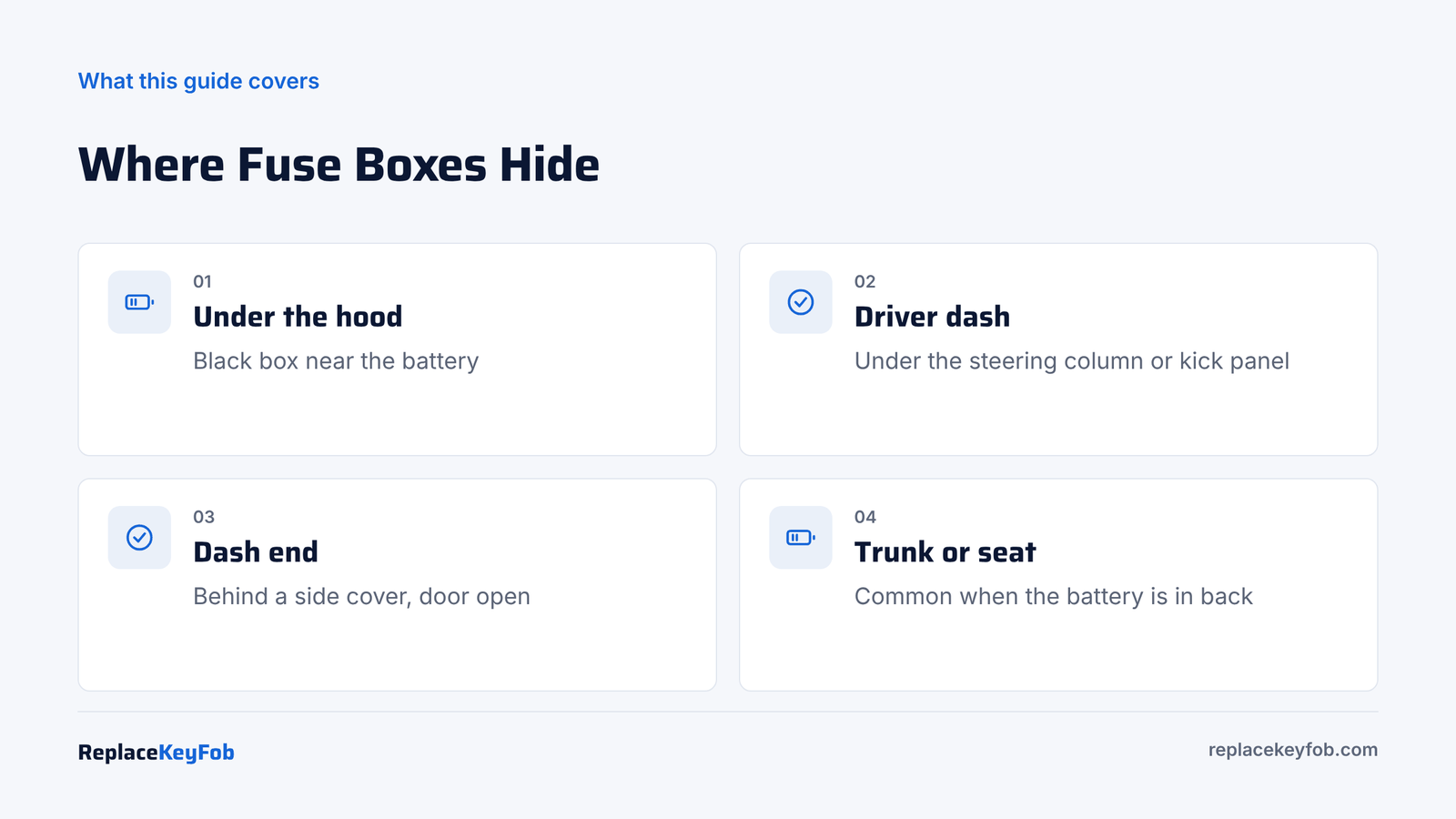
Where Most Cars Put Their Fuse Boxes
Nearly every car built in the last 25 years has at least two fuse boxes. They protect different kinds of circuits.
| Fuse box | Usual location | What it protects |
|---|---|---|
| Under-hood (power distribution) | Black plastic box next to the battery or along a fender | Cooling fan, fuel pump, ABS, starter relay, headlights, high-current circuits |
| Interior (passenger compartment) | Under the driver-side dash, kick panel, or dash end cover | Radio, power outlets, interior lights, windows, OBD2 port, body computer |
| Rear or auxiliary | Trunk side panel, under the rear seat, or near a rear-mounted battery | Trailer wiring, rear outlets, amplifiers, seat heaters |
The under-hood box usually has a clip-on lid with a printed diagram. The interior box may be hidden behind a removable panel with no obvious handle.
What You Need
- The owner’s manual, printed or the PDF from the automaker’s owner website
- A flashlight or headlamp
- A plastic trim tool or a flat screwdriver wrapped in tape for stubborn covers
- Your phone, to photograph the fuse layout before you touch anything
Plastic trim removal tool set
A nylon pry tool pops kick panels and dash covers without scratching or breaking clips. Look for a small set with flat and forked tips.
As an Amazon Associate, ReplaceKeyFob earns from qualifying purchases.
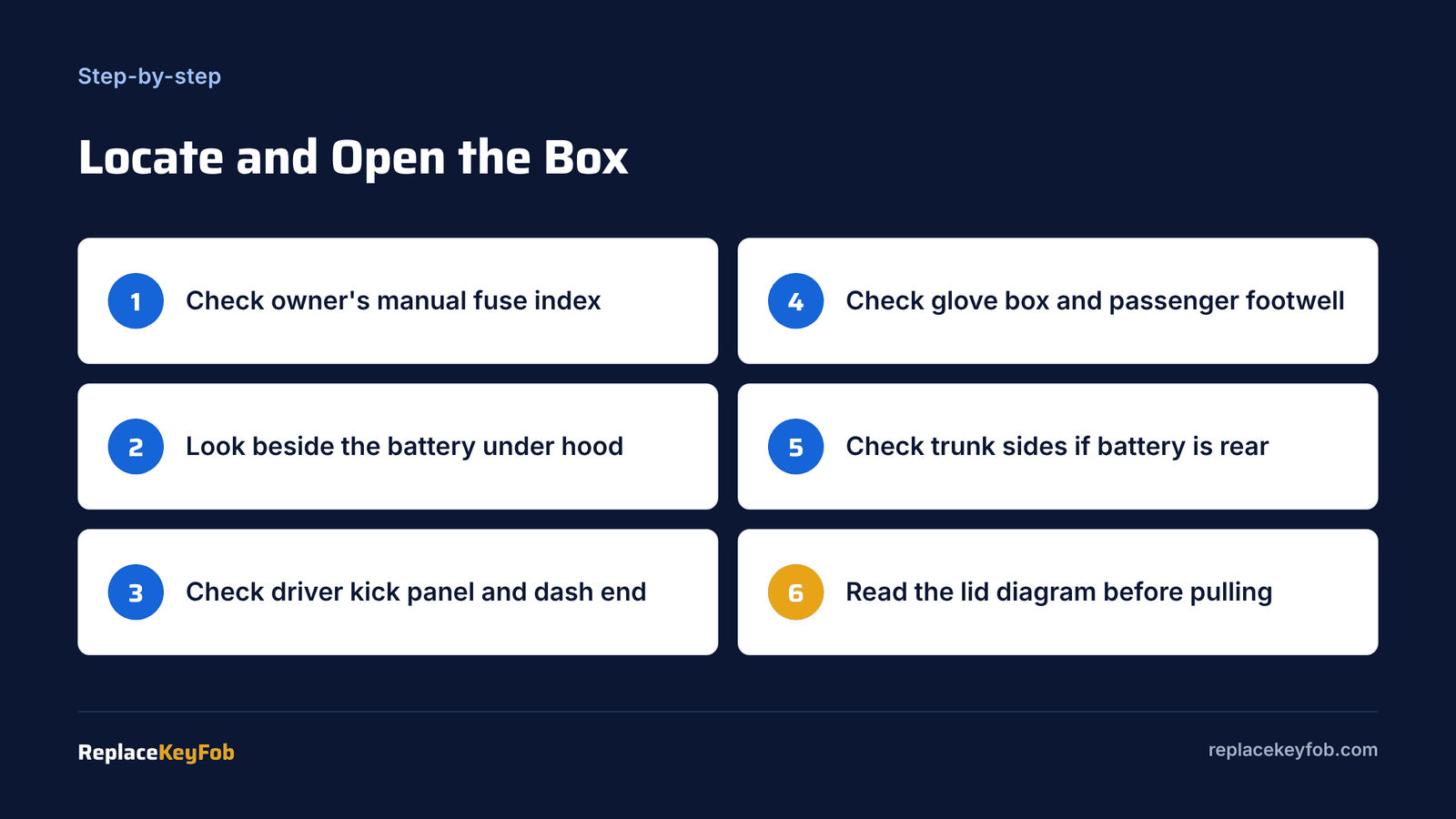
How to Find the Fuse Box in Your Car: Step by Step
- Open the owner’s manual index and look for “fuses” or “fuse box”. The manual shows every box with a small drawing of its location. This is always the fastest route.
- Check under the hood. Open the hood and look next to the battery. The main box is a black rectangle with a snap-on lid, often labeled “FUSE” or with a fuse symbol. On some cars it sits along the driver or passenger fender, near the windshield.
- Check under the driver-side dash. Kneel outside the open driver door and look up under the steering column and to the left. Some boxes are exposed; others sit behind a panel that pulls or clips off.
- Check the end of the dash. Open the driver door (and then the passenger door) and look at the side face of the dashboard. A flat cover there often hides the interior fuse panel.
- Check the kick panels and glove box. Look in the footwell beside your feet on both sides, and empty the glove box. Some cars hide a fuse panel behind the glove box liner.
- Check the trunk or under the rear seat if your battery is not under the hood. Cars with trunk-mounted batteries usually have a fuse panel nearby.
Common Fuse Box Locations by Brand
These are typical locations on many recent models. Generations differ, so confirm with your manual.
| Brand | Interior fuse box (typical) | Other boxes |
|---|---|---|
| Toyota / Lexus | Under the driver-side dash, lower left, sometimes behind a small cover | Under-hood box next to the battery |
| Honda / Acura | Under the driver-side dash, low and to the left; some models add a second panel | Under-hood box near the battery |
| Ford | Passenger-side footwell kick panel on many trucks and SUVs (including many F-150s); driver-side on some cars | Under-hood power distribution box |
| Chevrolet / GMC | Behind a cover at the driver-side end of the dash on many trucks and SUVs | Under-hood box, sometimes a rear box on large SUVs |
| Ram / Dodge / Jeep | Fewer interior fuses; main power box under the hood beside the battery on many models | Some have a small panel under the dash |
| Nissan / Infiniti | Under the driver-side dash behind a lower panel | Under-hood box near the battery |
| Hyundai / Kia | Under the driver-side dash, lower left, behind a cover | Under-hood box near the battery |
| Volkswagen / Audi | Behind a cover at the driver-side end of the dash on many models | Under-hood box on top of the battery area |
| BMW / Mini | Behind the glove box lining on many models | Trunk panel near the battery on many sedans and SUVs |
| Mercedes-Benz | Dash end or footwell on many models | Under-hood and trunk or rear seat boxes |
| Subaru | Under the driver-side dash, lower left | Under-hood box near the battery |
Fuse box in a car with the battery in the trunk
BMW, Mercedes, many Audi models, and some Chrysler and Dodge sedans put the battery in the trunk or under a seat. These cars almost always have a rear fuse or distribution panel near the battery. Lift the trunk floor and look behind the right-side trim panel.
Trucks and older vehicles
Many older trucks put the interior fuse panel low on the driver side, behind the parking brake pedal or kick panel. On classic cars from the 1970s and 1980s, the fuse block is often bolted to the firewall under the dash, with no cover.
How to Check Fuses in the Fuse Box
Once the cover is off:
- Read the diagram on the lid or the manual page. Match the fuse number or label to your problem, such as “CIG”, “AUDIO”, “WIPER” or “F/PUMP”.
- Photograph the layout so you can put everything back correctly.
- Find the fuse puller. It is usually a small white or colored plastic tool clipped inside the lid.
- Test the fuse in place with a test light, or pull it and look at the metal strip.
The full test methods are in how to check car fuses. Remember that the OBD2 port often shares a fuse with the power outlet, so a dead scanner can be a fuse problem; see OBD2 scanner fuse location.
Reading the Diagram
Fuse diagrams use short labels. A few common ones:
| Label | Circuit |
|---|---|
| ACC, CIG, PWR OUTLET | Accessory power, 12V sockets |
| IG1, IG2 | Ignition-switched circuits |
| ECU, PCM, EFI | Engine computer and fuel injection |
| ST, STARTER | Starter relay circuit |
| DRL, HEAD LH/RH | Headlights and daytime running lights |
| BCM, SJB, IPM | Body control module or smart junction box |
| ABS | Anti-lock brake pump and module |
Relays in the box look like small cubes. If a starting problem led you here, the starter relay is often in the under-hood box; how to start a car with a bad starter shows how to swap it.
Mistakes to Avoid
- Prying covers with metal tools: trim clips break easily, and a screwdriver near live terminals can short.
- Mixing up two similar boxes: check both the hood and cabin boxes; the same circuit name can appear in each.
- Ignoring water: a damp or corroded under-hood box can cause random electrical faults. Dry it and look for a missing lid seal.
- Pulling fuses with the circuit live: turn the ignition and the device off first.
Still Cannot Find It?
Search the automaker’s owner site for your model’s manual, or ask a dealer service desk; they can tell you in seconds. If you are working on a no-power or no-crank problem and the fuses are fine, the next checks are the battery and its clamps; see battery terminal corrosion and how to test a car battery at home.
A shop will usually find and test a fuse for little or no charge, but electrical diagnosis beyond that is typically about $100 to $200 per hour in 2026.
Frequently Asked Questions
Most cars have one fuse box under the hood next to the battery and a second inside the cabin, usually under the driver-side dash, behind a kick panel or behind a cover at the end of the dashboard.
Most have two, and many have three. The extra box is often in the trunk, under the rear seat or behind the glove box, especially on cars with a rear-mounted battery.
Look beside the battery under the hood, then under the driver-side dash, at both ends of the dashboard with the doors open, in the footwells and behind the glove box. Most automakers also post free owner’s manuals online.
Use the lid diagram to find the right fuse, then test it in place with a test light or multimeter, or pull it with the plastic puller and look for a broken metal strip inside.
On many cars with the battery in the trunk, such as many BMW and Mercedes models, yes. It is usually behind a side trim panel or under the trunk floor near the battery.