
How to Start a Car With a Bad Starter (5 Methods That Work)

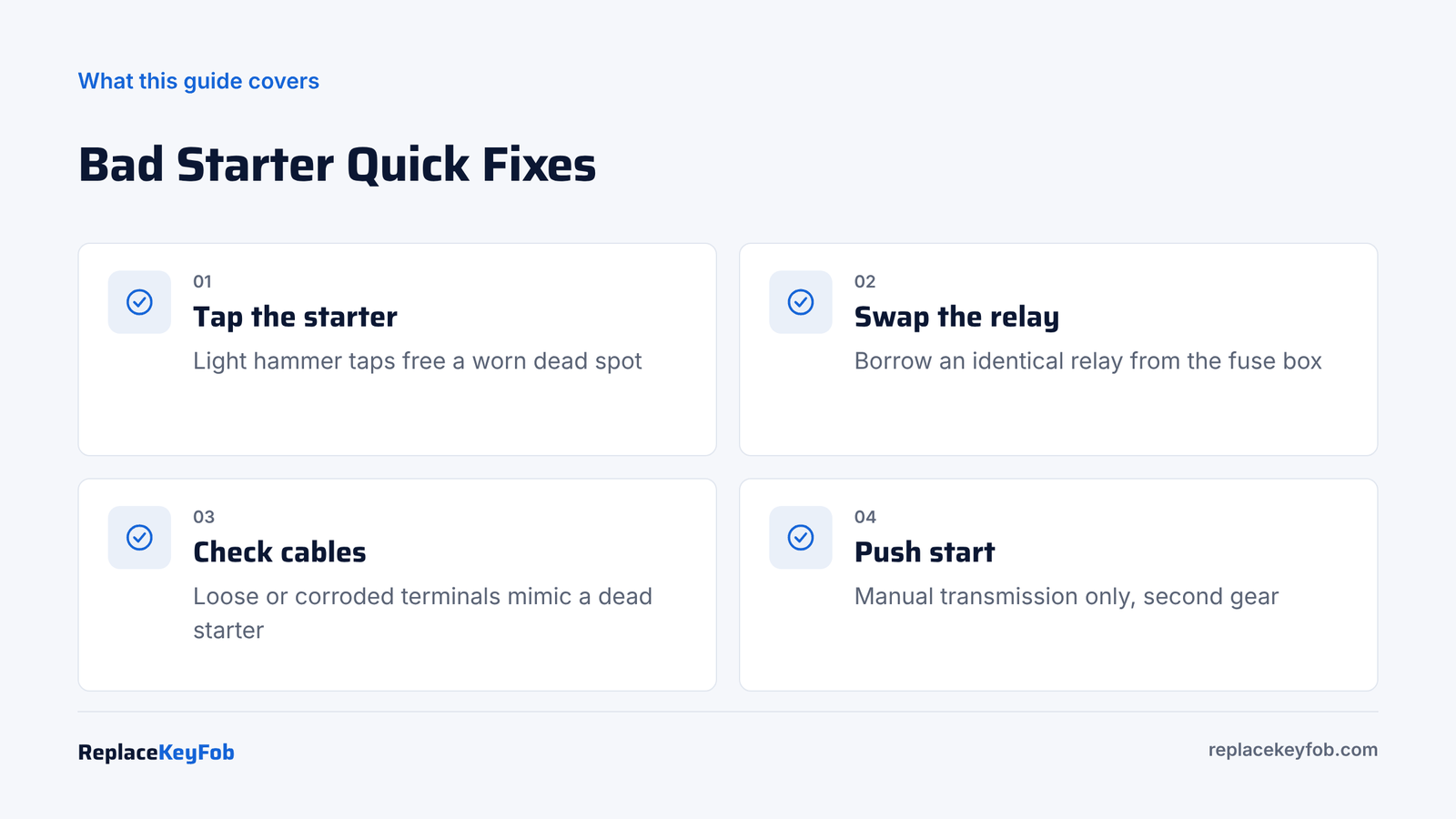
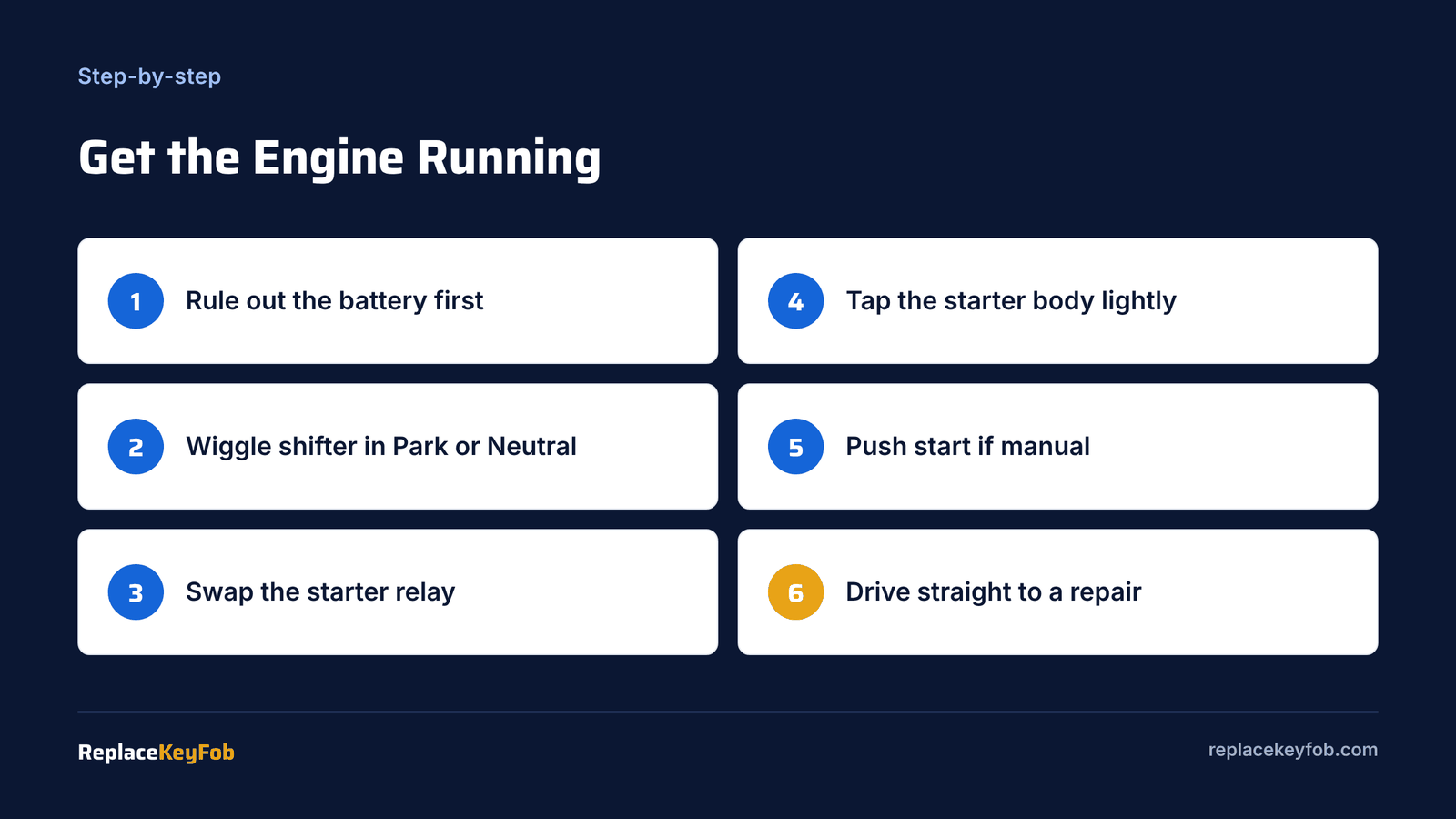
To start a car with a bad starter, first rule out a weak battery, then try wiggling the shifter in Park, swapping the starter relay with an identical one, and tapping the starter body with a hammer while a helper turns the key. A manual car can be push started. These tricks buy one or two starts, not a repair.
A starter that is on its way out rarely dies all at once. It usually gives warnings: a single click, a slow grinding crank, or a day where it works on the third try. When it finally refuses, you can often still get the engine running long enough to drive home or to a shop, as long as you know which part of the starting circuit is actually failing.
This guide covers the safe ways to get a car started with a failing starter motor, solenoid or relay, how to tell which one you have, and what the real repair costs. If your car only clicks, read why a car clicks but won’t start alongside this one.
First, Make Sure It Is the Starter
Many “bad starters” are really weak batteries or bad connections. A starter needs well over 100 amps to crank, so anything that limits current makes it act dead. Check these before you crawl under the car.
| Symptom | Most likely cause | Quick check |
|---|---|---|
| Dash lights dim or go out when you turn the key | Weak battery or bad terminal | Battery should read about 12.4V or more at rest |
| Single loud click, lights stay bright | Starter solenoid or worn motor contacts | Tap the starter, try again |
| Rapid clicking | Low battery voltage | Jump start or charge the battery |
| No click, no crank, lights bright | Relay, fuse, neutral safety switch, ignition switch | Swap the relay, wiggle the shifter |
| Grinding or whirring, engine does not turn | Starter drive gear or flywheel teeth | Do not keep cranking; repair needed |
| Cranks slowly, then starts | Worn starter or weak battery | Load test the battery |
If the headlights dim heavily when you try to crank, start with the battery. Follow our guide on how to jump start a car, and if the engine starts right away on a jump, the starter is probably fine. You can confirm battery health with how to test a car battery at home.
What You Need
Most of these methods need nothing more than what is in a typical trunk:
- A hammer, a short piece of wood or a long wrench to tap the starter
- A flashlight and gloves
- Safety glasses
- A 10mm or 13mm wrench to tighten battery and starter cables
- Jumper cables or a portable jump starter
- A helper to turn the key or press the start button
- A digital multimeter, if you want to confirm voltage at the starter
Digital multimeter for car diagnostics
Look for DC volts, continuity beep and at least a 10A range. It lets you check battery voltage, voltage at the starter and relay operation in minutes.
As an Amazon Associate, ReplaceKeyFob earns from qualifying purchases.
Method 1: Wiggle the Shifter and Try Neutral
On automatic cars, a switch on the transmission (the neutral safety switch or transmission range sensor) only lets the starter work in Park or Neutral. When that switch wears or goes out of adjustment, the car acts like it has a dead starter: no click, no crank, but the dash lights are bright.
- Press the brake firmly.
- Shift to Neutral and try to start.
- If nothing happens, shift back to Park and wiggle the lever slightly while turning the key.
- If the car starts in Neutral but not in Park, the range switch is the problem, not the starter.
This takes ten seconds and should always be your first try. Push-button cars also need the brake pedal pressed hard enough to trigger the brake switch.
Method 2: Swap the Starter Relay
The starter relay is a small plug-in cube in the under-hood fuse box. It carries the low-current signal that tells the solenoid to engage. Relays fail often, and they are cheap.
- Open the under-hood fuse box and read the diagram on the lid. Look for “ST”, “STARTER” or “START RELAY”.
- Find another relay in the same box with the same part number printed on top, such as the horn or fog light relay.
- Pull both relays straight up (a gentle side-to-side rock helps) and swap them.
- Try to start the car.
If it starts, the old relay is bad. Buy a matching relay, usually about $10 to $30. While the box is open, check the starter fuse too; the fuse box lid diagram shows which one it is. Not every car uses a separate plug-in starter relay, so if you cannot find one, skip to the next method.
Method 3: Tighten and Clean the Cables
A loose battery clamp or corroded terminal can drop voltage so far that the starter only clicks. Look at both battery posts and the thick cable that runs to the starter.
- Twist each battery clamp by hand. If it moves, tighten it.
- White or blue-green crust on the posts blocks current. Clean it with a baking soda and water mix and a wire brush; see battery terminal corrosion for the full process.
- Follow the negative cable to where it bolts to the engine or body. A loose ground strap is a common cause of “starter” trouble on older trucks.
Disconnect the negative cable first before cleaning, and reconnect it last.
Method 4: Tap the Starter
This is the classic fix, and it works more often than you would expect. Inside an old starter, the brushes and the solenoid contacts wear unevenly. When the motor stops on a worn “dead spot”, it cannot turn. A few light taps can move the armature or let the brushes seat again.
- Put the car in Park with the parking brake set (or in gear with the brake set on a manual).
- Find the starter. It is a small cylinder, usually 4 to 8 inches long, bolted where the engine meets the transmission. On many cars it is low on the engine, reached from underneath; on some it sits on top under the intake.
- Have a helper hold the key in the start position or press the start button.
- Tap the body of the starter several times with a hammer or a wrench. Use firm taps, not heavy blows.
- If the engine cranks, let it start and do not turn it off until you reach a safe place.
Why it works: tapping is a temporary fix for worn internals. Once tapping is needed, the starter usually fails completely within days to weeks.
Never lie under a car that is in gear or not secured, and keep hands, hair and tools clear of the belts and fan once the engine starts. If you need to get under the car, do it before the helper tries to start it, and stay to the side.
Method 5: Push Start a Manual Transmission
A manual car does not need the starter at all if you can get it rolling. The wheels turn the engine through the transmission.
- Turn the ignition to ON (not start).
- Press the clutch and put the car in second gear.
- Have helpers push, or roll down a gentle slope, until you reach about 5 to 10 mph.
- Release the clutch quickly. The engine should catch.
- Press the clutch again right away so the car does not lurch, and keep the engine running.
Our step-by-step guide on how to push start a car covers it in more depth. Automatic transmissions cannot be push started.
Bypassing the Solenoid: Only If You Understand the Risk
Older vehicles with a separate solenoid, such as many classic Fords and some older trucks, can be started by bridging the two large terminals on the solenoid or by connecting the battery positive terminal to the small “S” terminal with a remote starter switch. This sends power straight to the starter.
This skips every safety interlock. The car can start in gear and drive over you, and bridging the big terminals with a screwdriver throws sparks near the battery. Only consider it if:
- The car is in Park or Neutral with the parking brake set and wheels chocked
- You are working from the side, never in front of or behind the car
- You use an insulated remote starter switch rather than a screwdriver
- You know exactly which terminal is which
On most modern cars with immobilizers, the starter circuit is controlled by the computer, and a direct bypass may crank the engine but it still will not run without a recognized key. If you are not sure, use the tap or relay method or call for a tow. To learn how to confirm the solenoid is at fault, see how to test a starter solenoid.
How to Start a Car When the Starter Motor Is Bad: Variations
Push-button start cars
Hold the brake firmly and press the button once. If the dash shows “key not detected”, the problem is the fob, not the starter; see how to start a car when the key fob is not detected.
Hybrids
Toyota, Honda and Ford hybrids do not use a normal starter for the engine. The hybrid system turns the engine with the motor-generators. A “no start” there is usually the 12V auxiliary battery, so these methods do not apply.
Diesel trucks
Diesel starters draw much more current. A weak starter often shows up as very slow cranking in cold weather. Make sure both batteries (many diesel pickups have two) are fully charged before blaming the starter.
If It Still Will Not Start
| What you see | Next step |
|---|---|
| Starter spins but engine does not turn | Starter drive or flywheel teeth damaged; tow it |
| Engine cranks normally but will not fire | Not a starter problem: check fuel, spark, immobilizer |
| No voltage at the small starter wire | Ignition switch, range switch, relay or wiring |
| 12V at the starter but no crank | Starter motor is bad |
| Security light flashing | Immobilizer is blocking start; see how to fix an immobilizer problem |
A scan tool can show codes for the starter control circuit on newer cars; see diagnosing a no-start with an OBD2 scanner. For a full bench or on-car check, read how to test a starter motor.
Mistakes to Avoid
- Cranking for too long: crank no more than about 10 to 15 seconds at a time, then let the starter cool for a minute or two. Long cranking overheats the windings.
- Hammering hard: heavy blows can crack the starter housing or the solenoid. Firm, short taps are enough.
- Shutting the engine off right away: once a failing starter gets the engine running, drive directly to where it will be repaired.
- Replacing the starter without testing the battery: a new starter will act the same way on a weak battery.
When to Call a Pro and What It Costs
If the tricks above do not work, or if the starter is buried under the intake manifold, call a mobile mechanic or have the car towed. Typical 2026 US costs:
| Repair | Typical cost |
|---|---|
| Starter relay | About $10 to $30 for the part |
| Starter replacement, easy access | About $250 to $500 parts and labor |
| Starter replacement, hard access (V6/V8 under intake) | About $450 to $900+ |
| Remanufactured starter, DIY | About $100 to $300 |
| Tow, local | About $75 to $150 |
Many starters come with a core charge that is refunded when you return the old unit.
Frequently Asked Questions
Often yes, for a few more starts. Tapping the starter, swapping the starter relay, cleaning the battery cables or push starting a manual car can get the engine running. Once it starts, drive straight to a repair, because the starter will soon fail completely.
Find the starter relay in the under-hood fuse box using the lid diagram, then swap it with an identical relay from a less important circuit such as the horn. If the car starts, buy a new relay. Relays usually cost about $10 to $30.
It can. Light taps on the starter body can move a worn armature off a dead spot or help worn brushes make contact. It is a temporary fix that usually means the starter has days or weeks left.
If the dash lights dim or go out and you hear rapid clicking, it is usually the battery. If the lights stay bright and you hear one click or nothing, the starter, solenoid or relay is more likely. A jump start that fixes the problem points to the battery.
No. Automatic transmissions do not connect the wheels to the engine when it is off, so rolling the car will not turn the engine. Only manual transmission cars can be push started.