
How to Fix P0172: A Practical OBD2 Scanner Guide for Car Owners

A P0172 code can be confusing because your car may still start and drive. You might only notice a check engine light, poor fuel economy, rough idling, or a strong fuel smell.
Knowing how to fix P0172 starts with understanding what the code means. It does not automatically mean you need a new oxygen sensor, fuel injector, or mass airflow sensor. The correct repair depends on what is causing the engine to receive too much fuel or too little air.
This guide explains how to use an OBD2 scanner to investigate P0172, which parts commonly cause it, what repairs may cost, and when professional diagnosis is the smarter choice.
Quick Answer
To fix P0172, scan for related trouble codes, save the freeze-frame data, inspect the air filter and intake system, and check live fuel-trim readings. Common causes include a dirty mass airflow sensor, leaking fuel injector, excessive fuel pressure, stuck purge valve, or faulty engine sensor. Test the system before replacing parts.
What Does the P0172 Code Mean?
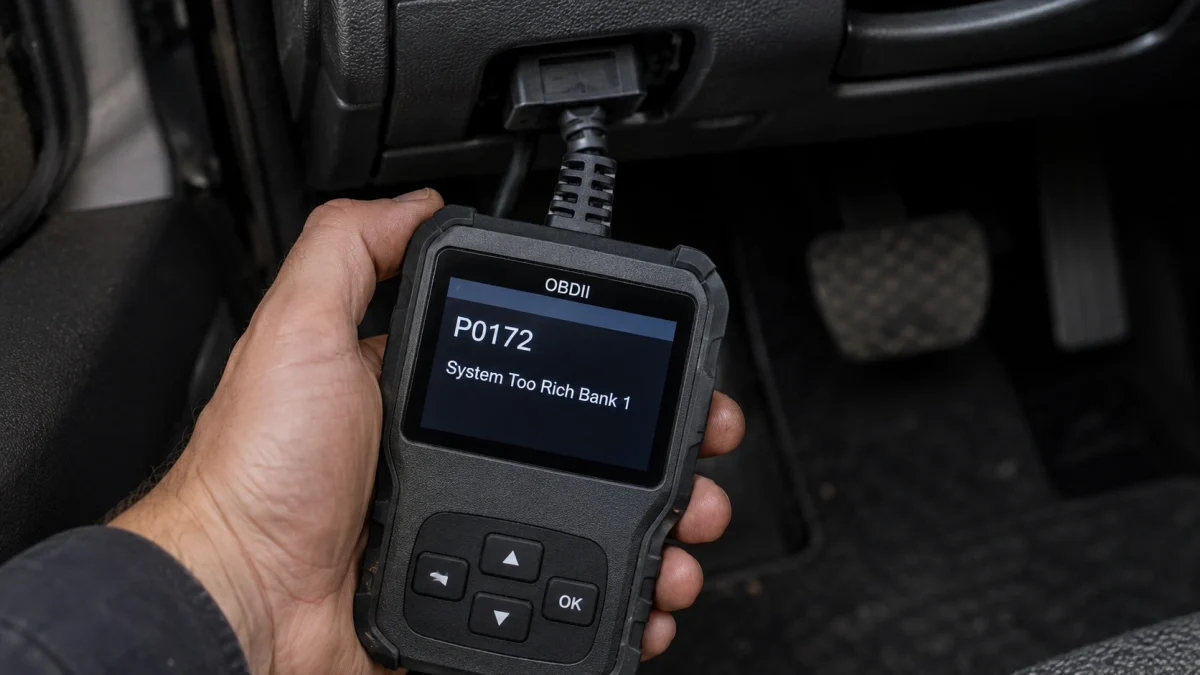
P0172 means “System Too Rich, Bank 1.” The engine computer has detected more fuel—or less air—in the combustion mixture than it can properly correct.
Ford’s official OBD system operation documentation identifies P0172 as a Bank 1 rich-condition fault monitored while the engine is operating in closed-loop fuel control. (Ford Service Content)
“Bank 1” refers to the side of the engine containing cylinder number one. On an inline four-cylinder engine, there is normally only one bank. On a V6 or V8, Bank 1 is one side of the engine.
A rich mixture may result from:
- Too much fuel entering the engine
- Not enough air reaching the engine
- Incorrect sensor information
- A fuel-control or emissions-system problem
The code identifies the condition, not the failed part.
How an OBD2 Scanner Helps Diagnose P0172
An OBD2 scanner communicates with your vehicle’s engine computer. It can display stored trouble codes, pending codes, freeze-frame information, readiness monitors, and live sensor data.
Most gasoline vehicles sold in the United States since the 1996 model year use OBD2. The EPA explains that an on-board diagnostic system monitors engine, transmission, and emissions-related operation and alerts the driver when a problem is detected. (NEPIS)
For P0172, a scanner with live-data capability is much more useful than a basic code reader. Look for these data points:
- Short-term fuel trim, or STFT
- Long-term fuel trim, or LTFT
- Mass airflow, or MAF
- Manifold pressure, or MAP
- Engine coolant temperature
- Upstream oxygen or air-fuel sensor readings
- Fuel rail pressure, when supported
- EVAP purge command
- Engine speed and calculated load
A scanner cannot directly confirm that a component is defective. It shows clues that help you decide what should be tested next.
Common Symptoms of P0172
Some cars show noticeable symptoms. Others only turn on the check engine light.
Common warning signs include:
- Illuminated check engine light
- Rough or unstable idle
- Hard starting, especially when warm
- Poor fuel economy
- Fuel smell from the exhaust
- Dark exhaust smoke
- Hesitation during acceleration
- Reduced engine power
- Spark plugs covered in black soot
- Engine oil that smells like gasoline
- Failed emissions inspection
A severe rich condition can damage the catalytic converter. Excess fuel may also wash protective oil from the cylinder walls or dilute the engine oil.
Do not ignore a flashing check engine light. EPA guidance states that a blinking check engine light may indicate a severe problem such as a misfire that needs prompt attention. Reduce driving and have the vehicle inspected as soon as safely possible. (NEPIS)
Most Common Causes of P0172
Dirty or Faulty Mass Airflow Sensor
The mass airflow sensor measures the air entering the engine. If it reports more air than is actually entering, the computer may add too much fuel.
Oil, dust, or residue can contaminate the sensor’s delicate sensing element. This is especially common when an over-oiled reusable air filter has been installed.
A dirty MAF sensor may be cleaned with MAF-sensor cleaner only. Carburetor cleaner, brake cleaner, and physical contact can damage it.
Restricted Air Filter or Intake
A severely clogged air filter can reduce airflow. A collapsed intake hose, blocked air inlet, or object inside the air box can create a similar problem.
Check for:
- A dirty or wet air filter
- A collapsed intake tube
- Debris in the air box
- A damaged intake hose
- Loose clamps
- Incorrectly installed aftermarket intake parts
A mildly dirty filter alone does not always cause P0172, but it is one of the easiest items to inspect.
Leaking Fuel Injector
A fuel injector that does not close completely may leak fuel into a cylinder. This can produce rough starts, fuel odor, black spark plugs, negative fuel trims, or a rich condition that is most noticeable at idle.
A leaking injector should be confirmed with an injector balance, pressure-decay, or leak-down test. Replacing injectors based only on the code can become expensive.
Excessive Fuel Pressure
Fuel pressure that is higher than the manufacturer’s specification can force excess fuel through the injectors.
Possible causes include:
- Faulty fuel pressure regulator
- Restricted fuel return line on return-style systems
- Incorrect fuel pump
- Faulty fuel pressure sensor
- Electronic fuel-pressure control problem
Modern direct-injection systems operate at extremely high pressure. Do not loosen high-pressure fuel lines as a DIY test.
Stuck-Open EVAP Purge Valve
The evaporative emissions system stores fuel vapors and sends them into the engine at controlled times. A purge valve that is stuck open can allow too much vapor into the intake.
This may cause:
- Rough idle after refueling
- Hard starting after filling the tank
- Strong fuel smell
- Rich fuel trims at idle
- EVAP-related trouble codes
Incorrect Coolant Temperature Reading
A cold engine needs extra fuel. If the coolant temperature sensor falsely reports that the engine is cold after it has warmed up, the computer may continue adding unnecessary fuel.
After the car has sat overnight, coolant temperature should normally be close to the outside air temperature. When fully warm, the reading should rise smoothly to a realistic operating range.
Faulty Oxygen or Air-Fuel Sensor
The upstream oxygen or air-fuel sensor helps the engine computer adjust fuel delivery. An inaccurate signal can cause incorrect fuel corrections.
However, an oxygen sensor should not be replaced simply because P0172 is present. Wiring problems, exhaust leaks, fuel pressure faults, or injector problems can all influence the sensor reading.
Contaminated Oil or Mechanical Problems
Fuel can enter the crankcase during repeated rich operation. The resulting oil dilution may affect lubrication and allow fuel vapor to enter through the crankcase ventilation system.
Low compression, incorrect cam timing, or other mechanical faults can also influence combustion and fuel-trim readings, although these are less common than intake, sensor, EVAP, and fuel-delivery problems.
How to Fix P0172 Step by Step
1. Scan All Vehicle Modules
Connect the OBD2 scanner with the ignition off, then turn the ignition on and follow the scanner instructions.
Record:
- Stored codes
- Pending codes
- Permanent codes
- Freeze-frame information
- Fuel-trim readings
- Coolant temperature
- Engine load and RPM
Do not focus only on P0172. Codes involving the MAF sensor, coolant sensor, fuel pressure, oxygen sensor, misfires, or EVAP system may point toward the real cause.
2. Save the Freeze-Frame Data
Freeze-frame data records vehicle conditions when the computer detected the fault. It may show whether P0172 occurred during idle, cruising, acceleration, cold operation, or a fully warmed drive.
For example, a code that sets during warm idle may suggest a leaking injector or excess purge vapor. A code that appears across different speeds and loads may point toward a MAF or fuel-pressure problem.
3. Perform a Basic Visual Inspection
Before buying parts, inspect the engine bay.
Look for:
- Disconnected sensor plugs
- Damaged wiring
- Loose battery terminals
- Dirty air filter
- Blocked intake opening
- Cracked or collapsed intake tubing
- Loose intake clamps
- Fuel leakage
- Strong gasoline odor
- Damaged vacuum or EVAP hoses
- Oil contamination around the MAF sensor
Do not continue driving if you find liquid fuel leaking. Shut off the engine and arrange professional repair.
4. Check Fuel-Trim Data
Warm the engine fully and observe STFT and LTFT.
Fuel trim shows how much fuel the computer is adding or removing:
- Positive numbers mean the computer is adding fuel.
- Negative numbers mean the computer is removing fuel.
- Numbers near zero generally indicate that little correction is needed.
The exact acceptable range depends on the vehicle. As a general diagnostic clue, consistently negative combined fuel trims beyond approximately 10% to 15% deserve investigation.
Compare readings at:
- Warm idle
- Approximately 2,000 to 2,500 RPM
- A steady road speed, when it is safe to do so
If the rich correction is strongest at idle and improves as RPM rises, investigate leaking injectors, excessive purge flow, or another source that has a greater effect at low airflow.
If the correction stays strongly negative at idle and higher RPM, investigate MAF accuracy, fuel pressure, temperature inputs, and broad fuel-control problems.
5. Inspect and Test the MAF Sensor
Check the MAF connector, wiring, and sensing element.
A lightly contaminated sensor may respond to proper cleaning:
- Turn off the ignition.
- Disconnect the sensor connector.
- Remove the sensor only when necessary.
- Spray the sensing element with dedicated MAF cleaner.
- Allow it to dry completely.
- Reinstall it without touching the sensing wires or film.
Do not assume cleaning will repair an electronically failed sensor. Compare live MAF readings with manufacturer specifications whenever possible.
6. Check Coolant and Intake Temperature Data
With a cold engine, compare coolant temperature and intake air temperature. Both should be reasonably close to ambient temperature after the car has been parked for several hours.
A reading that is extremely cold, hot, or unstable may indicate a sensor or wiring problem.
7. Evaluate the EVAP Purge System
Watch the commanded purge percentage on the scanner. A technician may also test the purge valve for unwanted flow when it should be closed.
Because EVAP systems differ by vehicle, follow model-specific service information. Disconnecting hoses or applying power incorrectly may damage a valve or create new codes.
8. Test Fuel Pressure and Injectors
Fuel pressure must be compared with the manufacturer’s specification. Too much pressure can create a rich condition even when the injectors are working correctly.
Injector testing may include:
- Fuel-pressure decay test
- Injector balance test
- Electrical resistance test
- Current-ramp test
- Spark plug comparison
- Cylinder-specific misfire analysis
These tests require more equipment than a basic scanner. Direct-injection systems should normally be handled by a qualified technician.
9. Check for Recalls and Manufacturer Information
Some fuel-system or engine-control problems may be covered by a recall, service campaign, emissions warranty, or technical service bulletin.
Use the official NHTSA recall lookup tool to check your VIN for open recalls. A recall repair is normally completed by an authorized dealership at no charge to the vehicle owner. (NHTSA)
10. Repair the Confirmed Cause
The correct repair may involve:
- Replacing a clogged air filter
- Cleaning or replacing the MAF sensor
- Repairing damaged wiring
- Replacing a faulty coolant temperature sensor
- Replacing a leaking purge valve
- Repairing excessive fuel pressure
- Cleaning or replacing a leaking injector
- Replacing a confirmed faulty air-fuel sensor
- Correcting an intake or mechanical problem
- Changing fuel-diluted engine oil
Do not replace several parts at once. You may spend hundreds of dollars without correcting the original problem.
11. Clear the Code and Verify the Repair
After completing the repair:
- Clear the trouble codes.
- Start the engine and watch fuel trims.
- Confirm that the readings have returned toward a normal range.
- Complete an appropriate road test.
- Scan again for pending codes.
- Confirm that P0172 does not return.
Clearing codes resets many emissions readiness monitors. The vehicle may need several drive cycles before it is ready for an emissions inspection.
Estimated P0172 Repair Costs
Costs vary by vehicle, labor rate, part quality, and the actual cause.
| Service or Repair | Typical Estimated Cost |
|---|---|
| Professional diagnostic inspection | $100–$220 |
| Replacement air filter | $20–$80 |
| MAF sensor cleaning | $15–$80 |
| MAF sensor replacement | $150–$500 |
| EVAP purge valve replacement | $120–$400 |
| Coolant temperature sensor replacement | $150–$350 |
| Upstream oxygen or air-fuel sensor | $220–$600 |
| Fuel injector cleaning service | $120–$300 |
| One fuel injector replacement | $250–$800+ |
| Fuel pressure regulator repair | $200–$600 |
| High-pressure fuel-system repair | $500–$1,500+ |
The lowest-priced part is not always the best value. Poor-quality sensors may produce inaccurate signals or fail early. For sensors and fuel-system components, use reputable parts that meet the vehicle manufacturer’s specifications.
Expert Tip: Diagnose P0172 while the problem is present. Clearing the code or disconnecting the battery before saving freeze-frame and fuel-trim data can erase the most useful clues.
DIY Diagnosis vs. Professional Repair
| Task | DIY Suitability | Main Limitation |
|---|---|---|
| Reading codes | Good | A code does not identify the failed part |
| Inspecting the air filter | Good | Severe restrictions may exist elsewhere |
| Checking connectors and hoses | Good | Internal wiring faults may be hidden |
| Viewing live fuel trims | Moderate | Correct interpretation takes experience |
| Cleaning a MAF sensor | Moderate | Wrong cleaner or physical contact can damage it |
| Testing EVAP purge flow | Moderate | Requires proper test procedures |
| Measuring low-pressure fuel systems | Advanced | Fuel and fire hazards |
| Testing direct-injection pressure | Professional | Extremely high operating pressure |
| Injector balance testing | Professional | Requires tools and vehicle-specific data |
| PCM software diagnosis | Dealership or specialist | Needs factory-level equipment |
DIY work makes sense when you can perform the test safely and understand the result. Professional diagnosis is usually less expensive than replacing multiple unconfirmed parts.
When to Call a Professional Locksmith or Dealership
A standard automotive locksmith normally specializes in keys, locks, immobilizers, ignition cylinders, and vehicle access. P0172 is an engine-management fault, not a key-fob or lock problem.
Choose an independent repair shop, mobile diagnostic technician, or dealership when:
- The check engine light is flashing
- The engine runs very roughly
- You smell raw gasoline
- Fuel is leaking
- The oil smells strongly of fuel
- The vehicle stalls or loses power
- Fuel trims remain severely negative
- Fuel-pressure testing is required
- The engine uses direct injection
- Several related codes are present
- You do not have live-data or testing equipment
- The repair may be covered by a warranty, recall, or service campaign
A dealership may be the best choice for software updates, factory campaigns, unusual model-specific faults, and warranty repairs. A qualified independent shop may provide lower labor costs and equally strong mechanical diagnosis.
Before authorizing work, request a written estimate showing the diagnosis, recommended repair, parts, labor, and warranty. The FTC’s auto repair guidance for consumers also recommends understanding the problem, asking questions, and getting repair terms in writing. (Consumer Advice)
Common Mistakes Car Owners Should Avoid
- Replacing the oxygen sensor immediately. P0172 can be caused by several fuel, air, EVAP, or sensor problems.
- Clearing the code before recording data. This may erase freeze-frame information and reset fuel trims.
- Using the wrong cleaner on the MAF sensor. Harsh chemicals can damage the sensing element.
- Touching the MAF sensing wire or film. Even gentle contact may cause damage.
- Ignoring related codes. A fuel-pressure, temperature, EVAP, or misfire code may reveal the actual cause.
- Installing the cheapest sensor available. Low-quality electrical parts can create inaccurate readings.
- Testing fuel pressure without proper safety equipment. Gasoline and high-pressure injection systems can cause fire or serious injury.
- Assuming the code is repaired because the light stays off for one trip. Verify fuel trims and check for pending codes.
- Driving for weeks with a rich condition. Excess fuel may damage the catalytic converter and contaminate the engine oil.
- Hiring the wrong specialist. A general automotive locksmith is not normally equipped to diagnose engine fuel-control faults.
FAQs
Can I drive with a P0172 code?
A short drive may be possible when the check engine light is steady and the car runs normally. Avoid unnecessary driving if the engine runs poorly, smells strongly of fuel, produces dark smoke, or has a flashing check engine light.
Will a dirty air filter cause P0172?
A severely restricted air filter may contribute to a rich condition by reducing airflow. However, inspect the full intake system and scanner data before assuming the filter is the only cause.
Can cleaning the MAF sensor fix P0172?
Yes, if contamination is causing inaccurate airflow readings. Use only dedicated MAF cleaner and allow the sensor to dry completely. Cleaning will not repair damaged wiring or an internally failed sensor.
Does P0172 mean the oxygen sensor is bad?
No. The oxygen sensor reports what is happening in the exhaust, but it may not be the cause. Fuel pressure, injectors, purge flow, airflow measurement, and temperature readings should also be tested.
What fuel-trim readings indicate a rich condition?
Negative fuel trims show that the computer is removing fuel. Consistently large negative values may confirm a rich condition, but acceptable limits and diagnostic thresholds vary by vehicle.
Can a bad fuel injector cause P0172?
Yes. An injector that leaks or delivers too much fuel can cause P0172, rough starting, poor fuel economy, fuel odor, and a dark spark plug. Confirm the injector fault before replacing it.
Will disconnecting the battery fix P0172?
Disconnecting the battery may temporarily turn off the check engine light, but it does not repair the cause. It also erases useful data and resets emissions readiness monitors. The code will likely return if the rich condition remains.
Conclusion
Learning how to fix P0172 is less about replacing a specific part and more about following a careful diagnostic process. Start by saving all codes and freeze-frame data. Inspect the intake system, compare fuel trims at different engine speeds, and evaluate the MAF sensor, temperature readings, EVAP purge system, fuel pressure, and injectors.
Simple inspections and scanner checks are reasonable DIY steps. Fuel-pressure work, injector testing, direct-injection repairs, and complex electrical diagnosis are better left to a qualified automotive technician.
Use the evidence from your OBD2 scanner, request a written diagnosis, and approve only the repair that addresses the confirmed cause. That approach protects your engine, avoids wasted money, and gives you the best chance of keeping P0172 from returning.
