
How to Push Start a Manual Car (Bump Start)

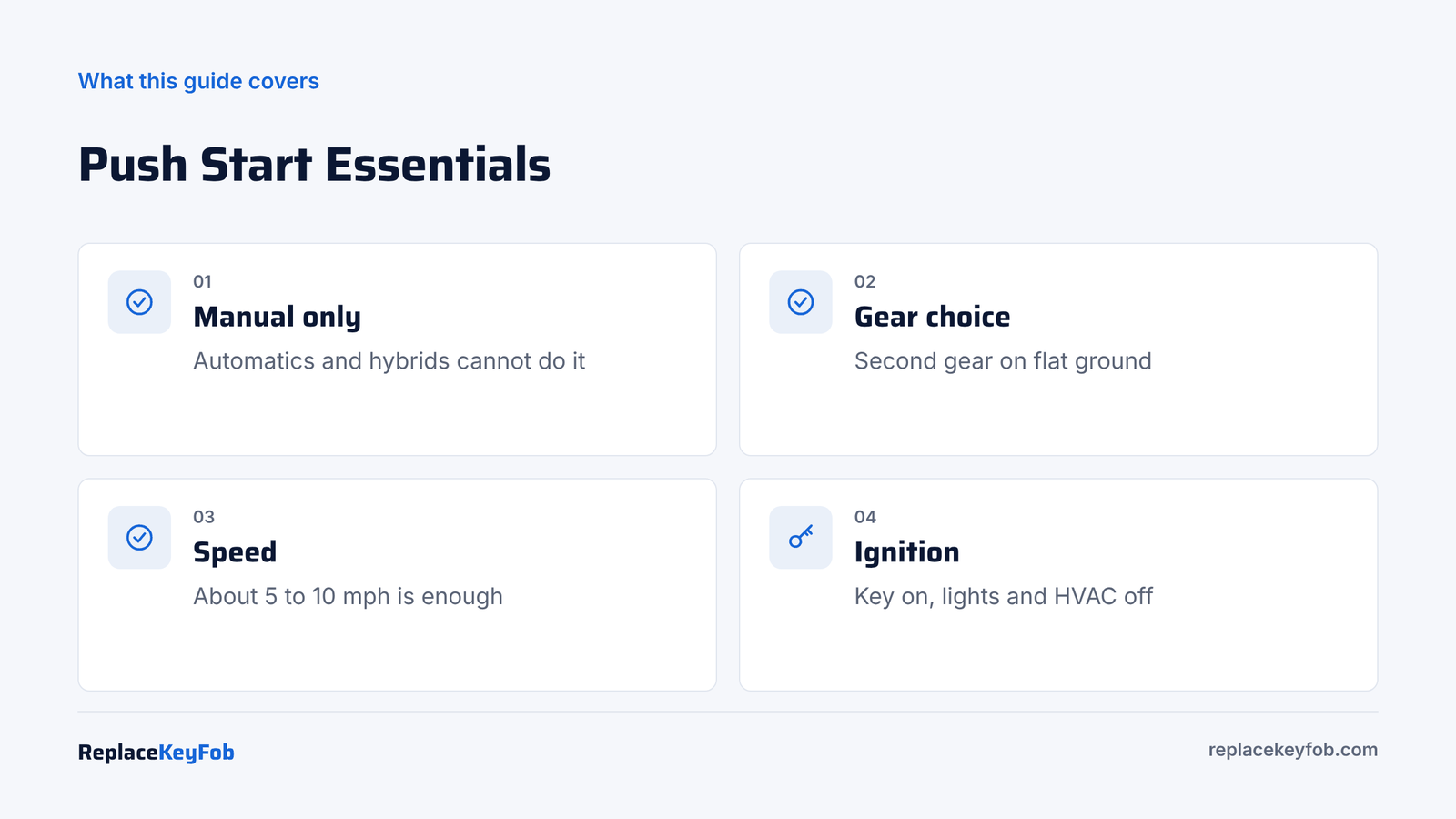
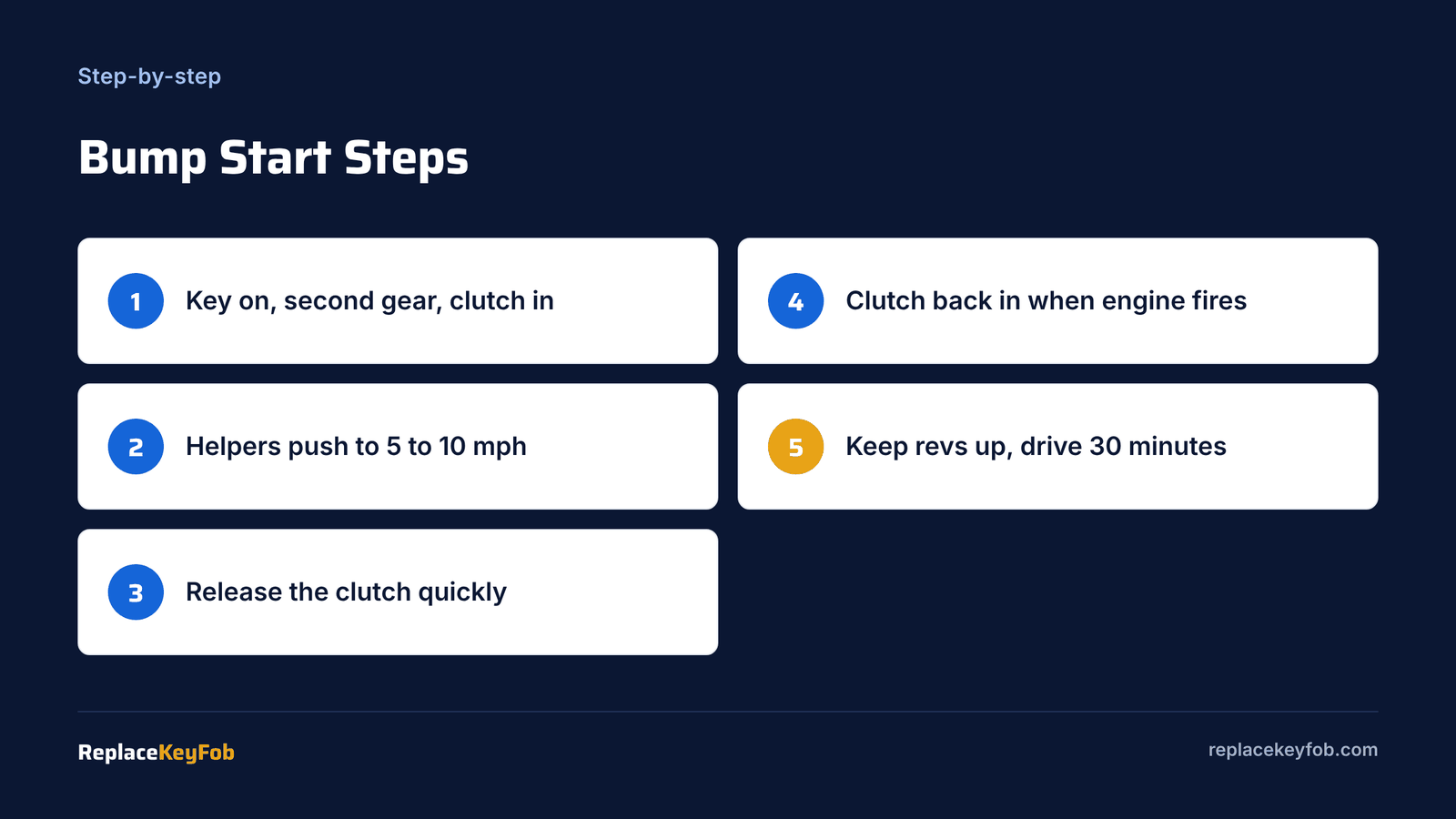
To push start a car, it must have a manual transmission. Turn the key to On, put it in second gear and hold the clutch down. Have helpers push to about 5 to 10 mph, then release the clutch quickly. When the engine fires, press the clutch back in and keep the revs up. Automatics and hybrids cannot be push started.
A push start, also called a bump start or roll start, uses the car’s motion to spin the engine instead of the starter motor. It works because, in a manual car, the wheels connect to the engine through the gearbox when the clutch is released. If the battery still has enough charge to power the fuel pump, ignition and computer, the engine fires.
It is a useful trick when no jump is available, but it only works on certain cars and only when done carefully.
Which Cars Can Be Push Started?
| Vehicle | Can it be push started? | Why |
|---|---|---|
| Manual transmission car or truck | Yes, usually | Wheels can turn the engine through the clutch |
| Automatic transmission | No | No direct link between wheels and engine when off |
| CVT automatic | No | Same reason as automatics |
| Dual-clutch automatic (DCT) | No | Computer-controlled clutches stay open without power |
| Hybrid | No | No conventional starter path; use the 12V jump method |
| Electric vehicle | No | No engine to start; jump the 12V only |
| Manual car with a completely flat battery | Often no | Fuel pump and ECU need some voltage to run |
If you drive an automatic, a jump pack or cables are your options. See how to jump start a car or how to use a jump starter.
Before You Try
- Check the battery is the problem. If the dash lights glow and the starter clicks or turns slowly, a push start is a reasonable fix. If nothing lights at all, the battery may be too flat to run the fuel pump and ignition.
- Find a safe spot. A flat, empty parking lot or a quiet street. A gentle downhill slope makes it easier. Never push into traffic.
- Get help. You need at least one or two people to push, or a gentle hill.
- Turn off all loads. Headlights, HVAC, rear defrost and radio. Every amp matters.
Compact lithium jump starter
A small jump pack in the glove box removes the need for pushers, hills or a second car, and works on automatics too.
As an Amazon Associate, ReplaceKeyFob earns from qualifying purchases.
How to Push Start a Manual Car Step by Step
- Sit in the driver’s seat with your seat belt on.
- Turn the key to On (the position where dash lights come on, not Start). For push-button cars, see the section below.
- Press the clutch all the way down.
- Select second gear. First gear gives a harsh jolt and can lock the wheels; second gear is smoother and easier to turn the engine. Third can work on a slight downhill but needs more speed.
- Release the parking brake.
- Signal your helpers to push. Keep the steering straight and watch ahead.
- At about 5 to 10 mph (a fast jog), release the clutch quickly but not violently. The car will jerk as the engine turns over.
- When the engine fires, press the clutch back down right away so the car does not stall or lurch.
- Give a little throttle to keep the engine running, and shift to neutral if you need to stop.
- If it does not fire, press the clutch in, coast, and try once more while you still have speed. Then stop and let helpers rest.
How to Push Start a Car on a Hill
With a gentle downhill you can do it alone:
- Point the car downhill with a clear runout.
- Key on, clutch in, second gear.
- Release the brake and let the car roll.
- At about 5 to 10 mph, release the clutch.
- When it fires, clutch in and brake to control speed.
Do not try this on a steep hill, near traffic, or where you cannot stop safely. Remember that power steering and power brakes are much heavier with the engine off. Brakes still work, but you will press harder.
Push Start a Car With a Push-Button Start
Many manual cars with keyless start can still be push started, but the ignition-on step is different:
- With the key fob inside, press the Start button without pressing the clutch. On many cars this turns the ignition on without trying to crank.
- If the car insists on cranking when you press the button, check the owner’s manual for the ignition-on procedure.
- If the battery is too low for the car to detect the fob or power the dash, a push start will not work. Use a jump instead.
People also use “push start” to mean the start button itself. If your push-button car will not start because it cannot see the key, read how to start a car when the key fob is not detected.
Why It Sometimes Fails
| Symptom | Likely cause | Fix |
|---|---|---|
| Wheels skid, engine does not turn | Too low a gear or slippery surface | Use second gear; try on dry pavement |
| Engine turns but will not fire | Battery too flat for fuel pump and ignition | Jump start or charge the battery |
| Fires, then dies | Released clutch too long or no throttle | Clutch in fast and add throttle |
| Car jerks hard and stops | Clutch released too slowly or too early | Build more speed; release quicker |
| Starts, dies again at idle | Alternator not charging | Test the charging system |
Safety and Mechanical Cautions
- Helpers push from the back, on the car body (not the spoiler or lights), with hands flat. Nobody should stand in front of the car.
- Watch traffic. Use hazard lights if the battery allows.
- Keep steering straight. With power steering off, steering is heavy.
- Do not push start repeatedly. Several failed attempts can wash raw fuel into the exhaust, which is hard on the catalytic converter. If two or three tries fail, stop and get a jump.
- Do not tow-start a car behind another vehicle unless you have experience and a proper tow strap; it is much riskier than pushing.
After the Car Starts
Keep the engine running and drive for at least 30 minutes so the alternator can recharge the battery. Avoid stopping the engine until you are somewhere you can get a jump if needed.
Then find out why the battery died. A battery that reads under about 12.4V at rest after driving, or a charging voltage under about 13.5V with the engine running, points to a weak battery or a charging problem. Our guide on how to test a car battery with a multimeter shows the readings, and testing the alternator with an OBD2 scanner is a quick second check.
Is Push Starting Bad for the Car?
Done correctly once or twice, a push start does not harm a healthy manual car. The risks come from poor technique or repeated tries:
- Clutch and drivetrain: dumping the clutch at high speed in first gear shocks the gearbox, axles and engine mounts. Second gear at a modest speed is gentle.
- Timing belt or chain: an engine turning normally is fine, but if the car has a known timing component problem, do not force it.
- Catalytic converter: many failed attempts send unburned fuel into the exhaust.
- Battery: a push start does nothing for the battery’s health. It still needs charging and testing.
Push Starting a Truck or Van
Heavier manual pickups and vans are harder to push and need more helpers or a slope. Diesels need more cranking speed to build compression heat, so they often need third gear on a downhill and a higher rolling speed. In cold weather, a diesel with a weak battery may not have enough power for its glow plugs, so a jump is usually the more reliable option. See how to jump start a truck.
When a Push Start Is the Wrong Fix
- The starter only clicks and the battery is strong: the starter or its wiring may be failing. See car clicks but won’t start.
- The car is an automatic, hybrid or EV.
- The battery is cracked, leaking or frozen.
Cost if You Need Help
A roadside jump without a membership typically costs about $50 to $125 in 2026. A new battery is typically about $150 to $400 installed, depending on the car. A new alternator typically runs about $400 to $900 installed.
Frequently Asked Questions
No. An automatic, CVT or dual-clutch transmission does not connect the wheels to the engine when the car is off, so pushing it will not turn the engine. Use a jump pack or cables.
Second gear is best on flat ground. First gear is too harsh, and third gear needs more speed.
About 5 to 10 mph, roughly a fast jog, is usually enough in second gear.
Often not. Modern fuel-injected cars need some battery voltage to run the fuel pump, ignition and computer. If nothing lights on the dash, a jump is the better fix.
Many manual cars with keyless start can be push started if you can switch the ignition on without cranking, usually by pressing the button without the clutch. Check the manual.