
How to Reset the Transmission Control Module (TCM)

This post contains affiliate links. As an Amazon Associate, ReplaceKeyFob earns from qualifying purchases, at no extra cost to you.
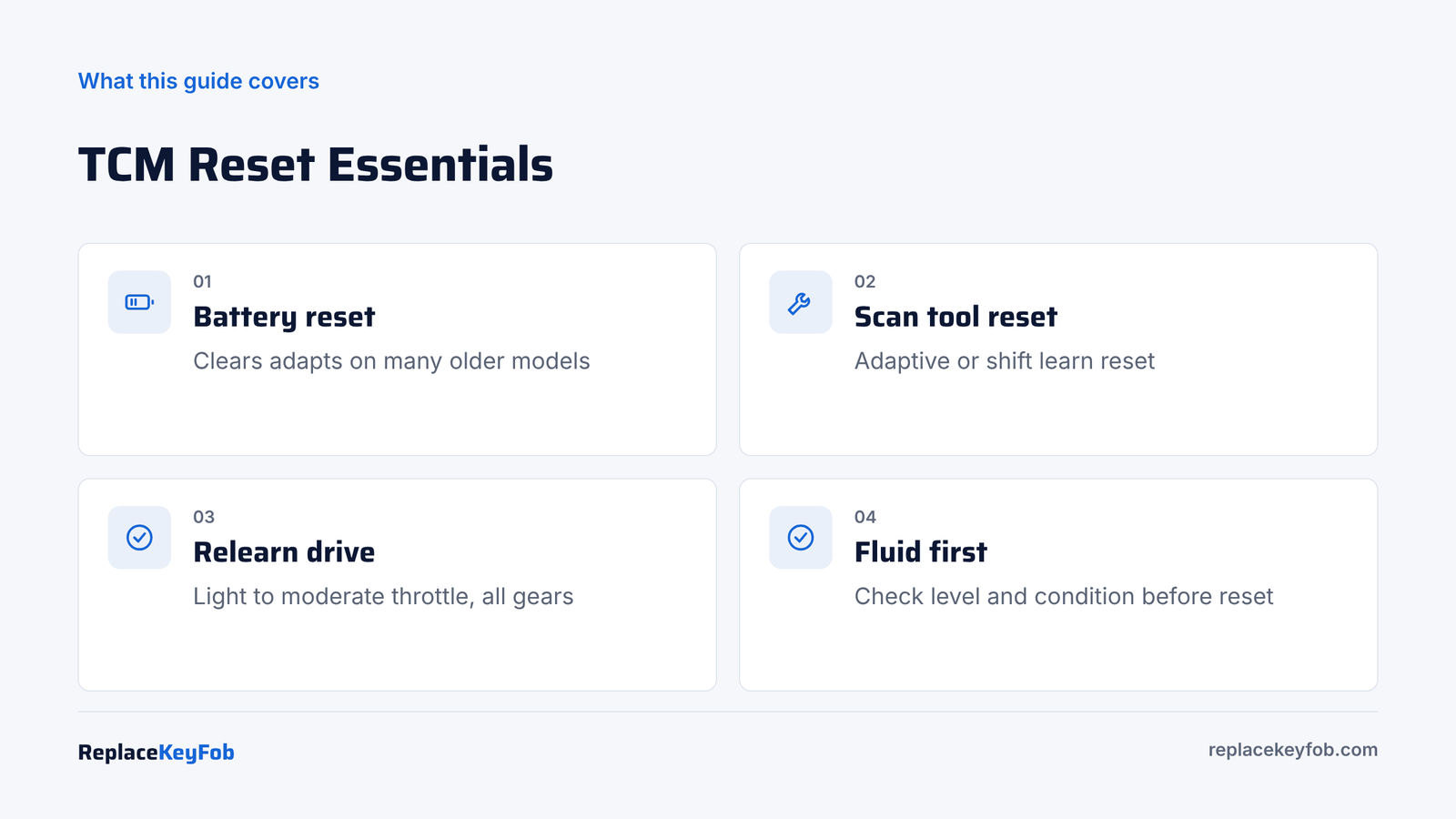
To reset the transmission control module, read and fix any transmission codes, then clear the TCM’s learned adaptations with a scan tool adaptive reset, or on many older vehicles by disconnecting the negative battery cable for 15 to 30 minutes. Afterward, drive with light to moderate throttle through every gear, with many stops and starts, so the TCM relearns shift pressures.
Modern automatic transmissions are run by a computer, the TCM, which may be a separate module or built into the engine computer. Over time, it learns how hard and how fast to apply each clutch to give smooth shifts as parts wear. A reset erases those learned values and stored codes.
A reset can help after a fluid service, a valve body or solenoid repair, or a new transmission. It will not fix low fluid, burnt clutches or a failed solenoid. This guide shows the two reset methods, the relearn drive that matters as much as the reset itself, and notes for Ford and GM 4L60E transmissions.
When a TCM Reset Makes Sense
| Situation | Reset helpful? |
|---|---|
| After a transmission rebuild or replacement | Yes, usually required |
| After a valve body or solenoid repair | Yes |
| After a fluid change, shifts feel odd | Sometimes; let it adapt first |
| Harsh shifts after a battery disconnect | Adapts were lost; do the relearn drive |
| Slipping, flare or no engagement | No: diagnose the cause |
| Fluid low or burnt | No: fix the fluid first |
What You Need
- A scan tool that reads transmission codes and, ideally, has a transmission adaptive reset
- A 10mm wrench for the battery method
- A way to check fluid level (dipstick, or the fill plug procedure on sealed units)
- A safe road with room for repeated gentle stops and starts
Scan tool with transmission relearn
Look for transmission code reading, live data such as fluid temperature, and a transmission adaptive reset for your make. Coverage varies widely between scanners.
As an Amazon Associate, ReplaceKeyFob earns from qualifying purchases.
See our guide to the best OBD2 scanner with transmission relearn and code readers for transmission codes.
Step 1: Check the Fluid and Read the Codes
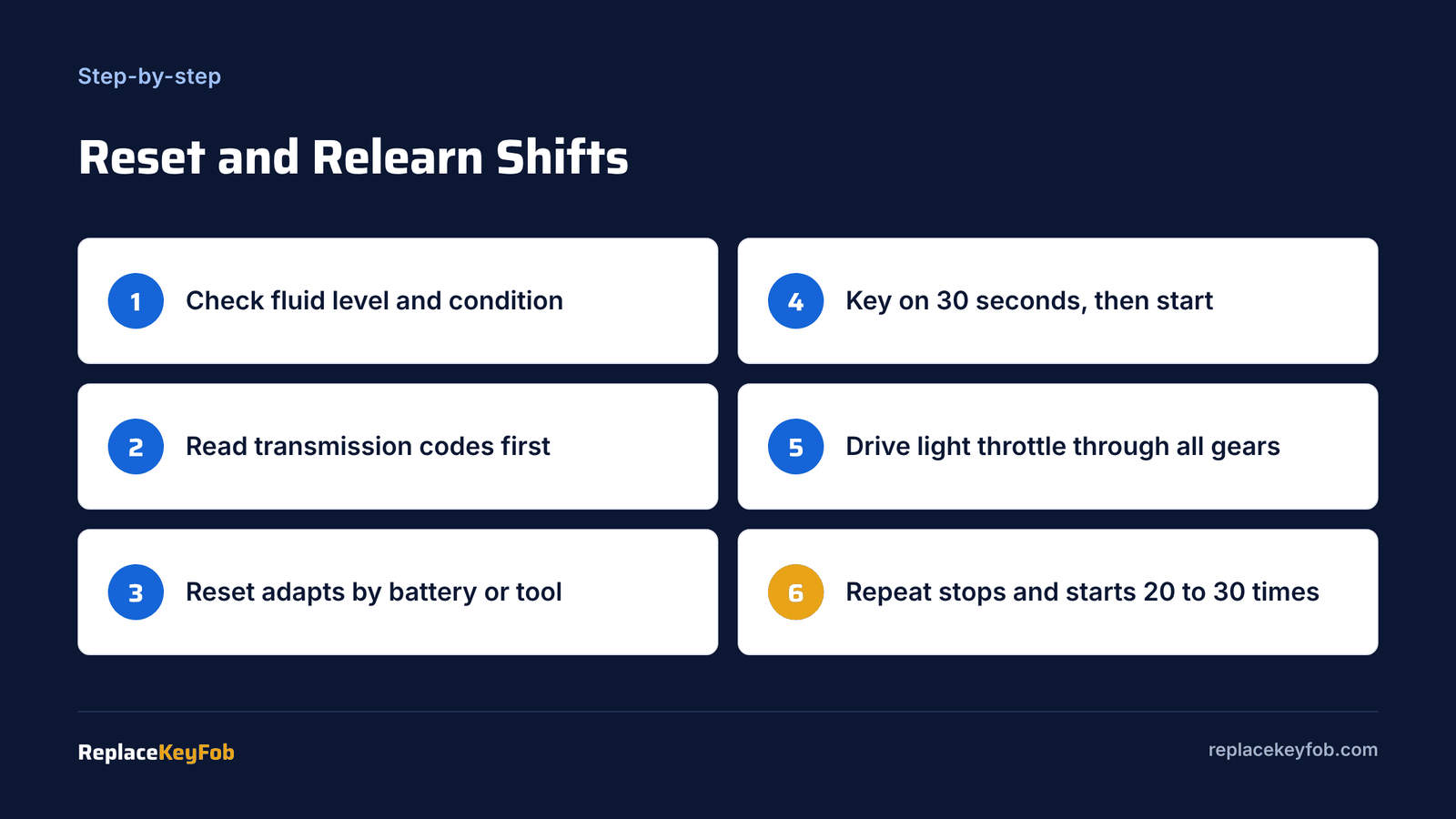
- Check fluid level and condition with the engine warm and running, if your car has a dipstick. Fluid should be red or pinkish and should not smell burnt. Sealed units need a fill-plug check at a specific temperature, usually best left to a shop.
- Read transmission codes. Generic code readers see some transmission codes (P07xx), but many brand-specific codes need a scanner with transmission module access.
- Fix what you find. A solenoid or speed sensor code will return after any reset.
Why first: a reset on low or bad fluid teaches the TCM to compensate for a problem, and the shifts get worse, not better.
Step 2: Reset the TCM
Method A: Scan tool adaptive reset
- Connect the scan tool and turn the ignition on.
- Select the transmission module (TCM, or the PCM on cars where it is combined).
- Go to special functions or service and choose “adaptive reset”, “transmission adapts reset”, “clutch volume reset” or similar.
- Follow the prompts. Some tools ask for the engine running and the transmission at a certain temperature.
This is the most reliable method, and on many newer vehicles it is the only one that works.
Method B: Battery disconnect
- Turn the engine off and remove the key.
- Disconnect the negative battery cable. See how to disconnect a car battery safely.
- Wait 15 to 30 minutes.
- Reconnect and tighten the cable.
- Turn the key to ON for about 30 seconds, then start the engine.
On many older vehicles this clears the adaptive tables. On many newer ones, adaptations are stored in non-volatile memory and survive. The battery method also resets the engine computer, so see how to reset the ECU for what else changes.
Step 3: The Relearn Drive
The TCM only learns by watching real shifts. Expect firm or soft shifts for the first 20 to 50 miles.
- Let the engine and transmission warm to normal temperature.
- From a stop, accelerate gently (about 15 to 25 percent throttle) and let the transmission shift through every gear without lifting.
- Slow gradually to a stop, letting it downshift on its own.
- Repeat 10 to 20 times, then do several runs at moderate throttle (about 30 to 40 percent).
- Include some steady highway cruising so the torque converter clutch learns its apply.
- Avoid hard launches, towing and wide-open throttle until the shifts feel normal.
Ford Transmission Control Module Reset
Many Ford automatics, such as the 6R80 and 10R80 used in F-150s and Mustangs, keep adaptive shift tables that can be reset.
- Scan tool: a Ford-capable scanner or FORScan with a compatible OBD2 adapter can run a “transmission adaptive table reset” or KAM reset.
- Battery disconnect: on many older Fords, disconnecting the battery resets the keep-alive memory, including transmission adapts.
After the reset, follow the relearn drive. Some Ford procedures also specify a series of light-throttle 1-2, 2-3 and 3-4 shifts at steady throttle until shifts smooth out.
4L60E Transmission Control Module Reset
The GM 4L60E (used in many Chevrolet and GMC trucks and SUVs from the 1990s into the 2010s) is controlled by the PCM on most models, or a separate TCM on some.
- Reset adapts with a GM-capable scanner (“transmission adapts reset”), or disconnect the battery on many older models.
- Drive with light to moderate throttle and let it complete 20 to 30 full upshifts and downshifts.
- Expect some firmness in the 1-2 and 2-3 shift at first.
Some later GM six-speed and eight-speed units need a dealer-level “fast learn” or “service fast learn” procedure after major work. If your scanner does not list it, a shop can do it.
Separate TCM vs Combined PCM
Where the transmission computer lives changes how you reset it.
- Combined PCM: many GM trucks with the 4L60E and many Ford, Toyota and Honda models run the transmission from the same powertrain computer as the engine. Resetting the PCM resets the transmission adapts too.
- Separate TCM: many European cars, many newer GM 6-speed and 8-speed units, and many Chrysler and Hyundai models use a separate module. It may sit on or inside the transmission, under a seat or behind the dash.
- Mechatronic units: many VW, Audi, BMW and Mercedes transmissions combine the TCM and valve body in one unit bolted inside the case. These usually need a brand-capable scan tool for resets and adaptations.
Signs the TCM Itself Is Failing
| Sign | What it suggests |
|---|---|
| Communication codes (U0101 “lost communication with TCM”) | Power, ground, wiring or a failed module |
| Random gear changes or no shifting with no mechanical noise | Module or solenoid power fault |
| Several unrelated transmission codes at once | Module, wiring harness or connector problem |
| Problems after water exposure | Module or connector corrosion |
A failed TCM often needs replacement and programming to the car. A replacement module typically costs about $400 to $1,200 installed, depending on the vehicle and whether programming is required.
If Shifts Are Still Wrong
| Symptom | Possible cause |
|---|---|
| Harsh 1-2 or 2-3 shift that does not improve | Low line pressure, worn valve body, wrong fluid |
| Engine revs up between shifts (flare) | Worn clutches or low fluid |
| Stuck in one gear (limp mode) | Active fault code; read it |
| Delay going into Drive or Reverse | Low fluid, worn seals or pump |
| Shudder at 35 to 50 mph | Torque converter clutch issue or fluid |
Mistakes to Avoid
- Resetting to hide a slipping transmission. It masks the problem briefly, then wears clutches faster.
- Using the wrong fluid. Always use the exact spec on the dipstick or in the manual.
- Driving hard right after a reset. The TCM learns best from gentle, repeated shifts.
- Skipping codes. A stored speed sensor code can make every shift feel wrong.
Cost
A DIY reset is free with a battery disconnect, or the cost of a capable scanner. A shop typically charges about $80 to $200 for a transmission scan and adaptive reset in 2026. A transmission fluid service is typically about $150 to $400, a solenoid pack or valve body repair often $400 to $1,200, and a rebuilt or replacement transmission $2,500 to $6,000 or more depending on the vehicle.
Frequently Asked Questions
Use a scan tool with a transmission adaptive reset, or on many older vehicles disconnect the negative battery cable for 15 to 30 minutes. Then drive gently through every gear with many stops and starts so the TCM relearns.
On many older vehicles it clears the learned shift tables. On many newer ones, the TCM keeps its adaptations in permanent memory, so you need a scan tool to reset them.
Shifts usually start to smooth out within 20 to 50 miles of normal driving, with gentle to moderate acceleration and many complete shift cycles.
Use a Ford-capable scanner or FORScan to run a transmission adaptive table or KAM reset, or disconnect the battery on many older Fords. Follow with a gentle relearn drive.
No. Slipping usually comes from low fluid, worn clutches or a hydraulic problem. A reset can make shifts feel different briefly, but the slipping will return.