
How to Use Mode 6 Data for Misfire Diagnosis

Quick Answer
To use Mode $06 data for misfire diagnosis, connect an OBD2 scanner that supports on-board monitoring results, open the Mode $06 or On-Board Monitoring menu, and locate the misfire test results. Compare cylinder-specific misfire counts, measured values, and manufacturer-defined limits, then cross-check the findings against trouble codes, freeze-frame data, and live engine readings. Mode $06 can reveal an intermittent misfire before a diagnostic trouble code appears, but it cannot identify a failed ignition coil, spark plug, injector, or mechanical component by itself.
What to Check First
- Misfire monitor: Confirm that the relevant monitor has completed and the displayed results are valid.
- Cylinder counts: Look for one cylinder with consistently higher misfire activity than the others under comparable conditions.
- Test limits: Compare measured values with the correct vehicle-specific limits and units.
- Stored codes: Check for P0300 random or multiple-cylinder misfires and P0301–P0308 cylinder-specific codes where applicable.
- Supporting evidence: Review freeze-frame data, live misfire counters, fuel trims, ignition performance, and engine operating conditions.
Important Safety Tip
- If the check engine light flashes or the engine shakes severely, avoid continued driving and arrange a safe inspection. An active misfire can damage the catalytic converter.
When an engine misfires only occasionally, a basic OBD2 code scan may not tell the whole story. Mode $06 can help reveal patterns in the engine computer’s recorded test results, even when the check engine light stays off.
In this guide, I’ll explain how to find the relevant data, interpret cylinder-level results, recognize misleading readings, and decide which diagnostic checks should come next. I’ll also explain why the correct interpretation depends on the vehicle’s year, engine, and manufacturer-specific definitions.
In This Guide
- What Does Mode $06 Data Mean for Misfire Diagnosis?
- How Do You Access Mode $06 Data With an OBD2 Scanner?
- How Do You Read Mode $06 Misfire Results?
- How Can Mode $06 Help You Find the Cause of a Misfire?
- Mode $06 vs. Trouble Codes and Live Data
- What Mistakes Should You Avoid When Interpreting Mode $06?
- Frequently Asked Questions
What Does Mode $06 Data Mean for Misfire Diagnosis?
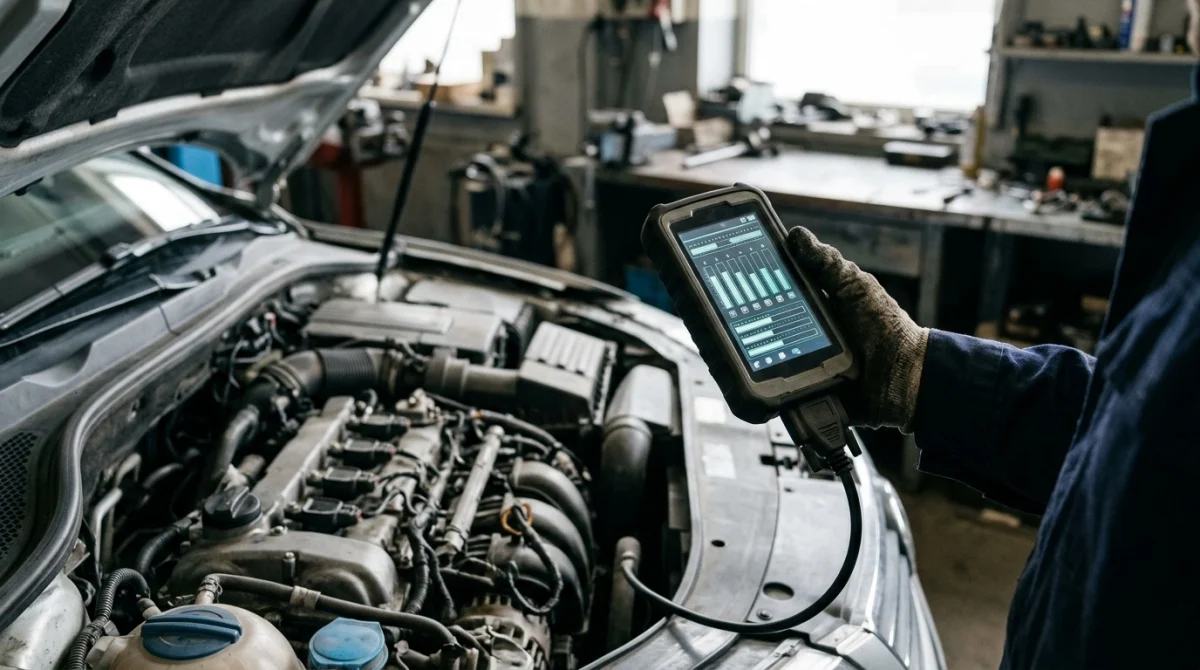
Mode $06 is an OBD2 diagnostic service that provides results from onboard monitoring tests. For misfire diagnosis, it can show cylinder-specific results, recorded misfire activity, and other monitor values supported by the vehicle’s diagnostic system.
Unlike a trouble code, which identifies a detected fault condition, Mode $06 often provides numerical evidence about how a monitored system performed. That extra detail can help narrow down an intermittent problem.
What Is Mode $06?
Mode $06, also written as Mode 6 or Mode $06, is part of the On-Board Diagnostics system used by a vehicle’s powertrain control module (PCM) or engine control module (ECM). It reports test results that the module records while monitoring engine and emissions-related systems.
These results may include continuous monitoring tests, such as misfire monitoring, and other supported tests that run only under specific operating conditions. The exact data available depends on the vehicle and the scanner.
Why Does Mode $06 Matter When No Misfire Code Appears?
A misfire can occur briefly without immediately meeting the conditions required to set a diagnostic trouble code (DTC). Mode $06 may preserve useful evidence of that activity, depending on the vehicle’s reporting strategy.
Consider an engine that stumbles briefly during acceleration but runs smoothly at idle. A basic code scan may show no current misfire code, while supported monitoring results may reveal activity concentrated on one cylinder.
That finding does not prove which part has failed. It tells you where to focus the next round of testing.
Understand the Terms on Your Scanner
Mode $06 screens can look confusing because different scanners and vehicle generations use different labels. Learn the common terms before drawing conclusions from the numbers.
- MID or OBDMID: Monitor identification, which identifies the monitored system or test group.
- TID: Test identification, commonly seen in older reporting formats.
- CID: Component identification, used in some formats to identify a component-specific test.
- Measured value: The result reported for the test.
- Minimum and maximum limits: The lower and upper thresholds reported for that test, where applicable.
- Pass/fail status: The scanner’s interpretation of whether the reported result falls within the applicable test limits.
Newer CAN-based vehicles often present these results differently from older vehicles. Some scanners translate the raw identifiers into readable cylinder names and misfire counts, while others display hexadecimal identifiers and numerical values that require manufacturer service information.
For additional technical background, see the Mode $06 explanation from AA1Car’s OBD-II diagnostic guide.
Section takeaway: Mode $06 provides diagnostic evidence, not a parts-replacement instruction. Use it to identify suspicious misfire patterns before confirming the underlying fault.
How Do You Access Mode $06 Data With an OBD2 Scanner?
You can access Mode $06 through a compatible OBD2 scanner, provided the vehicle exposes the relevant monitoring results. The general process is straightforward, although menu names and supported functions vary by tool.
Step 1: Connect a Compatible Scanner
Locate the vehicle’s OBD2 diagnostic connector and connect the scanner according to its instructions. Turn the ignition on or start the engine when the tool requests it.
Choose a scanner that explicitly supports Mode $06 or on-board monitoring data. A tool that reads and clears basic DTCs may not expose detailed misfire test results.
Step 2: Read the Diagnostic Trouble Codes First
Before exploring Mode $06, scan the vehicle for stored, pending, and current trouble codes where the tool supports those categories. Save the results instead of clearing codes or resetting the engine computer.
Look for codes such as:
- P0300: Random or multiple-cylinder misfire detected.
- P0301: Cylinder 1 misfire detected.
- P0302: Cylinder 2 misfire detected.
- P0303: Cylinder 3 misfire detected.
- P0304: Cylinder 4 misfire detected.
- P0305–P0308: Cylinder-specific misfire codes for applicable engines with those cylinder numbers.
These codes identify a detected misfire condition, not necessarily a defective spark plug or ignition coil. Record any accompanying codes because they may point toward a shared fuel, air, ignition, or mechanical problem.
Step 3: Open the Mode $06 Menu
Depending on the scanner, the feature may appear as Mode $06, On-Board Monitoring, Monitor Test Results, or a similarly named menu.
Select the relevant engine misfire monitor or cylinder-specific test. If the scanner offers enhanced manufacturer-specific diagnostics, check whether its descriptions are more detailed than the generic OBD2 display.
Step 4: Save the Test Results
Record the monitor identifier, test identifier, component identifier if present, measured result, limits, units, and pass/fail status. Capture the screen or export a report if the scanner supports it.
Also note when the symptom occurs, including whether the engine is cold, fully warmed up, idling, accelerating, or under load. Those conditions help you compare the stored evidence with the problem you experienced.
Step 5: Confirm That the Data Is Meaningful
Check whether the relevant monitor has completed and whether the scanner labels the result as valid. An incomplete test, unsupported identifier, or default numerical value should not be treated as proof of a healthy or failed cylinder.
Mode $06 retrieves recorded test results; it does not necessarily command the vehicle to perform a new misfire test on demand. Some values change only after the engine computer runs the relevant monitor.
Expert tip: Before interpreting raw identifiers, consult service information for the exact model year, engine, and control module. A familiar-looking test ID can mean something different across reporting formats.
Section takeaway: Read the codes first, access the supported misfire monitor, and preserve the data before making changes. Good records prevent a brief or intermittent symptom from being overlooked.
How Do You Read Mode $06 Misfire Results?
Read Mode $06 misfire results by comparing the correct cylinder-specific values, checking the applicable test limits, and identifying patterns that match the reported symptom. Do not assume every vehicle uses the same identifiers, units, or acceptable thresholds.
Look for Cylinder-Specific Misfire Activity
When the scanner identifies individual cylinders, compare their results under comparable conditions. One cylinder showing repeated or unusually high misfire activity deserves further investigation.
For example, imagine a four-cylinder engine whose supported current-drive-cycle results show the following illustrative counts:
| Cylinder | Illustrative misfire count | Initial interpretation |
|---|---|---|
| Cylinder 1 | 2 | Low recorded activity in this example |
| Cylinder 2 | 3 | Similar to the other cylinders |
| Cylinder 3 | 47 | Investigate cylinder 3 and verify the conditions |
| Cylinder 4 | 1 | Low recorded activity in this example |
These figures are hypothetical examples, not factory limits or universal failure thresholds. Actual counts depend on the monitor, drive cycle, operating conditions, and the vehicle’s reporting strategy.
Cylinder 3 stands out because its count is much higher than the others. The next step is to confirm the result with the correct service information and investigate cylinder 3 rather than replacing parts based on the count alone.
Understand Current and Historical Misfire Results
Some vehicles report misfire activity from the current driving cycle, while others also report an average or accumulated result from previous driving cycles. These values answer different questions.
- Current-cycle data: Can help show whether misfire activity is occurring during the latest monitored drive.
- Historical or averaged data: Can help reveal a recurring problem that may not be active at the moment of inspection.
- Overall misfire results: Can indicate broader engine misfire activity without necessarily identifying one cylinder.
Don’t compare values from different time windows as though they were identical measurements. Check the scanner’s test description and the manufacturer’s definitions before drawing conclusions.
Compare Measured Values With Test Limits
A Mode $06 result may show a measured value alongside minimum and maximum limits. The relationship between these fields matters more than the size of an unexplained number.
If the measured value exceeds the applicable maximum or falls outside another specified limit, the test may indicate an out-of-range condition. However, some tests use different scaling, special status values, or manufacturer-specific pass/fail logic.
Raw numbers may also appear in hexadecimal, or the scanner may show converted values. Don’t convert or scale a value unless you have the correct unit and conversion information.
What Do MID, TID, and CID Mean for Misfire Testing?
These identifiers tell you which monitor or test produced the reading. Their interpretation depends on the reporting format and vehicle-specific diagnostic definitions.
- Monitor ID (MID/OBDMID): Identifies the monitor group.
- Test ID (TID): Identifies an individual test within certain formats.
- Component ID (CID): Identifies a component-related result in formats that use this field.
For example, some service information documents identify particular misfire results using monitor IDs in the $A2–$AB range. That pattern is not a universal decoding rule for every vehicle or scanner.
The Walker Exhaust Mode $06 guide explains why test definitions, units, and vehicle-specific reference information matter when interpreting monitoring results.
Section takeaway: The most useful result is a verified pattern, not an isolated number. Compare cylinders, understand the time window, and use the correct test limits before deciding what to inspect.
How Can Mode $06 Help You Find the Cause of a Misfire?
Mode $06 helps narrow the search to a cylinder or monitored condition, but additional tests identify the underlying fault. The main possibilities include ignition problems, fuel delivery issues, air leaks, and mechanical engine faults.
1. Check the Ignition System
On a gasoline engine, a worn spark plug or failing ignition coil can cause a cylinder to misfire. If Mode $06 repeatedly points to one cylinder, start by inspecting the ignition components associated with that cylinder.
- Inspect the spark plug for wear, fouling, damage, or an incorrect gap where applicable.
- Check the ignition coil and its electrical connections for damage or poor contact.
- Look for moisture or oil in the spark plug well when the engine design makes this relevant.
- Use appropriate ignition testing to confirm whether the component performs correctly.
If the manufacturer permits coil swapping, a qualified technician may move a coil to another cylinder and see whether the misfire follows it. A change in the affected cylinder provides useful evidence, but it should be confirmed with the appropriate diagnostic procedure.
Expert tip: Don’t replace every ignition coil because one cylinder has elevated misfire counts. Confirm the fault first, and follow the manufacturer’s safety precautions around ignition components.
2. Investigate Fuel Delivery
A cylinder can misfire when it receives too little fuel, receives fuel inconsistently, or has an injector electrical or mechanical fault. Mode $06 may identify the affected cylinder without distinguishing an injector problem from an ignition failure.
Useful follow-up checks include:
- Inspecting injector wiring and connectors.
- Testing injector operation with suitable diagnostic equipment.
- Checking fuel pressure against the manufacturer’s specification.
- Reviewing fuel trims and other live data for evidence of a broader fueling problem.
If several cylinders show misfire activity together, investigate shared causes before assuming that multiple injectors or coils have failed simultaneously. Fuel pressure, air metering, intake leaks, and electrical supply issues may affect more than one cylinder.
3. Look for Air Leaks and Mixture Problems
Unmetered air entering the intake can create a lean mixture and contribute to rough running or misfires. A problem affecting a shared intake passage may influence several cylinders, while a localized leak may produce a more concentrated pattern.
Compare misfire results with fuel trims at idle and at an appropriate higher engine speed. Positive fuel trims can support a lean-mixture investigation, but they do not prove that an intake leak exists.
A smoke test, intake inspection, or other manufacturer-approved procedure may help confirm the source. Avoid spraying flammable substances around a running engine to search for leaks.
4. Consider Mechanical Engine Problems
If ignition and fuel checks don’t explain a recurring cylinder-specific misfire, investigate the engine’s mechanical condition. Low compression, a leaking valve, damaged piston rings, or a head-gasket problem can prevent a cylinder from contributing normally.
Depending on the symptoms, follow-up tests may include:
- A compression test performed according to the service procedure.
- A cylinder leak-down test to assess where pressure escapes.
- Valve-train inspection where indicated.
- Checks for coolant intrusion or other evidence of internal engine damage.
Mechanical testing becomes especially important when the same cylinder repeatedly misfires despite verified ignition and fuel-system operation. Replacing parts without checking compression can waste time and money.
5. Match the Pattern to the Driving Conditions
Misfires that occur only when the engine is cold, during acceleration, or under heavy load can require different diagnostic approaches. Record the conditions whenever possible and compare them with the monitoring results.
For example, an engine that runs smoothly at idle but misfires under load may need closer inspection of ignition performance under the conditions that trigger the symptom. A misfire confined to cold starts may point toward a different set of possibilities.
Mode $06 may not preserve enough detail to identify the exact moment of failure. A scanner with live misfire counters, graphing, or manufacturer-specific functions can provide additional evidence.
Section takeaway: Use Mode $06 to choose where to investigate, then verify the ignition, fuel, air, and mechanical systems with appropriate tests. A cylinder count identifies a direction, not a failed part.
Mode $06 vs. Trouble Codes and Live Data
Mode $06 is most effective when combined with other diagnostic information. Trouble codes identify recognized fault conditions, freeze-frame data records operating conditions associated with certain faults, and live data shows what supported sensors or counters report during testing.
Each source answers a different question, so using them together usually provides a stronger diagnosis than relying on one screen.
| Diagnostic method | What it tells you | Main limitation |
|---|---|---|
| Stored and pending DTCs | Which fault conditions the control module has recognized | A brief or developing misfire may not have set a code |
| Mode $06 | Supported monitor test results, limits, and sometimes cylinder-specific activity | Definitions and available detail vary by vehicle and scanner |
| Freeze-frame data | Recorded operating conditions associated with a qualifying fault | May not capture the exact instant of an intermittent misfire |
| Live data | Current readings and supported counters while the engine operates | Some faults occur too briefly or under conditions not reproduced during testing |
| Physical diagnostic tests | Evidence about component operation and engine mechanical condition | Require suitable tools, procedures, and technical knowledge |
How to Combine the Results
A useful diagnostic sequence is to move from the broad symptom toward the specific cause.
- Read the codes: Record all relevant engine and emissions-related faults.
- Review freeze-frame information: Note the recorded temperature, engine speed, load, and other available conditions.
- Check Mode $06: Look for abnormal or repeated cylinder-specific results, using the correct definitions and limits.
- Monitor live data: Observe available misfire counters, fuel trims, engine speed, and related parameters while reproducing the symptom safely.
- Perform confirmation tests: Test the suspected ignition, fuel, air, or mechanical system before replacing parts.
- Verify the repair: Recheck relevant data and confirm that the symptom has stopped under appropriate conditions.
For a technical discussion of cylinder-level misfire analysis and follow-up testing, see Underhood Service’s Mode 06 misfire diagnosis guide.
What If Mode $06 Shows a Failure but No Code Is Stored?
A failed or out-of-range test result does not always mean the control module has met the conditions needed to store a DTC. Some monitors use different thresholds, operating conditions, or fault-confirmation rules before setting a code.
Save the test results and check the manufacturer’s diagnostic information. Then compare the result with the current symptoms, other codes, and supporting data before deciding whether a repair is necessary.
Section takeaway: Codes tell you what the computer recognized, Mode $06 adds monitor evidence, and live data helps you observe current behavior. Confirmation testing connects those clues to a repair.
What Mistakes Should You Avoid When Interpreting Mode $06?

Mode $06 is valuable, but misreading the data can lead to unnecessary parts replacement or a missed fault. The safest approach is to verify the test definition, operating conditions, and supporting evidence before interpreting a result.
Assuming the Same IDs Apply to Every Vehicle
Mode $06 identifiers and descriptions can differ between manufacturers, model years, engine configurations, and reporting formats. Never assume a TID, MID, or CID has the same meaning on every vehicle.
Use manufacturer service information for the specific vehicle. Generic scanner descriptions are useful starting points, not a substitute for the correct reference data.
Treating Any Nonzero Count as a Failure
A nonzero misfire count alone does not establish that a component has failed. The number must be interpreted in context, including the time window, cylinder comparisons, test thresholds, and symptoms.
Likewise, a result of zero doesn’t prove the engine is free of misfires. The fault may be intermittent, the relevant monitor may not have run, or the scanner may not expose the needed data.
Ignoring Monitor Completion and Default Values
Some tests require particular operating conditions before the computer can complete them. A missing result, incomplete monitor, or default-looking value can be misleading if treated as a genuine pass.
Check the monitor status and the scanner’s explanation of unsupported or unavailable values. If the status is unclear, verify it through the service documentation rather than assuming the test passed.
Clearing Codes Before Saving Evidence
Clearing trouble codes or resetting the control module can erase useful diagnostic information and reset readiness monitors. That may make an intermittent issue harder to reproduce or evaluate.
Record codes, freeze-frame data, Mode $06 results, and relevant live readings first. Only clear codes when appropriate for the diagnostic procedure, and understand that the vehicle may need to complete its monitors again afterward.
Replacing Parts Without Confirming the Fault
Elevated misfire activity on one cylinder can result from ignition, fueling, air leakage, or mechanical problems. Replacing a coil or spark plug without testing can leave the real cause untouched.
Confirm the suspected failure with suitable measurements and the manufacturer’s recommended procedures. If the results point toward internal engine damage or require specialist equipment, a qualified repair technician may be the best next step.
Continuing to Drive With a Severe Misfire
A flashing check engine light often signals a misfire severe enough to threaten the catalytic converter. Continuing to drive under those conditions can increase the risk of expensive exhaust-system damage.
If the light flashes, the engine shakes heavily, or power drops sharply, reduce risk by stopping in a safe location and arranging professional assistance. Don’t conduct road tests that reproduce a severe misfire in traffic.
Expert tip: When the misfire is active and severe, protecting the vehicle and occupants comes before collecting more scanner data.
Section takeaway: Verify identifiers and test status, preserve diagnostic evidence, and avoid replacing parts based on a single number. Stop driving when a severe misfire creates a safety or damage risk.
Frequently Asked Questions
Can Mode $06 detect a misfire before the check engine light comes on?
Yes, it can reveal supported misfire-monitoring results before a diagnostic trouble code sets, depending on the vehicle’s monitoring and reporting strategy. It does not guarantee early detection of every misfire, and the relevant test must provide valid data.
Does Mode $06 tell me which ignition coil is bad?
No. Cylinder-specific misfire data can help identify where to investigate, but it cannot by itself prove that the ignition coil caused the problem. Check the spark plug, coil, injector, wiring, air supply, and mechanical condition as appropriate.
What Mode $06 values indicate a bad cylinder?
There is no universal misfire-count threshold that applies to every car. Compare the measured results with manufacturer-defined limits, other cylinders, operating conditions, and the vehicle’s service information before concluding that a cylinder has a fault.
Can I use a cheap OBD2 scanner to read Mode $06?
Some entry-level scanners support Mode $06, while others display only basic codes and live data. Check the scanner’s documented features before buying it, and confirm that it can interpret the relevant monitor results for your vehicle.
Why does Mode $06 show zero misfires when my engine runs rough?
The misfire may be intermittent, the monitor may not have run under the necessary conditions, or the scanner may not display the relevant data. Check for stored and pending codes, review live readings, and use manufacturer-specific diagnostic procedures when needed.
Should I clear codes before checking Mode $06?
No. Record existing codes, freeze-frame data, and relevant monitoring results before clearing anything. Resetting codes can remove useful evidence and may reset readiness monitors, making it harder to assess an intermittent misfire.
Can Mode $06 confirm that a misfire repair worked?
It can help verify a repair when the relevant monitor runs and reports valid results under suitable conditions. Also confirm that the engine operates normally, the original symptom has disappeared, and no relevant faults return during appropriate verification testing.
Final Takeaway: Use Mode $06 to Guide the Diagnosis
Mode $06 is a useful tool for diagnosing intermittent engine misfires, especially when basic trouble codes provide too little detail. It can help identify a cylinder with unusual misfire activity, reveal out-of-range monitoring results, and guide the next diagnostic test.
The key is to interpret the data correctly. Use the manufacturer’s test definitions, compare relevant cylinders, and combine Mode $06 with DTCs, freeze-frame information, live readings, and physical tests.
If you’re working through a misfire on your own vehicle, save the scanner report and identify the exact year, make, model, engine, and displayed test IDs before ordering parts. When a misfire is severe or the data remains unclear, have a qualified automotive technician confirm the fault.
Diagnostic note: This guide provides general OBD2 information current as of October 2026. Vehicle-specific procedures, monitor definitions, and thresholds should always be verified using the appropriate service information.
Disclosure: This article is for general educational purposes and does not replace manufacturer service information or professional diagnosis. Always follow the vehicle manufacturer’s safety procedures.
