
NOCO Boost X GBX45 Review (2026): Compact and Fast-Charging

We may earn a commission when you buy through links on this page, at no extra cost to you. How we pick products.
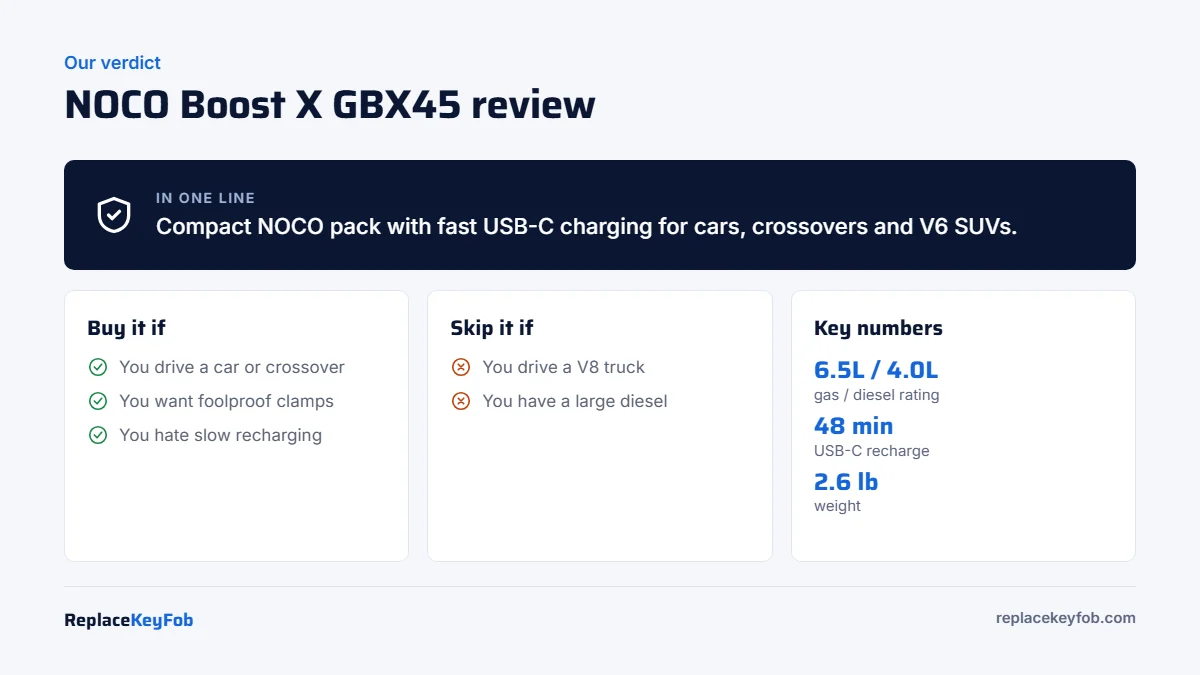
The NOCO Boost X GBX45 is the compact jump starter to buy if you want NOCO’s foolproof clamp safety without the slow charging of older Boost models. It covers gas engines up to 6.5L and diesels up to 4.0L, weighs about 2.6 lb, and recharges in about 48 minutes over USB-C. Buy it for cars, crossovers, minivans and V6 SUVs. Skip it for V8 trucks and larger diesels, where the GBX75 or a bigger pack is the better fit.
NOCO’s original GB40 became the default glove-box jump starter, but it charges slowly through an older port. The Boost X line was NOCO’s answer: the same easy, spark-proof design with modern USB-C fast charging and a higher-voltage battery. The GBX45 is the smallest Boost X model. This review covers what it does well, where it compromises, and who should buy something else, based on NOCO’s specs and manual, the retailer listing and long-term owner feedback. We have not run our own cranking tests.
NOCO GBX45 Specs at a Glance
| Spec | NOCO Boost X GBX45 |
|---|---|
| Peak current | 1250A |
| Rated engine size | Gas up to 6.5L, diesel up to 4.0L |
| Starts per charge | Up to 6 (NOCO rating) |
| Recharge | About 48 minutes via USB-C Power Delivery |
| Quick charge | 5 minutes for one jump from empty |
| Safety | UltraSafe 2.0: spark-proof, reverse-polarity protection |
| Power bank | 60W USB-C, two-way |
| Flashlight | 100 lumens, 7 modes including SOS and strobe |
| Weight | About 2.6 lb |
NOCO Boost X GBX45 1250A UltraSafe Jump Starter
Gas up to 6.5L, diesel up to 4.0L
Check Price on AmazonDesign and Build
The GBX45 keeps NOCO’s flat, hand-sized shape, so it slides into a glove box or seat-back pocket next to the owner’s manual. The clamps are compact and the cable is short, which is normal for this size. The body has the rugged over-molded feel NOCO is known for, and the controls are simple: a power button, a light button, a manual override and charge LEDs.
There is no screen, and for most people that is fine. The pack tells you with lights whether the connection is good, which is all you need on a cold roadside.
Jump Starting Performance
NOCO rates the GBX45 for gas engines up to 6.5L and diesels up to 4.0L. That is a step up from the GB40 (6.0L gas, 3.0L diesel) and covers nearly all four-cylinder and V6 cars, crossovers, minivans, compact pickups and smaller diesels. Owner feedback is consistent: on a drained battery in these vehicles, it starts reliably.
The number to understand is starts per charge. NOCO lists up to 6, while the GB40 lists up to 20. The Boost X design delivers more energy per jump from a higher-voltage battery, and a built-in 60-second timer conserves power between attempts. In practice, six good starts is plenty for one emergency, but you should recharge after use rather than leave it in the car half-empty.
Manual override
If the battery is too flat for the clamps to detect, the manual override forces power. It disables the safety detection for that attempt, so check the clamp connections carefully before using it, and follow the manual.
Charging: The Real Upgrade
This is the main reason to choose the GBX45. Through a USB-C Power Delivery charger, it recharges in about 48 minutes, compared with about three hours for the GB40. NOCO also says five minutes of charging gives enough power for one jump, even from a completely empty pack. That changes how you use it: if you find it flat, a short charge from a laptop charger or car USB-C port gets you going.
Use a USB-C PD charger of at least 60W for the fastest times. A standard low-wattage phone charger will work, but much more slowly.
Safety: UltraSafe 2.0
NOCO’s spark-proof, reverse-polarity protected clamps are the strongest reason to buy any NOCO. If you connect the clamps backwards, nothing happens, instead of a spark or damage to sensitive electronics. On a modern car that matters: a reverse connection can damage control modules, including the systems that handle keyless entry and the immobilizer, which can leave you with a car that won’t start even though the fob unlocks the doors. UltraSafe 2.0 also adds better thermal management for safer operation and longer battery life.
Power Bank and Flashlight
The two-way 60W USB-C port is a genuinely useful power bank. It can charge phones, tablets and many laptops, which the older GB40 cannot. The 100-lumen LED with seven modes including SOS and strobe is bright enough to see battery terminals, but not a work light. If you want a brighter light, the GBX55 and GBX75 have 200 and 400 lumens.
Where the GBX45 Falls Short
- Fewer starts per charge than the GB40. Recharge after every use.
- Not for V8s or big diesels. Its 6.5L gas rating is good for its size, but large engines need more.
- Basic flashlight. Fine for terminals, not for long roadside jobs.
- Short cable, which can be awkward on vehicles with deep-set batteries.
Pros and Cons
| Pros | Cons |
|---|---|
| About 48-minute USB-C recharge | Up to 6 starts per charge |
| 5-minute emergency charge | Not for V8s or large diesels |
| UltraSafe 2.0 clamp protection | 100-lumen light is basic |
| 60W USB-C power bank | Short cable |
| Glove-box size, about 2.6 lb | No screen for error details |
What the GBX45 Can and Cannot Start
| Vehicle | Typical engine | GBX45 suitable? |
|---|---|---|
| Compact car or hatchback | 1.5L to 2.0L | Yes, easily |
| Mid-size sedan | 2.5L 4-cylinder or 3.5L V6 | Yes |
| Crossover, minivan, V6 SUV | 2.0L turbo to 3.6L V6 | Yes |
| Small diesel | 2.0L to 3.0L | Yes, within its 4.0L rating |
| Half-ton V8 pickup | 5.0L to 6.2L | Possible when warm, not reliable in cold |
| Heavy-duty diesel | 6.6L to 6.7L | No |
Who Should Buy the NOCO GBX45?
| You are… | GBX45 a good fit? |
|---|---|
| A commuter with a sedan or crossover | Yes |
| Someone who forgets to charge gadgets | Yes, thanks to fast USB-C |
| A GB40 owner wanting faster charging | Yes |
| A V8 truck owner | No, choose the GBX75 |
| Someone who wants many starts per charge | Consider the GB40 or GB50 |
GBX45 Alternatives
- NOCO GB40: lower rating and slower charging, but up to 20 starts per charge. See NOCO GB40 vs GBX45.
- NOCO GBX55: 7.5L gas rating, 200-lumen light, about 1.2-hour recharge.
- Fanttik Potent T10: cup-sized, 7.0L gas rating, display on the clamp.
- NOCO GBX75: 8.5L gas rating for V8 trucks and SUVs.
All of these are compared in our compact jump starter guide and the main portable jump starter roundup.
How to Use the GBX45
- Check the charge LEDs. Charge first if it is low.
- Turn off the ignition and accessories.
- Connect the red clamp to positive (+) and the black clamp to negative (-) or a bare metal ground.
- Press the power button and wait for the white ready light.
- Start the car within the 60-second window; crank no longer than about five seconds.
- Disconnect black first, then red, and recharge the pack the same day.
Related Guides
- NOCO Boost vs Boost X: what changed
- NOCO GB40 review
- Best compact jump starters
- Key fob not detected after a jump start
FAQ
Is the NOCO GBX45 better than the GB40?
For most people, yes: it has a slightly higher engine rating and recharges in about 48 minutes over USB-C instead of about three hours. The GB40 gives more starts per charge.
Can the GBX45 start a V8?
It is rated for gas engines up to 6.5L, so many V8s are above its rating. It may start a warm V8 with a mildly drained battery, but a GBX75 is the reliable choice.
Why does the GBX45 have only 6 starts per charge?
Boost X packs deliver more energy per jump from a higher-voltage design. Six strong starts is enough for an emergency; recharge after use.
What charger should I use for the GBX45?
A USB-C Power Delivery charger, ideally 60W, for about 48-minute charging. Lower-wattage chargers work more slowly.
Can the GBX45 charge a laptop?
Yes. Its two-way 60W USB-C port can charge many laptops, as well as phones and tablets.
Will a jump start erase my key fob programming?
No. Some cars briefly fail to detect the fob after a dead battery; see our guide on key fob not detected after a jump start.