
Jump Starter vs Jumper Cables: Which Should You Keep in the Car?

We may earn a commission when you buy through links on this page, at no extra cost to you. How we pick products.
For most drivers, a portable jump starter is the better thing to keep in the car: you do not need a second vehicle, and smart clamps stop a wrong connection from doing damage. Jumper cables still win on one point: they never need charging, so they work after years in the trunk as long as a helper car is around. The best setup for winter driving and road trips is both: a charged lithium pack plus a set of thick 4-gauge cables.
When a car will not start because the battery is flat, there are two common fixes you can carry with you: a set of jumper cables or a portable jump starter. They do the same job in very different ways. Cables borrow power from another running car. A jump starter carries its own battery. This guide compares them on convenience, safety for modern electronics, reliability, cost of ownership and cold-weather performance, then tells you which to keep for the way you drive.
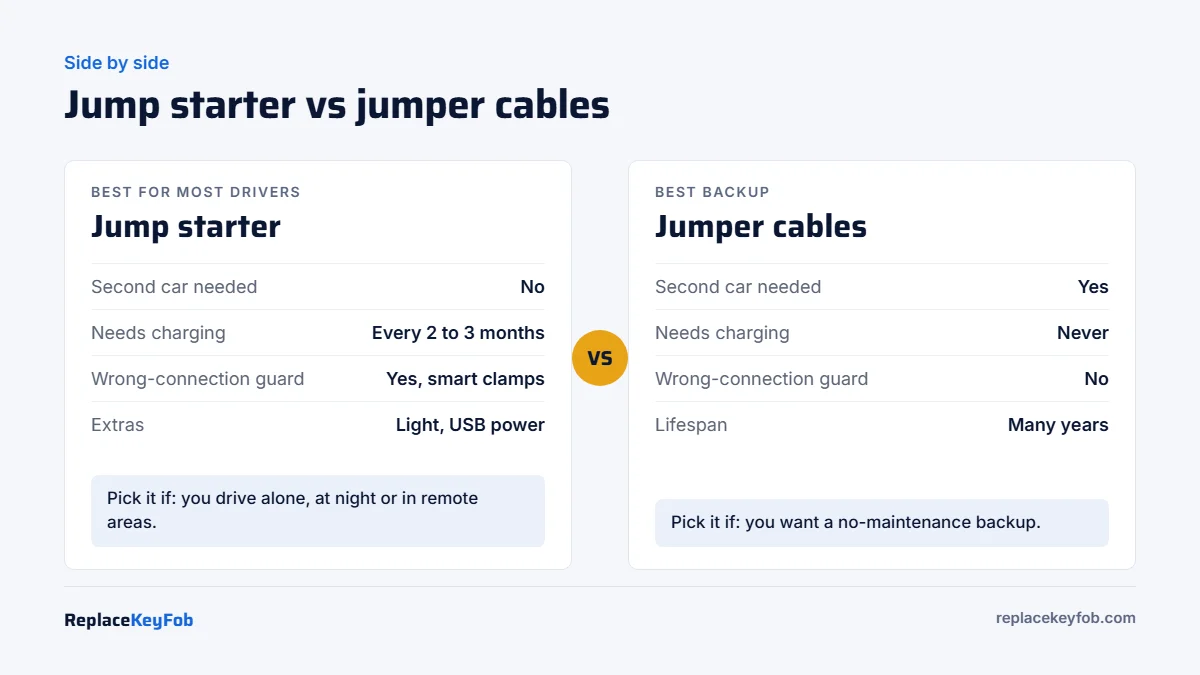
Jump Starter vs Jumper Cables at a Glance
| Portable jump starter | Jumper cables | |
|---|---|---|
| Needs a second car | No | Yes |
| Needs charging | Yes, every 2 to 3 months and after use | Never |
| Wrong-connection protection | Yes, on smart clamps | No |
| Spark risk | Very low with spark-proof clamps | Possible on the last connection |
| Extras | Phone charging, flashlight, sometimes tire inflator | None |
| Storage size | Glove box to under-seat | A bag in the trunk |
| Shelf life | Lithium battery ages over the years | Lasts many years if kept dry |
| Best for | Solo drivers, night and remote driving | Backup, fleets with helper vehicles |
How Each One Works
Jumper cables connect your dead battery to the battery of a running car. The donor car’s alternator and battery supply the current your starter needs. They are simple copper or copper-clad aluminum cables with clamps, and they have no electronics.
A portable jump starter is a battery pack, now almost always lithium, with a short cable and smart clamps. It delivers a short burst of high current straight to your battery and starter. Most modern packs check the connection first and only send power when the clamps are on the correct terminals.
Convenience: Jump Starter Wins
The biggest advantage of a jump starter is that you do not need anyone else. In an empty parking lot at night, on a rural road, or in a parking garage where another car cannot pull nose-to-nose with yours, cables are useless. A jump pack lets you fix the problem yourself in a couple of minutes. It also doubles as a phone charger and a flashlight, which helps if you end up waiting for a tow anyway.
Safety for Modern Cars: Jump Starter Wins
Modern cars have dozens of electronic modules, including the ones that handle keyless entry, push-button start and the immobilizer. A reversed connection with jumper cables can damage these modules, and a spark near a battery can ignite hydrogen gas from the battery. A good jump starter’s spark-proof, reverse-polarity clamps do nothing until the connection is right, which removes the two most common jump-start mistakes.
Cables are safe when used correctly, and millions of people do it every year. But the safety depends entirely on the person connecting them, often in the dark and in a hurry.
Reliability: Jumper Cables Win
Cables have no battery, so they cannot go flat. A set left in the trunk for five years works the same as on day one, as long as the clamps are not corroded. A jump starter is only as good as its last charge. Lithium packs hold charge for months, but heat, cold and time slowly drain them, and a pack that has sat for a year may not have enough left for a big engine. If you are the kind of driver who never charges anything, that is a real point in favor of cables.
Cold Weather: It Depends
Cold makes everything harder. Lithium packs lose some output in deep cold, and so does the donor car’s battery. With cables, a healthy running donor car with a large engine provides steady current for as long as you need. With a pack, you get the charge it holds. Our advice for real winters: keep the jump pack in the cabin rather than the trunk, bring it inside on very cold nights, and use thick 4-gauge or 2-gauge cables if you rely on cables, because thin cables lose a lot of current in the cold.
Large Engines and Diesels
Jumper cables can start a large engine if the cables are thick enough and the donor vehicle is similar in size. A jump pack must be rated for your engine; small packs made for four-cylinder cars will not crank a V8 truck or a heavy diesel. See our guide to the best jump starters for diesel trucks for packs rated up to 8.0L diesel.
Our Recommended Picks
Best jump starter for most cars: NOCO Boost GB40
NOCO Boost GB40 1000A Lithium Jump Starter
Gas up to 6.0L, diesel up to 3.0L, up to 20 starts
Check Price on AmazonSmall enough for a glove box, rated for gas engines up to 6.0L, and protected against sparks and reverse connections. Read our full NOCO GB40 review.
Best jump starter if you forget to charge: NOCO Boost X GBX45
NOCO Boost X GBX45 1250A Lithium Jump Starter
Recharges in about 48 minutes over USB-C
Check Price on AmazonIts USB-C charging takes about 48 minutes, and five minutes of charge gives one jump even from empty, which addresses the biggest weakness of jump packs. See GB40 vs GBX45.
Best jumper cables for cars and SUVs: Energizer 4-gauge, 16 ft
Energizer 4-Gauge 16 ft Jumper Cables
4 gauge, 16 feet, carry bag included
Check Price on AmazonThick 4-gauge cable carries current well, and 16 feet reaches most batteries when the cars cannot park nose-to-nose. A carry bag keeps them tidy in the trunk.
Best jumper cables for trucks: Energizer 2-gauge, 20 ft
Energizer 2-Gauge 20 ft Heavy Duty Jumper Cables
2 gauge, 20 feet
Check Price on AmazonFor V8 trucks, diesels and long reaches, 2-gauge cable loses less current, and 20 feet covers awkward parking spots.
Which Should You Keep in Your Car?
| Your situation | Best choice |
|---|---|
| You often drive alone, at night or in rural areas | Jump starter |
| You never remember to charge gadgets | Jumper cables (or a fast-charging pack) |
| Your car has push-button start and lots of electronics | Jump starter with smart clamps |
| You drive a large diesel truck | Pack rated for your engine, plus 2-gauge cables |
| Family with two cars at home | Cables at home, a pack in each car |
| Long road trips and winter driving | Both |
How to Use Each Safely
Jump starter
- Turn off the ignition and accessories.
- Red clamp to positive (+), black clamp to negative (-) or bare metal.
- Wait for the ready light, then start the car.
- Disconnect black first, then red, and recharge the pack.
Jumper cables
- Park the donor car close, turn both cars off.
- Red to the dead battery’s positive, then red to the donor’s positive.
- Black to the donor’s negative, then the last black clamp to bare metal on the dead car’s engine, away from the battery.
- Start the donor car, wait a few minutes, then start the dead car.
- Remove the cables in reverse order.
Our full guide on how to jump start a car covers each step in detail.
When Neither Will Help
If the car clicks but will not crank even with a good jump, the problem may be the starter, a corroded terminal or a failed battery. If it cranks but will not start, the problem is often fuel, spark or the immobilizer not recognizing the key. A weak key fob battery can cause push-button cars to refuse to start; see car won’t start because the key fob battery is dead and car won’t start but the key fob unlocks the doors.
Related Guides
- 7 best portable jump starters for cars, trucks and SUVs
- Best jump starters with air compressor
- How to jump start a car safely
- Key fob not detected after a jump start
FAQ
Is a jump starter better than jumper cables?
For most drivers, yes, because it works without a second car and smart clamps prevent wrong connections. Cables are better as a backup because they never need charging.
Can jumper cables damage a modern car?
Used correctly, rarely. The risk comes from reversed connections and sparks, which can damage electronic modules. Smart jump packs are designed to prevent both.
What gauge jumper cables should I buy?
4-gauge is a good all-round choice for cars and SUVs. For trucks, diesels and cold climates, 2-gauge is better. Avoid thin 8- or 10-gauge cables.
How long can a jump starter sit in a car?
Months, but recharge it every two to three months and after every use. Heat and cold speed up self-discharge.
Can I use a jump starter to help another car?
Yes, as long as the pack is rated for that car’s engine. It does not matter who owns the car.
Will jumping the car affect my key fob?
No, a jump does not erase key programming. If the car does not detect the fob afterwards, see key fob not detected after a jump start.