
How to Jump Start a Boat Battery (Safely on the Water)

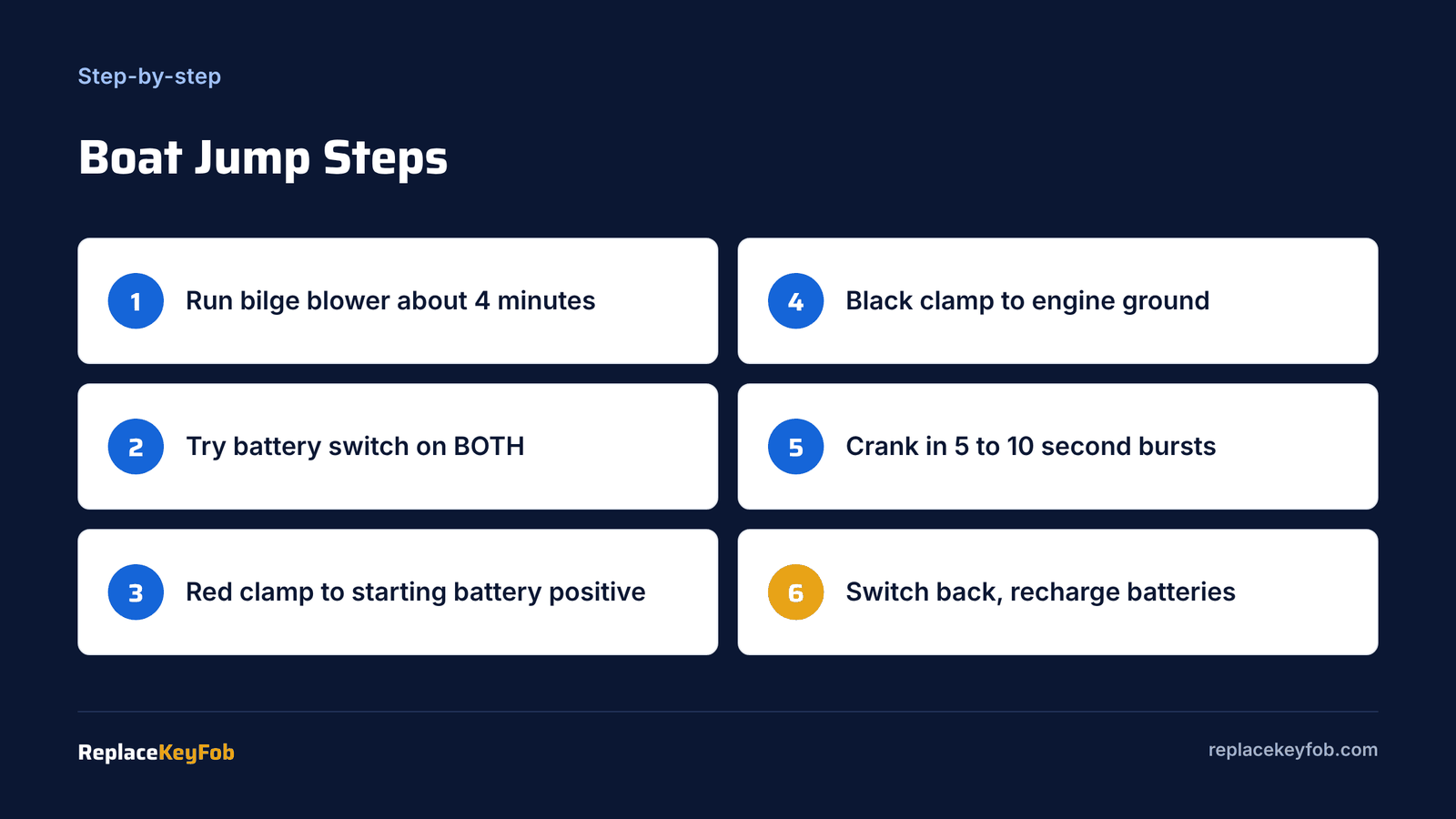
To jump start a boat battery, first run the bilge blower for about 4 minutes on gas inboards, then try the battery switch on BOTH or combine to use a second battery. If that fails, clamp a jump pack or cables red to the starting battery positive and black to the engine ground, and crank in short bursts.
A dead battery on a boat feels worse than in a driveway, because you may be on the water with no second vehicle nearby. The good news is that many boats already carry the fix: a second battery and a battery switch. If not, a portable jump pack is the most practical tool on board.
This guide covers the battery switch method, jumping with a pack, jumping from another battery with cables, and the ventilation step that keeps you safe. For the basic theory of jumping any 12V battery, our guide on how to jump start a car explains the safe connection order.
Why Boat Batteries Die
- Stereo, fish finder, bilge pump or lights left on while anchored.
- A bilge pump running repeatedly because of a leak or a stuck float switch.
- A deep-cycle “house” battery wired to the engine without a separate starting battery.
- Long storage without a maintainer.
- Corroded terminals from salt spray.
What You Need
- A portable jump pack sized for your engine, or jumper cables and a charged second battery.
- Safety glasses and gloves.
- A wire brush and a small wrench for terminal nuts.
Waterproof lithium jump starter
Choose a 12V jump pack with sealed ports and enough peak amps for your outboard or inboard, and keep it charged in a dry compartment.
As an Amazon Associate, ReplaceKeyFob earns from qualifying purchases.
Safety First: Ventilate Before Cranking
Gasoline engines in enclosed engine compartments (inboards and sterndrives) can collect fuel vapor. A spark from the starter or a jumper clamp can ignite it.
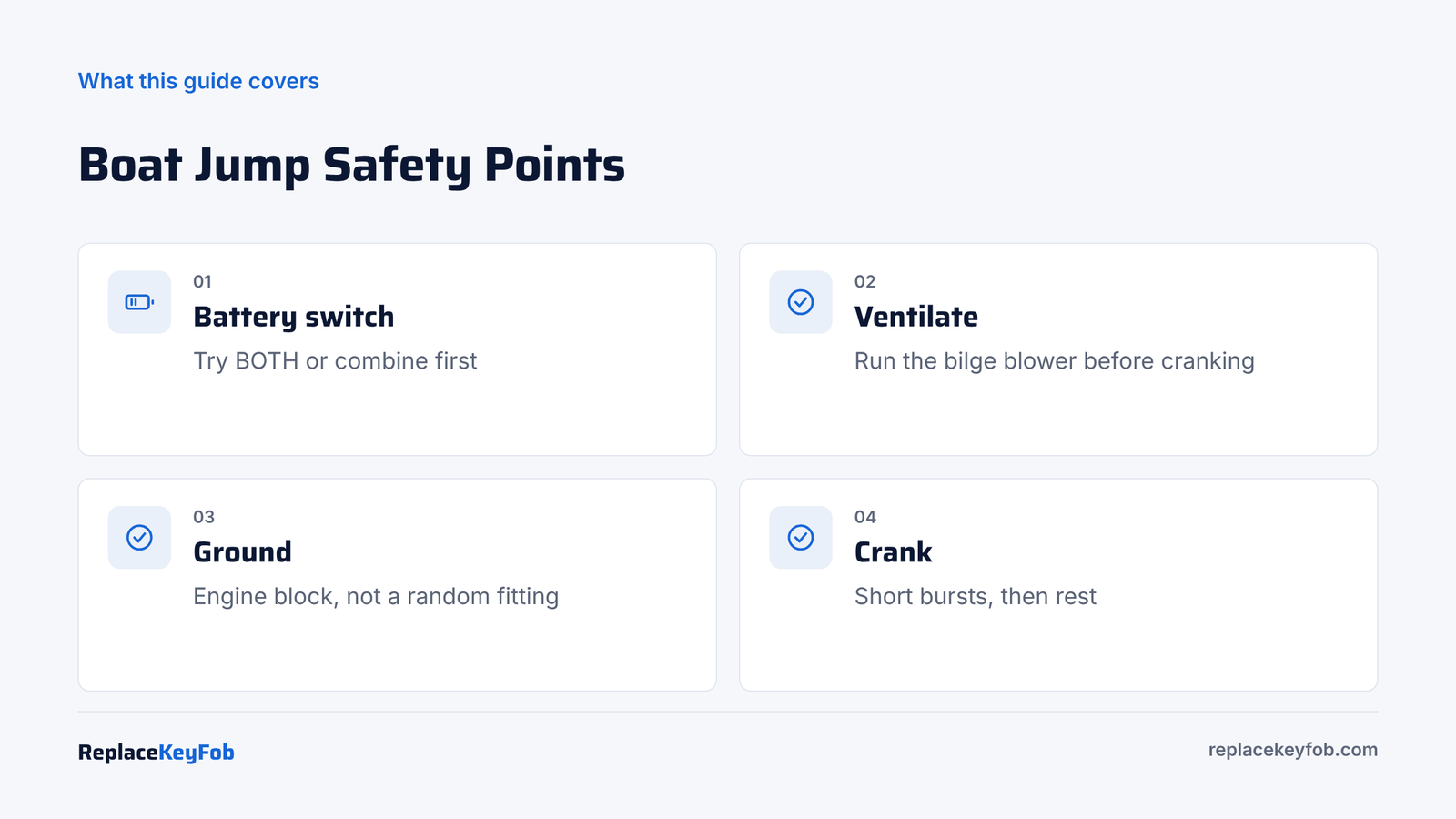
- Run the bilge blower for at least 4 minutes before cranking a gasoline inboard. This is the standard warning on most boats.
- Sniff the engine compartment. If you smell gasoline, do not crank. Find the leak.
- No smoking or open flames anywhere near the batteries.
- Wear eye protection; batteries can vent hydrogen gas while charging and cranking.
Outboards are in open air, so fume buildup is less of a concern, but the battery compartment itself can still hold hydrogen.
Method 1: Use the Battery Switch
Many boats have two batteries and a selector switch labeled 1, 2, BOTH (or ALL) and OFF. Some have a separate “emergency parallel” or “combine” switch.
- Turn the switch to the other battery (for example from 1 to 2) and try starting.
- If both are weak, turn it to BOTH or press the combine or emergency parallel switch. This joins the batteries so they share their remaining power.
- Crank in short bursts.
- Once the engine runs, switch back to the normal position your boat uses for charging (often BOTH while running, then 1 or 2 when anchored, or as your setup requires). Some switches must not be turned through OFF while the engine runs, because it can damage the alternator. Check the label on your switch.
Method 2: Jump With a Portable Jump Pack
- Run the blower (gas inboards) and turn off all accessories.
- Locate the starting battery. It is the one wired to the engine starter, usually through the battery switch.
- With the pack off, connect red to the starting battery’s positive (+) terminal.
- Connect black to the engine block ground or the battery’s negative (-) terminal. On a boat, using the battery negative is acceptable and often easier, since clean engine metal can be hard to reach.
- Turn the pack on and wait for the ready light.
- Crank for 5 to 10 seconds. Rest 30 to 60 seconds between tries.
- Once running, turn the pack off and remove black, then red.
For pack basics, see how to use a jump starter. For pack sizes, see our list of portable jump starters.
Method 3: Jump From Another Battery With Cables
If another boat raft-ups alongside or you have a spare battery:
- Both engines off, and run blowers on both boats if they are gasoline inboards.
- Red to the dead battery positive.
- Red to the good battery positive.
- Black to the good battery negative.
- Black to the dead boat’s engine ground or battery negative.
- Start the good boat’s engine if it has one and let it run a few minutes.
- Crank the dead boat.
- Remove cables in reverse order.
Keep cables clear of propellers, water and moving parts. Do not stand in water while handling the clamps.
Outboards With a Pull Cord
Many smaller outboards (and some mid-size ones) have an emergency pull rope or a manual start option. Check the cover for a recoil starter or a rope notch on the flywheel. A pull start does not need any battery on many carbureted outboards. Some fuel-injected outboards need a minimum battery voltage to run the ECU and fuel pump, so they may not start even when pulled.
Troubleshooting a Boat That Won’t Start
| Symptom | Likely cause | What to check |
|---|---|---|
| Nothing at all | Battery switch off, main fuse or breaker | Switch position, breaker by the battery |
| Click, no crank | Weak battery, corroded cable, bad solenoid | Clean terminals; check starter solenoid |
| Cranks slowly | Cables too thin or corroded | Clean and tighten all connections |
| Cranks fine, no start | Fuel issue, kill switch lanyard | Lanyard clip on, fuel primer bulb, fuel valve |
| Starts, then battery dies again | Charging fault or drain | Test alternator output; look for pump running |
The kill switch lanyard is a common one. If the clip is off, the engine will crank but not start, or will not crank at all on some models.
Mistakes to Avoid
- Skipping the blower. Fuel vapor and sparks do not mix.
- Using the house battery for starting long-term. Deep-cycle batteries are not built for high cranking current every trip.
- Turning the switch through OFF while running. Some alternators can be damaged by this.
- Jumping a frozen or damaged battery.
- Leaving salt crust on terminals. It causes weak starts and eats the cable ends.
After the Jump: Recharge and Test
The engine’s charging output is often modest at idle. Run at cruising rpm for at least 30 minutes, or recharge at the dock with a proper marine charger. Then test: a healthy 12V battery reads about 12.6 to 12.8V at rest. A starting battery under 12.4V after a full charge is weak. Our guide on how to test a car battery with a multimeter applies to marine batteries as well. If you are replacing one, see AGM vs flooded batteries to choose the right type, and keep terminals clean with the tips in battery terminal corrosion.
Prevent the Next Dead Battery
- Separate starting and house batteries. A dual-battery setup with a switch or an automatic charging relay keeps the starting battery full while you run electronics from the house battery.
- Turn the battery switch off when you leave the boat, unless the bilge pump is wired to stay powered (many are, through a direct float switch circuit).
- Check the bilge pump cycle. A pump that kicks on every few minutes at the dock points to a leak and will drain the battery.
- Use a maintainer in storage. An onboard marine charger or a portable maintainer keeps batteries healthy through the off-season. A battery maintainer for winter storage works for trailered boats too.
- Coat terminals with a marine-grade protectant after cleaning to slow salt corrosion.
When to Call for Help and Cost
If you smell fuel, the battery is damaged, or nothing works, call a towing service such as a boat towing membership or local marine assistance. Without a membership, an on-water jump or tow can typically cost a few hundred dollars or more depending on distance. A new marine starting battery typically costs about $120 to $300, and dual-purpose or AGM marine batteries about $180 to $400.
Frequently Asked Questions
Yes, on a trailer at the ramp. Keep the car engine running at idle, connect red to both positives, black to the car negative, and black to the boat’s engine ground or battery negative. Run the boat’s blower first if it is a gasoline inboard.
It connects both batteries together so they share power. It is often the quickest way to start an engine when one battery is weak.
At least 4 minutes on gasoline inboards and sterndrives, and do not crank if you smell fuel.
A dual-purpose battery can. A pure deep-cycle battery can start small engines in a pinch, but it is not designed for repeated high cranking loads.
Ventilate, connect red to the dead battery positive, red to the good source, black to the good source negative, and black to the dead boat’s engine ground. Crank in short bursts and remove cables in reverse order.