
How to Check Car Fuses (With and Without a Tester)

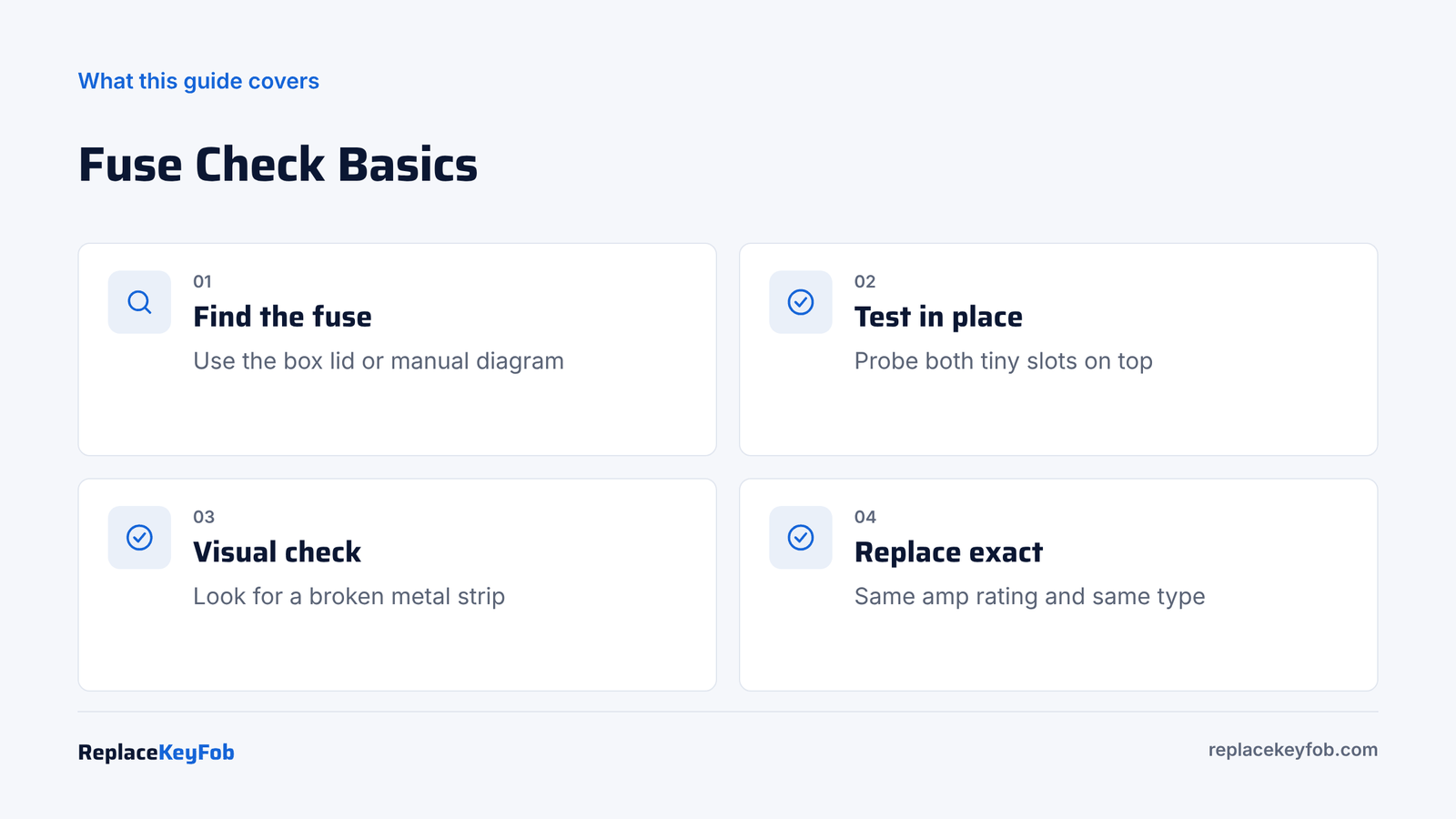
To check car fuses, find the fuse for the dead circuit on the fuse box diagram, turn the ignition to ON, and touch a test light or multimeter to the two small test points on top of the fuse. Power on both sides means it is good; power on one side means it is blown. You can also pull it and look for a broken strip.
Most electrical failures in a car start with a simple question: is the fuse good? A blown fuse is the most common reason a radio, 12V power outlet, wiper motor, power window or even a fuel pump suddenly stops working. Checking takes a few minutes and costs almost nothing.
This guide shows three ways to do it: by looking, with a test light and with a multimeter, plus how to test fuses without pulling every one out. If you have not found your fuse box yet, check the owner’s manual index under “fuses”; most cars have one box under the hood and one under the dash.
How Car Fuses Work
A fuse is a thin metal strip inside a plastic housing. When too much current flows, from a short circuit or a failing motor, the strip melts and opens the circuit before wires overheat. That is why a fuse should never be replaced with a higher rating than the one printed on the diagram.
Most cars have at least two fuse boxes: one under the hood and one inside the cabin, usually under the dash on the driver side or at the end of the dash behind a cover. Some cars add a third in the trunk or under the rear seat.
Common fuse types and colors
| Type | Where you see it | Notes |
|---|---|---|
| Standard blade (ATO/ATC) | Older cars, accessory circuits | About 19mm wide |
| Mini blade | Most cars since the 2000s | Most common type today |
| Low-profile mini | Many GM, Ford and Asian models | Short body, hard to grip |
| Micro2 / Micro3 | Many newer Ford and GM vehicles | Very small, two or three legs |
| Cartridge (J-case) | Under-hood box, high-current circuits | 20A to 60A, square housing |
| Maxi blade | Under-hood, high current | Large blade, 20A to 80A |
Blade fuse colors follow a standard: 5A tan, 7.5A brown, 10A red, 15A blue, 20A yellow, 25A clear or natural, 30A green. The number is also printed on top.
What You Need
- The fuse diagram (on the fuse box lid or in the owner’s manual)
- A fuse puller (often clipped inside the fuse box lid) or needle-nose pliers
- A 12V test light or a digital multimeter
- A flashlight
- A spare fuse kit with the same types your car uses
Automotive fuse assortment with puller
Choose a kit that matches your car’s fuse style, such as mini or low-profile mini, and includes a puller. Some kits include a simple circuit tester too.
As an Amazon Associate, ReplaceKeyFob earns from qualifying purchases.
Step 1: Find the Right Fuse
Do not pull fuses at random. Open the fuse box and find the diagram, usually printed under the lid or on a card. Labels can be cryptic: “CIG” or “PWR OUTLET” for the 12V socket, “AUDIO” or “RADIO”, “WIP” for wipers, “F/PUMP” or “FUEL” for the fuel pump, “ECU” or “PCM” for the engine computer.
If the diagram only gives numbers, the owner’s manual will have a table that matches each number to its circuit. Many manuals are free on the automaker’s owner website.
Step 2: Check Car Fuses With a Test Light
This is the fastest method because you can test fuses without removing them.
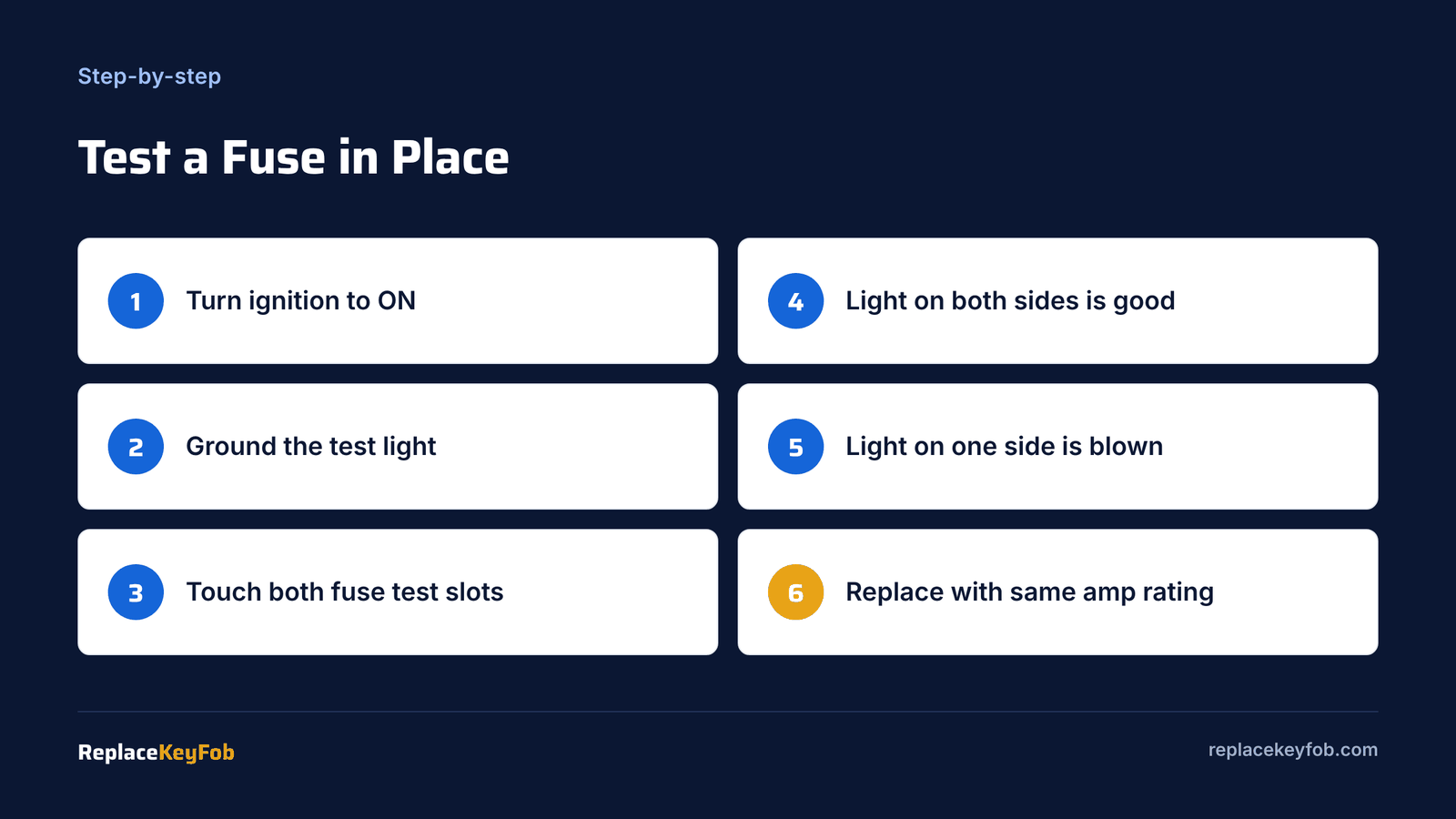
- Turn the ignition to ON (engine off). Many circuits are only powered with the key on.
- Clip the test light’s ground lead to bare metal, such as a door hinge bolt, or to the battery negative terminal.
- Look at the top of the fuse. Most blade fuses have two tiny metal test points exposed through the plastic.
- Touch the probe to one test point, then the other.
- Light on both sides: the fuse is good.
- Light on one side only: the fuse is blown.
- No light on either side: the circuit is not powered in this key position, or the feed to the fuse box has a problem. Try with the key in a different position or check a known live fuse.
Why this works: a good fuse passes power straight through, so both ends see battery voltage. A blown fuse stops it halfway.
Step 3: Check Car Fuses With a Multimeter
A multimeter can be used two ways.
Voltage test in place
- Set the meter to DC volts (20V range on manual meters).
- Black lead to ground, red lead to each test point on the fuse.
- About 12V on both sides means good. 12V on one side and 0V on the other means blown.
Continuity test out of the car
- Pull the fuse.
- Set the meter to continuity (the beep symbol) or the lowest ohms range.
- Touch the leads to each blade.
- A beep or a reading close to 0 ohms means the fuse is good. “OL” or no beep means it is open (blown).
The continuity test is the most reliable, because it does not depend on the circuit being powered.
Step 4: The Visual Check
Pull the fuse straight out with the puller. Hold it up to a light and look through the plastic.
- Good: the metal strip is continuous.
- Blown: the strip has a gap, or the plastic is darkened or melted.
Visual checks work well on clear blade fuses but can miss a hairline break. Cartridge fuses have a small window on top, but many have to be tested with a meter.
How to Check Car Fuses Without Removing Them
The test light and voltage methods above are the way to check car fuses without removing them. This matters in crowded boxes where low-profile fuses are hard to grip and easy to drop into the dash. Test every fuse in a box in a couple of minutes by running the probe across both test points of each one.
A few cars have fuses mounted so the tops are not reachable. In that case, pull them one at a time and put each back in the same slot before moving on.
Replacing a Blown Fuse
- Turn the ignition and the circuit off.
- Pull the blown fuse.
- Fit a new fuse with exactly the same amp rating and type.
- Push it fully into the slot.
- Turn the ignition on and test the circuit.
If you are stranded and have no spare, you can borrow a fuse of the same rating from a non-essential circuit, such as the rear 12V outlet, and replace it later.
If the New Fuse Blows Again
A fuse that blows right away is telling you there is a short or an overloaded device. Replacing it again, or fitting a bigger fuse, will not fix it and can cause a fire.
| When it blows | Likely cause |
|---|---|
| Immediately when the key is turned on | Short to ground in wiring or a component |
| When you use the device (window, wiper) | Motor binding or failing, drawing too much current |
| When you plug something into the 12V outlet | Faulty charger, or a coin or debris in the socket |
| After an accessory install (dash cam, remote start) | Install wiring pinched or tapped into the wrong circuit |
| Randomly over bumps | Chafed wire touching metal |
A dead OBD2 port is a common example: the port often shares a fuse with the cigarette lighter. If your scanner will not power up, see OBD2 port not getting power and OBD2 scanner fuse location.
Mistakes to Avoid
- Using a higher amp fuse: it lets wires overheat before anything protects them.
- Bridging with foil or wire: this removes protection entirely. Never do it.
- Pulling fuses with the circuit live: it can arc and damage the terminals. Switch the circuit off first.
- Forgetting the under-hood box: high-current circuits such as the fuel pump, cooling fan and ABS pump are often there.
- Mixing up slots: use a phone photo of the fuse box before you start pulling.
When It Is Not the Fuse
If the fuse is good but the circuit is still dead, look at the relay that controls it, the switch, the ground connection or the component itself. A no-start with good fuses may point to the starter circuit; see how to start a car with a bad starter and diagnosing a no-start with an OBD2 scanner. A test light that glows weakly can also mean a low battery, which you can check with how to check battery voltage with an OBD2 scanner.
A shop typically charges about $50 to $150 for basic electrical diagnosis on a blown-fuse problem, and more if a short has to be traced through the harness.
Frequently Asked Questions
Ground the test light, turn the ignition to ON and touch the probe to both small test points on top of the fuse. If the light comes on at both points, the fuse is good. If it lights on only one, the fuse is blown.
Either measure DC voltage at both test points with the key on, looking for about 12V on each, or pull the fuse and use continuity mode. A beep or near zero ohms across the blades means the fuse is good.
Yes. A test light or multimeter can test each fuse through the small exposed metal points on top while it stays in the fuse box. This is faster and avoids dropping small fuses.
Yes. Fuses for the fuel pump, ignition, engine computer or starter relay can stop the engine from starting or cranking. Check those fuses first on a no-start with a good battery.
A fuse that keeps blowing means the circuit has a short to ground or a component that draws too much current. Find and fix the cause instead of fitting a bigger fuse.