
P0204 Symptoms: What Your Car Is Telling You

Quick Answer
Common P0204 symptoms include a check engine light, rough idle, engine shaking, weak acceleration, misfiring, poor fuel economy, and difficult starting. The symptoms resemble other injector circuit faults, including P0203 symptoms affecting cylinder 3, but P0204 points specifically to the cylinder 4 injector circuit.
Signs to watch for
- Check engine light: The engine computer stores P0204 after detecting an abnormal injector circuit signal.
- Rough idle: Cylinder 4 may contribute little or no power, making the engine shake.
- Weak acceleration: Power may drop when climbing hills, merging, or carrying a load.
- Engine misfire: The vehicle may hesitate, stumble, or store a related P0304 code.
- Starting trouble: Severe or multi-cylinder circuit faults may cause extended cranking or a no-start condition.
- Intermittent operation: Symptoms can disappear temporarily when a damaged wire or loose terminal reconnects.
What to do next
- Read all stored and pending codes before replacing the injector.
- Stop driving if the check engine light flashes or the vehicle shakes severely.
P0204 is an OBD-II engine code, not a key fob, smart key, or immobilizer fault. An OBD2 scanner displays it when the engine computer detects an electrical problem involving fuel injector number 4.
I’ve seen drivers blame the remote key system when a car starts poorly after unlocking normally. If the engine cranks and P0204 appears, the injector circuit needs attention before the key fob does.
In This Guide
What Are the Most Common P0204 Symptoms?

The most common P0204 symptom is an illuminated check engine light. Many vehicles also develop rough running because cylinder 4 is not receiving the commanded amount of fuel.
Severity depends on whether the circuit fault is constant or intermittent. A stored code may appear before the driver notices a major change.
Check engine light
The powertrain control module, or PCM, monitors the injector’s electrical circuit. It stores P0204 when the observed voltage or current falls outside the expected range.
The light may remain solid. It can flash if the circuit problem causes a severe misfire.
Rough idle and engine shaking
A dead or poorly controlled injector can stop cylinder 4 from producing normal power. The imbalance often feels strongest while the engine idles.
- Steering wheel vibration: Shaking may travel through the wheel, seat, or floor.
- Uneven exhaust note: The exhaust may sound irregular instead of producing a steady rhythm.
- Changing idle speed: Engine speed may dip, surge, or approach a stall.
Hesitation and reduced power
The engine may hesitate when you press the accelerator. Acceleration can feel flat because the remaining cylinders must carry more of the load.
The problem may become clearer during a hill climb or highway merge. Some vehicles enter a reduced-power strategy to protect the engine.
Misfiring or stalling
P0204 can appear with a cylinder 4 misfire code. You may feel stumbling, jerking, or a repeated loss of power.
Stalling is possible at low speed when the engine cannot maintain a stable idle. A single circuit fault does not guarantee a stall, however.
Hard starting or no-start condition
A gasoline engine may still start with one disabled injector, though it can crank longer. A no-start becomes more likely when several injector circuit codes appear together.
Some diesel applications can also react more severely. Manufacturer bulletins available through the NHTSA vehicle-safety and service-information resources document no-start complaints with injector circuit faults on certain vehicles.
Higher fuel use or unusual exhaust
A misfiring engine can use fuel less efficiently. The exact change depends on how the PCM responds and whether the injector stays inactive or behaves erratically.
A fuel smell, dark exhaust, or excessive smoke needs prompt inspection. These signs may indicate an additional fuel-delivery problem rather than P0204 alone.
Section Takeaway: P0204 may cause anything from a warning light with no obvious drivability change to severe shaking and starting trouble.
What Does the P0204 Code Mean?
P0204 means the engine computer detected a malfunction in the fuel injector circuit for cylinder 4. It identifies an electrical circuit problem, but it does not prove the injector itself has failed.
Definition: A fuel injector is an electrically controlled valve that meters fuel into an engine. The PCM switches the injector circuit on and off to control when and how long the injector opens.
The code belongs to the P0201–P0208 family. The last digit normally identifies the affected cylinder.
You can compare that numbering pattern with guides explaining what P0203 means and how a cylinder 2 injector fault behaves.
What can trigger P0204?
- Loose connector: The injector plug may not make firm electrical contact.
- Damaged terminals: Bent, spread, corroded, or overheated terminals can interrupt current.
- Broken wiring: Engine vibration and heat can damage a wire inside its insulation.
- Short circuit: Chafed wiring may contact ground, power, or another circuit.
- Failed injector coil: The injector’s internal electrical winding may become open or shorted.
- Power supply fault: A relay, fuse, or shared supply circuit may affect one or more injectors.
- PCM driver fault: The computer’s injector driver can fail, but this is less common and requires careful proof.
Volkswagen technical guidance published through NHTSA specifically directs technicians to inspect injector connectors, harness routing, corrosion, loose terminals, and chafing before replacing parts.
Technician’s note: Never condemn the PCM until the injector, connector, power supply, and control wiring pass the correct manufacturer tests.
Why Do P0204 Symptoms Vary Between Vehicles?
P0204 symptoms vary because engine designs and failure modes differ. A loose terminal can behave differently from a shorted injector coil.
Intermittent connection
A loose terminal may reconnect as the engine moves. The car could run normally when cold, then stumble after vibration or heat changes the connection.
Open circuit
An open circuit prevents current from flowing through the injector. Cylinder 4 may stop contributing, producing a steady misfire and rough idle.
Short circuit
A short can pull voltage or current outside the expected range. Some control modules disable the affected output to prevent further electrical damage.
Single-cylinder versus shared fault
P0204 alone usually focuses diagnosis on cylinder 4. Several injector codes appearing together point more strongly toward shared power, grounding, harness, contamination, or control-module problems.
- One injector code: Inspect the cylinder-specific connector, wire, and injector first.
- Several injector codes: Check shared circuits, harness pass-throughs, relays, and relevant service bulletins.
- Intermittent code: Examine freeze-frame data and wiring near hot or vibrating components.
P0204 vs. P0304: What Is the Difference?
P0204 identifies an electrical problem in cylinder 4’s injector circuit. P0304 reports that cylinder 4 is misfiring, regardless of the underlying cause.
| Comparison | P0204 | P0304 |
|---|---|---|
| Basic meaning | Cylinder 4 injector circuit malfunction | Cylinder 4 misfire detected |
| Fault category | Electrical or injector-control circuit | Combustion or crankshaft-speed variation |
| Common causes | Connector, wiring, injector coil, power supply, or PCM driver | Ignition, fuel, compression, air leak, or mechanical fault |
| Can they appear together? | Yes | Yes |
| First diagnostic focus | Injector electrical circuit | All possible causes of cylinder 4 misfire |
Replacing spark plugs may address some P0304 cases, but it usually will not repair P0204. Likewise, replacing an injector without testing the circuit can leave a broken wire untouched.
A scanner with code, pending-code, and freeze-frame support helps separate these conditions. See the features used in OBD2 scanners for misfire diagnosis.
Can You Drive With P0204?
You should avoid unnecessary driving with an active P0204 code. A short trip to a repair facility may be reasonable only if the light stays solid and the vehicle runs normally.
Pull over safely when the check engine light flashes. You should also stop for severe shaking, major power loss, smoke, fuel odor, overheating, or repeated stalling.
AAA’s check engine light guidance advises prompt attention and recommends stopping when a flashing light accompanies abnormal performance. Continued misfiring can overheat or damage the catalytic converter.
- Solid light, normal operation: Drive gently only as needed and arrange diagnosis soon.
- Rough running: Minimize driving because the fault is affecting combustion.
- Flashing light: Reduce speed, pull over safely, and shut off the engine.
- Fuel smell or smoke: Stop immediately and keep away from ignition sources.
- No-start condition: Avoid repeated cranking and request professional assistance.
Safety note: Driving advice depends on the vehicle and symptoms. When uncertain, use roadside assistance instead of risking engine, exhaust, or electrical damage.
How Is P0204 Diagnosed and Repaired?
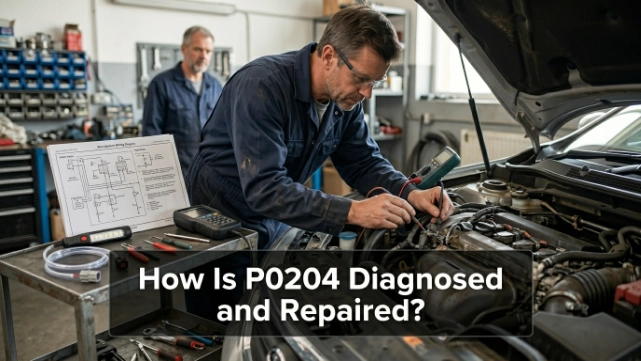
A correct diagnosis proves whether the problem lies in the injector, connector, wiring, power supply, or control module. Reading P0204 alone is not enough to select a replacement part.
1. Scan all control-module codes
A technician records stored, pending, and related codes before clearing anything. Freeze-frame data shows engine conditions when the fault appeared.
P0201, P0202, P0203, or other injector codes can change the diagnostic direction. Shared faults deserve attention when several cylinders appear together.
2. Confirm which cylinder is number 4
Cylinder numbering varies by engine layout and manufacturer. A diagram from the correct service manual should identify cylinder 4 before anything gets disconnected.
Guessing by physical position can lead to testing the wrong injector. This happens often on V-shaped engines.
3. Inspect the injector connector and harness
- Look for a connector that is loose or not fully latched.
- Check for bent, pushed-back, spread, green, or overheated terminals.
- Follow the harness and inspect areas touching brackets or engine covers.
- Look for oil, water, or other contamination inside the connector.
- Check whether a previous repair stretched or pinched the wiring.
A visual inspection can reveal the fault without expensive parts. However, damage hidden inside insulation may require an electrical test.
4. Perform vehicle-specific electrical tests
A qualified technician may test injector resistance, power supply, control continuity, shorts, and the commanded waveform. All measurements must follow the service information for that engine.
Mitsubishi’s official P0204 diagnostic example shows why specifications cannot be generalized. It uses model-specific terminals, resistance limits, voltage checks, and special equipment.
Technician’s note: Some diesel injectors use high-voltage control circuits. Do not back-probe or energize them with generic test methods.
5. Isolate the injector from the circuit
When the manufacturer permits it, a technician may compare injector readings or move an injector between cylinders. If the code follows the injector, the injector becomes the leading suspect.
If P0204 stays with cylinder 4, the harness or control circuit needs further testing. Fuel components should only be moved under clean and safe workshop conditions.
6. Repair the confirmed fault
- Connector damage: Repair terminals or replace the approved connector pigtail.
- Chafed wiring: Restore the affected circuit and correct the routing problem.
- Failed injector: Replace the injector using the correct sealing and installation procedure.
- Shared supply problem: Repair the relevant fuse, relay, connection, or harness.
- PCM fault: Replace or repair the module only after every external circuit passes testing.
Repair cost varies widely by vehicle, access, parts, diagnostic time, and region. A connector repair may cost much less than an injector or programmed control module.
Related guides such as common P0201 causes can help explain the circuit pattern. They should not replace service information for your make, model, engine, and year.
Repair note: Ask for the test result that identified the failed part before approving an injector or PCM replacement.
Section Takeaway: Diagnose the complete cylinder 4 injector circuit before buying parts. Wiring and connector faults can imitate a failed injector.
Frequently Asked Questions
Can P0204 appear without noticeable symptoms?
Yes. An intermittent terminal or wire can set P0204 while the engine still feels normal. Pending codes and freeze-frame information may show that the failure occurred only under certain temperatures, loads, or vibration levels.
Does P0204 always mean the fuel injector is bad?
No. P0204 can result from a loose connector, damaged terminal, open wire, short circuit, power supply fault, failed injector coil, or PCM driver problem. The circuit should be tested before replacing the injector.
Can a bad spark plug cause P0204?
A worn spark plug can cause a cylinder 4 misfire and P0304. It does not normally create an injector circuit code because P0204 monitors the injector’s electrical control circuit.
Can a weak battery trigger P0204?
Low system voltage can create unusual electrical behavior, especially during starting. However, a repeatable cylinder-specific P0204 code still requires inspection of the injector circuit rather than assuming the battery is responsible.
Will clearing the code fix the problem?
No. Clearing P0204 only erases the stored diagnostic information and turns off the warning light temporarily. The code will return if the PCM detects the same circuit fault again.
Can P0204 cause a no-start?
A single P0204 fault may allow many gasoline engines to start and run poorly. A no-start becomes more plausible on certain diesel systems or when multiple injector circuits, a shared power supply, or another major fault is involved.
Is P0204 related to the key fob or immobilizer?
No. P0204 concerns the cylinder 4 fuel injector circuit. A key or immobilizer fault usually produces different security-related symptoms and codes, though both problems can exist at the same time.
Final takeaway: Treat P0204 as an electrical diagnosis, not an automatic injector replacement. Record every code, avoid driving with severe symptoms, and have the cylinder 4 circuit tested against the correct manufacturer specifications.
