
5 Best Jump Starters for Cold Weather (2026): Below-Zero Picks

We may earn a commission when you buy through links on this page, at no extra cost to you. How we pick products.
The GOOLOO GT4000 Arctic is the best jump starter for cold weather: it has battery pre-heat technology rated for starts down to -40°F, covers gas engines up to 12L and diesels up to 10L, and recharges in about 1.2 hours. The Hulkman Alpha 85S also pre-heats for -40°F starts and has a clear 3.3-inch screen, in a lighter package for cars and SUVs. If you want a pack that shrugs off cold without any electronics, the lead-acid Clore Jump-N-Carry JNC660 is the shop-trusted classic.
Cold is hard on car batteries and on jump starters. A car battery can lose a large share of its cranking power at 0°F while the engine needs more current to turn thick oil. Lithium jump packs suffer too: their cells deliver less power when frozen, and most cannot be charged below freezing. A jump starter that works perfectly in October may fail on the first sub-zero morning. This guide picks five jump starters that handle winter well, and explains the storage habits that matter just as much as the pack you buy.
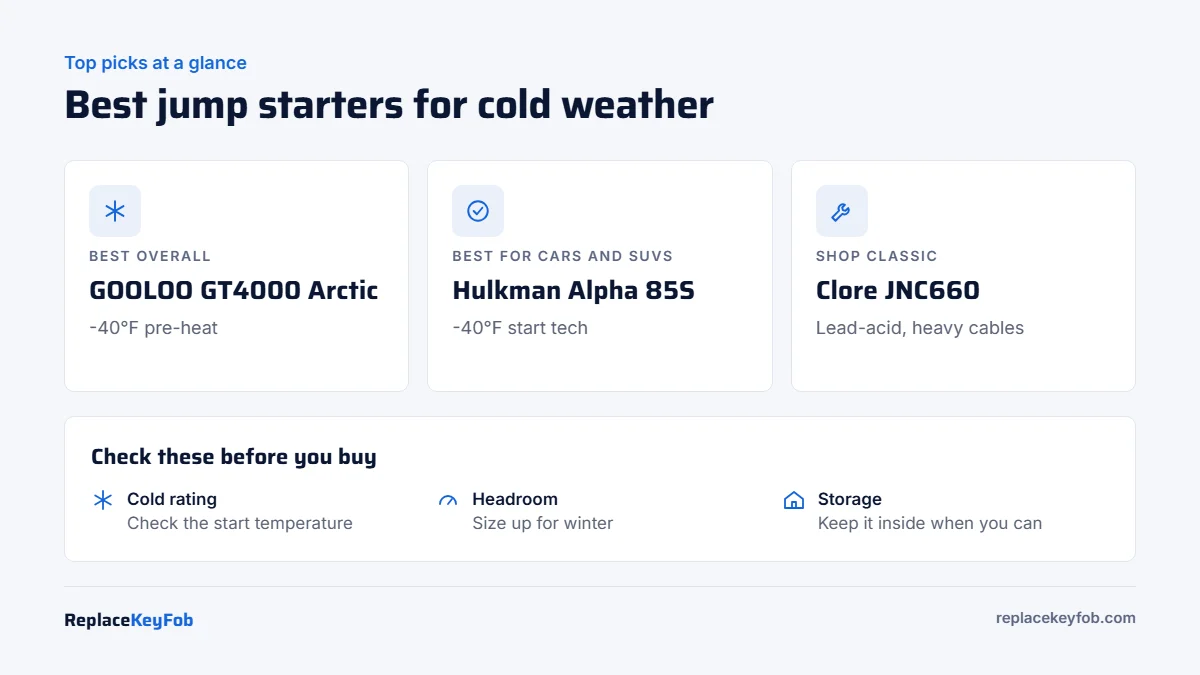
Our Top Picks at a Glance
| Jump starter | Best for | Cold feature | Rated engine size (maker) |
|---|---|---|---|
| GOOLOO GT4000 Arctic | Best overall | Pre-heat, starts down to -40°F | 12L gas / 10L diesel |
| Hulkman Alpha 85S | Best for cars and SUVs | Pre-heat, starts down to -40°F | 8.5L gas / 6.0L diesel |
| Clore Jump-N-Carry JNC660 | Lead-acid toughness | 22Ah AGM jump battery, heavy cables | Professional 12V use |
| LOKITHOR J400 | Big screen on a budget | Smart connection detection | 8.0L gas / 6.0L diesel |
| NOCO Boost X GBX55 | Fast winter top-ups | 5-minute charge for one jump | 7.5L gas / 5.0L diesel |
How We Chose These Cold-Weather Jump Starters
We compared makers’ cold ratings, manuals and retailer listing specs, plus owner feedback from cold climates. We did not run our own freezer tests. We looked for:
- Pre-heat or cold-start technology that warms the pack’s cells before a jump.
- Extra engine-size margin, because cold engines draw more current.
- Charging speed, since you will want to top up a pack you brought indoors overnight.
- Heavy cables and good clamps that stay flexible and bite on cold, corroded terminals.
- Standby time, because cold slowly drains lithium packs.
The Best Jump Starters for Cold Weather
1. GOOLOO GT4000 Arctic: Best Overall
GOOLOO GT4000 Arctic Jump Starter With -40°F Pre-Heat
12L gas / 10L diesel, starts down to -40°F
Check Price on AmazonThe GT4000 Arctic is designed for exactly the problem most lithium packs have: weak output from frozen cells. GOOLOO’s pre-heating technology warms the battery before a jump, and the company rates it for reliable starts from -40°F up to 140°F. Combined with a 4000A peak and a rating for gas engines up to 12L and diesels up to 10L, that gives plenty of margin for frozen V8s, diesels and SUVs.
It is also a fast-charging power station: the included 100W car charger takes it from empty to full in about 1.2 hours, and five minutes is enough for an emergency start. Outputs include 150W DC, 100W USB-C PD and two USB-A ports, so it can run a heated blanket or charge a laptop while you wait. GOOLOO quotes up to 24 months of standby and lists 10 protections including spark-proof and reverse-polarity protection.
Pros: pre-heat for -40°F starts, huge engine rating, 1.2-hour recharge, strong outputs.
Cons: pre-heating takes a little time before the jump; bigger than compact packs.
Best for: northern states, Canada, diesels and big engines.
Skip it if: you live where it rarely freezes.
2. Hulkman Alpha 85S: Best Cold-Weather Pack for Cars and SUVs
Hulkman Alpha 85S Jump Starter With -40°F Start Tech
8.5L gas / 6.0L diesel, 3.3-inch screen
Check Price on AmazonThe Alpha 85S takes Hulkman’s popular Alpha 85 and adds pre-heat technology that warms the pack for starts down to -40°F. It is rated for gas engines up to 8.5L and diesels up to 6.0L with up to 60 starts per charge, which covers nearly all cars, crossovers, SUVs and half-ton trucks.
Its 3.3-inch screen shows status, battery level and errors in plain text, which helps when you are cold and in a hurry. Hulkman lists 65W charging (0 to 80% in about an hour, full in about 90 minutes), five minutes of charging for one jump, and 10 layers of protection. At about 3.7 lb it is lighter than the GOOLOO.
Pros: pre-heat, clear screen, up to 60 starts, fast charging.
Cons: lower diesel rating than the GT4000 Arctic.
Best for: gas cars, crossovers and SUVs in cold climates.
Skip it if: you drive a large diesel.
3. Clore Jump-N-Carry JNC660: Lead-Acid Toughness
Clore Jump-N-Carry JNC660 1700 Peak Amp 12V Jump Starter
22Ah Proformer battery, 46-inch #2 AWG cables
Check Price on AmazonThe JNC660 is the jump box you see in tow trucks and repair shops. Instead of lithium cells, it uses a 22Ah Clore Proformer sealed lead-acid battery built for jump starting, with 1700 peak amps, 46-inch #2 AWG cables and heavy clamps that grip cold, corroded terminals. A built-in voltmeter shows the pack’s charge, and a 12V outlet runs accessories.
The trade-off is weight: about 18 lb, so it lives in a trunk or truck bed, not a glove box. It also lacks spark-proof smart clamps, so you must connect it correctly. But its simple design and heavy cables make it a favorite for people who jump cars often in winter.
Pros: professional-grade cables and clamps, simple and durable, proven in fleets.
Cons: heavy; no spark-proof or reverse-polarity protection; needs regular charging.
Best for: experienced users, rural drivers and anyone helping others in winter.
Skip it if: you want something light and foolproof.
4. LOKITHOR J400: Big Screen on a Budget
LOKITHOR J400 2000A Jump Starter With Smart Display
8.0L gas / 6.0L diesel, 5.75-inch screen
Check Price on AmazonThe J400 has a large 5.75-inch screen showing battery status, connection state and alerts, which is helpful when you are wearing gloves and fumbling in the dark. LOKITHOR rates it for 8.0L gas and 6.0L diesel with up to 25 starts per charge, using 80C high-rate cells for strong current delivery.
Its ConnectMax technology detects the connection and adjusts output to reduce failed starts, and the BMS and smart clamps protect against reverse polarity, short circuits and overcurrent. A 300-lumen LED with SOS mode is built in. It does not have pre-heat, so in deep cold keep it indoors and bring it out when needed.
Pros: very large screen, good engine rating, high-rate cells.
Cons: no pre-heat; fewer starts per charge than Hulkman.
Best for: value buyers in moderately cold areas.
Skip it if: your mornings regularly fall well below 0°F.
5. NOCO Boost X GBX55: Fast Winter Top-Ups
NOCO Boost X GBX55 1750A UltraSafe Jump Starter
7.5L gas / 5.0L diesel, 1.2-hour USB-C recharge
Check Price on AmazonThe GBX55 is a smart winter choice for cars and mid-size SUVs, mostly because it is easy to keep charged. It recharges in about 1.2 hours over USB-C Power Delivery, and NOCO says five minutes of charging gives enough power for one jump even from empty. That suits the best cold-weather habit: keep the pack indoors at night and grab it in the morning.
NOCO rates it for 7.5L gas and 5.0L diesel, with UltraSafe 2.0 spark-proof and reverse-polarity protection, a 60-second timer that conserves energy, and up to 9 jump starts per charge. It also works as a 60W USB-C power bank.
Pros: fast USB-C charging, NOCO safety, good rating for most cars.
Cons: no pre-heat; fewer starts per charge.
Best for: commuters who can bring the pack indoors at night.
Skip it if: you need to leave the pack in a frozen car all winter.
Lithium vs Lead-Acid in the Cold
| Lithium pack | Lead-acid jump box | |
|---|---|---|
| Weight | 1 to 5 lb | 15 to 25 lb |
| Output when frozen | Drops unless pre-heated | Drops, but heavy cables help |
| Charging below freezing | Usually not allowed | Possible, slower |
| Self-discharge | Low | Higher, needs regular charging |
| Safety features | Smart clamps on most | Often basic clamps |
| Picks here | GT4000 Arctic, Alpha 85S, J400, GBX55 | Clore JNC660 |
Winter Jump Starter Habits That Matter Most
- Store the pack inside overnight when temperatures drop below about 20°F, then take it to the car in the morning.
- Keep it charged. Top up every month in winter, not every three months.
- Do not charge a frozen lithium pack. Let it warm to room temperature first.
- Use pre-heat if you have it. Give it the time the manual asks for before cranking.
- Clean the terminals. Corrosion and ice block current. A quick wire-brush helps.
- Crank in short bursts. Five seconds on, a minute off.
Buying Guide: Cold-Weather Jump Starters
Size up
Pick a pack rated well above your engine size. Cold engines need more current, and a cold pack delivers less. For trucks, see our guide to the best jump starters for V8 trucks and SUVs.
Prevention beats rescue
A strong battery is the best cold-weather tool. If yours is over four years old, test it before winter with a battery tester, and consider one of the best car batteries for cold weather. For cars parked outside or stored, a winter battery maintainer keeps the battery full.
Cold also affects your key fob
Coin cells lose voltage in the cold, and a weak car battery can cause keyless entry trouble. Read does cold weather affect key fobs if your fob acts up in winter.
Related Guides
- 7 best portable jump starters for cars, trucks and SUVs
- Best car batteries for cold weather
- How to jump start a car safely
- Jump starter vs battery charger
FAQ
Do jump starters work in freezing temperatures?
Yes, but lithium packs deliver less power when cold. Models with pre-heat, like the GOOLOO GT4000 Arctic and Hulkman Alpha 85S, are designed for starts down to -40°F.
Can I leave a jump starter in my car in winter?
You can, but it will be weaker in deep cold and may lose charge faster. Bringing it indoors overnight and charging it monthly gives the best results.
Why won’t my jump starter charge in the cold?
Most lithium packs block charging below about 32°F to protect the cells. Let it warm to room temperature, then charge it.
Is lead-acid or lithium better in cold weather?
Both lose power in the cold. Lithium packs with pre-heat are the easiest to use; lead-acid boxes like the Clore JNC660 are heavy but rugged, with excellent cables.
How big a jump starter do I need for winter?
Choose one rated at least one size above your engine. For a 5.0L V8 in a cold climate, an 8.5L or higher rating is a safer bet.
Should I warm up a car battery before jumping it?
Never heat a battery with a flame or heater. If the battery is frozen solid, do not jump it at all; it can crack or burst. Let it thaw and have it tested.