
How to Recondition a Car Battery (What Works and What Doesn’t)

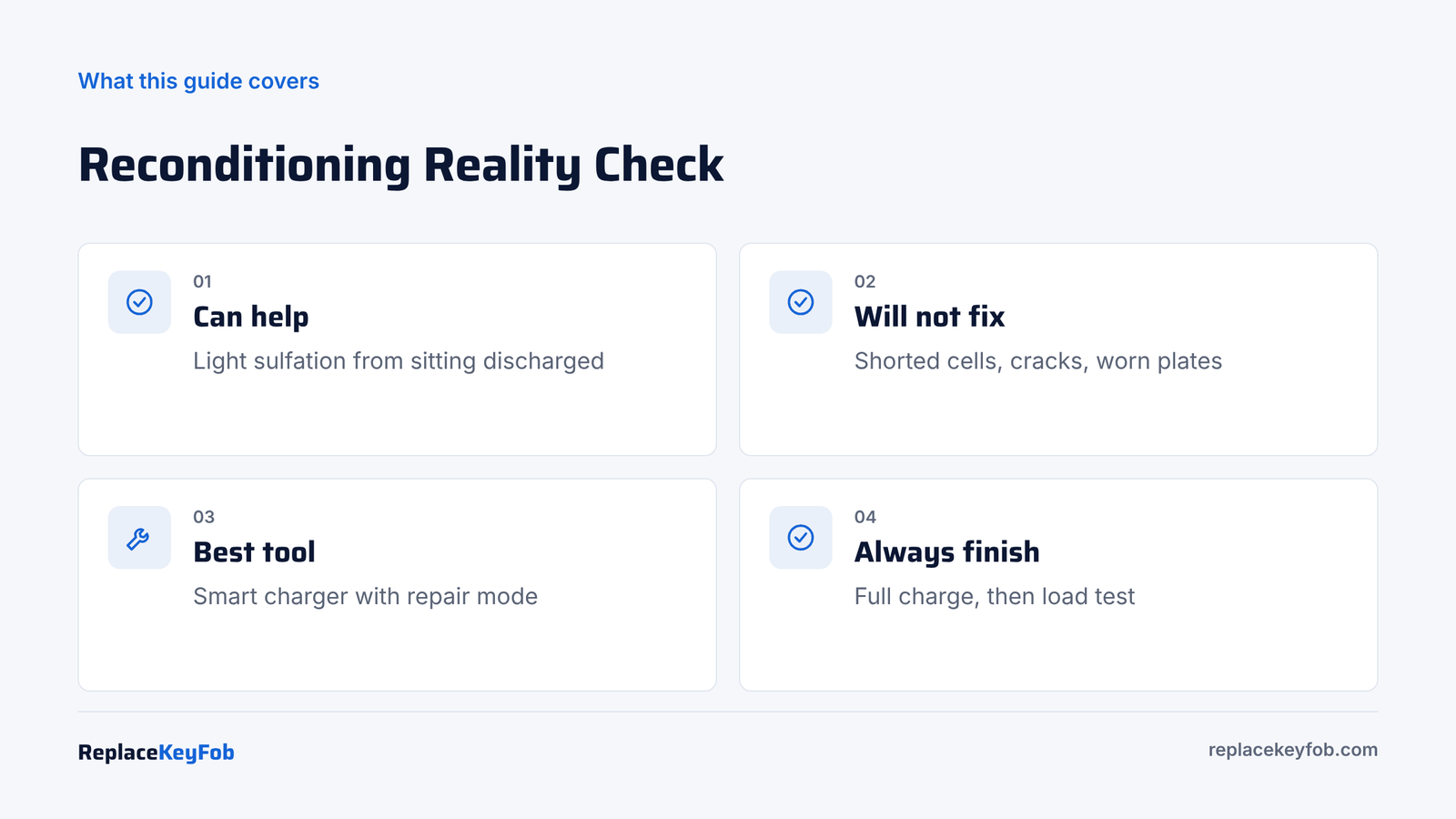
To recondition a car battery, inspect it for damage, slow charge it fully with a smart charger, and run its desulfation or repair mode. Flooded batteries with caps can also get a controlled equalizing charge. Then load test it. This can recover a battery weakened by sitting discharged, but it cannot fix shorted cells, cracked cases or worn-out plates.
Battery reconditioning is surrounded by big promises: miracle formulas, Epsom salt tricks and claims that any dead battery can be brought back. The reality is more modest. Some batteries fail because they sat discharged and built up sulfate crystals on the plates. That kind of damage can sometimes be partly reversed. Many others fail because the plates have shed material, a cell has shorted, or the grid has corroded through. No charger or additive fixes that.
This guide explains what reconditioning can do, the safe way to try it, and how to tell when the battery is done. If your battery is under warranty, check car battery warranty first, because opening or treating the battery can void it.
What Causes a Battery to “Die”
| Cause | What happens | Can reconditioning help? |
|---|---|---|
| Soft sulfation | Lead sulfate crystals build up after the battery sits discharged | Often partly, if caught early |
| Hard sulfation | Crystals harden over weeks or months | Sometimes a little; often not |
| Acid stratification | Acid settles at the bottom of flooded cells | Yes, an equalizing charge mixes it |
| Water loss | Plates exposed in flooded batteries | Partly, by refilling with distilled water |
| Shed plate material | Active material falls to the bottom of the case | No |
| Shorted cell | Plates touch internally; one cell reads near zero | No |
| Grid corrosion | Plate grids corrode, common in hot climates | No |
| Physical damage or freezing | Cracked case or buckled plates | No, and it is unsafe to try |
Most car batteries last about 3 to 5 years. A battery that is six years old and failing is usually worn out, not just sulfated. A battery that is two years old and died because the car sat for two months is the best candidate for recovery.
Safety First
- Work outdoors or in a ventilated space. Charging releases hydrogen gas, which is explosive.
- Wear safety glasses and acid-resistant gloves.
- Never charge a frozen, cracked, swollen or leaking battery.
- Keep sparks and flames away. Connect clamps before plugging in the charger.
- Do not open AGM, gel, EFB or sealed batteries.
- Do not drain or replace the acid yourself. Handling sulfuric acid at home is dangerous and disposing of it is regulated.
What You Need
- A smart charger with a desulfation, repair or reconditioning mode
- A digital multimeter
- Distilled water for flooded batteries with caps
- A hydrometer for flooded batteries, if you want cell-by-cell readings
- Terminal brush and baking soda to clean the top and posts
- Access to a load tester or a parts store that tests free
Smart Battery Charger With Repair Mode
Look for a charger with a desulfation or repair mode, separate settings for flooded and AGM, and a temperature sensor or automatic shutoff.
As an Amazon Associate, ReplaceKeyFob earns from qualifying purchases.
How to Recondition a Car Battery Step by Step
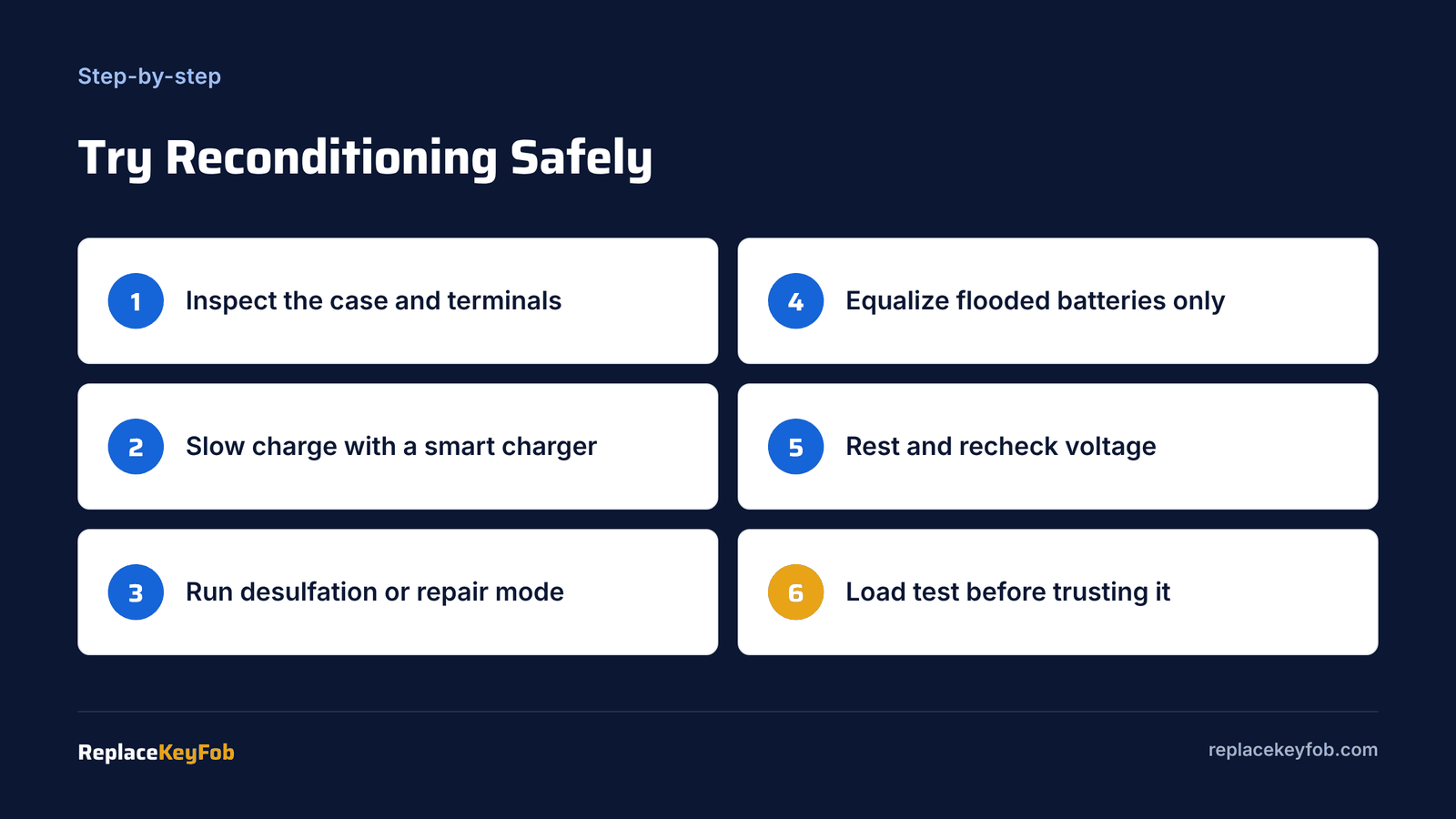
- Inspect the battery. Check for cracks, bulges, leaks or melted posts. Any of these means replace it.
- Check the date code. An old battery has little left to recover; see how to read a car battery date code.
- Clean the top and terminals. Neutralize corrosion with baking soda and water, rinse, and dry. Keep cleaning solution out of the cells. See battery terminal corrosion.
- Measure resting voltage. Note it. Readings under about 10.5 volts mean deep discharge; many smart chargers need a special mode to start.
- Check water level on flooded batteries. If the plates are exposed, add distilled water just to cover them before charging. Follow how to add water to a car battery for the full method.
- Slow charge to full. Use a low current, about 2 to 4 amps for a car battery, and let the charger finish its cycle. This alone recovers many batteries that were simply flat.
- Run the desulfation or repair mode. These modes use controlled pulses or a higher voltage stage to break down sulfate. Follow the charger’s instructions; cycles can take several hours to a few days.
- Equalize flooded batteries only (optional). Some chargers offer an equalize mode that holds about 15 to 16 volts for a few hours. It mixes stratified acid and evens out cells. Monitor temperature; stop if the battery gets hot. Never equalize AGM or gel batteries unless the maker approves it.
- Top up water after charging on flooded batteries.
- Let it rest 12 to 24 hours and recheck voltage. A recovered battery holds about 12.6 volts or more.
- Load test it. This is the real verdict; see how to load test a car battery.
Why slow charging comes first
Sulfate converts back to active material most effectively at a slow, steady charge rate. Fast charging a sulfated battery mostly makes heat and gas. A long, gentle charge followed by a controlled desulfation stage gives the plates the best chance.
What Does Not Work
Epsom salt
Adding magnesium sulfate to the cells is a popular internet trick. It may give a brief bump in performance on a badly sulfated battery, but it changes the electrolyte chemistry permanently, can speed up plate damage, and makes the battery a poor candidate for recycling credit. It is not a real repair.
Replacing the acid
Draining and refilling the electrolyte is dangerous, and it does nothing for shed material or grid corrosion. It also creates hazardous waste you cannot legally pour out.
Additives and miracle formulas
Most battery additives offer little proven benefit. Spend the money toward a new battery if the battery is old.
Repeatedly jump starting
Jump starting gets the car running but does not recover the battery. Driving does not fully charge a deeply discharged battery either.
AGM, EFB and Lithium Batteries
AGM batteries can sometimes be recovered with a charger’s AGM or repair mode, but results are less predictable and you cannot add water. EFB batteries are usually sealed and should be charged on their own profile. Lithium 12-volt batteries have built-in management electronics; do not use desulfation modes on them. See how to charge an AGM battery and how to charge a lithium car battery.
How to Tell if Reconditioning Worked
| Check | Recovered battery | Not recovered |
|---|---|---|
| Voltage after 24 hour rest | About 12.6 V or higher | Drops below about 12.4 V |
| Load test | Passes at half CCA | Fails or drops sharply |
| Hydrometer, flooded | Cells close to each other | One cell far lower |
| Real world | Starts the car reliably for weeks | Fails again within days |
Even a recovered battery is not new. Treat it as a backup for a garden tractor, a shop battery or a short-term fix, and keep a maintainer on it. For long storage, see how to store a car battery for winter.
Cost: Reconditioning vs a New Battery
| Option | Typical cost | What you get |
|---|---|---|
| Slow charge with a charger you own | Electricity only | Recovers batteries that were just flat |
| Smart charger with repair mode | About $50 to $150 | Reusable tool; can recover lightly sulfated batteries |
| Shop charge and test | Often free to about $40 | Professional verdict, no recovery attempt |
| New battery installed | About $150 to $400 | Full warranty and full capacity |
A smart charger is worth owning anyway, because it doubles as a maintainer. Buying one just to rescue a six-year-old battery rarely pays off. Buying one to rescue a two-year-old battery that went flat during a long trip often does.
How to Prevent Sulfation in the First Place
- Do not let the battery sit discharged. Recharge within a day or two of a drain.
- Use a maintainer on cars parked for more than two weeks; see how to keep a car battery charged.
- Drive long enough. Short trips never fully recharge the battery.
- Keep flooded batteries topped up with distilled water.
- Fix parasitic drains from aftermarket accessories or faulty modules quickly.
When to Replace Instead
If the battery is over four or five years old, has a dead cell, fails a load test after reconditioning, or will not hold a charge overnight, replace it. A new battery typically costs about $150 to $400 installed. Returning the old one usually earns a core refund of about $15 to $30.
Frequently Asked Questions
Sometimes. A battery weakened by sitting discharged can often be partly recovered with slow charging and a desulfation mode. A battery with a shorted cell, cracked case or worn plates cannot be fixed.
Inspect it, clean it, slow charge it with a smart charger, run the repair or desulfation mode, equalize if it is a flooded battery, then rest and load test it.
Not in any lasting way. It may give a short-term bump on a sulfated battery, but it changes the chemistry and is not a real repair.
Sometimes, using a charger with an AGM repair mode. You cannot add water, and results are less predictable than with flooded batteries.
Usually from several hours to a few days, depending on how sulfated the battery is and the charger’s cycle.