
How to Reset the Check Engine Light Without a Scanner

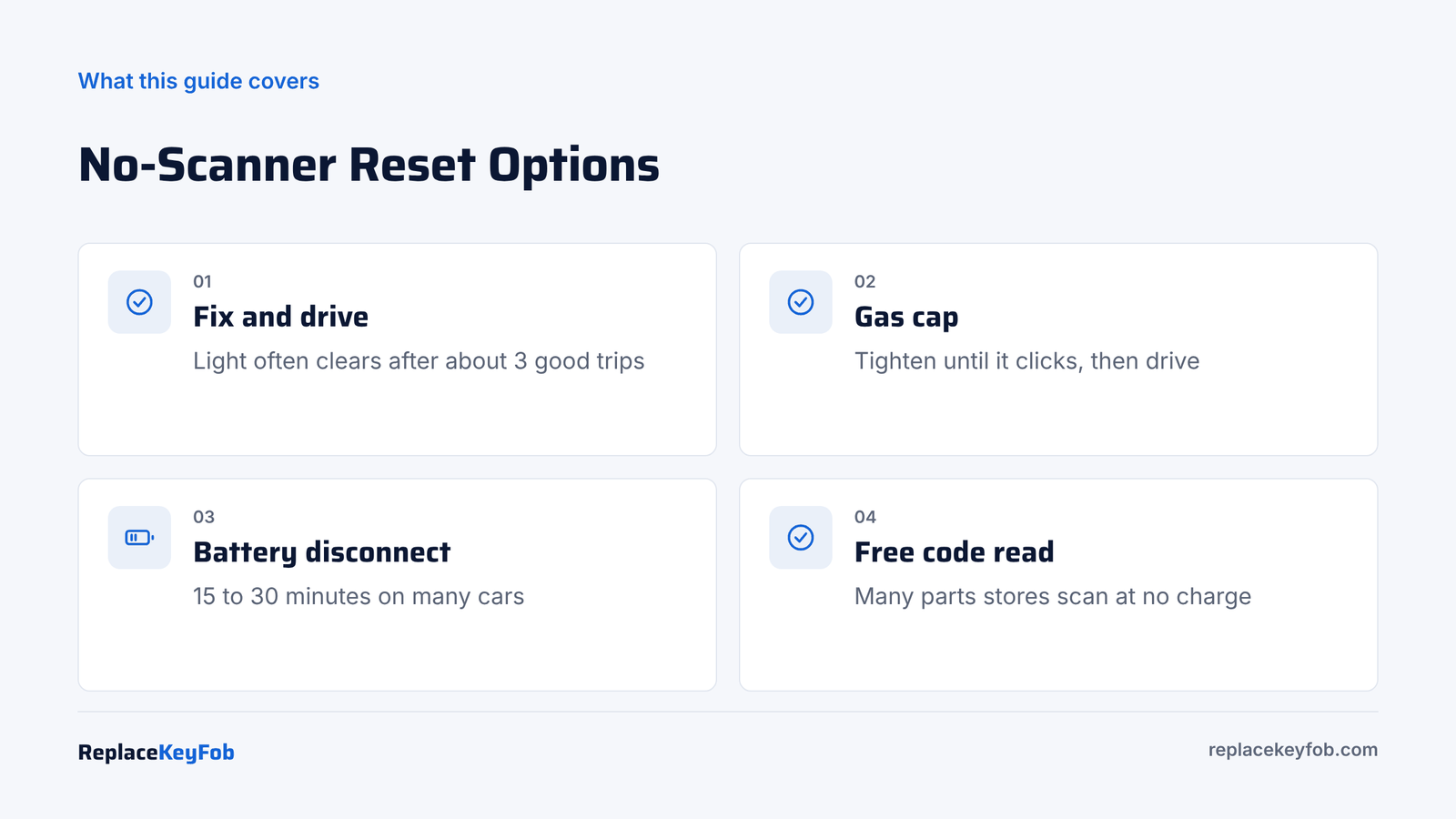
To reset the check engine light without a scan tool, fix the problem and let the car turn the light off on its own, which usually takes about three trips without the fault. A loose gas cap is the classic example. You can also disconnect the negative battery cable for 15 to 30 minutes on many cars, but this resets other settings and readiness monitors.
The check engine light is the engine computer telling you it has stored a trouble code. The light is controlled by that computer, so to turn it off without a scanner you have two options: let the computer decide the fault is gone, or wipe its memory.
Both work in the right situation. Neither fixes anything by itself. If the light comes back, the fault is still there. If you have a scanner available, our guide on clearing the check engine light with an OBD2 scanner is faster and keeps more control. This guide is for when you do not have one.
Before You Clear Anything: Find Out Why It Is On
Clearing the light without knowing the code throws away the best clue you have. You can get the code without owning a scanner:
- Free code reads: many national auto parts stores will scan your car for free in the parking lot.
- Odometer or cluster code display: some older vehicles can show codes through a key or button sequence. See how to read OBD2 codes without a scanner.
- Connected car apps: some brands show active warnings and sometimes codes in their phone app.
Also check whether the light is solid or flashing:
| Light | Meaning | What to do |
|---|---|---|
| Solid | A fault is stored; usually not an emergency | Get the code read within a few days |
| Flashing | Severe misfire that can damage the catalytic converter | Reduce speed and get it checked right away |
| On with other warnings and poor running | Possible limp mode | Drive gently to a safe place |
A flashing light should never be cleared and ignored.
What You Need
- Your owner’s manual
- A 10mm wrench (most battery clamps) for the battery method
- Safety glasses and gloves
- Your radio anti-theft code if your car uses one
Basic OBD2 code reader
Even a simple code reader shows the code and clears the light in seconds, which saves battery disconnects and lost settings. Check that it supports your vehicle year.
As an Amazon Associate, ReplaceKeyFob earns from qualifying purchases.
Method 1: Fix the Cause and Let It Clear Itself
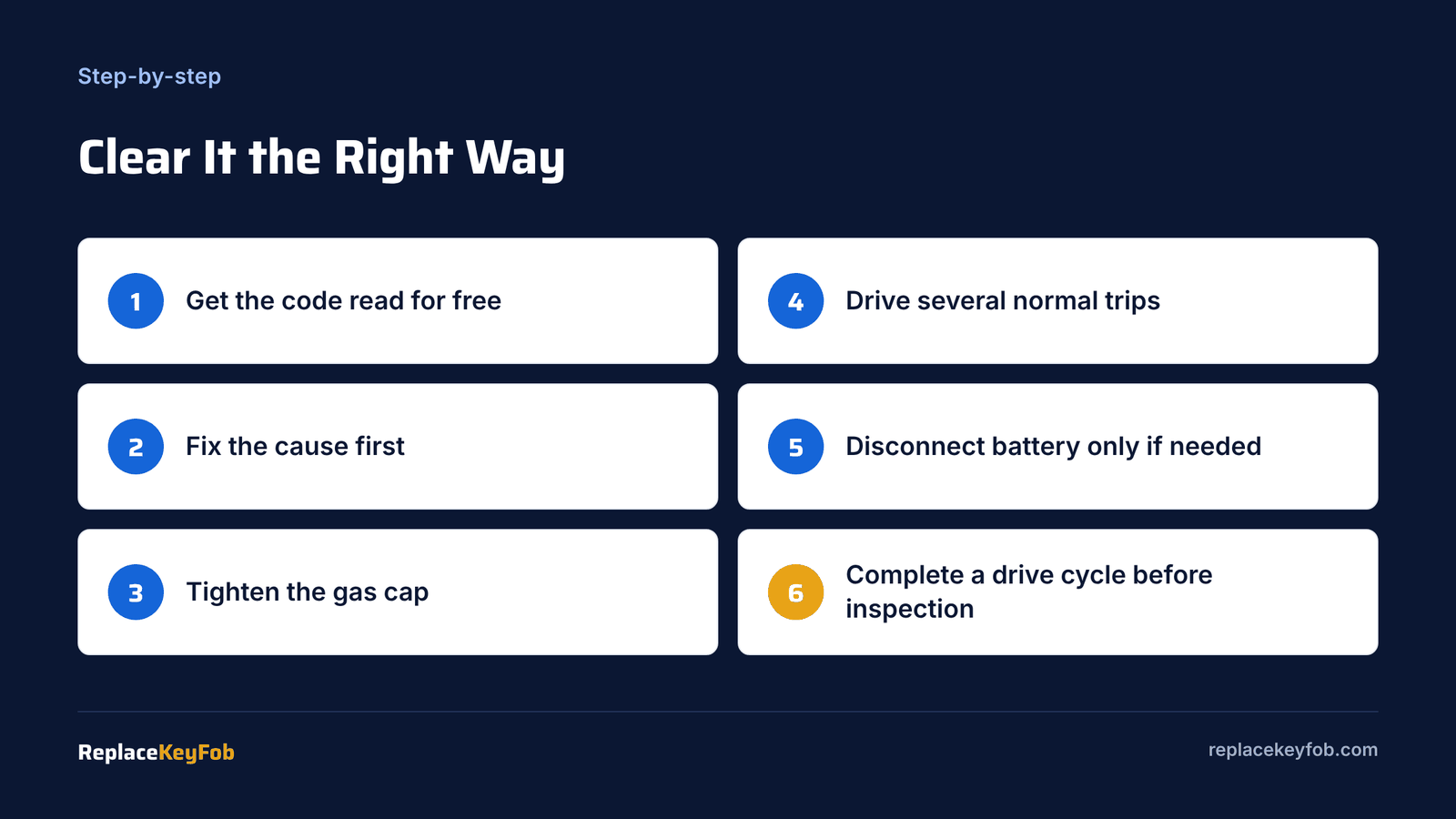
The engine computer re-checks most faults on every drive. When a monitor passes on several consecutive trips, many cars turn the light off on their own. On many vehicles this takes about three good drive cycles, though some faults need more.
- Get the code read and fix the problem, such as a failed oxygen sensor, loose vacuum hose or misfiring coil.
- Drive normally for a few days, including a mix of city and highway driving.
- The light should go out once the computer confirms the fix.
Why this is the best method: the readiness monitors stay complete, so the car is ready for an emissions test, and the code history stays in memory for a while.
Method 2: Tighten or Replace the Gas Cap
A loose, cracked or missing gas cap lets fuel vapor escape and sets an evaporative emissions (EVAP) code, often P0455, P0456 or P0457.
- Remove the gas cap and check the rubber seal for cracks.
- Refit it and turn until it clicks several times.
- Drive normally. The EVAP monitor only runs under certain conditions, often after a cold start with the fuel tank between about a quarter and three quarters full, so it can take several days.
If the light stays on after a week, replace the cap or have the EVAP system tested. Our guide on checking an EVAP leak with an OBD2 scanner explains what comes next.
Method 3: Disconnect the Battery
Removing power from the engine computer clears its stored codes on many cars.
- Turn off the engine and remove the key or move the fob away.
- Put on safety glasses.
- Loosen the negative (black, minus) battery clamp and remove it. Tuck it away so it cannot touch the post.
- Wait 15 to 30 minutes. Some cars keep codes in memory longer; pressing the horn or turning on the headlight switch with the battery disconnected helps drain stored power.
- Reconnect the negative clamp and tighten it.
- Start the car and let it idle for a few minutes before driving.
For the full safe procedure, see how to disconnect a car battery safely.
What you lose
- Radio presets, the clock and sometimes the radio anti-theft code
- Auto-up and auto-down window positions on many cars
- Learned idle and fuel trim values, so the engine may idle rough for a few drives
- Readiness monitors, which must run again before an emissions test
On many newer cars, especially some European and some later Ford and GM models, the computer keeps codes in non-volatile memory, so a battery disconnect does not clear them. Use a scanner instead.
Method 4: Let a Shop Clear It
If you only need the light off once, most shops and many parts stores can clear it in a minute after reading the code. Many do it for free with a code read.
Common Codes and Whether They Self-Clear
| Code family | Example cause | Clears itself after fix? |
|---|---|---|
| P0440 to P0457 (EVAP) | Loose gas cap, cracked purge hose | Yes, after the EVAP monitor passes, often several days |
| P0300 to P0308 (misfire) | Worn spark plug, failed coil | Usually yes, after a few clean trips |
| P0171 / P0174 (lean) | Vacuum leak, dirty MAF sensor | Usually yes, once fuel trims return to normal |
| P0420 / P0430 (catalyst) | Aging catalytic converter, O2 sensor | Only if the catalyst monitor passes |
| P0128 (thermostat) | Thermostat stuck open | Yes, after a normal warm-up is seen |
If your code is in the misfire or catalyst family, fix the cause before clearing, because driving with an active misfire can overheat and ruin the converter. For misfires, see how to diagnose a misfire with an OBD2 scanner.
Methods That Do Not Work
- Turning the key on and off repeatedly. Some websites claim cycling the ignition three or four times clears codes. It does not clear them on standard OBD2 cars.
- Pulling random fuses. You may clear codes if you happen to pull the engine computer fuse, but you also risk losing other modules’ settings.
- Removing the bulb or covering the light. This hides real faults and fails inspection.
Ford Check Engine Light Reset Without Scanner
On many older Ford models, disconnecting the negative battery cable for 15 to 30 minutes clears codes, after which the computer relearns idle during the first drives. On some newer Fords, codes may survive a battery disconnect. Ford’s EVAP system is sensitive to the capless fuel filler on many models: if you see an EVAP code after refueling, check that the filler flap closed fully and the nozzle area is clean.
After the Reset: Emissions Tests
When codes are cleared by battery disconnect, every readiness monitor resets to “not ready”. Most emissions stations will not pass a car with too many incomplete monitors, even if the light is off. Allow time for the monitors to run:
- See how many miles it takes to reset readiness monitors.
- Follow a proper drive cycle after clearing codes.
- Learn what each monitor does in what are OBD2 readiness monitors.
If the Light Comes Back
| Light returns | Meaning |
|---|---|
| Within minutes | Hard fault still present, such as a failed sensor |
| After a few days | Intermittent fault or a monitor that runs only under certain conditions |
| Only after refueling | Gas cap or EVAP problem |
| Only in cold or wet weather | Wiring, vacuum or sensor issue that comes and goes |
Cost of a Shop Diagnosis
| Service | Typical 2026 US cost |
|---|---|
| Free code read at a parts store | Free |
| Shop diagnostic fee | About $100 to $180 |
| Dealer diagnosis | About $150 to $250 |
| Gas cap | About $15 to $40 |
Frequently Asked Questions
Yes. Fix the cause and drive several trips so the computer turns the light off itself, or disconnect the negative battery cable for 15 to 30 minutes on many cars. A free parts store scan can also clear it.
On many cars, the light turns off after about three consecutive drive cycles without the fault. Some faults, such as EVAP leaks, need specific conditions and can take several days.
On many cars it does, after 15 to 30 minutes. It also resets radio presets, window settings and readiness monitors, and some newer cars keep codes even after a disconnect.
Usually, yes. After the cap clicks tight, the EVAP monitor has to run and pass, which can take several days of normal driving.
Usually not. Clearing codes resets the readiness monitors, and most stations need them complete. Drive normally for several days, often 50 to 100 miles or more, before testing.