
P0133 Causes: Why the Oxygen Sensor Responds Slowly

P0133 causes usually include a slow upstream oxygen sensor, damaged sensor wiring, exhaust leaks, vacuum leaks, fuel pressure issues, or a dirty mass air flow sensor. The code means Bank 1 Sensor 1 is not switching fast enough for the engine computer to control the air-fuel mixture correctly.
- Most common cause: aging upstream O2 sensor.
- Most missed cause: exhaust leak before the sensor.
- Worst mistake: replacing parts without live-data testing.
- First check: wiring, connector, and sensor voltage activity.
If your check engine light shows P0133, your car is telling you the upstream oxygen sensor signal is too slow. That does not always mean the sensor is the only bad part.
The real issue is response speed. The powertrain control module needs fast oxygen sensor feedback to adjust fuel delivery, protect the catalytic converter, and keep emissions under control. This takes about 8 minutes to read.
Key takeaway: Treat P0133 as an air-fuel feedback problem first, not a parts-replacement order. The sensor can be bad, but leaks, wiring, fuel trim problems, and contamination can make a good sensor look slow.
P0133 Code Meaning and Main Cause
P0133 means “O2 Sensor Circuit Slow Response Bank 1 Sensor 1.” Bank 1 is the engine side with cylinder 1, and Sensor 1 is the upstream sensor before the catalytic converter.
This upstream oxygen sensor measures oxygen in exhaust gases before the converter. The engine computer uses that signal during closed-loop fuel control to adjust the air-fuel mixture near the target combustion range.
A healthy narrowband oxygen sensor switches between lean and rich signals many times during normal operation. A slow sensor gives delayed feedback, so the computer corrects fuel delivery late.
- A rich mixture leaves less oxygen in exhaust.
- A lean mixture leaves more oxygen in exhaust.
- The O2 sensor reports that change to the PCM.
- The PCM adjusts injector pulse width.
- P0133 appears when the feedback comes too slowly.
The New York Vehicle Inspection Program explains that the oxygen sensor monitor checks whether O2 sensors stay calibrated and work during closed-loop operation. That matters because poor feedback increases fuel use and emissions.
For official emissions context, see the NYVIP oxygen sensor monitor reference.
Most Common P0133 Causes
The most common P0133 causes are a worn upstream oxygen sensor, damaged wiring, exhaust leaks, and air-fuel mixture problems. Each cause slows the signal in a different way.
Many drivers replace Bank 1 Sensor 1 first because the code names the sensor. That works when the sensor element is aged, coated, or heat-damaged.
The problem starts when the sensor is only reporting another fault. A vacuum leak, fuel pressure issue, or dirty MAF sensor can shift the air-fuel mixture enough to delay normal switching.
| Cause | Why It Triggers P0133 | What To Check First |
|---|---|---|
| Aging upstream O2 sensor | The sensor element reacts slowly to exhaust oxygen changes. | Live voltage switching and heater operation. |
| Damaged wiring | Poor signal quality delays or interrupts PCM readings. | Connector pins, melted wires, oil-soaked harness. |
| Exhaust leak before sensor | Outside air changes oxygen readings before the sensor samples exhaust. | Manifold gasket, flex pipe, cracked flange. |
| Vacuum or intake leak | Unmetered air creates lean fuel trim correction. | Hoses, intake boot, PCV system, brake booster hose. |
| Dirty MAF sensor | Wrong airflow data causes delayed fuel correction. | MAF grams per second and contamination. |
| Low fuel pressure | The engine runs lean and forces slow correction. | Fuel pressure, filter restriction, weak pump. |
The key conclusion is simple: P0133 points to slow feedback, not one guaranteed bad part.
How a Bad O2 Sensor Causes P0133
A bad upstream oxygen sensor causes P0133 when the sensing element cannot react fast enough to exhaust oxygen changes. Heat, age, contamination, and internal wear are the usual reasons.
Oxygen sensors live in extreme exhaust heat. Over time, the ceramic element gets slower, and the voltage signal loses sharp lean-to-rich movement.
Oil ash, coolant residue, silicone contamination, fuel additives, and carbon can coat the sensor tip. That coating acts like a filter between exhaust gases and the sensing element.
Tip: A slow O2 sensor often looks lazy on live data. The voltage changes, but it changes late, flat, or with weak movement compared with the opposite bank.
What most people miss is the heater circuit. The upstream O2 sensor must reach operating temperature fast enough to give accurate feedback. A weak heater can delay sensor activity even when the sensor still produces voltage.
That is why a full diagnosis checks sensor signal, heater power, heater ground, and connector condition. Replacing the sensor without checking the heater circuit can leave the same code active.
Wiring and Connector Problems Behind P0133
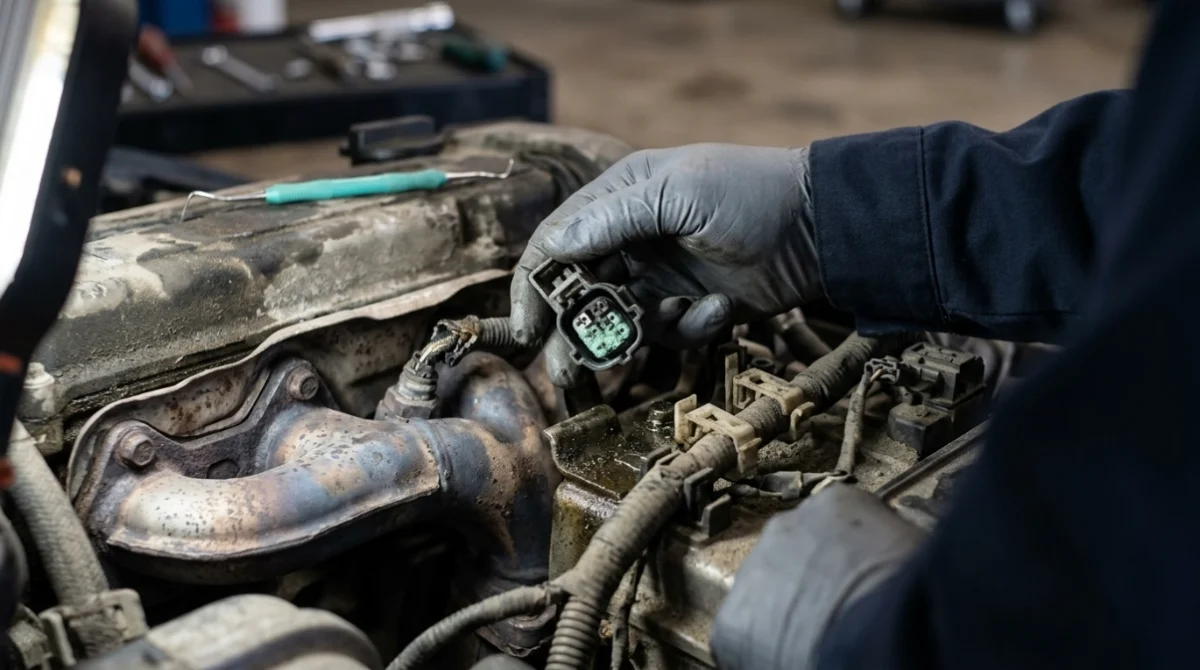
Wiring problems cause P0133 when the oxygen sensor signal cannot reach the PCM cleanly. The sensor can work, but the computer receives delayed, weak, or unstable data.
The upstream O2 sensor harness sits near the exhaust manifold, downpipe, or catalytic converter. Heat hardens insulation, melts plastic clips, and damages wires over time.
Oil leaks create another issue. Oil-soaked connectors trap dirt and weaken electrical contact. Corrosion on the pins adds resistance and distorts the sensor signal.
- Check for melted insulation near exhaust parts.
- Inspect connector pins for green corrosion.
- Look for loose terminals inside the plug.
- Check heater power and ground.
- Confirm signal wire continuity to the PCM.
You can spot many wiring failures before buying a part. Move the harness gently while watching live O2 data. A jumping signal during movement points toward wiring or connector failure.
IMAGE SUGGESTION: Close-up of an upstream oxygen sensor connector beside an exhaust manifold with labeled signal, heater power, and ground wires.
ALT TEXT: P0133 causes oxygen sensor wiring and connector inspection near exhaust manifold.
Exhaust Leaks and Vacuum Leaks That Trigger P0133
Exhaust leaks before Bank 1 Sensor 1 can trigger P0133 because outside air enters the exhaust stream. That extra oxygen changes what the sensor reads.
A small leak at the manifold gasket, cracked manifold, flex pipe, or flange can fool the sensor. The PCM then sees a leaner signal than expected and fuel correction becomes unstable.
Vacuum leaks create the opposite path to the same problem. Unmetered air enters the intake after the MAF sensor, so the engine runs lean and the O2 sensor struggles to show normal switching.
Warning: Do not clear P0133 and drive to an emissions test without repair. The check engine light, stored codes, or incomplete OBD monitors can fail inspection in many programs.
The California Bureau of Automotive Repair publishes OBD test standards for Smog Check inspections. Those standards explain why stored diagnostic trouble codes and monitor readiness matter during emissions testing.
You can review the official California OBD test reference for inspection context.
Fuel and Air Problems That Make the Sensor Look Slow
Fuel and air problems can trigger P0133 even when the oxygen sensor works. The sensor reports exhaust oxygen, but bad inputs make the engine mixture slow to correct.
A dirty MAF sensor underreports incoming air. The PCM then commands less fuel than the engine needs, creating lean conditions and delayed O2 switching.
Low fuel pressure creates the same lean pattern. A weak pump, clogged filter, restricted injector, or faulty pressure regulator can starve the engine under load.
| Live Data Clue | Likely Direction | Next Check |
|---|---|---|
| High positive fuel trims | Lean condition | Vacuum leak, fuel pressure, MAF reading. |
| High negative fuel trims | Rich condition | Leaking injector, fuel pressure regulator, EVAP purge. |
| Slow O2 voltage movement | Sensor or mixture delay | Compare sensor response with forced rich/lean test. |
| Flat O2 signal | Circuit, heater, or dead sensor | Check power, ground, signal, and connector. |
The practical takeaway is clear: scan-tool data tells you whether P0133 is a sensor fault or an engine control problem.
What Most People Get Wrong About P0133 Causes
Most people get P0133 wrong because the code names the oxygen sensor. A code name identifies the monitored circuit, not the confirmed failed part.
P0133 does not always mean replace the O2 sensor
The O2 sensor is a common cause, but it is not the only cause. Exhaust leaks, intake leaks, wiring faults, and fuel delivery issues can all slow the reported response.
Replace the sensor after testing confirms slow response. That saves money and prevents repeat check engine light problems.
Cleaning the oxygen sensor is not a reliable repair
Cleaning an oxygen sensor rarely restores proper response speed. Sensor contamination often affects the ceramic element and internal pores, not only the outer surface.
A cleaned sensor can look better for a short time, then fail again after normal heat cycles. Testing beats guessing.
Clearing the code does not fix the monitor
Clearing P0133 only erases the stored code and resets readiness monitors. The PCM will run the oxygen sensor monitor again when drive conditions match.
If the slow response remains, the check engine light returns. The vehicle also needs enough driving to reset OBD readiness.
The California Air Resources Board defines oxygen sensor response rate as the delay between lean-to-rich or rich-to-lean switching after a commanded air-fuel change.
For the technical definition, see the CARB oxygen sensor response-rate reference.
How To Diagnose P0133 Before Replacing Parts
Diagnose P0133 by checking codes, freeze-frame data, live O2 activity, fuel trims, wiring, and exhaust leaks. This order prevents wasted parts.
Start with freeze-frame data because it shows when the code set. Engine load, coolant temperature, RPM, speed, and fuel trim values reveal the operating condition.
Next, watch Bank 1 Sensor 1 live data after the engine reaches operating temperature. A healthy narrowband upstream sensor will move between lean and rich during closed-loop control.
- Scan all stored and pending codes.
- Record freeze-frame data before clearing anything.
- Inspect Bank 1 Sensor 1 wiring and connector.
- Check for exhaust leaks before the sensor.
- Review short-term and long-term fuel trims.
- Test sensor response with safe rich and lean changes.
- Replace the confirmed failed part.
A forced rich test can be done by briefly adding propane through a controlled diagnostic method, but home DIYers should avoid unsafe fuel handling. A shop can run this test with proper equipment.
A forced lean test can be done by creating a controlled vacuum leak during diagnosis. The upstream sensor should respond fast. Slow movement confirms a sensor or circuit problem.
Tip: Compare Bank 1 Sensor 1 with Bank 2 Sensor 1 on V6 or V8 engines. A clear difference between banks gives a strong diagnostic clue.
When P0133 Is Serious
P0133 is serious when the engine runs rough, fuel economy drops, or other lean and rich codes appear. Slow fuel correction can damage the catalytic converter over time.
A single P0133 code with no drivability symptoms is not an emergency stop-now fault. It still needs repair because the PCM depends on that upstream signal for fuel control.
Driveability symptoms change the priority. Hesitation, stalling, rough idle, fuel smell, black smoke, or flashing check engine light means the engine needs faster attention.
- If the car runs normally, diagnose within a few days.
- If fuel economy drops, check fuel trims soon.
- If the engine misfires, stop driving and diagnose.
- If inspection is due, repair before testing.
The unasked question is whether P0133 can damage another part. The answer is yes. Long-term rich or lean correction can overheat the catalytic converter or increase emissions.
Best Fix for P0133 Based on the Cause
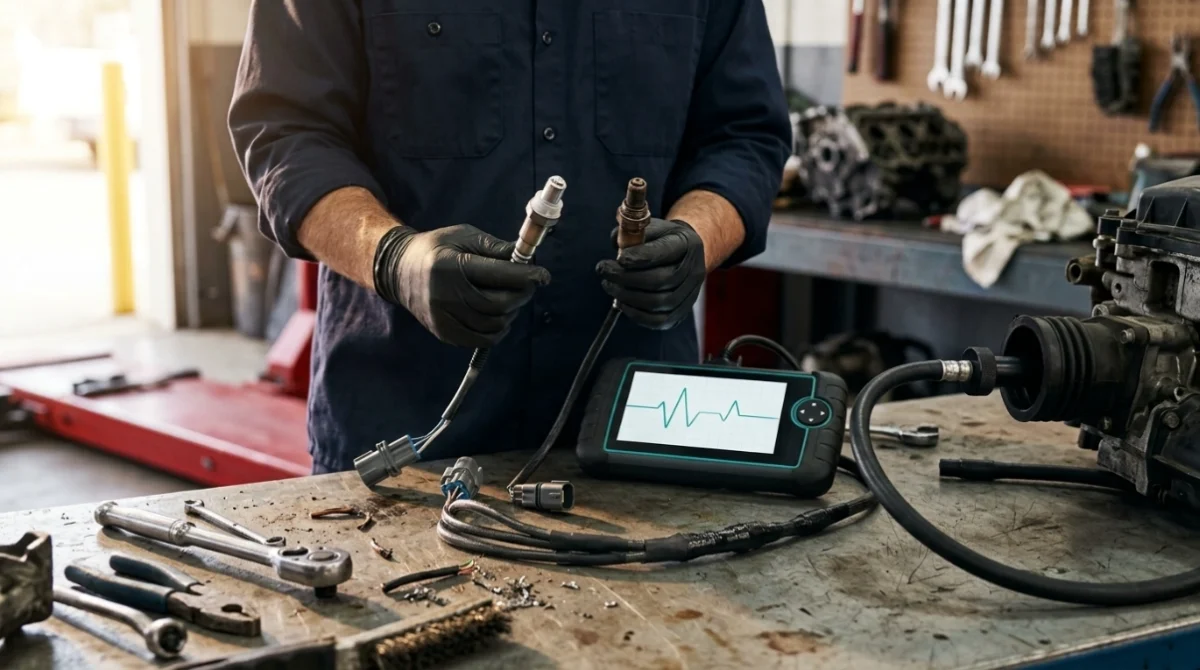
The best fix for P0133 depends on the confirmed cause. Replace the upstream O2 sensor only after signal testing, wiring checks, and leak inspection support that repair.
If the sensor is slow after the engine warms up, replace Bank 1 Sensor 1 with a direct-fit quality sensor. Avoid universal splice-in sensors when connector quality matters.
If wiring is damaged, repair the harness and protect it from exhaust heat. If the connector is oil-soaked or corroded, clean or replace the connector before retesting.
If fuel trims show a lean condition, repair the vacuum leak, MAF issue, or low fuel pressure problem first. The O2 sensor code can clear after the mixture problem is corrected.
Decision block: If live O2 data is slow and fuel trims are normal, test the sensor and heater circuit. If fuel trims are high, find the mixture problem first. If the signal jumps when the harness moves, repair wiring before buying a sensor.
After repair, clear the code and complete a proper drive cycle. The oxygen sensor monitor must run again before the repair can be fully confirmed.
IMAGE SUGGESTION: Diagnostic flowchart showing P0133 checks from scan code to wiring, leaks, fuel trims, sensor response, and final repair.
ALT TEXT: P0133 causes diagnostic flowchart for oxygen sensor slow response.
P0133 causes point to slow oxygen sensor feedback, not one guaranteed failed sensor.
As vehicles age, wiring heat damage and small exhaust leaks become just as important as sensor wear.
Before replacing parts, spend two minutes checking freeze-frame data, fuel trims, and the Bank 1 Sensor 1 connector.
Frequently Asked Questions
Can I drive with a P0133 code?
You can drive short distances with P0133 if the engine runs smoothly and the check engine light is steady. Do not ignore the code for weeks because poor fuel correction can hurt fuel economy, raise emissions, and stress the catalytic converter.
Will a bad catalytic converter cause P0133?
A bad catalytic converter is not the usual cause of P0133 because the code points to the upstream oxygen sensor response. A restricted converter can affect exhaust flow and engine behavior, but wiring, sensor wear, air leaks, and fuel trim issues should be checked first.
Can a dirty MAF sensor cause P0133?
Yes, a dirty mass air flow sensor can cause P0133 by sending inaccurate airflow data to the PCM. The engine then receives the wrong fuel command, which can delay oxygen sensor switching and create lean fuel trim correction.
How do I know if Bank 1 Sensor 1 is bad?
Bank 1 Sensor 1 is suspect when live data shows slow voltage switching after warm-up and fuel trims do not point to a major mixture problem. Confirm heater power, ground, connector condition, and exhaust leaks before replacing the sensor.
Does clearing P0133 reset the oxygen sensor monitor?
Yes, clearing P0133 resets readiness monitor status on most vehicles. The PCM must complete another drive cycle before the oxygen sensor monitor shows ready again, and the code will return if the slow-response fault remains.
