
Jump Starter vs Battery Charger: What Each One Does

We may earn a commission when you buy through links on this page, at no extra cost to you. How we pick products.
A jump starter gives a dead battery a short, powerful burst so the engine can crank right now, anywhere, in seconds. A battery charger slowly refills the battery over hours from a wall outlet and, if it is a smart charger, keeps it healthy over time. You need a jump starter for roadside emergencies and a charger for prevention and recovery at home. Most drivers are best served by owning both: a pack like the NOCO Boost GB40 in the car and a smart charger like the NOCO Genius5 in the garage.
When a car will not start, it is tempting to think any battery gadget will fix it. But a jump starter and a battery charger solve different problems, and using the wrong one can leave you stuck or shorten your battery’s life. This guide explains what each tool does, when to use which, and what happens to your battery in each case. We use NOCO’s GB40 jump starter and Genius5 smart charger as examples, based on NOCO’s published specs and manuals.
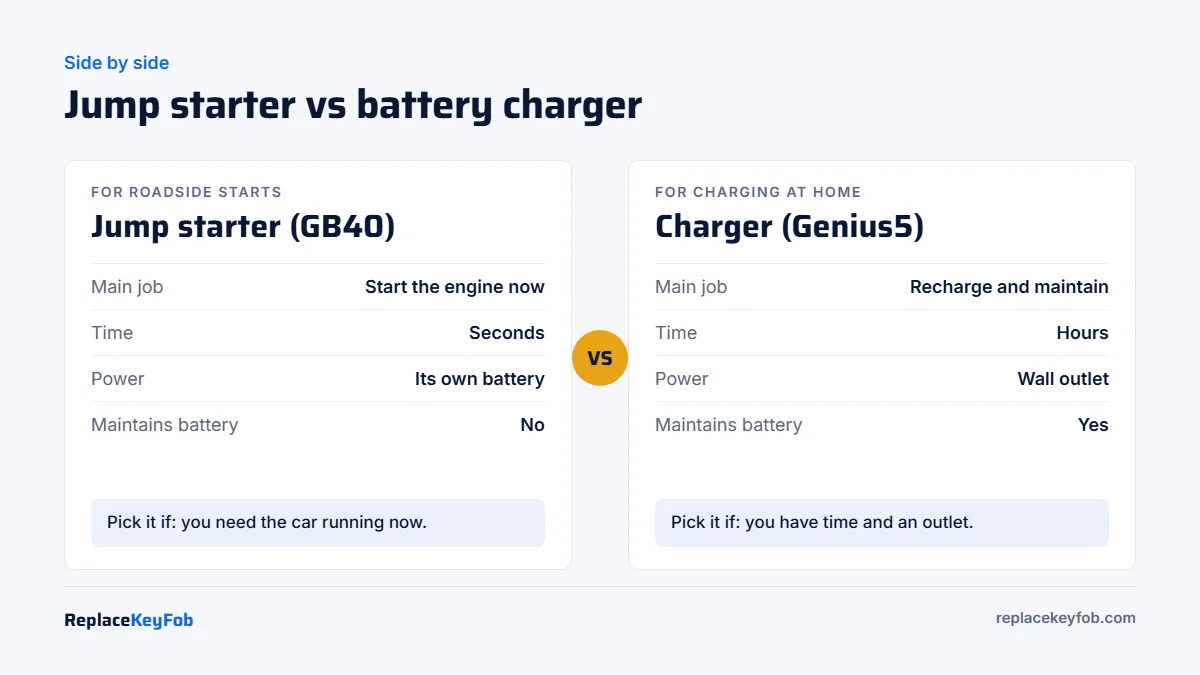
Jump Starter vs Battery Charger: Side by Side
| Jump starter (NOCO GB40) | Battery charger (NOCO Genius5) | |
|---|---|---|
| Main job | Start the engine now | Recharge and maintain the battery |
| Time needed | Seconds | Hours (often overnight) |
| Power source | Its own lithium battery | Wall outlet |
| Where you use it | Anywhere: roadside, parking lot | Garage, driveway, near an outlet |
| Recharges your car battery? | No, the alternator does that after starting | Yes, fully |
| Long-term maintenance | No | Yes, can stay connected indefinitely |
| Helps a sulfated or neglected battery | No | Yes, with desulfation and repair modes |
| Example rating | 6.0L gas / 3.0L diesel, up to 20 starts | 5A, 6V and 12V, lead-acid and lithium |
NOCO Boost GB40 1000A UltraSafe Jump Starter
6.0L gas / 3.0L diesel
Check Price on AmazonNOCO Genius5 5A Smart Battery Charger and Maintainer
Charge, maintain, desulfate
Check Price on AmazonWhat a Jump Starter Does
A jump starter is a portable lithium battery with clamps. When you connect it and turn the key, it supplies the large current the starter motor needs for a few seconds, together with what is left in your car battery. Once the engine runs, the car’s alternator takes over and slowly recharges the car battery while you drive.
That makes it the right tool when you are away from home: a battery drained by a dome light, a cold morning, or a car that sat for a couple of weeks. It does not repair or fully recharge the battery. If you jump a car and drive for only five minutes, the battery may still be too weak to start next time.
Use a jump starter when: you need the car running now, you are not near an outlet, or you are helping someone else.
What a Battery Charger Does
A battery charger plugs into the wall and pushes a controlled current into the battery over hours, bringing it back to full charge. A modern smart charger like the Genius5 also analyzes the battery, adjusts for temperature, and switches to maintenance mode when full, so it can stay connected for weeks or months without overcharging. NOCO lists the Genius5 for 6V and 12V lead-acid (AGM, gel, flooded) and lithium batteries, with a repair mode for sulfation and a Force Mode to charge batteries that have dropped to zero volts.
Use a battery charger when: the car is at home, the battery is low but you have time, a car is going into storage, or you want to recover a battery that has been run flat.
Speed: Seconds vs Hours
A jump starter wins on speed: connect, wait for the ready light, start. A 5A charger needs several hours to bring a flat car battery back up, and longer for a large truck battery. If you are late for work and the car is dead, only a jump starter (or jumper cables and another car) gets you moving immediately.
Winner: Jump starter.
Battery Health
A charger wins clearly here. Repeated deep discharges and partial recharges from short drives after a jump slowly damage lead-acid batteries through sulfation. A smart charger restores a full charge, can reverse light sulfation, and keeps the battery topped up between drives. If you jump a car, it is a good idea to put it on a charger that evening.
Winner: Battery charger.
Portability and Convenience
A compact jump starter fits in the glove box and works anywhere. A charger needs mains power and time, so it lives in the garage. Some chargers have a quick-boost or engine-start mode, but they still need an outlet.
Winner: Jump starter.
Storage and Seasonal Cars
For a car that sits for weeks, a convertible stored for winter, or a motorcycle, a charger in maintenance mode is the right tool. A jump starter only solves the dead battery after it happens, and repeated deep drain shortens battery life. Our guides to the best battery maintainers and maintainers for winter storage cover this in detail.
Winner: Battery charger.
Which Tool for Which Problem?
| Situation | Use |
|---|---|
| Dead battery in a parking lot | Jump starter |
| Car will not start at home, no rush | Battery charger |
| Car stored for the winter | Battery charger or maintainer |
| Battery drained by lights left on | Jump starter now, charger tonight |
| Battery dies every few days | Neither alone; test the battery and charging system |
| Helping a friend’s car | Jump starter |
| Before key programming or ECU work | A charger with power-supply mode |
When Neither Will Help
If a battery is internally shorted, frozen, swollen or leaking, do not jump or charge it; replace it. If the car needs a jump every few days, the problem is likely an old battery, a failing alternator or a parasitic drain. A battery tester tells you which. A weak battery can also cause odd electrical symptoms, including key fob and push-button start problems.
Which One Should You Buy?
| You are… | Buy |
|---|---|
| A daily commuter | Jump starter first, charger second |
| Someone with a weekend or classic car | Charger or maintainer first |
| Living in an apartment without an outlet near the car | Jump starter |
| Living somewhere very cold | Both |
| Doing your own car maintenance | Both, plus a battery tester |
The Verdict
A jump starter is your emergency tool; a battery charger is your maintenance tool. The jump starter gets you home, and the charger keeps the battery healthy so you need the jump starter less often. If you can only buy one, choose based on where your car sits: away from outlets, buy a jump starter; in a garage or for a car that sits, buy a smart charger.
Compare models in our portable jump starter roundup and best car battery chargers guide.
Related Guides
- Jump starter vs jumper cables
- Battery maintainer vs trickle charger
- NOCO Genius5 review
- How to jump start a car
FAQ
Can a jump starter charge a car battery?
Not in a useful way. It provides a short burst to start the engine; the alternator or a battery charger does the actual recharging.
Can a battery charger start a car?
Only some larger chargers with an engine-start mode, and only near an outlet. A standard smart charger like the Genius5 is for charging and maintaining, not starting.
How long should I drive after a jump start?
At least 20 to 30 minutes, and ideally put the battery on a charger afterwards to restore a full charge.
Do I need both a jump starter and a battery charger?
Many drivers benefit from both: the jump starter for emergencies, the charger for prevention and storage.
Is it bad to jump start a car often?
Frequent jumps usually mean a battery or charging problem. Repeated deep discharges also shorten battery life, so test the system and use a charger.